
Quick summary
The Ordinary is the clearest benchmark for ingredient-led skincare stores: its Regimen Builder drives AOV while clinical transparency converts the sceptical buyer. Charlotte Tilbury leads in prestige makeup with a virtual try-on and shade matching tool that directly replaces the in-store counter experience. Beauty Pie is the most instructive case study in membership commerce, using a dual-price display to make subscription value obvious at the product level. Aesop proves that luxury positioning at scale means removing urgency mechanics entirely and letting editorial brand voice carry conversion.
Beauty is one of the highest-stakes categories in ecommerce. Customers cannot smell the fragrance, feel the texture, or test the shade before buying. The stores that convert consistently are the ones that close that gap: through ingredient education, swatches, before-and-after imagery, expert credibility, and frictionless repeat purchase journeys. Beauty is also a category where Shopify Plus has proven itself at serious scale — from independent UK skincare founders selling out on launch day to global prestige brands running loyalty programmes across dozens of markets. These ten stores show what best-in-class looks like in 2026.
1. The Ordinary
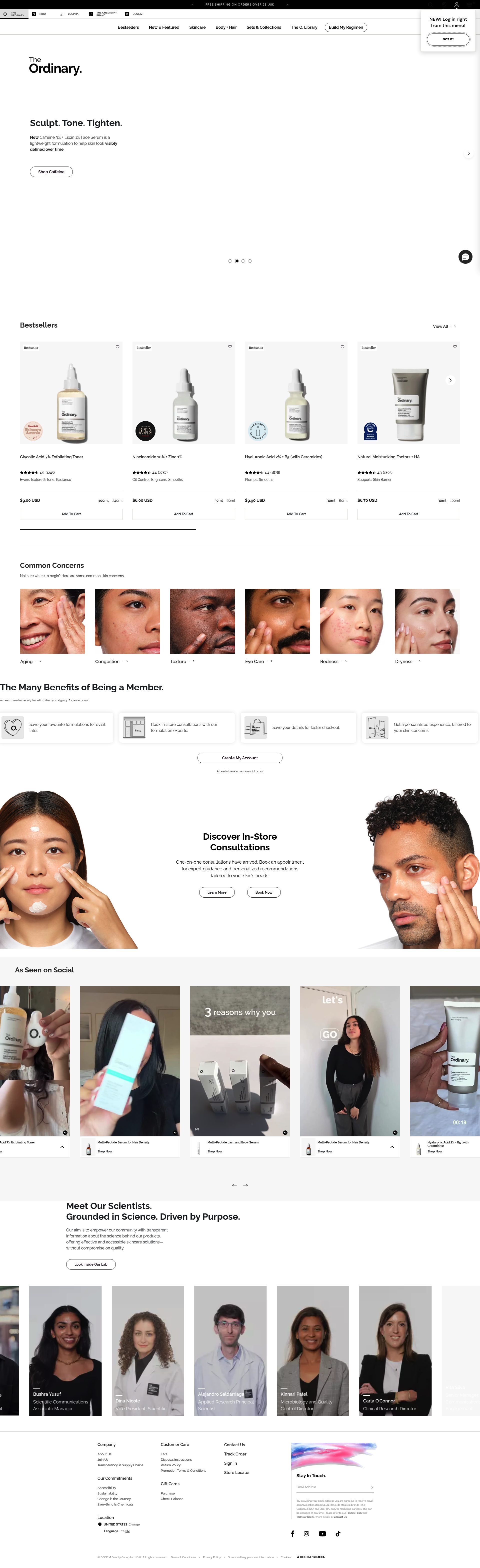
The Ordinary's Shopify store is a clinic in product education. The brand built its entire proposition on transparency: ingredient names in INCI format, percentages, pH levels, and usage conflicts listed directly on product pages. That content-first approach has been replicated endlessly, but the original still sets the standard. Their "Regimen Builder" functionality — guiding customers to a sequenced routine rather than selling single products — is one of the most effective AOV-lifting features in skincare ecommerce. It also reduces returns and repeat customer churn by setting realistic expectations about what each product does and when to use it.
Their collection and navigation structure handles a large catalogue without overwhelming the customer. Filters by skin concern, ingredient type, and formulation make it straightforward to narrow down a 100+ SKU range. The store's clinical aesthetic, white backgrounds and typographic hierarchy, is a deliberate signal: this is science, not marketing. That consistency builds credibility with the sceptical, ingredient-literate customer that The Ordinary has always spoken to.
2. Charlotte Tilbury
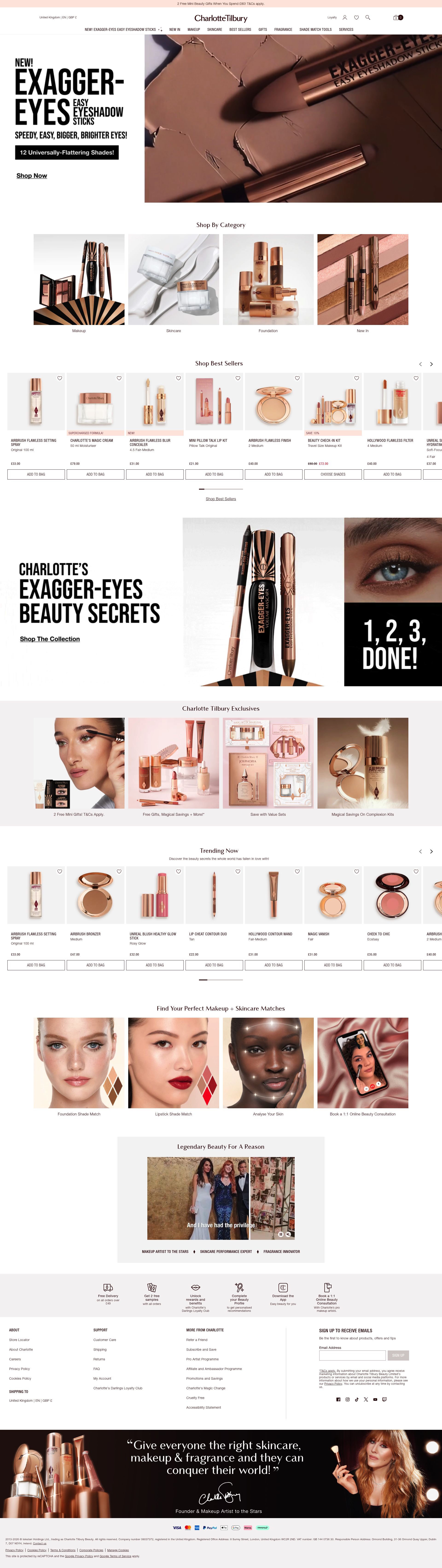
Charlotte Tilbury's Shopify Plus store is a masterclass in translating a prestige retail experience online. The virtual try-on feature — letting customers see how foundation shades, lip colours, and eyeshadow palettes look on their own face via the camera — directly addresses the single biggest barrier to makeup purchases online. Paired with a detailed shade matching quiz and a model library across a wide range of skin tones, the pre-purchase confidence tools are as thorough as anything in beauty ecommerce.
The store's design reflects the brand: rich, warm, glamorous without being cluttered. Charlotte Tilbury as a founder is woven throughout via editorial content and video tutorials, which reinforces the expert-led positioning and gives the purchase a personal quality. The gifting experience is particularly strong: curated gift sets are presented as hero products in their own right, with dedicated occasion-based landing pages that drive seasonal search traffic and convert browsers into buyers through clear price point signalling.
3. ESPA
ESPA is a British spa skincare brand that has built its Shopify store around the brand's professional provenance. The store opens with visual language borrowed from luxury spa environments: clean whites, warm neutrals, immersive lifestyle photography. The product pages carry the weight of clinical credibility — ingredient sourcing stories, therapist recommendations, and skin type guidance are woven into each listing rather than relegated to a generic FAQ tab.
What ESPA does particularly well is the bundle and ritual concept. Their "Face Rituals" and "Body Rituals" collections present products in the context of a full treatment sequence, which mirrors how customers discover their products in hotel spa settings and replicates that behaviour online. This is a smart Shopify implementation: metafield-driven "complete the ritual" cross-sells on each PDP increase basket size without requiring a custom app. The subscription offering for top-selling serums and oils is presented clearly with percentage savings and pause-before-cancel options surfaced at the point of adding to basket.
4. Fenty Beauty
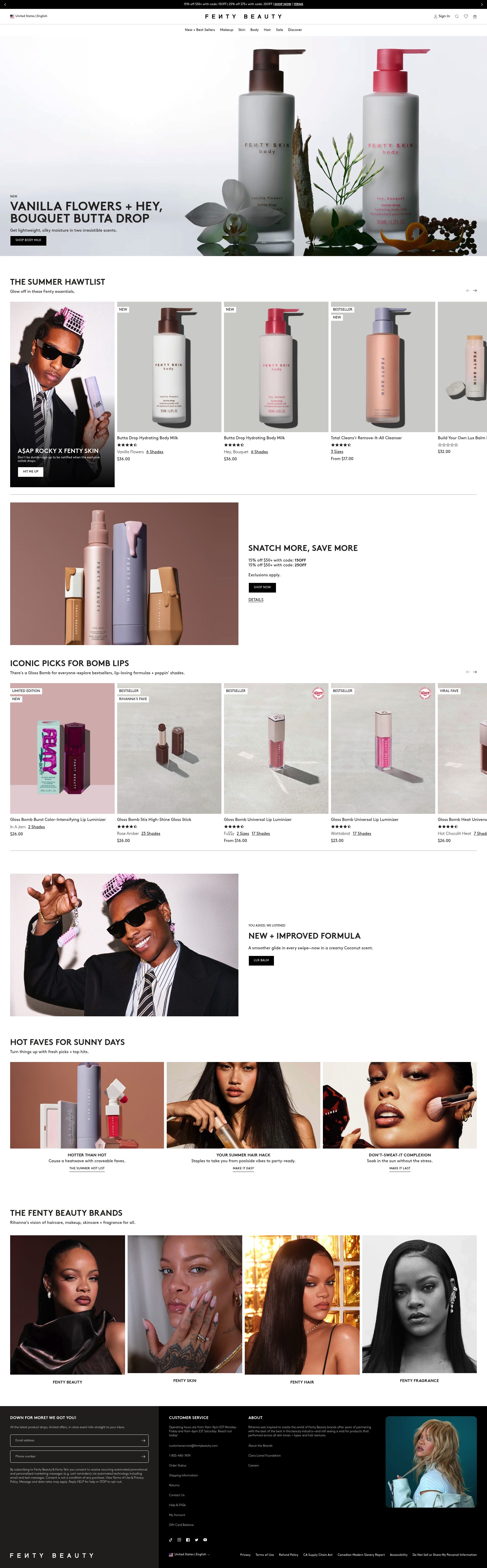
Fenty Beauty's Shopify Plus store reflects what the brand has stood for since launch: genuine shade inclusivity, executed at scale. The Pro Filt'r Foundation remains one of the most range-diverse foundations in mass-prestige makeup, and the store's shade filtering tools, model images across the full 50-shade spectrum, and AI-powered shade matching keep that promise credible rather than tokenistic. The visual merchandising on collection pages uses a diverse model library as a functional tool, not just a brand statement.
Their store speed and mobile experience are notable: Fenty was built as a mobile-first brand from day one and the performance reflects it. Product photography is rich but optimised, cart interactions are fast, and the checkout flow is clean. Social proof is integrated natively, with high-volume verified reviews and real-skin before-and-after user content surfaced prominently on hero product pages. Bundles and limited-edition sets are handled through a dedicated "Fenty Beauty Sets" collection with urgency mechanics tied to real inventory rather than artificial scarcity.
5. Huda Beauty
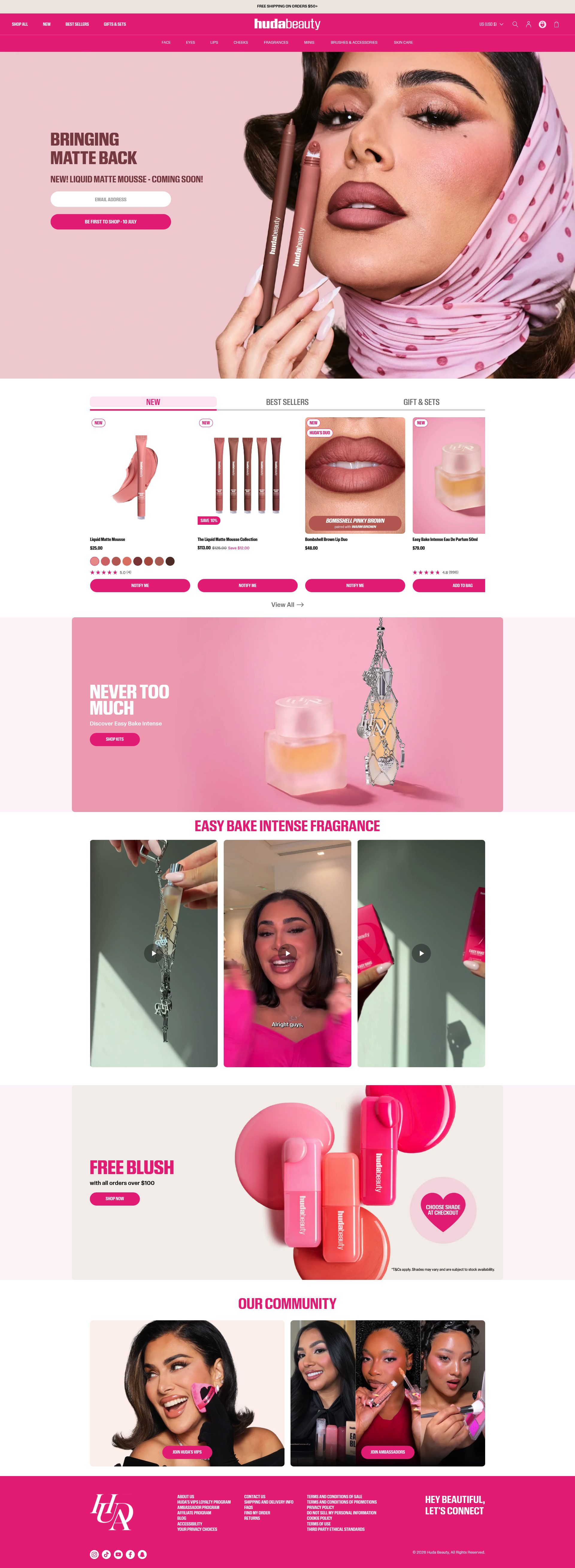
Huda Beauty operates one of the most commercially aggressive beauty stores on Shopify Plus, and it works because the aggressiveness is backed by product depth. The store surfaces bestsellers, new launches, and limited editions with enough merchandising hierarchy that the homepage never feels chaotic. Huda Kattan's personal brand is integrated throughout: tutorial content linked from product pages, editorial video on collection pages, and founder commentary woven into campaign assets. This is an influencer-first brand that has successfully translated its social presence into an owned channel that does not rely on algorithm reach to convert.
The international and multi-currency implementation is smooth, with localised pricing and relevant payment methods surfacing without manual switching. For a brand that sells across the Gulf, UK, US, and Southeast Asia simultaneously, that market-aware commerce layer is not a nice-to-have but a core revenue driver. The loyalty and rewards programme is surfaced early and clearly, reducing first-time buyer hesitation by showing the long-term value of purchasing direct rather than through a retailer.
6. Pai Skincare
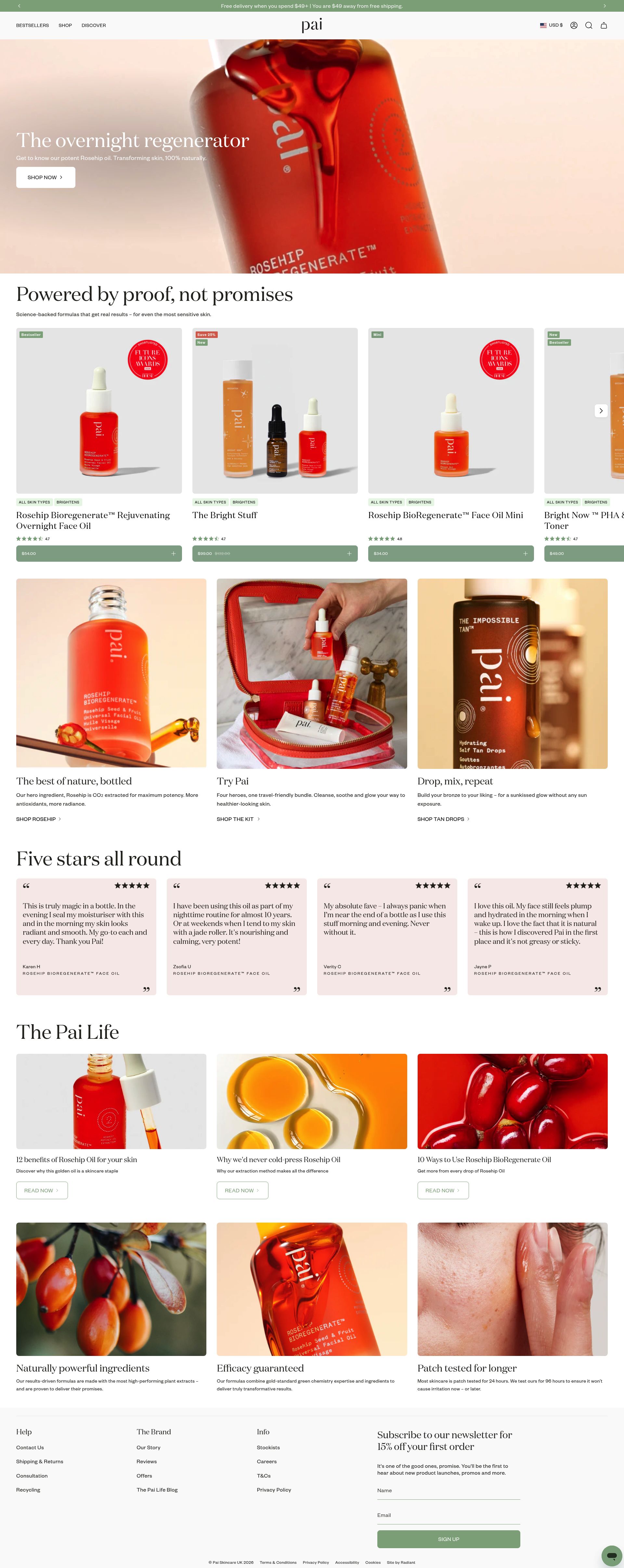
Pai Skincare is a certified organic British skincare brand built specifically for sensitive skin. Their Shopify store puts ingredient transparency and clinical evidence at the centre of every product page: COSMOS certification badges, dermatologist testing data, and detailed ingredient glossaries are presented as confidence builders rather than afterthoughts. The "Sensitive Skin Experts" positioning is backed up with genuine substance, and the store communicates that without overselling.
Their quiz-led product recommendation flow is one of the better implementations in UK indie skincare: a short skin concern questionnaire routes customers to a personalised routine, which both improves conversion and reduces the volume of post-purchase queries about compatibility. The store's subscription offering for routine staples like cleansers and serums is presented with genuine flexibility, including easy pause and product-swap options, which reflects an understanding that sensitive skin customers are often trialling new products slowly and need to feel in control of their subscription.
7. Olaplex
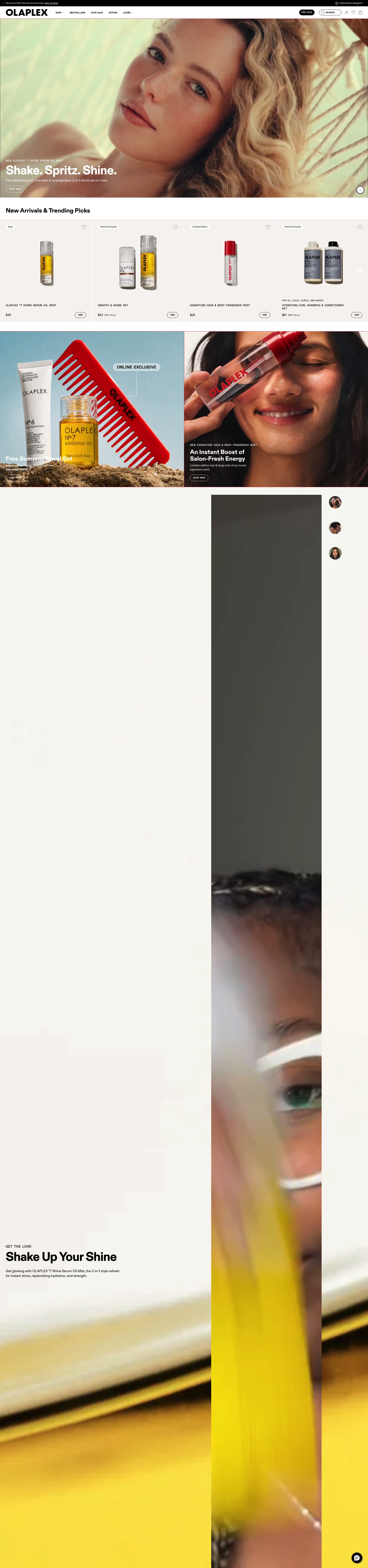
Olaplex moved from a professional salon-only product to a consumer DTC brand in one of the most successful channel pivots in haircare. Their Shopify Plus store had to do a significant amount of work to make a highly technical product range accessible without losing the professional credibility that drove the brand's reputation. They achieved it through a "Bond Building" education hub that explains the science behind the bond repair system in plain language, with video content and step-by-step routine guides that help first-time buyers understand how the numbered system works.
The store's cross-sell logic is particularly strong: because Olaplex's products are designed to be used in sequence, "complete the routine" cross-sells on PDPs are contextually relevant rather than generic. Product pages surface salon professional quotes and reviews, which maintains the professional authority signal even in a consumer DTC context. The store handles the brand's premium pricing well: the value narrative is built around treatment result longevity rather than product volume, which repositions the cost per use rather than the upfront price.
8. Lush
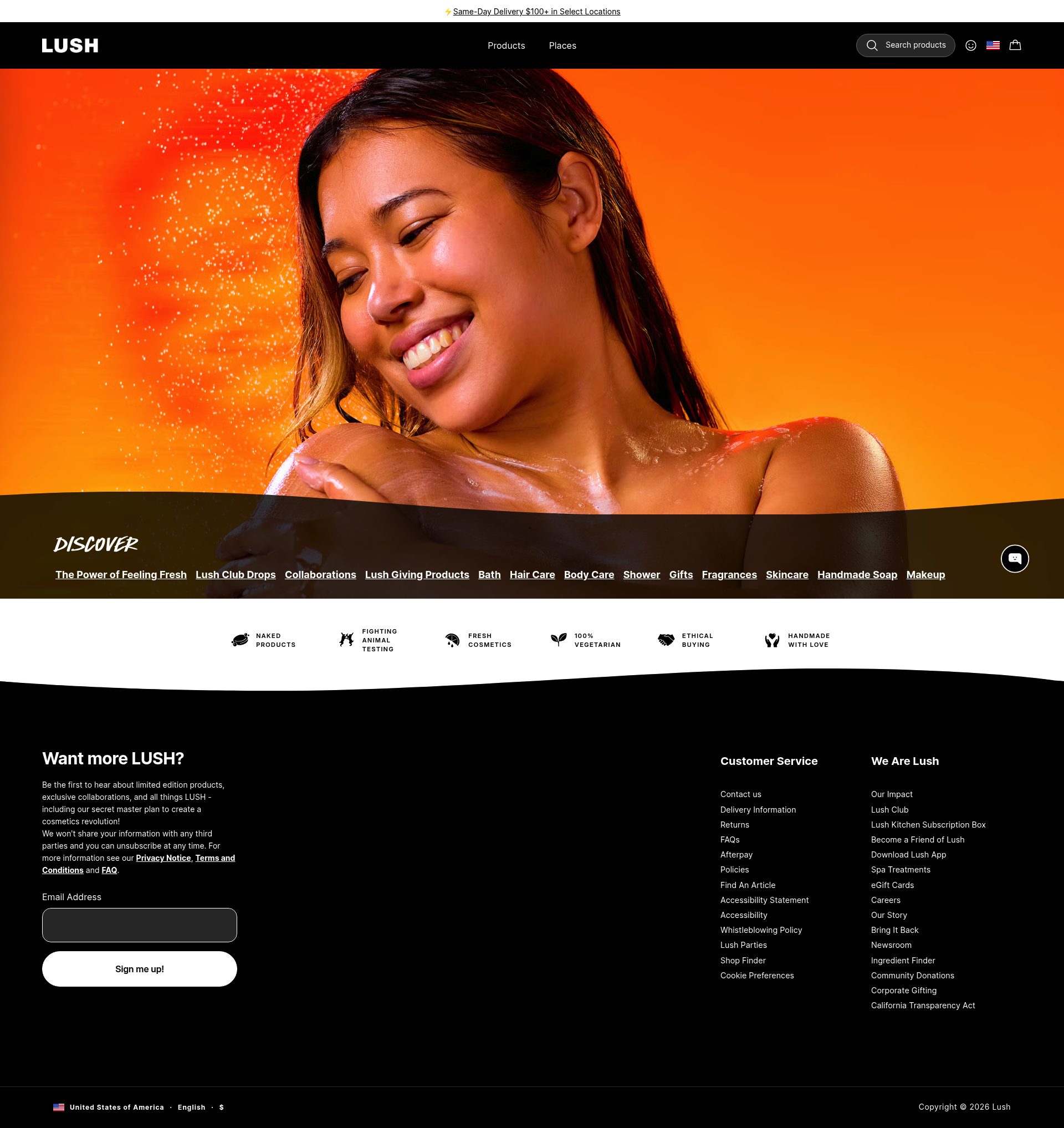
Lush is one of the most operationally complex beauty brands on Shopify, and the store reflects the demands of that complexity in a good way. Their product range spans fresh, preservative-free items with short shelf lives alongside solid shampoos, bath bombs, and gift sets, all requiring different purchase consideration. The store handles this with clear freshness dating on relevant products, a robust gifting infrastructure (Lush gift sets and customisable gift boxes are a significant revenue stream), and collection navigation built around occasion, ingredient, and format rather than just product type.
Their ethics and values content, animal testing stance, ingredient sourcing, Lush Prize, is integrated into the shopping experience rather than siloed in an "About" section. This matters for their customer, who is buying on values as well as product quality. The Lush store also runs a kitchen-sink approach to format: bath bombs, shower gels, solids, jellies, and skincare are presented under one roof with a search and filter experience that handles the breadth without losing focus. On Shopify Plus, managing that catalogue complexity at the product variant and tag level is no small feat.
9. Aesop
Aesop is a premium Australian skincare and bodycare brand that has built one of the most distinctive retail aesthetics in beauty, in store and online. Their Shopify store carries the same qualities that define the in-store experience: restraint, considered typography, editorial imagery, and an unhurried pace. Product descriptions read as considered essays rather than feature lists. There are no countdown timers, no pop-up discount overlays, and no urgency mechanics. The brand does not need them because the store builds confidence through quality of information rather than pressure.
Each product page includes recommended usage rituals, skin type guidance, and ingredient explanations in a consistent format that makes browsing the full range feel coherent. The store also does something unusual well: it presents ancillary categories, home fragrance, candles, hand care, as natural extensions of the skincare range rather than separate businesses. That breadth is managed through a navigation and visual system that keeps the house of Aesop coherent across categories. At the price points Aesop operates at, that coherence is a direct revenue driver.
10. Beauty Pie
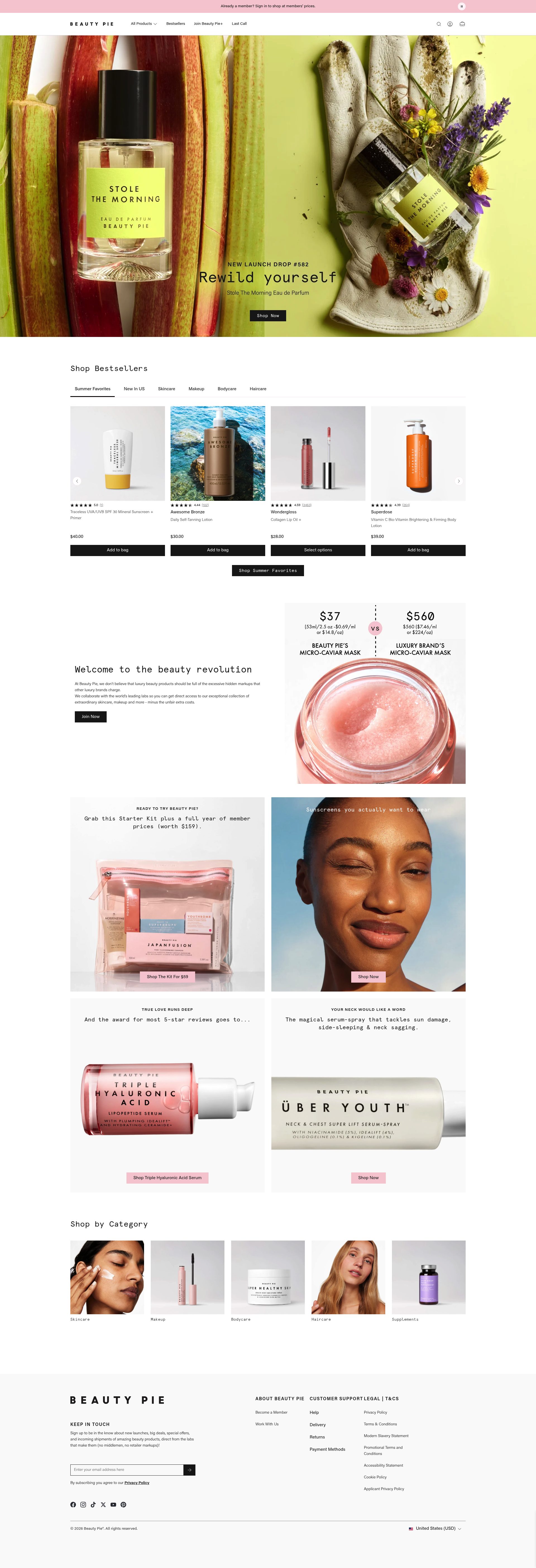
Beauty Pie is the most commercially unusual brand on this list. It operates as a membership model, selling prestige-quality beauty products at factory cost to subscribers. Their Shopify Plus store has to simultaneously explain a counterintuitive pricing model, convert non-members into subscribers, and serve an existing member base with different pricing visibility. That is a genuinely difficult UX problem, and the store handles it cleanly: the dual-price display (member price versus non-member price) on every product page makes the membership value proposition obvious without being aggressive.
The subscription and account area is built with enough functionality to support a member base that tracks allowance spend, manages product favourites, and reviews past orders, all without leaving the Shopify storefront. Their editorial content, which covers ingredient science, lab transparency, and category explainers, does the heavy lifting of building trust in a brand that asks customers to buy into a model before they have bought a product. For merchants thinking about subscription or membership mechanics on Shopify Plus, Beauty Pie is the most instructive case study in this list.
Beauty Brand Shopify Stores Compared
| Brand | Niche Focus | Price Point | Shopify Standout |
|---|---|---|---|
| The Ordinary | Skincare (actives) | Budget-mid | Regimen Builder, ingredient education, catalogue filtering |
| Charlotte Tilbury | Makeup, skincare | Premium | Virtual try-on, shade matching, gifting experience |
| ESPA | Spa skincare, body | Mid-premium | Ritual bundles, therapist provenance, metafield cross-sells |
| Fenty Beauty | Makeup (inclusive) | Mid | Shade range tools, mobile-first performance, social proof |
| Huda Beauty | Makeup, skincare | Mid-premium | Founder integration, international commerce, loyalty programme |
| Pai Skincare | Sensitive skincare | Mid | Skin quiz, COSMOS certification, flexible subscriptions |
| Olaplex | Haircare (bond repair) | Mid-premium | Education hub, sequential cross-sells, professional credibility |
| Lush | Bath, body, skincare | Mid | Gifting infrastructure, values integration, catalogue complexity |
| Aesop | Premium skincare, body | Luxury | Editorial brand voice, no urgency mechanics, category coherence |
| Beauty Pie | Skincare, makeup | Membership model | Dual-price display, membership UX, account management |
What These Stores Get Right
The best beauty brand Shopify stores share a short list of things that separate them from the average.
- They treat product education as a conversion tool, not a content afterthought. The Ordinary, Olaplex, and Pai Skincare put ingredient and usage education directly on product pages because an informed customer converts better and returns less.
- They solve the online sensory gap with specificity. Swatches across real skin tones, before-and-after imagery, shade finders, virtual try-on, and model libraries replace what a tester at a counter would do. Every store on this list has invested in at least one of these tools seriously.
- They build repeat purchase infrastructure from day one. Subscriptions, loyalty programmes, replenishment reminders, and bundle pricing are present across most of these stores. In beauty, the lifetime value of a retained customer dwarfs the margin on a single transaction.
- Their store design reflects the brand positioning accurately. Aesop looks like Aesop. Fenty looks like Fenty. The Ordinary looks clinical. There is no gap between the brand promise and the store experience, which is where most mid-tier beauty stores lose trust before the customer reaches checkout.
- They handle gifting seriously. Beauty is one of the top gifted categories in UK ecommerce. Stores that invest in curated gift sets, occasion-based landing pages, and clear gift wrapping options are capturing revenue that brands with a product-only navigation structure leave behind.
If you are building or rebuilding a Shopify store in the beauty category, these stores are the benchmark. Not to copy the design, but to understand the commercial thinking behind each choice.
Frequently asked questions
Which Shopify stores are the best examples for beauty brands?
The Ordinary, Charlotte Tilbury, and Aesop are the strongest benchmarks depending on your positioning. The Ordinary leads on ingredient education and catalogue architecture, Charlotte Tilbury on prestige makeup UX with virtual try-on, and Aesop on luxury brand voice and editorial trust-building. All three run on Shopify Plus and handle very different price points.
How do top beauty stores handle the online sensory gap?
The best beauty stores replace the in-store tester experience through a combination of virtual try-on (Charlotte Tilbury), shade range model libraries across real skin tones (Fenty Beauty), skin concern quizzes with personalised routine outputs (Pai Skincare), and high-volume verified user-generated content on product pages. The stores that convert best invest seriously in at least one of these tools rather than relying on product photography alone.
What Shopify features do successful beauty merchants use to increase repeat purchase rates?
Subscriptions with pause-and-swap flexibility (Pai Skincare, ESPA), loyalty and rewards programmes surfaced at first purchase (Huda Beauty), regimen and routine cross-sells based on product sequence logic (Olaplex, The Ordinary), and membership pricing tiers (Beauty Pie) are the most common and most effective mechanics. In beauty, lifetime customer value dwarfs single-transaction margin, so these features are commercial priorities, not optional extras.
Is Shopify Plus the right platform for a prestige beauty brand?
Yes. Charlotte Tilbury, Fenty Beauty, Huda Beauty, and Beauty Pie all run Shopify Plus at significant scale. The platform handles multi-currency and multi-market commerce, custom checkout extensions, subscription apps, loyalty integrations, and the kind of high-volume launch traffic that premium beauty brands generate on new product drops. The question is not whether Shopify Plus can support a prestige beauty brand but whether the store build matches the brand positioning.
How should a beauty Shopify store handle gifting?
Treat gifting as a standalone revenue stream with its own navigation, landing pages, and product logic. Charlotte Tilbury and Lush both run occasion-based gift landing pages that capture seasonal search traffic and present curated sets as hero products rather than bundles assembled from individual SKUs. Clear price point navigation, gift wrapping options surfaced in the cart, and a dedicated gifting collection in the main nav are the minimum. Beauty is one of the top gifted categories in UK ecommerce, and stores that invest in this infrastructure capture revenue that product-only navigation leaves behind.