
Quick summary
Neal's Yard Dairy sets the benchmark with a subscription-first navigation structure and honest sold-out signalling that builds repeat trust. Paxton & Whitfield is the strongest pick for gifting architecture, with price-tier segmentation and a prepaid Cheese Club that improves cashflow predictability. The Cheese Geek leads on subscription personality, using named collections and plain-language tasting notes to convert gift buyers who know nothing about cheese. Snowdonia Cheese demonstrates the clearest commercial case for a custom hamper builder, reporting a 33% AOV uplift on hamper orders after their Shopify Plus migration.
Cheese is one of the most demanding categories in food ecommerce. Products are perishable, temperature-sensitive, and often unfamiliar to buyers who want to be guided rather than left to browse. The stores that succeed here have learnt to combine careful curation, intelligent gifting architecture, and subscription mechanics that keep customers coming back. Here are ten that are doing it well on Shopify.
1. Neal's Yard Dairy
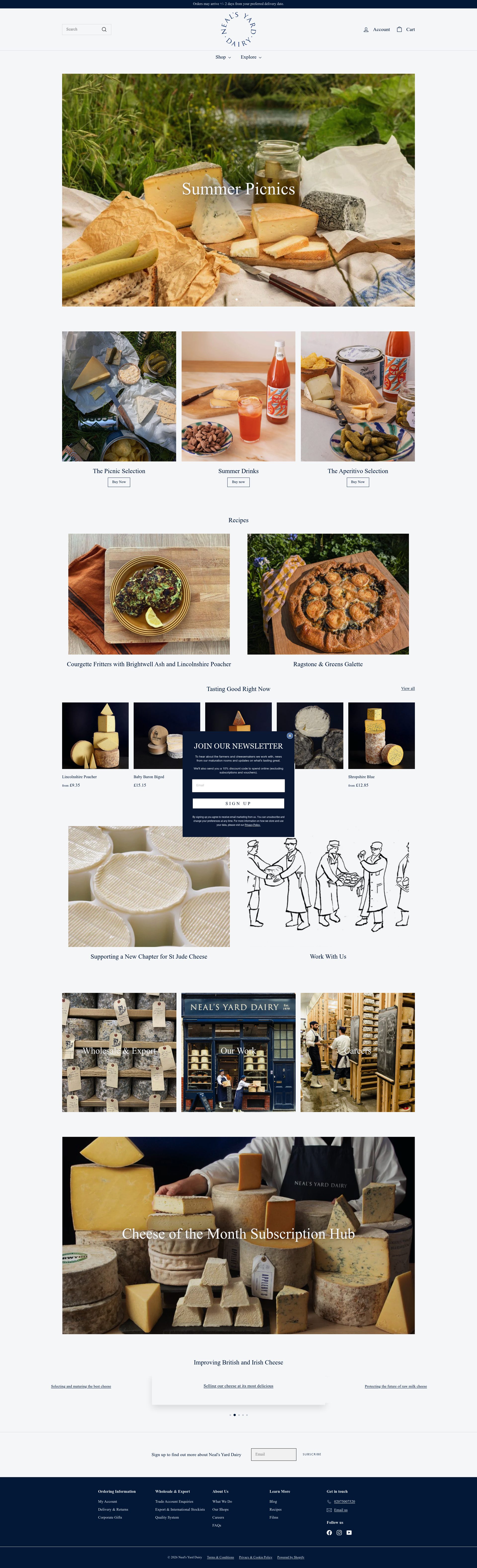
Neal's Yard Dairy is the standard against which serious British cheese retail is measured. Their Shopify store carries that authority through without overcomplicating it. Navigation is structured by cheese type and then by selection, with subscriptions given their own top-level menu item rather than buried in a footer promotion. The Cheese of the Month hub is built as a content-and-commerce destination: it explains the subscription mechanics, surfaces the current selection, and handles both gifting and self-purchase without splitting into separate flows.
Product pages are restrained by design. Each cheese gets one or two images, a short description grounded in provenance and flavour, and a quick-add button. The scarcity is real: sold-out statuses appear regularly, and the store makes no attempt to hide them. That honesty builds the kind of trust that drives repeat purchases. Delivery expectations are communicated at the top of the page rather than revealed at checkout, which is a low-cost friction reducer that more food stores should copy.
2. Paxton & Whitfield
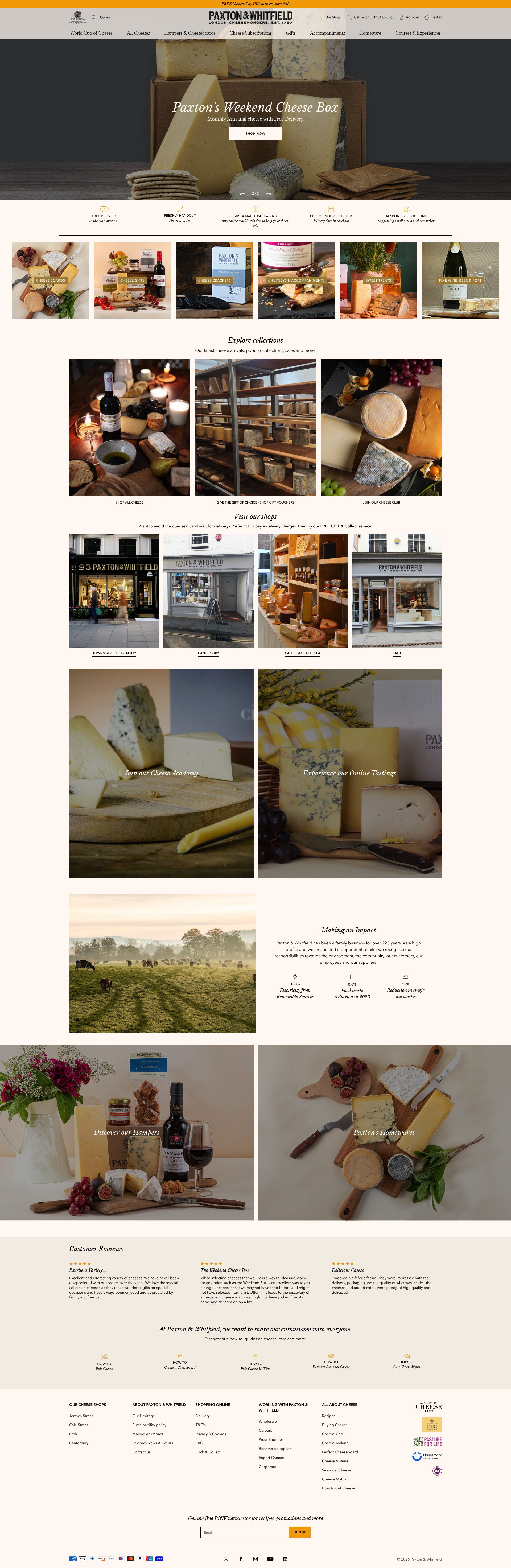
Paxton & Whitfield has been selling cheese since 1797, and their Shopify store manages to convey that heritage without feeling like a museum piece. The gifting architecture is particularly strong: products are segmented by price tier (under £35, £45, £60, £100, over £100) and by occasion, which means a customer who knows their budget but not their product lands somewhere useful immediately rather than scrolling a flat catalogue.
Their Cheese Club subscription asks customers to prepay for three, six, or twelve months of curated selections, with biscuits and tasting notes included. Asking for commitment upfront is the right call for a premium subscription: it filters for engaged customers and improves cashflow predictability. The delivery proposition is clear: named-day UK delivery is free above £45, and customers choose their date at checkout. The Paxton's Exclusives range, a collection of cheeses matured and created by the business itself, gives the store a proprietary product layer that justifies the price premium and differentiates it from pure resellers.
3. Snowdonia Cheese
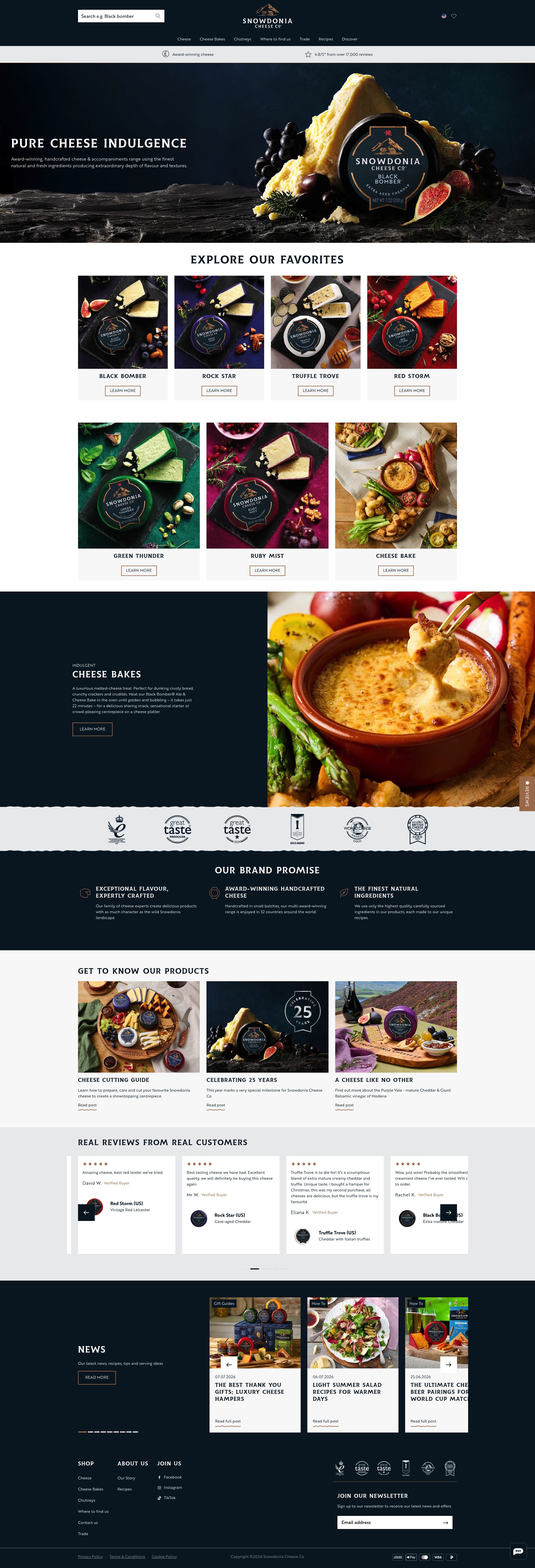
Snowdonia Cheese moved from WooCommerce to Shopify Plus and built a store that justifies the migration on commercial grounds. The custom hamper builder, developed by their agency partner, allows customers to assemble their own selection with category filters and minimum or maximum selection rules. The result is a 33% increase in average order value on hamper orders compared to pre-build baskets. That single feature improvement accounts for a material revenue shift.
The delivery date picker reduces a common abandonment trigger in food ecommerce: the uncertainty about when a perishable product will arrive. Customers select a date, the store applies location-based shipping rules, and the anxiety around fresh delivery is removed. The Discovery Subscription surfaces in hero placement and uses bold photography tied to Welsh landscape and product provenance. The store also has 17,000-plus verified reviews displayed at 4.8 out of 5, which carries weight in a category where buyers cannot taste before buying.
4. The Cheese Geek
The Cheese Geek has built its Shopify store around a subscription-first model and made the recurring purchase the dominant path rather than an upsell. The flagship subscription, named the Jimi, is a monthly rolling selection of five artisan cheeses curated by founder Edward Hancock. The naming convention across the range (the Freddie, the Stevie, the Robin) gives the gift collections personality without requiring the customer to understand cheese taxonomy before buying.
Product pages carry Great Taste Award stars alongside tasting notes written in plain language: no jargon, no assumptions about the buyer's knowledge level. In-cart add-ons for crackers, wine, and charcuterie appear before checkout rather than after, which is the right placement to lift basket value without creating post-purchase friction. The Cheese Exchange content hub, housing recipes and a cheese library, serves two purposes: it generates organic search traffic and it gives subscribers a reason to engage between deliveries. Press coverage from GQ, Vogue, and the Telegraph is surfaced as social proof rather than buried on an about page.
5. The Fine Cheese Co.
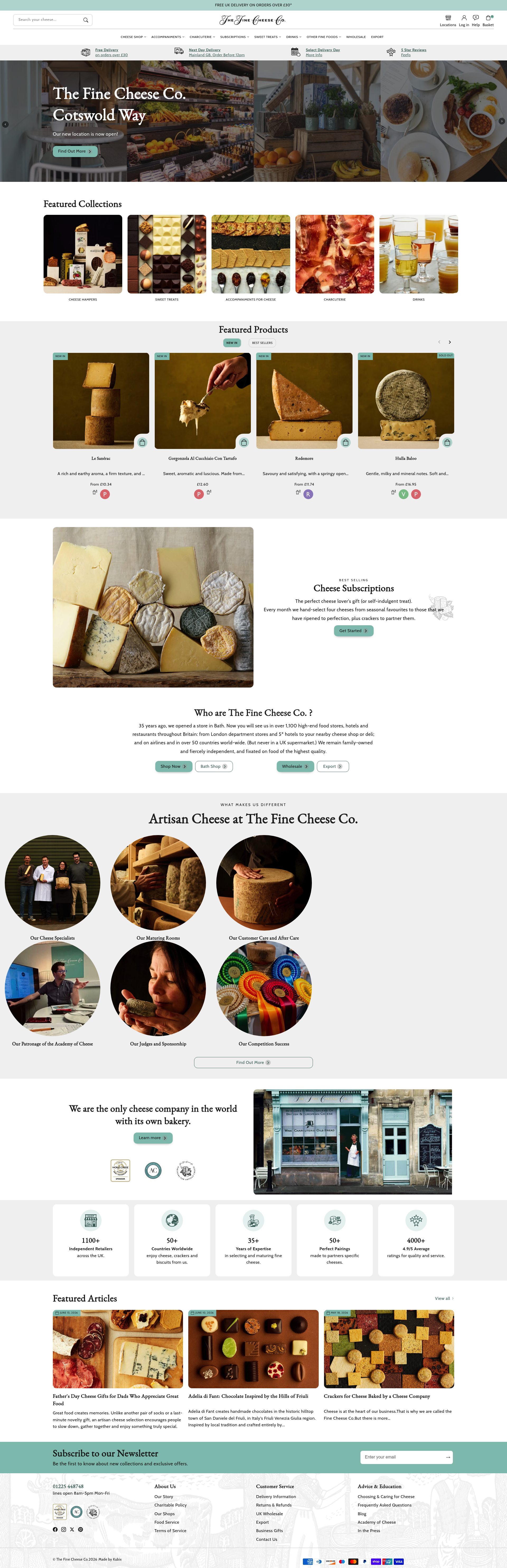
The Fine Cheese Co. operates out of Bath and their Shopify store handles a broad catalogue, cheese, crackers, charcuterie, wines, and sweet treats, without the navigation collapsing under its own weight. Products can be filtered by style, dietary requirement, milk type, and nationality, which means an experienced buyer can reach what they need in two clicks, while a gift-buyer can follow curated collection paths instead.
The subscription is positioned explicitly as a gift product on the homepage hero: "the perfect cheese lover's gift." That framing converts gift intent into recurring revenue rather than one-time hamper sales. The product pages earn their detail: each cheese displays dietary icons (vegetarian, raw milk, pregnancy-safe), milk type, and origin, alongside tasting notes. The 4,000-plus Feefo reviews at 4.9 out of 5, displayed across multiple pages, answer the trust question before the buyer reaches checkout. A free delivery threshold at £30 and next-day delivery messaging address the two most common hesitations in online food retail at the same time.
6. The Chuckling Cheese Company
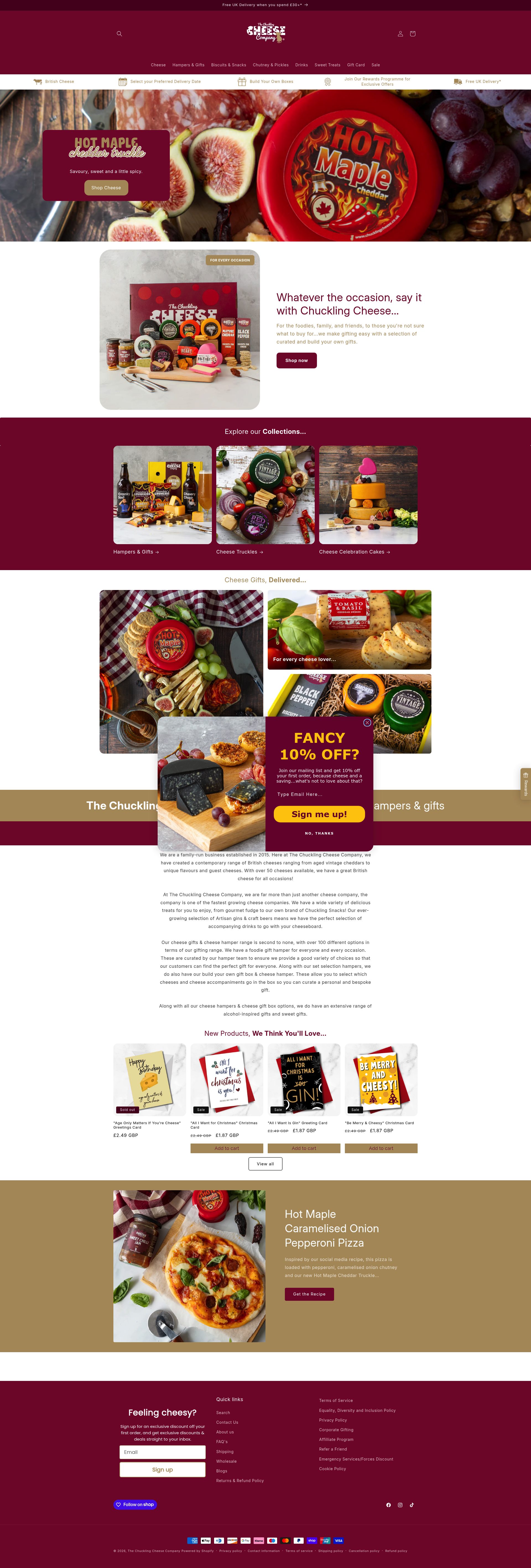
The Chuckling Cheese Company's Shopify store is built for gifting volume. The navigation spans cheese, hampers, biscuits, chutneys, drinks, and sweet treats, and the Build Your Own Box feature sits prominently within the gifting section. Customers select which cheeses and accompaniments go into the box themselves, creating a personalised gift experience that feels more considered than choosing from a fixed selection, and typically drives a higher spend than pre-curated equivalents.
The preferred delivery date selection feature is well-implemented: it appears early in the journey rather than as a checkout-stage reveal, which reduces the surprise factor when perishable food orders are involved. Klarna is offered alongside Apple Pay, Google Pay, and PayPal, which broadens the conversion pathway for higher-value hamper orders where payment friction matters. The loyalty programme and corporate gifting section round out a store that is clearly optimised for repeat and B2B customers as well as one-time buyers.
7. La Fromagerie
La Fromagerie runs three physical shops in London, and their Shopify store extends that authority online without trying to replicate the in-store experience directly. The catalogue covers individual cheeses, boards, wine, charcuterie, and gift boxes, with ticketed events and private tastings bookable through the same site. That combination of product commerce and experience commerce on a single Shopify store is rare and commercially valuable: it keeps high-intent customers on the domain rather than sending them to a separate ticketing platform.
The gift box range is structured for occasion-based gifting, and gift vouchers are available as a standalone product, which captures the buyer who wants to give the La Fromagerie experience but cannot make the selection decision themselves. The brand's reputation as one of London's leading cheese destinations means the store does not need to work as hard on trust signals as a newer brand would; the navigation and product depth do the persuasion work instead.
8. The Cheese Lady
The Cheese Lady is based in Scotland and their Shopify store reflects the logistical reality of shipping perishable goods across UK postcodes. Delivery information is transparent and specific: free delivery thresholds differ between local and national orders (£40 and £50 respectively), and temperature-controlled packaging for 48-hour transit is explained as a product feature rather than tucked into a FAQ. That clarity removes a major objection before it arises.
The Cheese Explorer tool is the store's most distinctive navigation decision: customers input their preferred cheese type or preferred drink pairing and receive personalised recommendations. For a buyer who knows they want something to go with a Burgundy but cannot name a cheese, this feature converts what would be an abandoned browsing session into a completed order. The cheese club subscription uses "Amazing cheese every month" as its entire value proposition, which is correctly simple. The named selection names (Bonnie, Jolie) give gift collections a personality that makes the buying decision easier.
9. Rennet & Rind
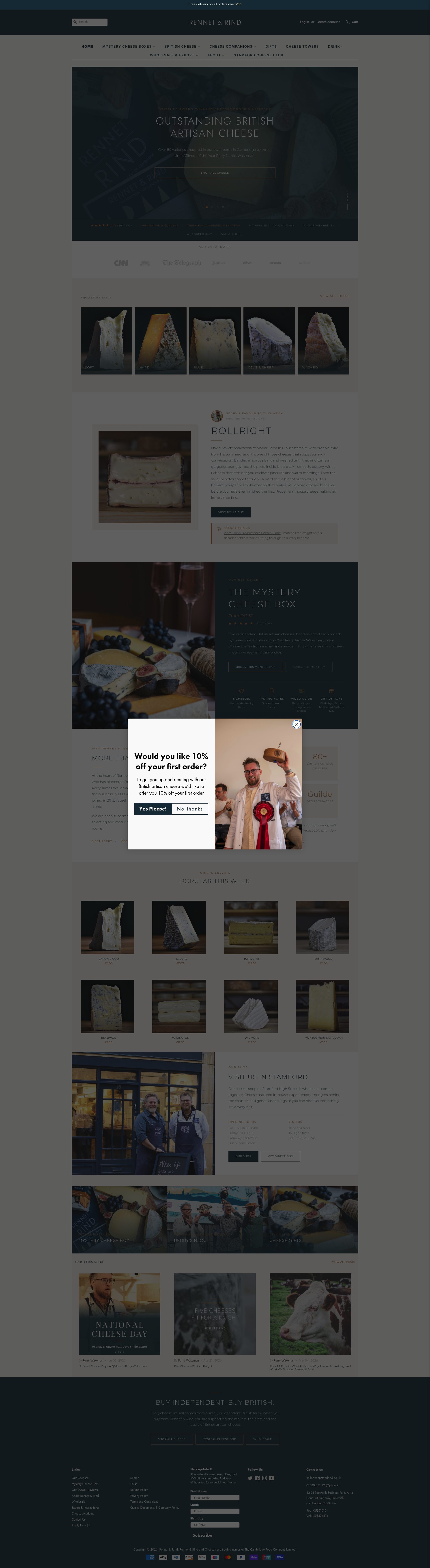
Rennet & Rind is built around the curation authority of founder Perry Wakeman, who holds a three-time Affineur of the Year title. That credential is not hidden: it appears in product page copy, in the subscription positioning, and in the "Perry's Favourite This Week" feature that creates genuine scarcity signals rather than fabricated urgency. The store stocks over 80 British artisan cheeses, browsable by style, milk type, and production method, which means an experienced buyer can navigate with precision.
The Mystery Cheese Box subscription is positioned as the primary recurring revenue product, available both as a one-time purchase and a monthly subscription on the same product page. Presenting both options together gives the buyer the comparison they need without requiring a separate subscription discovery flow. The Cheese Towers range, targeting weddings and celebrations, is an untapped category that most cheese retailers ignore, and it diversifies order values significantly. Over 4,200 five-star reviews are displayed prominently, a strong trust signal in a category where product quality cannot be verified before purchase.
10. Edenmoor
Edenmoor, formerly Pipers Farm, is primarily an online butcher and farm shop, but their cheese section demonstrates how a non-specialist can handle artisan cheese well on Shopify. The category is filtered by style (cheddar and hard, soft, goat's, raw milk, cooking), which keeps navigation clean despite being one section within a broader food catalogue. Products are sourced from small-scale producers and described with the same provenance-first language used across the rest of the site, which maintains brand consistency rather than treating cheese as a separate vertical.
The MOOR REWARDS loyalty programme and a 10% first-order incentive apply across the full catalogue, including cheese, which means the retention mechanics built for butchery customers also benefit repeat cheese buyers. The higher free delivery threshold (£75) is appropriate for a premium farm shop with temperature-controlled logistics, and it is communicated clearly enough that customers understand the trade-off rather than being surprised at checkout.
If you sell cheese, food gifts, or artisan produce and your Shopify store is not converting at the level these brands achieve, the gap is usually in how your gifting, subscriptions, and delivery confidence are structured. See our Shopify design service or get in touch to talk through what is possible.
Frequently asked questions
Which Shopify cheese store has the best subscription model?
The Cheese Geek leads on subscription design: named tiers (the Jimi, the Freddie), plain-language tasting notes, and in-cart add-ons before checkout make the recurring purchase feel personal rather than automated. Paxton & Whitfield's prepaid Cheese Club is the stronger cashflow model for merchants, asking customers to commit to three, six, or twelve months upfront.
How do the best cheese Shopify stores handle gifting?
The strongest gifting stores segment by price tier rather than product type. Paxton & Whitfield filters by budget (under £35, £45, £60, £100, over £100) and occasion, so a gift-buyer with a fixed spend lands somewhere useful immediately. The Chuckling Cheese Company's Build Your Own Box feature converts gifting intent into higher AOV by letting buyers personalise the contents.
What delivery features matter most in food ecommerce?
Named-day delivery selection and upfront free-delivery thresholds are the two highest-impact features. Snowdonia Cheese's date picker reduced abandonment by removing uncertainty about when a perishable product would arrive. The Cheese Lady explains temperature-controlled packaging as a product feature rather than hiding it in a FAQ, which removes the objection before it is raised.
Can a Shopify store handle both product sales and event bookings for a cheese brand?
La Fromagerie does this on a single Shopify store, selling individual cheeses, gift boxes, and wine alongside ticketed tastings and private events. Keeping experience commerce on the same domain retains high-intent customers rather than routing them to a separate ticketing platform, which matters for brand authority and repeat purchase rates.
What is the biggest conversion mistake cheese stores make on Shopify?
Revealing delivery information at checkout rather than on the product page. Perishable food buyers need to know when their order will arrive before they commit, not after. The stores with the lowest abandonment rates — Neal's Yard Dairy, The Cheese Lady, Snowdonia Cheese — all surface delivery expectations at or before the add-to-cart stage.