
Quick summary
Cubitts is the standout for prescription UX: a thorough Rx journey, ZEISS lens options surfaced at the right moment, and omnichannel services fully integrated in Shopify rather than bolted on. Pretavoir leads on clinical credibility, with next-day prescription delivery and a dispensing optician available post-purchase — a genuine operational differentiator. BonLook is the best omnichannel case study, unifying in-store and online Rx orders through a Shopify Plus headless build that increased AOV by 18%. DIFF Eyewear is the strongest DTC mission story, embedding its 1.4 million donated pairs into every product page rather than hiding it in an about section.
Prescription eyewear is one of the hardest product categories to sell online. You are asking customers to make a medical decision without a professional in the room, spend money on a product they cannot try on in the usual sense, and trust that the lenses will be made correctly. The brands that convert well have solved those problems systematically: they invest in prescription input flows, virtual try-on, optician-backed trust signals, and a UX that makes the gap between online and in-store feel manageable. These ten Shopify stores are the benchmark.
1. Seen Opticians

Seen Opticians, based in Manchester, is one of the UK's most respected independent opticians and their Shopify store reflects the curatorial rigour of the physical shop. The brand carries premium frames from Garrett Leight, Jacques Marie Mage, Kuboraum, Moscot, and other names that do not appear in the average high street optician window. The store is built to showcase this selection rather than overwhelm it: clean product imagery against white, generous white space, and collection pages that are more gallery than catalogue.
What sets Seen apart from a Shopify implementation standpoint is the way they have translated the in-store experience online. Their eye test booking is integrated directly into the site rather than redirected to a third-party diary system, keeping the customer journey within the brand. Reviews from customers who have visited the Manchester store appear alongside online orders, which bridges the physical and digital presence effectively. The store achieved 60% year-on-year revenue growth after moving to Shopify, a result that comes from building the digital store to match the quality of the physical one rather than treating it as a secondary channel.
2. Cubitts

Cubitts is a London-based spectacle maker with a strong point of view and a Shopify store that communicates it precisely. Every frame goes through fifty stages of craft over six weeks and the store makes this legible to the customer without making it feel like a lecture. Product pages include materials and production detail at the right level: enough to justify the price point, not so much that it buries the CTA.
The prescription journey on Cubitts is thorough. Customers can order with or without prescription lenses, and the ZEISS ClearView lens option is surfaced prominently as the premium choice. Frame fit information is presented with enough detail to reduce the guesswork around online sizing, which is the primary conversion friction in spectacle retail. Cubitts also integrates in-store services, eye exams, frame adjustments, and bespoke commissions, into the Shopify site in a way that makes the omnichannel relationship feel coherent rather than bolted on. Their Klaviyo integration means post-purchase communication is handled with the same level of craft as the product itself.
3. Fashion Eyewear
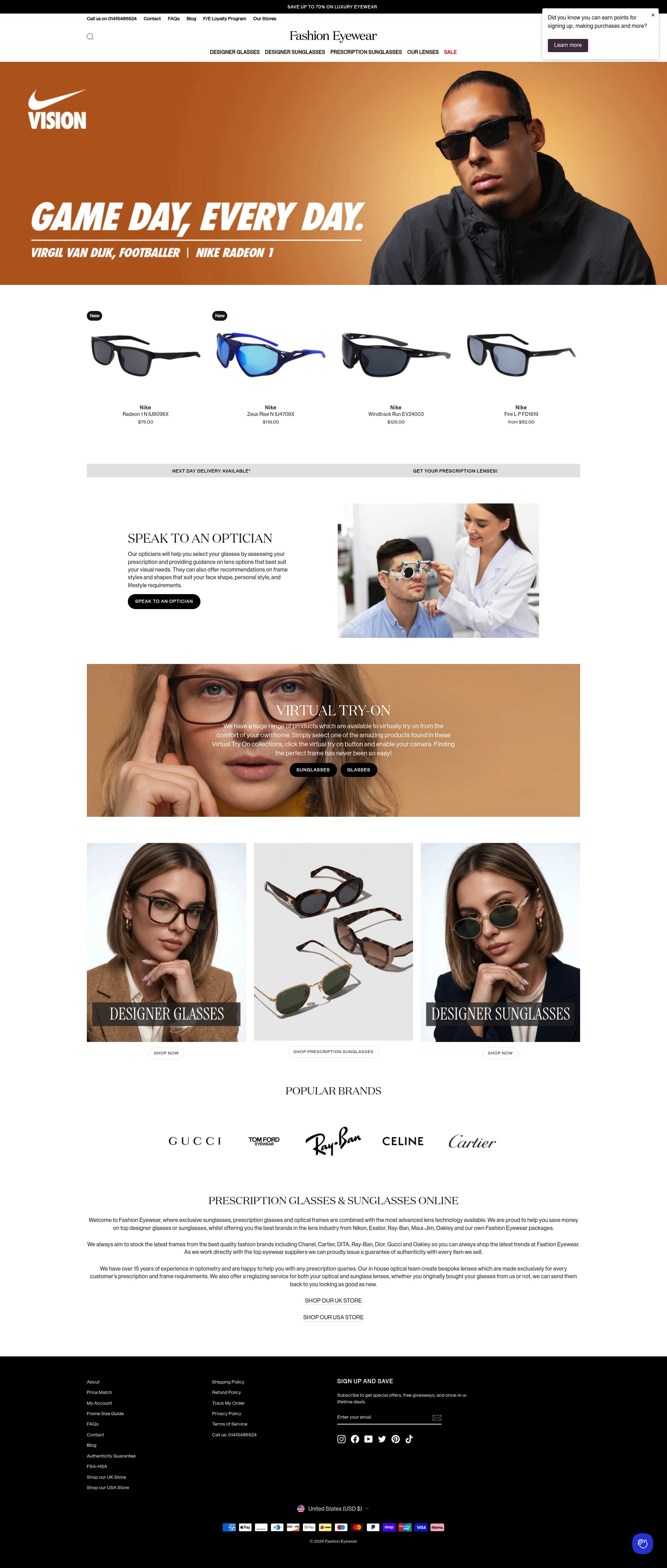
Fashion Eyewear is one of the UK's leading online opticians for luxury designer frames, stocking Chanel, Cartier, DITA, Dior, Gucci, Ray-Ban, and Oakley, with every pair sourced from official brand suppliers and verified by an in-house optical team. Their Shopify store carries the weight of that proposition: a clean, confident layout that puts the product photography first and handles the complexity of a multi-brand luxury catalogue without becoming chaotic.
Filtration across brand, lens type, frame material, and face shape is implemented clearly, which matters considerably when customers are navigating dozens of designer ranges simultaneously. The prescription lens section is prominent and specific: single vision, bifocal, and progressive options are explained with enough detail for customers who are new to buying prescription eyewear online, along with lens upgrade options including anti-reflective coating, UV protection, and blue light filtering. Trust is handled through the in-house optical team credential, explicit confirmation that frames are 100% authentic, and a price match policy that removes the lingering fear of paying more than they should.
4. Pretavoir
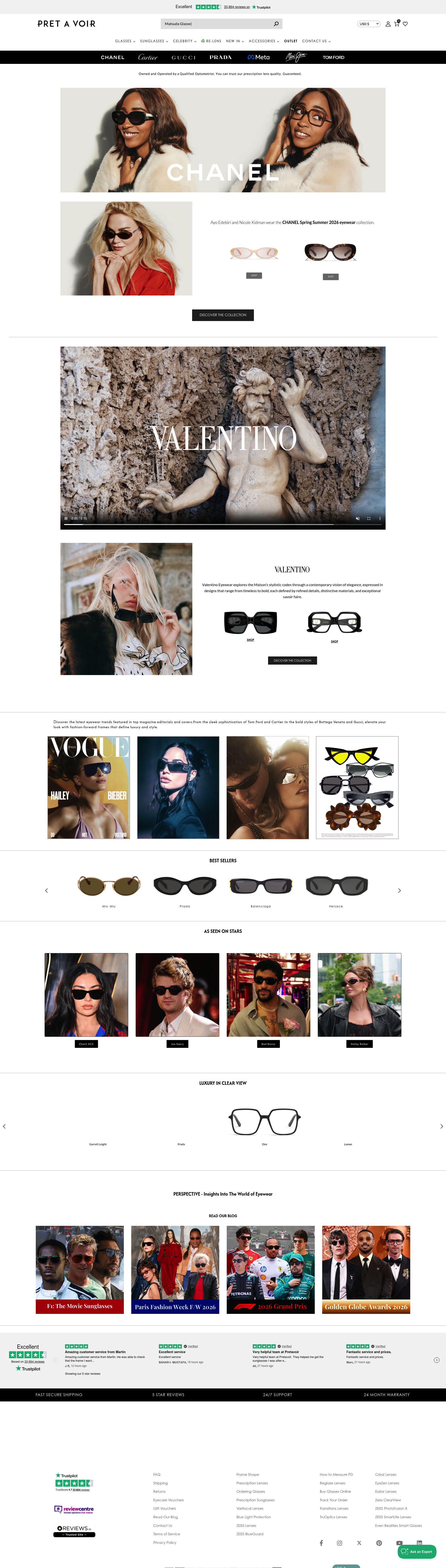
Pretavoir was founded by an optometrist with over twenty years of clinical experience and the Glasgow-based business's Shopify store carries that professional credibility throughout. The category spans luxury frames, prescription glasses, and sunglasses, with a particular strength in designer names at accessible price points. What they do well commercially is present the optometrist backstory not as a marketing line but as a functional reassurance: customers are buying their prescription eyewear from someone who actually understands optics.
Their prescription lens workflow is one of the more detailed implementations in the UK market. TruOptics, Essilor, and Zeiss lenses are available with blue control glazing and transitions, and the glazing process is explained at the point of decision rather than in a buried FAQ. Next-day delivery on prescription orders is a significant operational commitment that the store promotes prominently because it addresses a genuine objection in the category: people do not want to wait two weeks for glasses they rely on daily. Pretavoir backs this with a dispensing optician available for post-purchase queries, which is a genuine differentiator from the volume-led players.
5. DIFF Eyewear
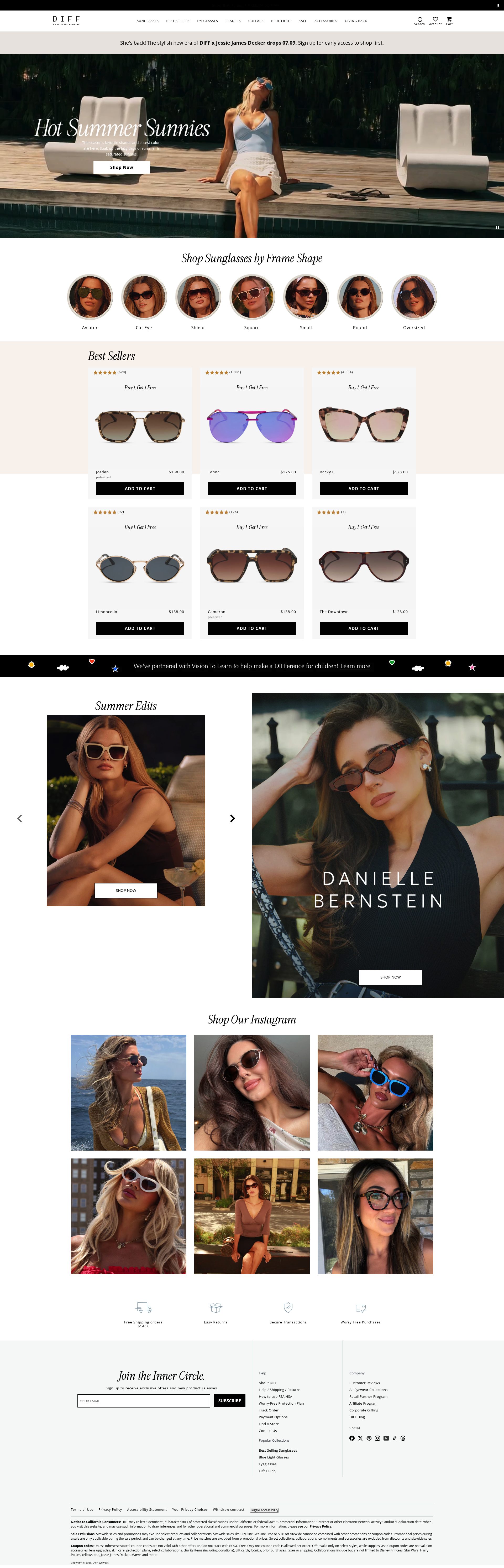
DIFF Eyewear was built on Shopify from launch and has grown into one of the stronger DTC eyewear brands in the US market. Founded in 2014 by three friends who wanted to make designer-quality prescription eyewear accessible while funding charitable giving, DIFF has donated over 1.4 million pairs of reading glasses to people in need globally and given sight-related care to more than 4.5 million individuals. That mission is embedded in the store, not just mentioned in an about page.
The product range covers sunglasses, blue light glasses, and prescription frames, with designs produced in their Southern California studio and sold at a price point that undercuts traditional optical retail significantly. Their Shopify implementation handles the charitable element at the product level: every PDP includes the "give back" component clearly, which functions both as a trust signal and a conversion driver for socially conscious buyers. The checkout is fast and the returns process is clean. DIFF is featured in Shopify's own case studies for their commercial execution, and the product photography across the catalogue is consistently strong.
6. BonLook
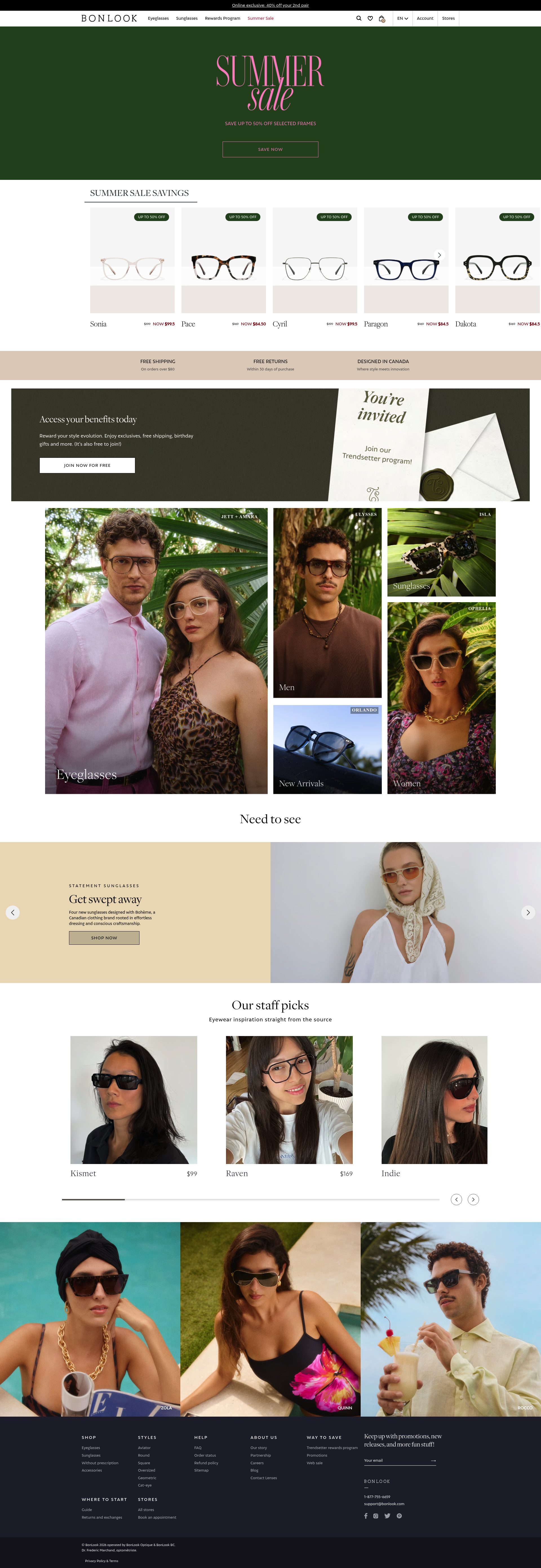
BonLook is a Canadian prescription eyewear brand founded in Montreal, operating 37 physical stores across Canada alongside a Shopify Plus headless storefront that handles both online orders and in-store assisted purchasing. The headless implementation, built with a Shopify Plus agency partner, was specifically designed to unify the online and offline experience, and it shows: customers who start a prescription order in-store can complete it online, and vice versa. Average order value increased 18% following the transition to the headless Shopify Plus architecture.
What BonLook gets right for the prescription category is the complexity of their Rx input flow. They accept all prescription types, including complex prescriptions that most online-only eyewear brands decline, and the prescription upload interface is clear enough for customers who have never bought glasses online. The virtual try-on tool is integrated into PDPs, and the in-store optician service is surfaced in the digital experience rather than treated as a separate business. For any merchant looking at how to build a true omnichannel prescription eyewear operation on Shopify Plus, BonLook is the clearest case study available.
7. Peepers

Peepers by PeeperSpecs is a US eyewear brand focused on stylish reading glasses, blue light readers, and progressive lenses, running on Shopify Plus. Their Shopify case study is one of the more instructive in the eyewear category: after migrating to Shopify Plus, the site handled Oprah-level traffic spikes without degradation and organic conversion rates increased by 25-30% following a customised checkout implementation.
The Peepers store design is built around the category insight that reading glasses are often dismissed as a grudge purchase and need to be repositioned as an accessory. Their product photography and collection organisation reflects this: colour stories, seasonal drops, and editorial-style imagery that makes readers look like deliberate fashion choices rather than functional necessities. Their "find your reader strength" tool reduces the barrier to first purchase by giving customers a way to identify their lens requirement without needing a clinical prescription. For any Shopify merchant selling vision-adjacent products, the Peepers approach to making a utilitarian product desirable is worth studying in detail.
8. Lookmatic
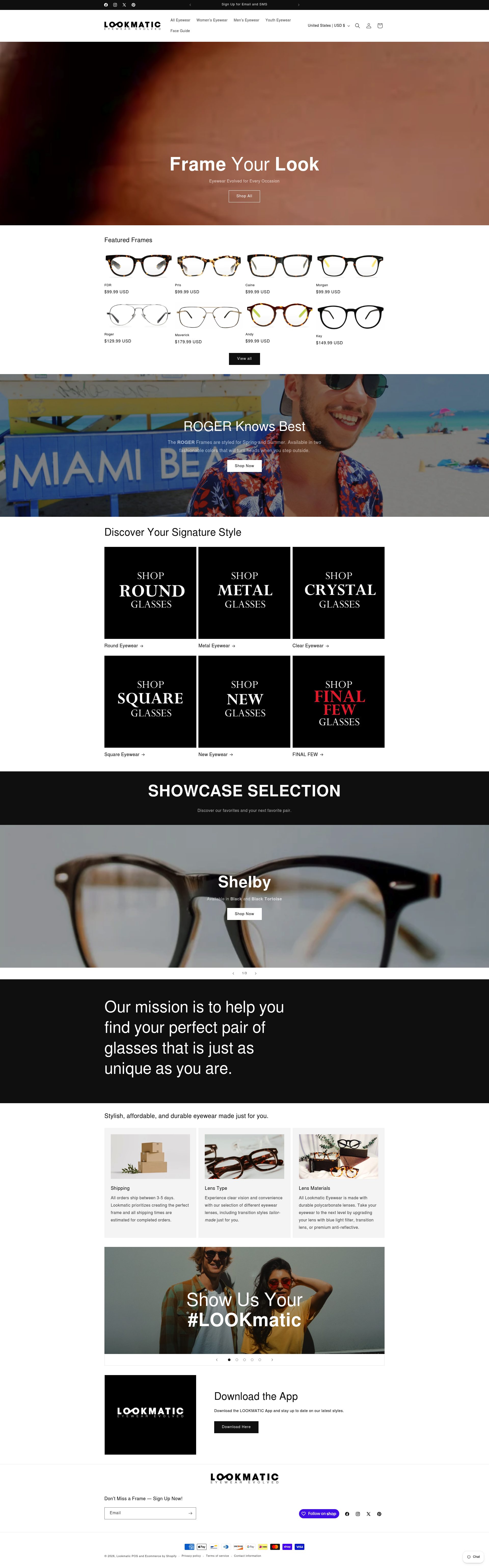
Lookmatic is a Shopify-native prescription eyewear brand built around transparency, selling fully customised prescription glasses from $99 with free home try-on and free returns. They were featured in Shopify's own success stories for the way they structured their customer education: the brand spent months explaining the value gap between retail optical pricing and direct-to-consumer manufacturing before launching. That approach built a customer base that understood what they were buying and why it cost what it did.
The home try-on programme, which lets customers select up to six frames to try at home before committing, is implemented directly within the Shopify store flow rather than redirected to a separate fulfilment system. This keeps the customer in a single journey and reduces drop-off between discovery and trial. The lens customisation interface, which covers single vision, progressive, blue light, and transition lenses, is one of the cleaner implementations of a complex product configurator in Shopify. Virtual try-on via front camera is also available from any device with a camera, handling the try-before-you-buy expectation for customers who will not use the physical home trial.
9. Proof Eyewear
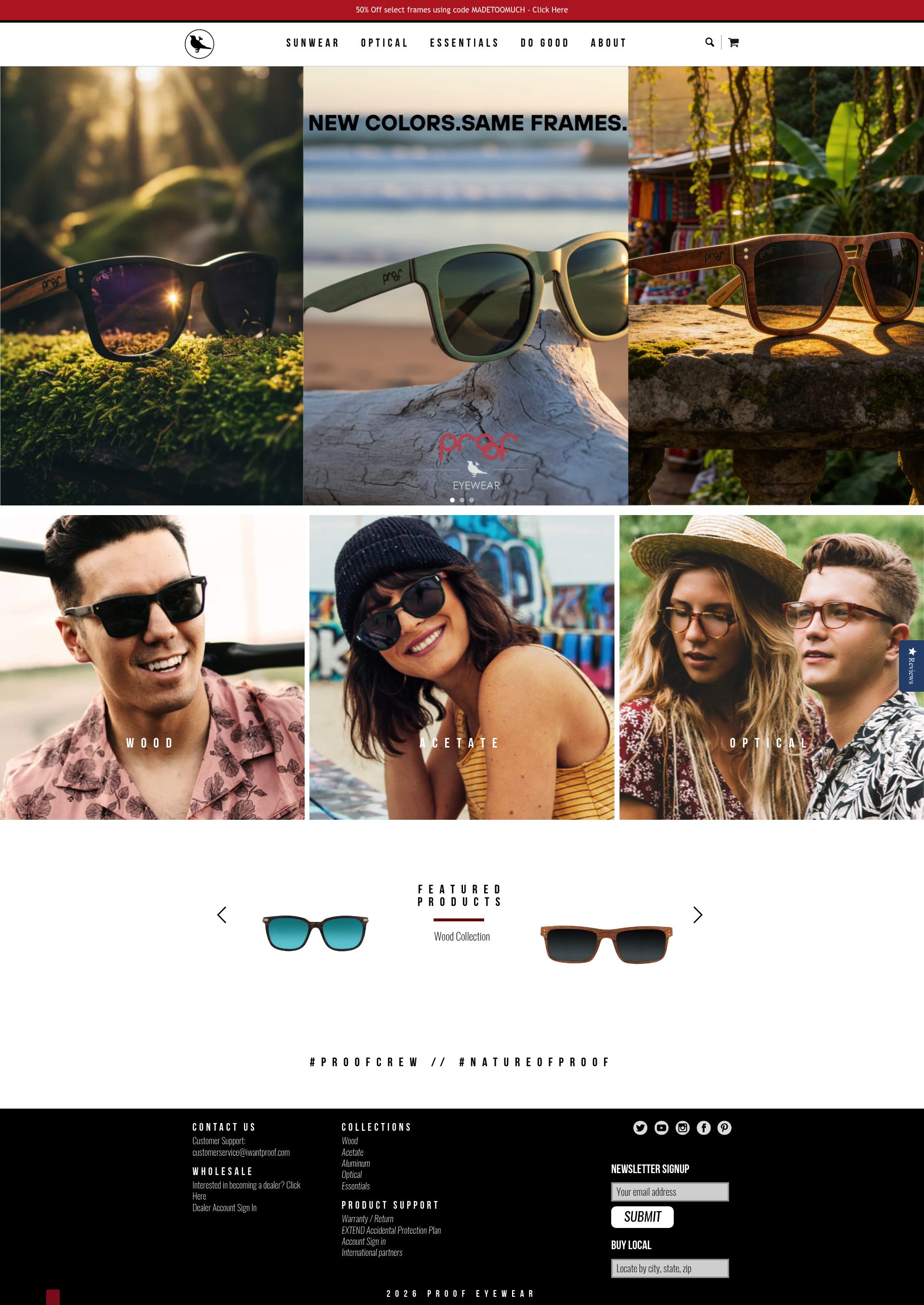
Proof Eyewear is an Idaho-based brand making handcrafted sunglasses and prescription frames from sustainable materials: wood, reclaimed aluminium, recycled skateboard decks, and biodegradable cotton-based acetate. The brand was born from the family's woodworking heritage, with their grandfather having started a sawmill in the 1960s. That origin story is genuine and the Shopify store communicates it without overselling it.
The sustainability credentials are verifiable rather than vague: specific materials, specific sourcing practices, and a nonprofit partnership in India that funds cataract surgeries. Every product page anchors the brand story to the actual materials in that frame, which is more effective than a generic sustainability badge in the footer. Proof was featured in Shopify's success stories for their social media-to-commerce conversion strategy, which involved extended brand education before product launch and a DTC model that cuts out the traditional optical retail margin. Their price range of $90-$115 delivers a product that competes on quality and story rather than price alone.
10. HEYWEAR
HEYWEAR is a New York-based optical studio that inverts the traditional optician model: all frames and lenses start at $149 total, including the eye exam, with the option to get two pairs for $249 or three for $349. Their Shopify store supports this model by handling online prescription orders, appointment booking for their NYC studios, and lens replacement orders, all within a single platform.
The vertically integrated model, where their optical lab, showroom, and fitting are all in-house, means same-day and in-minutes turnaround is genuinely possible. The Shopify store communicates this operational reality clearly: booking pages for studio visits are native to the site rather than redirected to an external calendar, and the process of ordering online for pickup is explained at the right level of detail for a customer who may never have done it before. HEYWEAR is a useful reference point for any Shopify merchant thinking about how to bring a service-heavy, in-person business model into a digital storefront without losing the premium experience that justifies the price point.
Comparison Table
| Brand | Niche Focus | Price Point | Shopify Standout |
|---|---|---|---|
| Seen Opticians | Independent luxury eyewear | Premium | In-store integration; curated DTC builder |
| Cubitts | Handcrafted British spectacles | Premium | Prescription flow plus omnichannel services |
| Fashion Eyewear | Designer frames, luxury brands | Mid-high | Multi-brand luxury UX; in-house optical team |
| Pretavoir | Optometrist-led luxury and Rx | Mid-high | Next-day prescription; optometrist credibility |
| DIFF Eyewear | Charitable DTC prescription eyewear | Mid | Mission-driven PDP; Shopify case study brand |
| BonLook | Canadian prescription; omnichannel | Mid | Shopify Plus headless; unified online/offline Rx |
| Peepers | Reading glasses and blue light | Accessible | Shopify Plus; custom checkout; traffic spike resilience |
| Lookmatic | Direct-to-consumer prescription | Accessible | Home try-on integrated in store; transparent pricing |
| Proof Eyewear | Sustainable handcrafted frames | Mid | Origin story at product level; eco DTC model |
| HEYWEAR | NYC optical studio; all-inclusive pricing | Accessible | Appointment booking native in Shopify; same-day lab |
What These Stores Get Right
These are the consistent patterns across the strongest optician and prescription eyewear Shopify stores, and the lessons that apply to any merchant in the space.
- Prescription input is treated as a feature, not a form. The best stores handle prescription upload, entry, or verification as a designed product experience rather than an afterthought. Complex Rx handling is presented as a positive differentiator, not buried.
- Trust is earned at the point of purchase, not in the about page. Optometrist credentials, in-house optical teams, and authentication guarantees appear on PDPs and in the checkout, where they influence the buying decision. Brands like Pretavoir and Cubitts place professional credibility where it actually does conversion work.
- Try-before-you-buy is solved in different ways for different price points. Home try-on programmes, virtual try-on, and liberal return policies each serve a different segment. The stores that convert well are explicit about which approach they use and why.
- Omnichannel is handled in Shopify, not around it. Whether it is Cubitts integrating eye test bookings or BonLook unifying in-store and online prescription orders, the strongest stores keep the customer journey within Shopify rather than redirecting to external systems that break continuity.
- Sustainability and mission claims are specific, not generic. DIFF Eyewear's donation count, Proof Eyewear's named materials and named nonprofit partner, and Peepers' clinical lens strength tool are all specific enough to be believed. Vague green claims and unverified charitable statements do not move prescription eyewear customers who are already making a considered purchase decision.
Frequently asked questions
Can you actually sell prescription glasses on Shopify?
Yes, and several brands do it at scale. The key is how you handle prescription input: the best stores, like BonLook and Lookmatic, treat Rx upload or entry as a designed product experience rather than a form tacked on at checkout. Complex prescriptions including progressives and high-index lenses are manageable with the right fulfilment partner and prescription validation flow built into the store.
Which Shopify eyewear store has the best virtual try-on?
BonLook and Lookmatic both integrate virtual try-on directly into their product pages rather than redirecting to a third-party tool. Lookmatic's front-camera try-on works from any device. The distinction that matters is keeping the customer in a single journey: stores that redirect to an external try-on app lose drop-off at that handoff.
How do optician Shopify stores handle trust for online prescription orders?
The strongest stores embed clinical credentials at the point of purchase, not just in the about page. Pretavoir puts the optometrist backstory on PDPs and offers a dispensing optician for post-purchase queries. Cubitts surfaces ZEISS as the premium lens choice on the product page. Trust signals need to appear where the buying decision is made, not in the footer.
What makes prescription eyewear a difficult category to sell on Shopify?
Three problems compound each other: customers are making a medical decision without a professional present, they cannot physically try the product on, and they are often spending more than they would on a standard fashion purchase. The brands that convert well solve these separately: virtual try-on or home trials address fit anxiety, optician credentials address clinical trust, and transparent Rx workflows address the fear of getting the prescription wrong.
How do top eyewear brands handle omnichannel on Shopify?
BonLook is the clearest example: their Shopify Plus headless build lets customers start an Rx order in-store and complete it online, with AOV up 18% after the migration. Cubitts integrates eye test bookings natively in Shopify rather than pointing to a third-party diary. The principle is consistent: keep the customer in one journey rather than redirecting to external systems that break continuity and attribution.