
Quick summary
Huel is the standout for subscription-first UX and a guided quiz that turns overwhelmed new buyers into high-LTV subscribers. Grenade sets the benchmark for high-SKU protein bar stores, with real-time flavour filtering and a prominent mixed-pack builder that reduces drop-off at the hardest point in the funnel. Form Nutrition leads on design credibility in the premium plant-based segment, with editorial-quality photography and ingredient sourcing detail that converts considered buyers. Bulk shows what mature Shopify Plus infrastructure looks like: in-page competitor comparison tables, Shopify Functions for tiered bundle discounts, and a loyalty ecosystem that runs through the full purchase journey.
The sports nutrition and protein snack market has grown up. Where it was once dominated by chalky powders and garish tubs aimed at bodybuilders, it now spans premium bars, functional snacks, whole-food meals, and everything in between. That shift has been great for Shopify merchants: when you're selling a product people genuinely want to understand before they buy, a well-built store does serious commercial work.
The stores in this list aren't just visually impressive. They solve real problems: building trust with first-time buyers, making ingredient information legible, reducing friction at checkout, and turning one-off purchasers into subscribers. If you're running a protein or nutrition brand on Shopify, these are your benchmarks.
Grenade
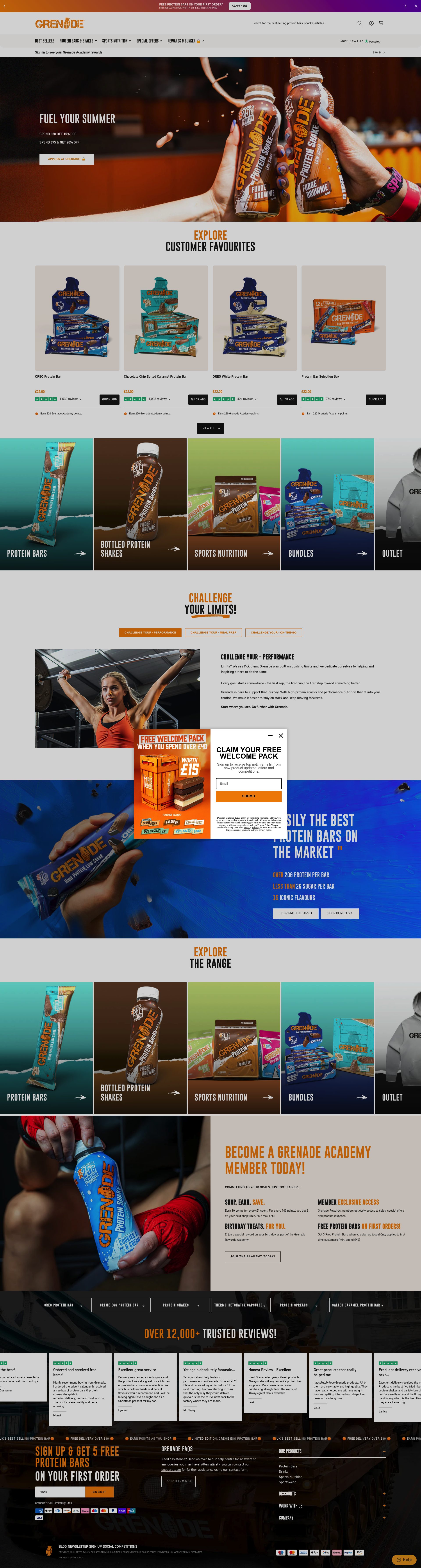
Grenade is one of the UK's best-known protein bar brands, famous for its Carb Killa range. Their Shopify store does exactly what a mass-market brand needs to do: fast, clean, and built for bulk purchasing. Product pages lead with the macros — protein, carbs, fat, calories — displayed in a visual breakdown above the fold, so buyers never have to scroll to find the information they came for.
The subscription model is prominent on every product page, with a clear price saving displayed in percentage terms. Grenade uses Shopify's native subscription integrations cleanly, and the subscribe-and-save callout sits directly alongside the add-to-cart button, reducing the cognitive effort required to opt in. Bundle builders let customers select mixed-flavour packs, which cuts down on the "I can't decide" drop-off common in high-SKU nutrition stores.
Flavour filtering is well implemented: shoppers can narrow by flavour profile, dietary requirement (gluten-free, vegetarian), and product line without leaving the collection page. For a brand with dozens of SKUs, this is essential and Grenade handles it without a bloated sidebar.
Huel
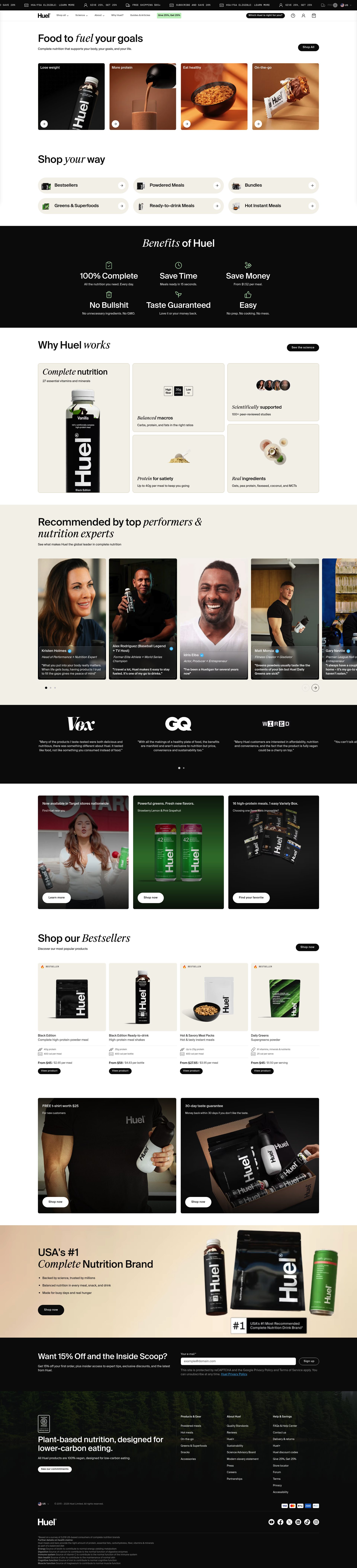
Huel operates at the premium end of the nutritionally complete food category, and their Shopify store is built to educate as much as it is to sell. Product pages are long and deliberately so: each one includes a full ingredient breakdown, amino acid profile, third-party certifications, and a "How to use" section before you ever reach the add-to-cart button. That approach works because Huel's buyers are considered purchasers who want to understand what they're putting in their body.
The subscription model is core to the Huel business, and the store treats it accordingly. Subscription pricing is the default option on product pages, with one-off purchasing available as a secondary choice. The framing is clear: "Most popular: Subscribe and save." Shopify's subscription infrastructure underpins this, and Huel's front-end implementation makes the upsell feel like a recommendation rather than a sales tactic.
Their starter bundle flow is particularly well executed. New customers are funnelled into a guided quiz that helps them select the right product line and flavour combination, reducing the overwhelm that comes with a wide product catalogue. The quiz feeds directly into a customised cart, which increases average order value while simultaneously improving the first-purchase experience.
MyProtein
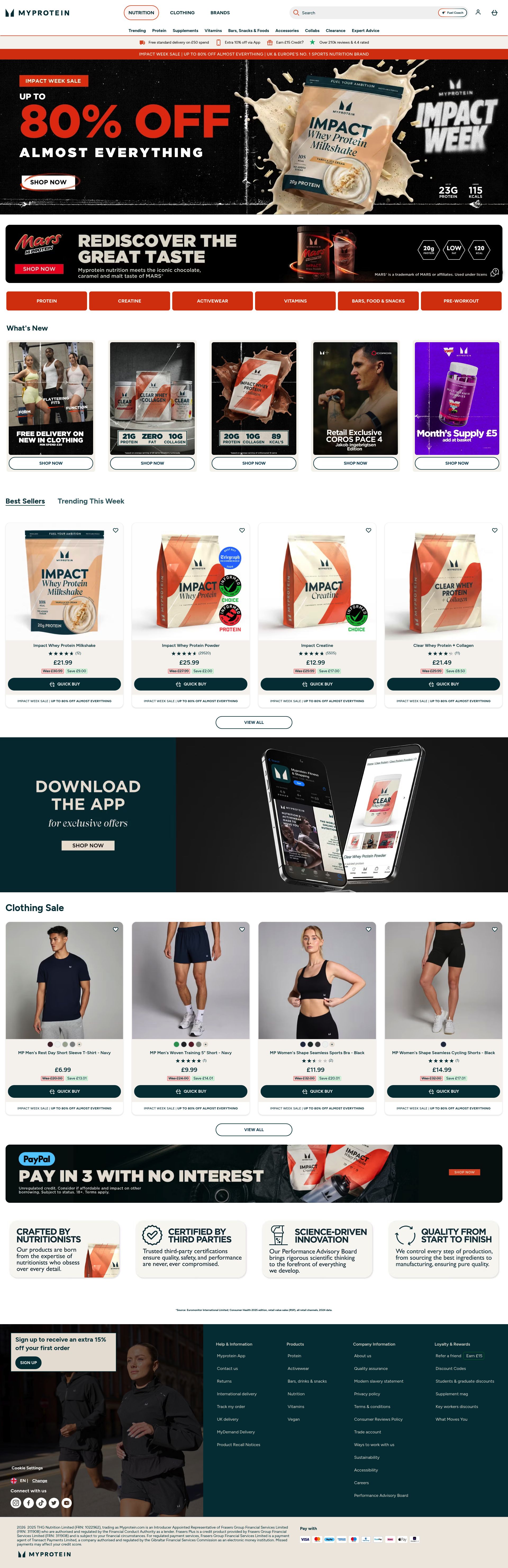
MyProtein is Europe's largest online sports nutrition brand and runs a high-volume Shopify-based store built for scale. The store is engineered around promotional mechanics: prominent sale banners, countdown timers on flash deals, and tiered discount offers (spend X, get Y% off) are baked into the homepage and product pages. For a brand that competes heavily on price, this infrastructure matters.
Where MyProtein genuinely excels is in search and filtering. The collection pages handle thousands of SKUs across protein powders, bars, clothing, and accessories. The filtering system — by flavour, size, dietary requirement, goal, and price — is fast and does not require a page reload. This is backed by Shopify's Storefront API with custom front-end rendering, which keeps the experience snappy even under heavy filter combinations.
The protein powder product pages use a flavour-selection interface that shows stock availability per variant in real time, so a customer choosing Chocolate Smooth sees immediately if it's in stock before adding to the cart. That one detail eliminates a significant source of post-checkout disappointment and reduces customer service contacts. MyProtein's scale means they've invested in Shopify Plus features: custom checkout logic, B2B pricing tiers for their trade accounts, and dedicated landing pages built with Shopify's theme customiser for every major sale event.
TREK
TREK makes plant-based protein bars and whole-food snacks, and their Shopify store reflects the brand's clean, honest positioning with real precision. The store uses a muted colour palette — creams, greens, naturals — that reinforces the "nothing artificial" message before a single word is read. This kind of visual-to-content coherence is what separates considered brands from generic ones.
Product pages are concise and ingredient-forward. Each bar leads with its five or six key ingredients listed prominently, alongside the protein content, and a short "Why you'll love it" section that reads like a conversation rather than a spec sheet. TREK relies on Shopify's metafields to power the ingredient display, keeping it consistent across the entire range without requiring individual page edits.
The store's handling of variety packs is smart. Instead of selling pre-fixed mixed boxes, TREK allows customers to build their own selection from the product page itself, choosing flavour quantities within a fixed total. This reduces the barrier to trying multiple flavours on a first order and has an obvious positive effect on repeat purchase rates, since customers discover which flavours they prefer before committing to a full box.
Fulfil Nutrition
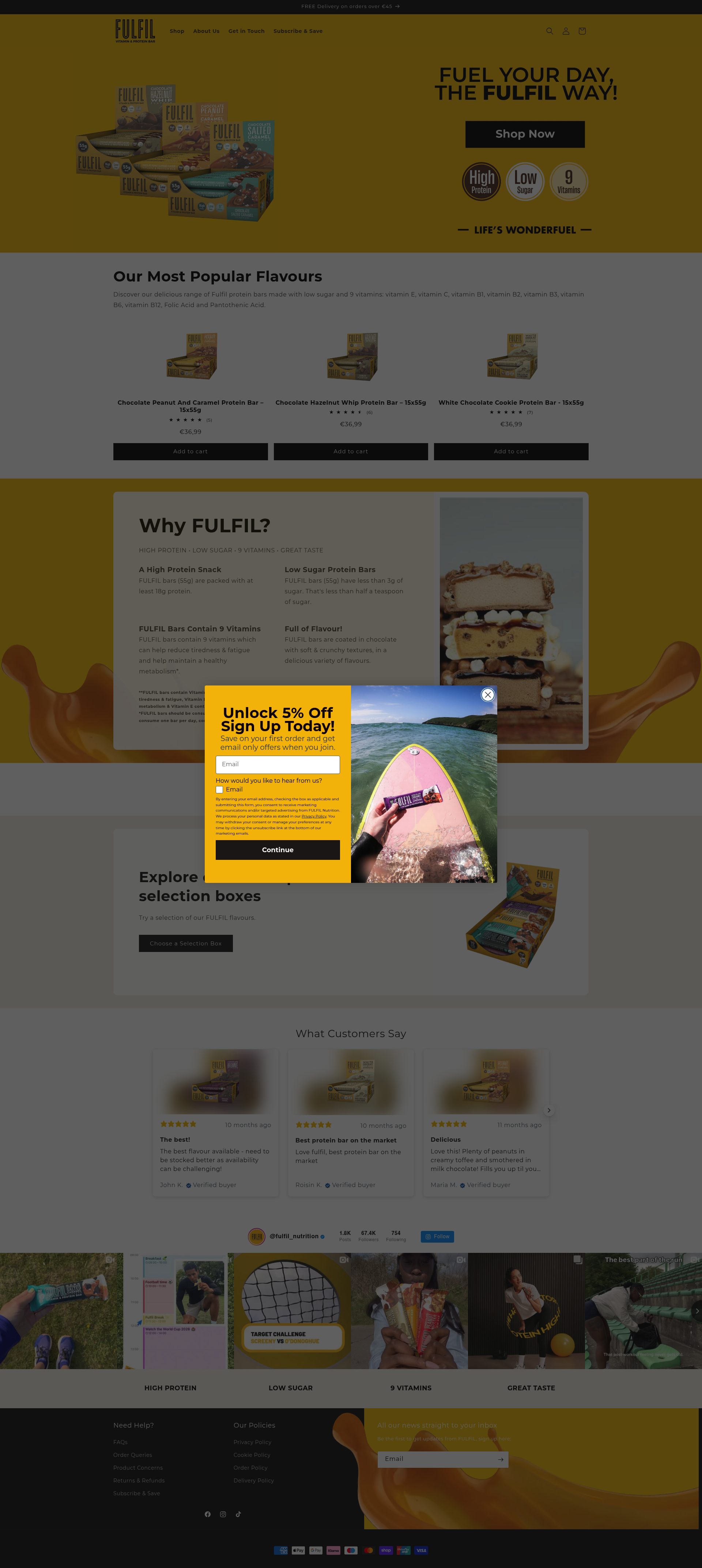
Fulfil is an Irish protein bar brand with a loyal UK following and one of the more distinctive Shopify stores in the category. The brand has leaned hard into bold, high-contrast visual branding — black backgrounds, vivid product photography, and typographic hierarchy that treats macro information like headline news. It's an effective approach for a brand targeting gym-goers and younger consumers who make purchasing decisions quickly.
The product pages open with a macro tile: protein, carbs, fat, sugar, and calories in a large, scannable grid. That grid sits above the fold before any marketing copy, which reflects a clear understanding of what the buyer actually wants to know first. Below it, a full nutritional breakdown and ingredient list is available without leaving the page. Fulfil uses collapsible accordion sections to keep the page clean while surfacing all the detail a rigorous buyer might want.
Fulfil's loyalty programme is integrated directly into the Shopify storefront. Customers earn points on every purchase, and the balance and redemption mechanic are visible in the cart and at checkout. This kind of integration — rather than a bolted-on rewards widget — creates a frictionless loop between purchasing and earning that drives measurable repeat purchase lift.
Battle Oats
Battle Oats is a UK-based protein bar and flapjack brand built for the fitness market, and their Shopify store reflects a direct-to-consumer brand that knows its audience precisely. The store is straightforward: clear product navigation, strong product photography, and category pages that separate bars, flapjacks, and multipacks without any unnecessary depth. For a brand with a focused range, that simplicity is a feature.
What makes Battle Oats worth studying is how effectively they use social proof. The product pages aggregate verified reviews with specific macro callouts — customers frequently mention the protein content, texture, and value compared to competitors, and the review display templates highlight these naturally rather than burying them in a five-star count. Shopify's native review integrations are supplemented with custom review display logic to surface the most conversion-relevant content.
The multipack builder allows customers to mix flavours across the full range. This is powered by Shopify's variant system extended with a custom bundle app, and it works cleanly on mobile — which matters, because a significant share of their direct traffic comes from Instagram and other mobile-first social channels. The checkout flow is lean: minimal upsells, fast load time, and a clear order summary that reinforces the purchase before the customer clicks pay.
Form Nutrition
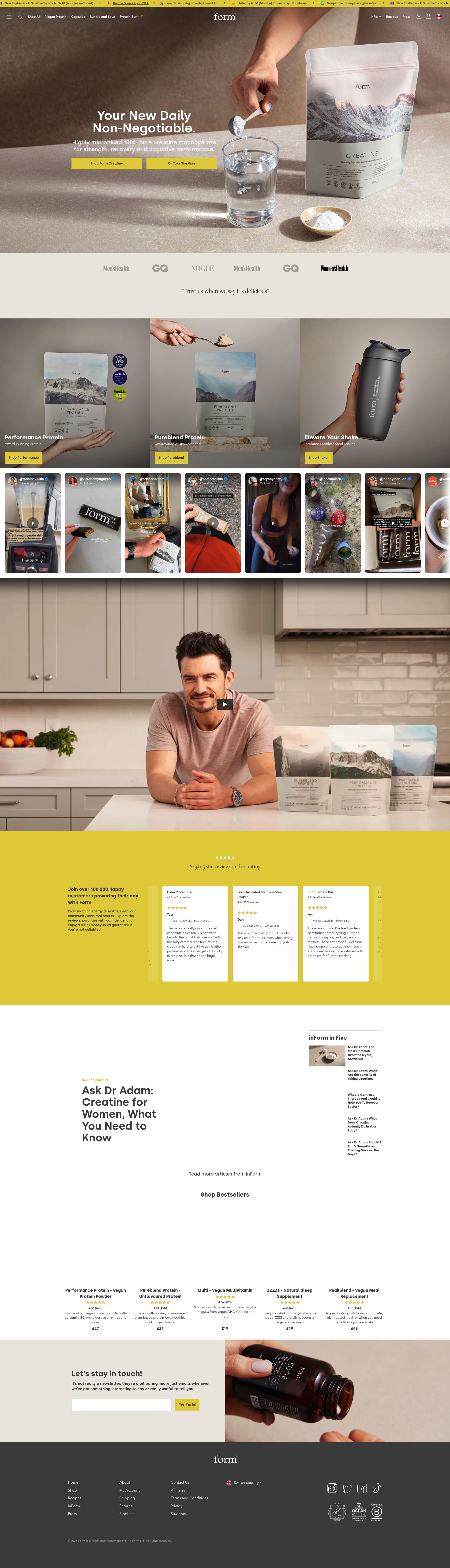
Form Nutrition makes premium plant-based protein and supplements aimed at a health-conscious, design-literate buyer. Their Shopify store is one of the most visually polished in the sports nutrition category, and it earns that reputation through genuine craft rather than surface-level aesthetics. Every section of the homepage is composed with the discipline of a brand that understands visual hierarchy: product photography is editorial quality, typography is restrained, and whitespace is used deliberately.
The product pages balance depth with clarity. Form provides full ingredient sourcing information — where the protein comes from, how it's processed, why each ingredient is included — without burying the practical information a buyer needs to make a decision. The macro breakdown is clear and prominent, and the flavour selector uses product photography to show exactly what the packaging looks like in each variant, which reduces post-purchase disappointment from customers who couldn't visualise what they were buying.
Subscriptions are presented as the obvious default without being pushy. Form's approach is to show the subscription price first with the full-price option secondary, and to accompany it with a brief explanation of what subscribers get — priority access to new products, flexible dispatch, and free cancellation. That framing converts better than a bare percentage discount because it addresses the subscription hesitations buyers typically have.
Warrior Supplements
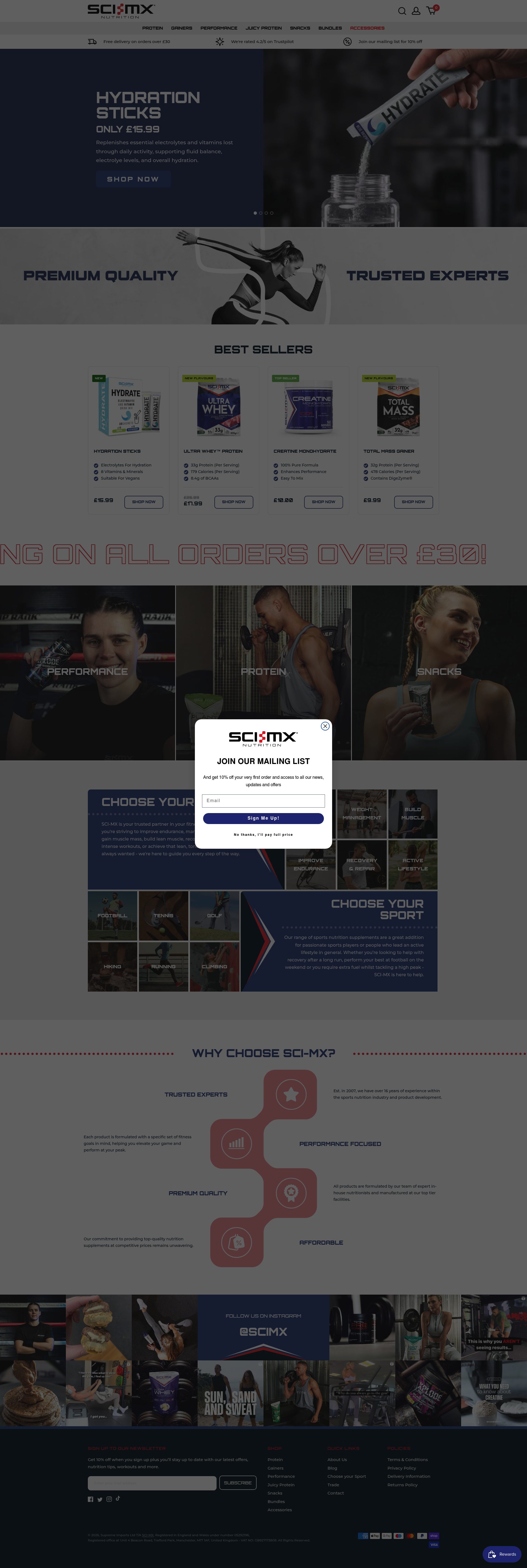
Warrior is a UK performance nutrition brand selling protein bars, powders, and pre-workouts to a gym-focused audience. Their Shopify store is built for speed and volume, with a homepage that moves quickly from brand positioning into active promotions. Discount mechanics are prominent throughout: bundle deals, introductory offers, and loyalty pricing are all visible before a customer reaches any product page.
The protein bar product pages use a flavour matrix rather than a dropdown selector. Each flavour has a thumbnail with a colour-coded wrapper, and availability is shown per thumbnail in real time. For a product where flavour choice is the primary purchase decision, this visual approach reduces hesitation and speeds up add-to-cart. It's the kind of detail that takes custom Shopify theme development to implement correctly, and it pays off in conversion metrics.
Warrior's wholesale and trade section operates as a separate customer-tagged segment within Shopify, with specific pricing rules applied at the cart level. This B2B layer runs alongside the D2C store without requiring a separate storefront, which keeps their operational overhead lean. For a brand that sells into gyms and health food shops as well as direct, that flexibility is a genuine commercial advantage.
Nutramino
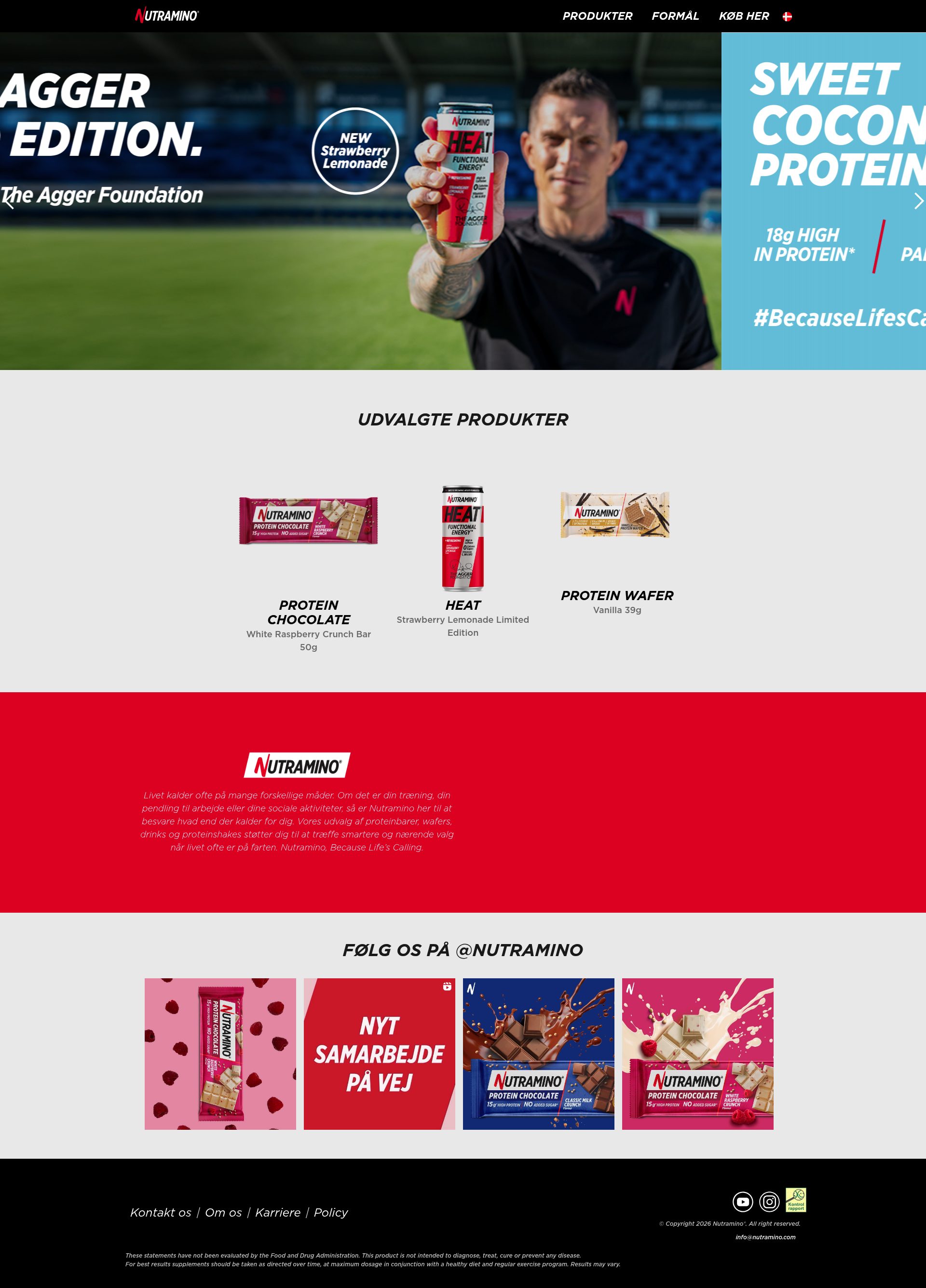
Nutramino is a Scandinavian protein and sports nutrition brand with strong distribution across the UK and Europe. Their Shopify store is optimised for international commerce: currency switching is handled via Shopify Markets, language detection redirects visitors to localised store versions, and checkout currency conversion is transparent and accurate. For a brand selling across multiple EU markets, getting that infrastructure right is as important as anything on the product page.
The protein bar product pages are clean and conversion-focused. Macro callouts are delivered as icon tiles — a format that reads well on mobile and loads fast — alongside a prominent star rating aggregated from across all review platforms. Nutramino uses Shopify's combined product listings feature to group flavour variants under a single URL, which consolidates social proof and prevents review dilution across colour and size variants.
Their category navigation separates products by goal — muscle building, weight management, energy, recovery — which mirrors how their target customers think about buying decisions rather than how the brand organises its catalogue internally. That customer-first navigation logic, implemented via Shopify's smart collections with tag-based rules, means buyers find relevant products faster and exit the category page less frequently.
Bulk (formerly Bulk Powders)
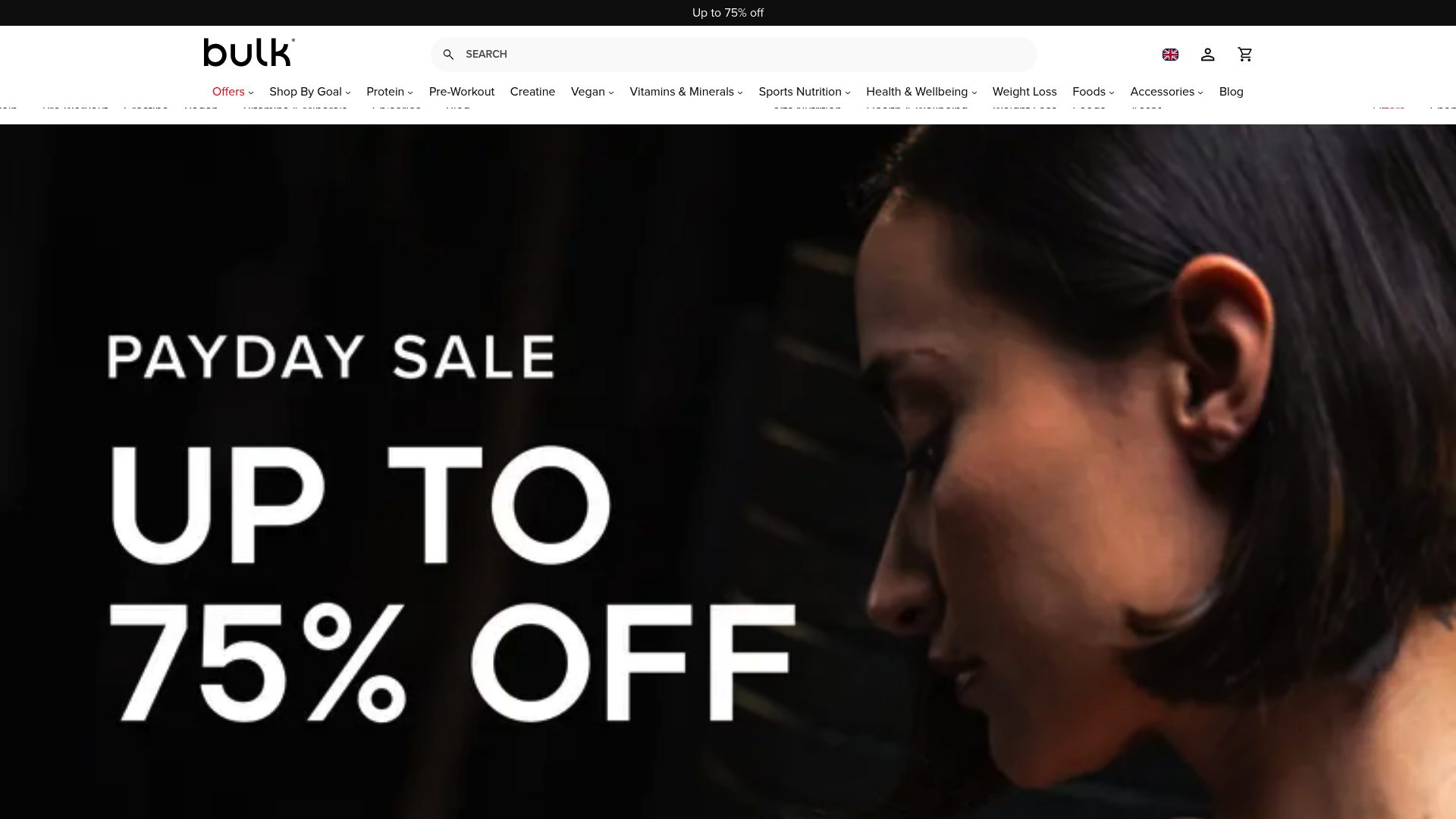
Bulk is one of the UK's largest online sports nutrition retailers, and their Shopify store reflects the investment of a brand that treats ecommerce infrastructure as a core business asset. The homepage operates like a promotional engine: seasonal campaigns, hero offers, and product launches rotate through a high-impact hero section, supported by curated collection rows that surface bestsellers and new arrivals with urgency-led copy.
The product pages on Bulk are thorough without being overwhelming. Protein powder pages include a comparison table within the page itself, allowing buyers to benchmark the product against alternatives in the Bulk range by protein content, cost per serving, and ingredient source. This internal comparison mechanic keeps buyers on-site rather than opening new tabs for competitor research, which is one of the most effective conversion levers available to a multi-SKU nutrition brand.
Bulk's subscription and loyalty ecosystem is mature: the "Bulk Rewards" programme integrates with Shopify's customer account system and is surfaced at multiple points in the purchase journey, from the product page through to the post-purchase email flow. Their use of Shopify Scripts — now Shopify Functions — to handle tiered discount logic across complex bundle combinations is an example of Shopify Plus capability used to solve a real commercial problem rather than as a feature for its own sake.
Comparison Table
| Brand | Niche Focus | Price Point | Shopify Standout |
|---|---|---|---|
| Grenade | Protein bars, Carb Killa range | Mid | Visual macro breakdown, mixed-pack builder |
| Huel | Nutritionally complete food | Premium | Guided quiz, subscription-first UX |
| MyProtein | Full-range sports nutrition | Budget to mid | Scale filtering, real-time variant stock |
| TREK | Plant-based whole-food bars | Mid | Custom variety pack builder, metafield-driven ingredients |
| Fulfil Nutrition | High-protein confectionery bars | Mid | Macro tile above fold, integrated loyalty programme |
| Battle Oats | Protein flapjacks and bars | Budget to mid | Mobile-optimised bundle builder, review surface |
| Form Nutrition | Premium plant-based protein | Premium | Editorial design, subscription default framing |
| Warrior Supplements | Performance nutrition, bars | Budget to mid | Flavour matrix selector, B2B trade pricing |
| Nutramino | Protein bars, international D2C | Mid | Shopify Markets, goal-based navigation |
| Bulk | Full-range nutrition retail | Budget to mid | In-page comparison table, Shopify Functions for bundles |
What These Stores Get Right
- Macro information above the fold. The best-converting product pages in this niche lead with the numbers: protein, calories, and key dietary flags. Buyers in this category are comparison shoppers who make decisions based on data. Burying that information below the fold is a direct conversion cost.
- Subscription as the obvious default. The leading stores do not present subscription as an upgrade or an add-on. They present it as the standard way to buy, with one-off purchase as the secondary option. The framing shift — from "would you like to subscribe?" to "this is how most people buy" — is small in implementation and significant in conversion.
- Bundle builders that work on mobile. Flavour selection, mixed packs, and variety builders generate higher average order values, but only if they work cleanly on mobile. Every store in this list has invested in mobile-first bundle UX. Broken variant selectors on small screens are a top-three conversion killer in this category.
- Trust through ingredient transparency. Whether it's sourcing information, third-party certifications, or detailed nutritional breakdowns, the top-performing stores treat ingredient transparency as a conversion tool rather than a compliance obligation. Buyers who trust what's in the product convert faster and return more often.
- Social proof that surfaces relevant information. Star ratings alone do not move buyers. The stores doing this well surface review content that speaks directly to the purchase decision: flavour comparisons, texture feedback, post-workout experience. That specificity builds confidence far more effectively than a generic aggregate score.
Frequently asked questions
Which protein bar brands use Shopify?
Grenade, Fulfil Nutrition, TREK, Battle Oats, and Form Nutrition all run their direct-to-consumer stores on Shopify or Shopify Plus. Most of the leading UK protein bar brands have moved to Shopify for its subscription integrations, bundle builder apps, and Shopify Markets support for international selling.
What Shopify apps do protein and nutrition brands use?
The most commonly used categories are subscription apps (to power subscribe-and-save on product pages), bundle builders (for mixed flavour packs and variety boxes), loyalty and rewards programmes (integrated into the cart and checkout), and review apps configured to surface macro-relevant content. Shopify Plus brands also use Shopify Functions for tiered discount logic on large orders.
How do protein brands handle flavour variants on Shopify?
The most effective implementations use a visual flavour matrix rather than a dropdown selector, showing each flavour as a thumbnail with real-time stock status. This is faster to scan on mobile and eliminates the post-checkout disappointment that comes from selecting an out-of-stock variant via a dropdown. Warrior Supplements and MyProtein both use this approach well.
How important is subscription UX for protein and nutrition Shopify stores?
It is the single biggest lever for LTV in this category. The stores that convert the most subscribers present subscription as the default purchase option rather than an upgrade, show the saving in percentage terms alongside the add-to-cart button, and accompany it with a brief explanation of what subscribers get — not just a price difference. Huel and Form Nutrition both execute this well.
What makes a high-converting protein product page on Shopify?
Four things matter most: macro information (protein, calories, key dietary flags) displayed above the fold before any marketing copy; a visual flavour selector with real-time stock; ingredient transparency that treats sourcing detail as a trust signal rather than small print; and social proof that surfaces specific review content about texture, flavour, and post-workout performance rather than a generic star count.