
Quick summary
Govee UK sets the standard with immersive lifestyle photography and clear compatibility badges that remove the biggest smart home purchase barrier before customers can raise it. tado UK leads on conversion for considered purchases by quantifying every benefit in actual pounds saved rather than vague efficiency claims. Vesternet is the strongest example of technical content replacing a sales team, with deep protocol guides and compatibility matrices built for the installer and enthusiast segment. SwitchBot UK shows how to make a wide, complex ecosystem feel coherent rather than overwhelming through well-structured hub-and-device diagrams.
Smart home ecommerce has a problem that most other categories do not: customers are not just buying a product, they are buying into an ecosystem. Will it work with Alexa? Does it need a hub? Is it compatible with what I already have? The stores that win in this category are the ones that answer those questions before the customer has to ask. Here are 10 doing it well.
1. Govee UK
Govee's official UK store is one of the most visually impressive in the smart home category. Products are shown in real home environments with the lighting effects active — which is far more persuasive than product-on-white photography for an LED brand. Compatibility badges (Alexa, Google, HomeKit) are displayed clearly on every product listing, which removes the most common purchase barrier.
2. SwitchBot UK

SwitchBot's store handles product complexity well. The ecosystem is explained through clear diagrams showing how devices connect to each other via the Hub, and Matter compatibility is called out prominently for customers building future-proof setups. The breadth of the range (locks, curtains, thermostats, sensors) is presented as a strength rather than a confusing array of choices.
3. Philips Hue UK
Philips Hue is the benchmark for smart home product presentation. The store uses room-based navigation (kitchen, bedroom, outdoor) so customers can shop by space rather than by product type — which is a much more natural way to think about home lighting. The "Works with" ecosystem integrations are exhaustive and clearly displayed, reinforcing Hue's position as the default choice.
4. tado UK
tado's store is built around a single, clear value proposition: cut your heating bills. Every page quantifies the benefit — specific percentages, typical annual savings — rather than relying on vague efficiency claims. The installation guide is surfaced prominently, which addresses the biggest objection for a smart thermostat purchase: "Will I be able to fit this myself?"
5. Aqara UK
Aqara is a Chinese smart home brand with a strong UK following built around Apple HomeKit, Matter, and Zigbee compatibility. The DTC store makes the ecosystem story central rather than incidental: every product page leads with platform compatibility, and setup guides are prominent rather than buried in FAQs. The positioning around advanced automation for serious smart home enthusiasts is communicated consistently, which attracts a buyer who will spend more and return more often than a first-time casual smart home shopper.
6. Meross Official Store
Meross punches above its weight in brand presentation for a relatively niche direct store. Compatibility with all four major voice and smart home platforms (HomeKit, Alexa, Google, Matter) is the store's key differentiator and it is surfaced on the homepage, category pages, and product listings. A clean, uncluttered layout keeps the focus on the products and their integrations.
7. Tapo UK
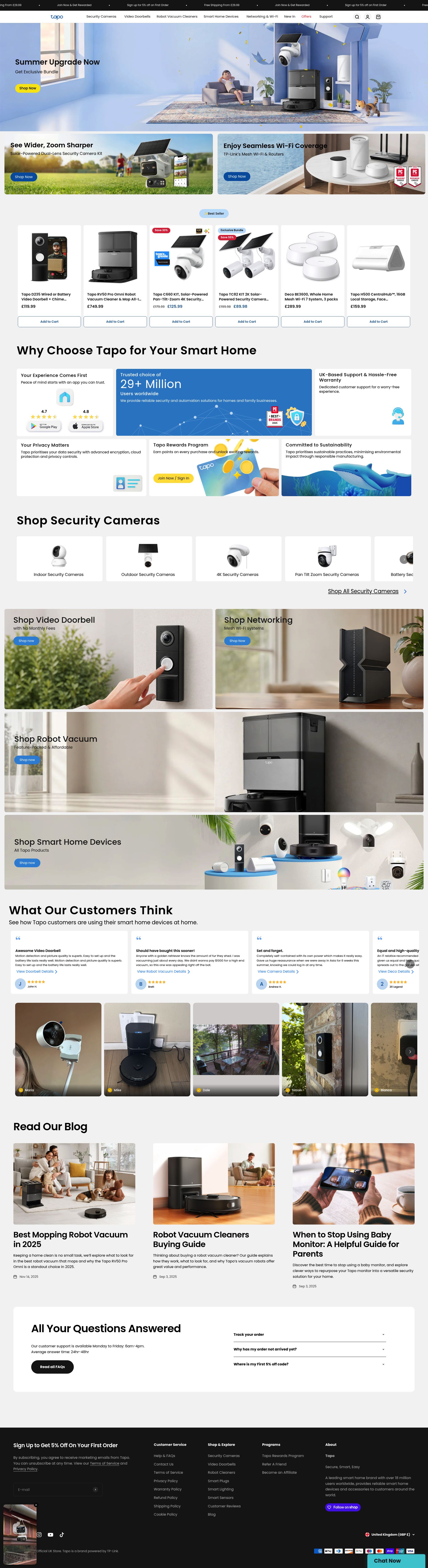
TP-Link's Tapo store makes a virtue of its no-hub-required proposition. For customers who find the smart home category intimidating, the promise of plug-in-and-go simplicity is a powerful entry point. Product pages are clear about what does and does not require the Tapo Hub, which builds trust through honesty rather than obscuring the details.
8. Vesternet
Vesternet is a UK specialist in smart home automation, covering Z-Wave, Zigbee, and Wi-Fi devices from brands including Fibaro, Aeotec, and Hue. The DTC store sits at the advanced end of the market: technical buyers find detailed compatibility matrices, protocol explanations, and integration guides that a general retailer would never invest in. For smart home merchants targeting the enthusiast and installer segment, Vesternet shows how deep technical content can replace the need for a sales team at the conversion stage.
9. Smarthome UK
Smarthome UK sits at the useful intersection of editorial and retail: buying guides and product comparisons sit alongside the shop, which helps customers make informed decisions rather than bouncing off to a third-party review site. That editorial layer builds topical authority and keeps purchase intent on-site — a smart content strategy for a considered-purchase category.
10. Lights.co.uk Smart Home
Lights.co.uk brings deep lighting expertise to the smart home category, which is credible in a way that a general electronics retailer cannot easily replicate. The Philips Hue range is presented with genuine product knowledge, and the filtering options (bulb type, fitting, colour temperature, smart platform) are more granular than most competitors. A strong example of category depth as a conversion driver.
Selling smart home products on Shopify requires more than good photography — it requires content architecture that answers technical questions and builds ecosystem confidence. If your store is not communicating its product's value clearly enough, that is where we start.
See our Shopify design services or get in touch to discuss your store.
Frequently asked questions
Which smart home brands sell direct on Shopify in the UK?
Several leading brands run their own Shopify DTC stores in the UK, including Govee, SwitchBot, Aqara, Meross, and Tapo. tado and Philips Hue also operate direct stores for their UK market. Selling DTC gives these brands control over how ecosystem compatibility and installation are communicated — something a general marketplace listing cannot easily do.
What makes a smart home product page convert well?
The biggest conversion driver in smart home ecommerce is answering compatibility questions before the customer has to ask. Pages that clearly display which voice assistants and platforms a device works with — Alexa, Google, HomeKit, Matter — consistently outperform those that bury this information in a spec table. Installation complexity should also be addressed upfront, either with a step count or a guide link, because setup anxiety is a leading reason for abandoned baskets in this category.
Is Shopify a good platform for selling smart home products?
Shopify works well for smart home brands that need to explain ecosystem compatibility, bundle devices, and support post-purchase with guides and documentation. The platform handles multi-SKU product families cleanly, and apps like Bundler and ReConvert support the cross-sell and upgrade paths that are common in this category. Shopify Plus adds the script-level control needed for complex tiered bundles.
How do smart home stores handle ecosystem complexity in their product listings?
The best stores use a combination of compatibility badge icons, ecosystem diagrams, and filtering by platform rather than by product type. Vesternet uses detailed protocol-level compatibility matrices. Philips Hue uses room-based navigation so customers shop by space rather than by product category. SwitchBot uses hub-and-device diagrams to show how components connect. The common thread is answering "will this work with what I already have?" without requiring the customer to dig.
What content strategy works for smart home ecommerce SEO?
Buying guides and compatibility explainers are the highest-performing content type for smart home stores because they match the research-heavy intent behind most smart home searches. Smarthome UK is a strong example: editorial buying guides sit alongside the product catalogue, keeping purchase-intent traffic on-site rather than losing it to third-party review sites. Targeting protocol-specific queries (Z-Wave, Zigbee, Matter, Thread) also captures high-intent searches from enthusiast buyers who convert well and return often.