
Quick summary
Gymshark is the standout for community-driven commerce, weaving training content and subscription mechanics directly into the Shopify store to create repeat purchase without relying on discounts. Rogue Fitness is the strongest model for complex high-ticket equipment, with configuration tools, bundle builders, and freight-aware checkout that competitors in strength gear rarely match. Osprey Europe earns its place for the interactive fit-finder alone, a tool that cuts returns and builds pre-purchase confidence better than any size chart. Decathlon UK shows how to manage extreme catalogue depth — tens of thousands of SKUs across every sport — without losing usability, making it essential reading for any merchant scaling beyond a focused product range.
Sports equipment is a category where trust does most of the heavy lifting. Customers are spending serious money on gear that directly affects performance and safety, which means a weak product page or a clunky checkout costs you far more than in a lower-stakes niche. The stores that win here do two things consistently: they give buyers enough technical information to make a confident decision, and they remove every point of friction between that decision and payment.
Shopify has become the platform of choice for mid-market sporting goods brands, and for good reason. The app ecosystem handles complexity well, whether that's size and variant matrices, subscription-based training plans, or bundled kit builders. The 10 stores below cover everything from gym equipment and team sports kit to outdoor gear and specialist coaching tools. Each one is doing something worth studying.
1. Gymshark
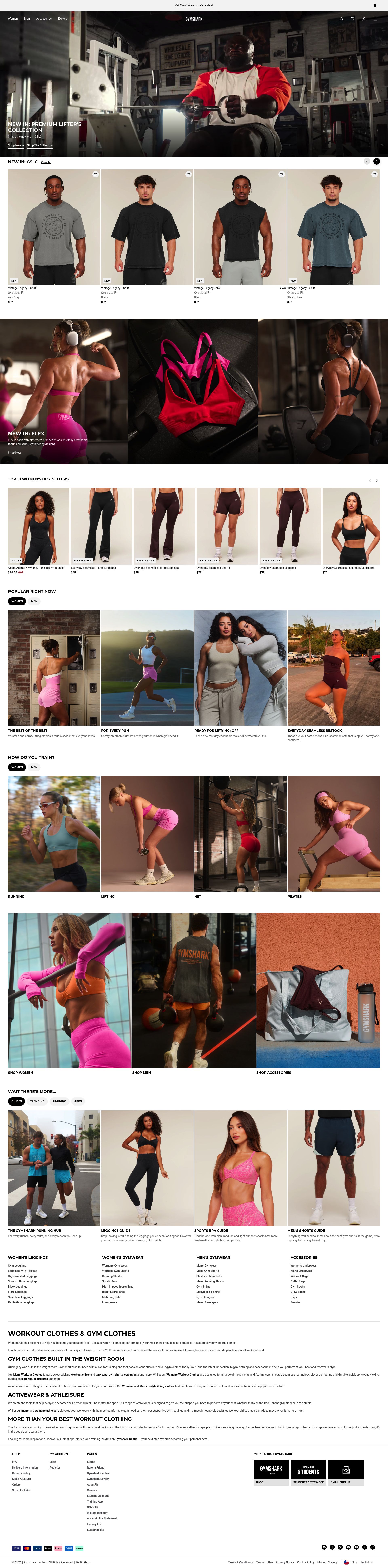
Gymshark is the benchmark for community-led sportswear on Shopify. What started as a screen-printing operation in a garage in Solihull is now a billion-pound brand, and the Shopify store reflects that journey without losing the brand's grassroots energy. The homepage cycles between performance content and product, and the transition feels natural rather than forced.
The product pages are particularly strong. Every item has multiple lifestyle shots alongside technical flat-lays, and the size guide is embedded directly in the page rather than opening in a new tab. That one decision reduces the friction that kills conversions in apparel. The filtering system across category pages is fast and intuitive, which matters when the catalogue runs to hundreds of SKUs.
Gymshark also uses Shopify's subscription infrastructure to build recurring revenue through its Gymshark Central training content, tying community membership directly to the commerce platform. That level of integration between content, community, and checkout is something most competitors aren't attempting.
2. NOBULL
NOBULL makes training footwear and apparel for CrossFit athletes and functional fitness enthusiasts, and the store reflects that no-frills identity. The design is stripped back, high-contrast, and fast to load. There's no bloated hero carousel or unnecessary animation. Every element is there because it earns its place.
The product detail pages are particularly well-constructed for a technical footwear brand. Drop height, sole construction, and intended use case are all documented clearly, which matters when your customer is choosing between a training shoe and a running shoe. The checkout flow is short and the guest checkout option is prominent, something a lot of sports stores still get wrong by forcing account creation.
NOBULL has also invested heavily in UGC integration. Real athlete photos pulled into the product page via a reviews widget build social proof at the moment it matters most, immediately before a customer commits. For a brand competing against Nike and Reebok with a fraction of the marketing budget, that kind of earned credibility is essential.
3. Castore
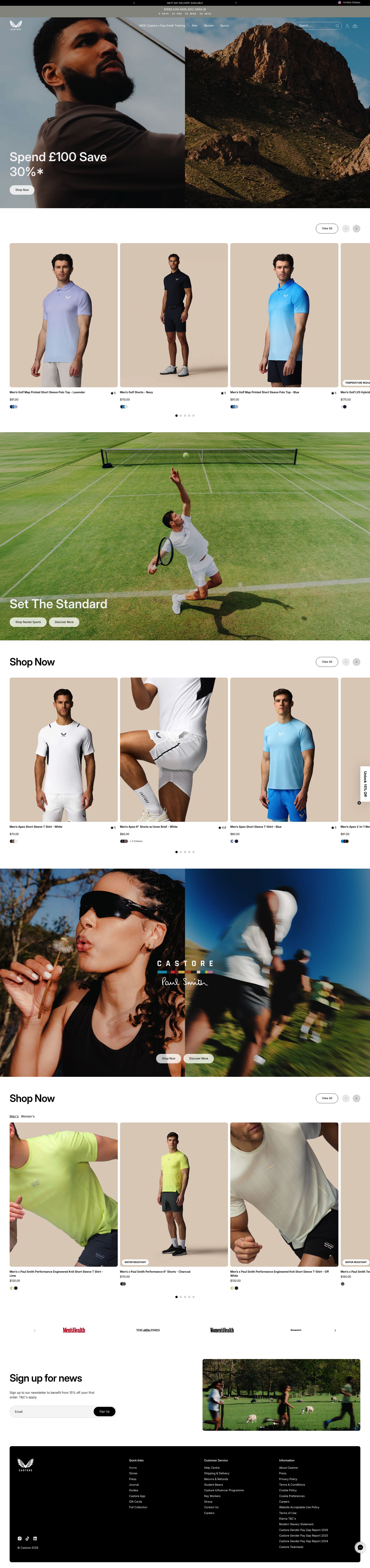
Castore is a Manchester-based premium sportswear brand with partnerships across cricket, golf, tennis, and football. The Shopify store manages a complex product catalogue spanning team kit, training apparel, and fan merchandise, and it handles that complexity without overwhelming the customer.
The navigation architecture is worth studying. Sport-specific landing pages act as micro-homepages, each with their own editorial content, featured products, and ambassador photography. A golfer landing on the Castore golf section gets a completely different experience from a cricket fan, even though they're on the same Shopify instance. That level of segmentation requires careful planning but pays off in relevance and conversion.
Castore's checkout experience reflects the premium positioning. The cart is clean, upsell logic is tasteful rather than aggressive, and the post-purchase email sequence is on-brand from the start. For a UK brand competing with established heritage names, execution at every stage of the funnel matters.
4. Rogue Fitness
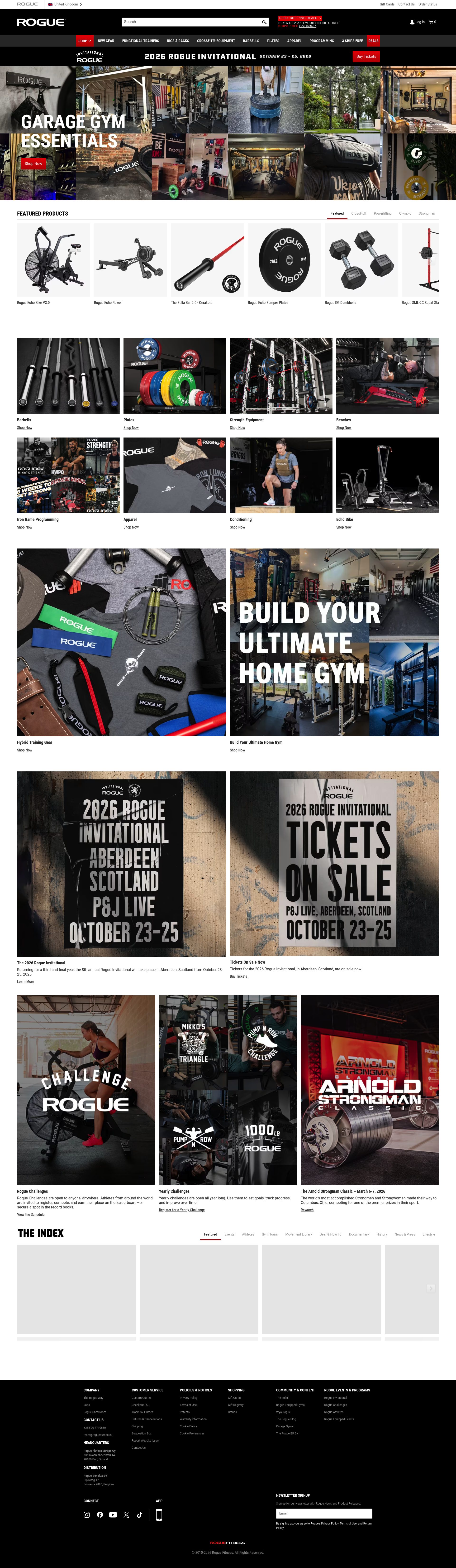
Rogue Fitness is the dominant player in strength equipment in the US, supplying everything from barbells and weight plates to full gym rig systems. The Shopify store handles a catalogue that runs to thousands of SKUs, including heavy, configurable equipment that ships on freight carriers, and it manages the complexity without making the buying process feel difficult.
The product pages for complex items like power racks and monolift systems include specification tables, compatibility charts, and optional add-ons in a layout that guides the customer rather than overwhelming them. The bundles and packages section is particularly well-executed: rather than asking a customer to build a home gym from scratch, Rogue presents curated setups by budget and space, which shortens the decision cycle considerably.
The store also integrates directly with Rogue's event sponsorship calendar, the US Open, the Rogue Invitational, and the CrossFit Games, pulling limited-edition drops and event merchandise into the main commerce experience. That blurring of content, events, and commerce is a model many sporting goods stores aspire to but few execute consistently.
5. Sundried
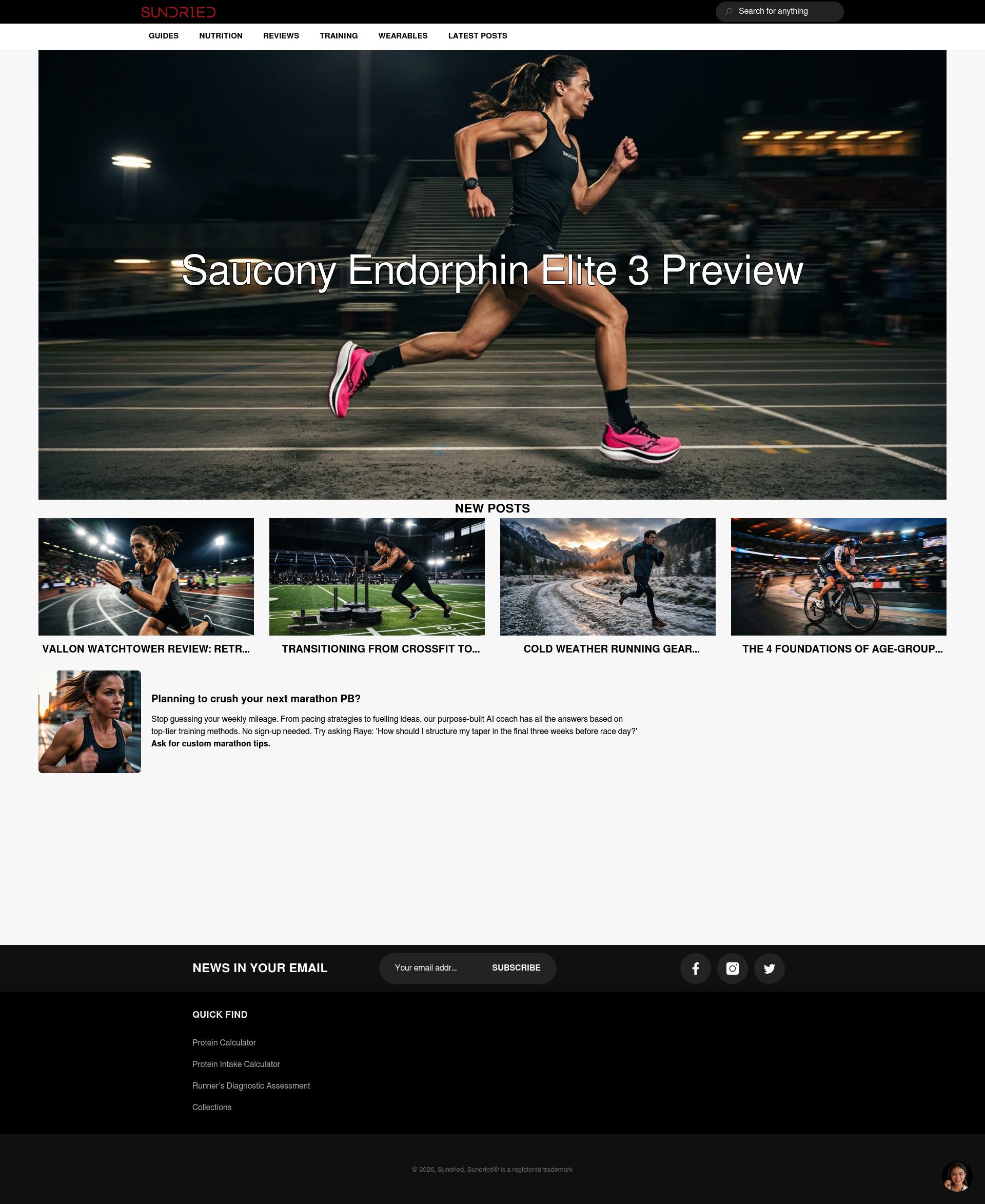
Sundried is a UK-based sustainable activewear brand making kit from recycled materials. The store is a good example of how to lead with brand values without sacrificing conversion optimisation. The sustainability messaging is integrated into the product pages rather than siloed on a separate "about" page, so customers are learning about material sourcing while they're evaluating a product.
Each product page includes a breakdown of the recycled content in that specific item, the number of plastic bottles used in the fabric, the carbon offset, and the ethical manufacturing certification. That transparency builds trust with an audience that is, by definition, sceptical of greenwashing. It also gives customers a story to tell when they wear the kit, which feeds word-of-mouth.
The Shopify implementation makes smart use of metafields to surface sustainability data per-product rather than relying on static copy. That's the kind of technical decision that scales well as the catalogue grows, and it keeps the product pages accurate without requiring constant manual updates.
6. Osprey Europe
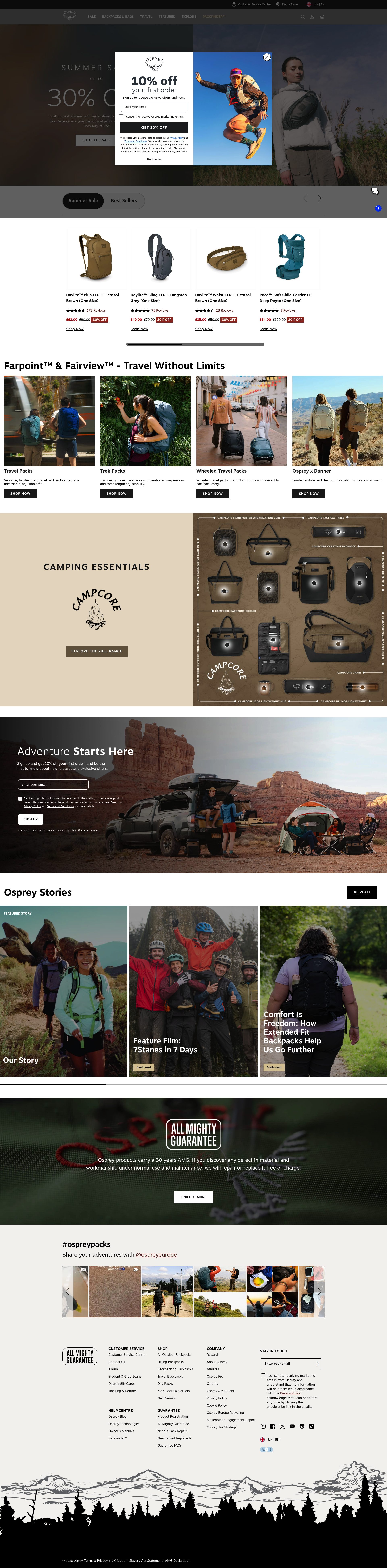
Osprey makes backpacks and travel gear for hikers, cyclists, and outdoor enthusiasts. The European Shopify store is a well-structured example of how to sell technical products to customers who need a lot of information before they'll commit to a high-value purchase.
The fit-finder tool on pack product pages is the standout feature. Rather than asking customers to interpret a size chart, Osprey walks them through torso length measurement and recommends the right harness size. That interactive guide reduces both pre-purchase anxiety and post-purchase returns, two metrics that hit margin hard in the outdoor gear category.
The store also handles Osprey's All Mighty Guarantee well, surfacing the lifetime repair warranty prominently on product pages rather than burying it in the footer. For a product where someone is spending upwards of £200, that guarantee is a genuine conversion driver, and the store treats it as one.
7. WIT Fitness

WIT Fitness is a London-based retailer specialising in functional fitness and CrossFit equipment, serving both individual athletes and gym owners. The store manages a wide product mix including footwear, apparel, supplements, and large equipment, and the catalogue organisation is clean despite that breadth.
The athlete programme is built directly into the Shopify store, offering professionals and coaches a dedicated pricing tier with a streamlined application and approval process. That kind of B2B functionality layered onto a consumer Shopify store is technically straightforward with the right apps, but it requires clear UX decisions to avoid confusing the two audiences. WIT handles the separation well.
WIT also runs frequent drops of limited-edition colourways and collaborations with equipment brands like Nike and Assault Fitness. The store's notification and waitlist functionality for these drops is integrated natively, building anticipation without requiring a separate platform.
8. Sweaty Betty
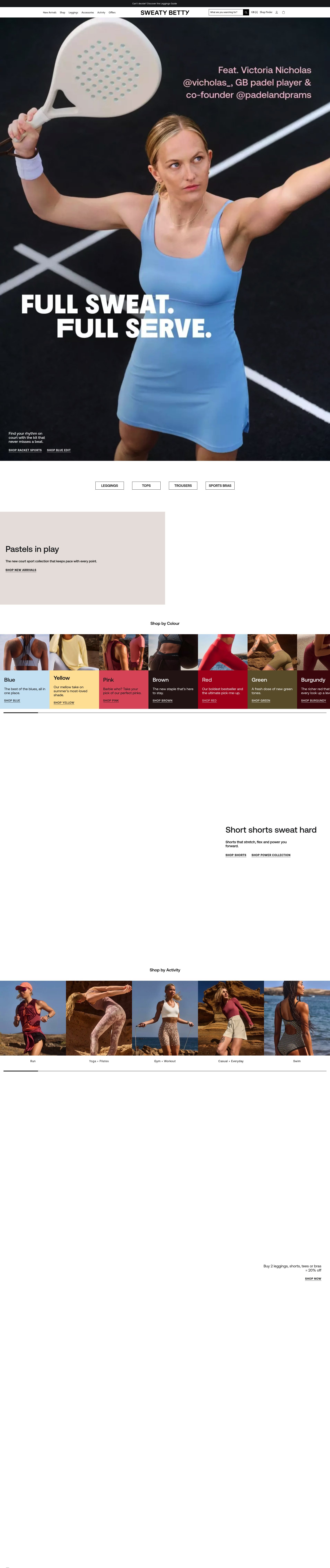
Sweaty Betty is a UK-founded premium women's activewear brand now owned by Wolverine Worldwide. The Shopify store is one of the most polished examples of how to blend editorial content with commerce in the apparel space. The homepage functions more like a magazine than a product catalogue, and the conversion architecture underneath it is invisible in the best possible way.
The personalisation layer is particularly effective. Returning customers see recently viewed items, size-filtered collections based on past purchases, and activity-specific recommendations based on browsing behaviour. For a brand with a loyal repeat-purchase base, that personalisation converts significantly better than a static catalogue view.
The international expansion is handled cleanly through Shopify Markets, with UK, US, and European storefronts sharing product data and content while presenting localised pricing, currency, and sizing conventions. The seam between those markets is invisible to the customer, which is harder to achieve than it looks.
9. Represent Clothing (Owners Club Athletic)

Represent Clothing built its brand in streetwear but has expanded significantly into premium athletic and training apparel through its Owners Club Athletic line. The Shopify store reflects that dual identity, managing high-fashion drops alongside performance-focused kit without the two audiences cannibalising each other.
The drop model is the most interesting part of the store architecture. Limited releases are announced through the store's notification system with countdown timers and reserved-stock mechanics, creating urgency without the chaotic queue systems that damage customer experience on other drop-focused sites. The cart reservation timer during checkout is a specific Shopify implementation detail that reduces abandoned carts during high-traffic drops.
The post-purchase experience extends into the Owners Club membership, which unlocks early access, exclusive colourways, and training content. Tying membership benefits directly to purchase history and engagement through Shopify's customer data infrastructure is a clean loyalty mechanic that doesn't require a separate platform.
10. Decathlon UK
Decathlon is the world's largest sporting goods retailer, and the UK Shopify store is a masterclass in managing extreme catalogue depth without losing usability. Tens of thousands of SKUs across every conceivable sport, from fencing to freediving, are organised through a faceted navigation system that stays navigable because the filtering is genuinely helpful rather than exhaustive.
The own-brand product strategy means most of what Decathlon sells is exclusive, removing the price-comparison pressure that affects multi-brand retailers. The product pages lean on that exclusivity with transparent pricing breakdowns, "how it compares to premium alternatives" copy, and detailed technical specifications written for the sport's actual practitioners rather than a general audience.
The store's ability to handle both ultra-low-price beginners' equipment and high-end category gear under one roof, with appropriate content for each buyer stage, is the most instructive thing about the Decathlon implementation. The same customer who buys a £12 yoga mat might return for a £800 road bike. The store accommodates both journeys without friction.
Comparison Table
| Brand | Niche Focus | Price Point | Shopify Standout |
|---|---|---|---|
| Gymshark | Fitness apparel | Mid–premium | Community integration, filtering at scale |
| NOBULL | Training footwear and apparel | Premium | UGC integration, clean checkout |
| Castore | Premium team and training kit | Premium | Sport-specific landing pages |
| Rogue Fitness | Strength equipment | Mid–premium | Complex product configuration |
| Sundried | Sustainable activewear | Mid | Per-product sustainability metafields |
| Osprey Europe | Outdoor backpacks and gear | Premium | Interactive fit-finder tool |
| WIT Fitness | Functional fitness equipment | Mid–premium | B2B athlete tier on consumer store |
| Sweaty Betty | Women's performance apparel | Premium | Shopify Markets, personalisation |
| Represent Clothing | Premium athletic apparel | Premium | Drop mechanics, cart reservation |
| Decathlon UK | Full-range sporting goods | Budget–mid | Catalogue depth with usable navigation |
What These Stores Get Right
-
Technical product information at the point of decision. Every store on this list puts the specification, size guide, or fit tool on the product page itself, not behind a click. Customers who have to hunt for information don't convert. This is especially critical in equipment and footwear where a wrong purchase means a return.
-
Social proof at scale. Whether it's athlete UGC pulled into product pages, verified purchase reviews with photos, or ambassador content embedded in collection pages, these stores treat social proof as a product-page conversion tool rather than a marketing afterthought.
-
Loyalty built into the store architecture. Gymshark's training content, WIT's athlete programme, Represent's Owners Club: the best performing stores in this list don't just sell to customers, they create a reason to come back that isn't just "here's 10% off your next order."
-
Checkout that doesn't create obstacles. Guest checkout is prominent, accelerated payment options (Shop Pay, Apple Pay) are enabled, and cart abandonment mechanics like reservation timers are used during high-demand drops. None of these stores make buying harder than it needs to be.
-
Content and commerce are the same thing. The editorial sections, athlete stories, and sport-specific landing pages on these stores aren't separate from the shopping experience. They're built into it, because product discovery in sporting goods still often starts with inspiration rather than intent.
If you're building or scaling a sporting goods store on Shopify, these ten are worth dissecting page by page. The decisions they've made, around navigation structure, product page layout, loyalty mechanics, and international expansion, are the same decisions you'll face. They've already tested what works.
Frequently asked questions
What makes a sporting goods Shopify store convert better than average?
The single biggest factor is putting technical information — size guides, fit tools, specification tables — on the product page itself rather than behind a click or in a separate tab. Sporting goods customers spend serious money and need confidence before they commit. Stores that embed that information at the point of decision consistently outperform those that don't.
How do the best sports equipment stores handle large product catalogues on Shopify?
The strongest examples, Rogue Fitness and Decathlon UK, use faceted navigation with genuinely useful filters rather than exhaustive ones, sport-specific or use-case landing pages that act as micro-homepages, and curated bundle or package sections that shortcut decision-making for customers who don't want to build from scratch. Metafields are key for keeping per-product technical data accurate at scale.
Can Shopify handle freight and heavy equipment shipping for sports brands?
Yes, though it requires custom work. Rogue Fitness ships barbells, racks, and full gym systems via freight carriers, and manages that complexity through a combination of custom shipping logic, carrier-calculated rates, and clear product-page messaging about delivery timeframes. The checkout flow is configured to handle the different shipping rules for heavy items without confusing customers buying lighter accessories in the same order.
How do sports Shopify stores build loyalty without just offering discounts?
The best stores on this list build loyalty into the store architecture rather than bolting on a points programme. Gymshark ties training content and community membership to the Shopify store. WIT Fitness runs an athlete pricing tier with a dedicated application flow. Represent Clothing gates early drop access behind the Owners Club membership linked to purchase history. In each case, the loyalty mechanic gives customers a reason to return that isn't a coupon.
What Shopify features do top sporting goods stores use most?
Shopify Markets for international pricing and localisation (Sweaty Betty is the strongest example), Shopify's subscription APIs for recurring revenue, metafields for per-product technical data and sustainability attributes, and native checkout customisation for drop mechanics like cart reservation timers. Shop Pay and accelerated checkout are enabled across all of them — in a category where checkout friction is a real conversion killer, that's non-negotiable.