

Quick summary
Native Union is the standout for lifestyle-first PDP structure, using desk-context photography and a clean device selector to justify premium cable pricing. Nomad Goods earns its position at the top of the market through materials provenance copy that names specific suppliers — Horween leather, Kevlar — near the top of every product page. Peak Design handles the most technically complex product range of any store in this list, with ecosystem compatibility callouts and carbon offset specifics that convert sceptical buyers. Ugmonk is the best example of small-batch storytelling done through the store itself: waitlists, long-form copy, and real-workspace photography that makes desk products feel worth the premium.
Tech accessories is one of the most brutally competitive categories in ecommerce. Amazon dominates generic search. Chinese manufacturers undercut on price. And customers arrive sceptical: they have already been burned by a cable that stopped charging after three weeks or a case that cracked on the first drop. The brands that win on Shopify in this space are not trying to compete on price. They are competing on trust, specificity, and a clear point of view on what they make and who it is for. They invest in compatibility information, product photography that shows real-world scale, and UX that makes a complex variant matrix — device model, colour, finish, bundle — feel manageable rather than overwhelming. These ten stores do that consistently.
1. Native Union
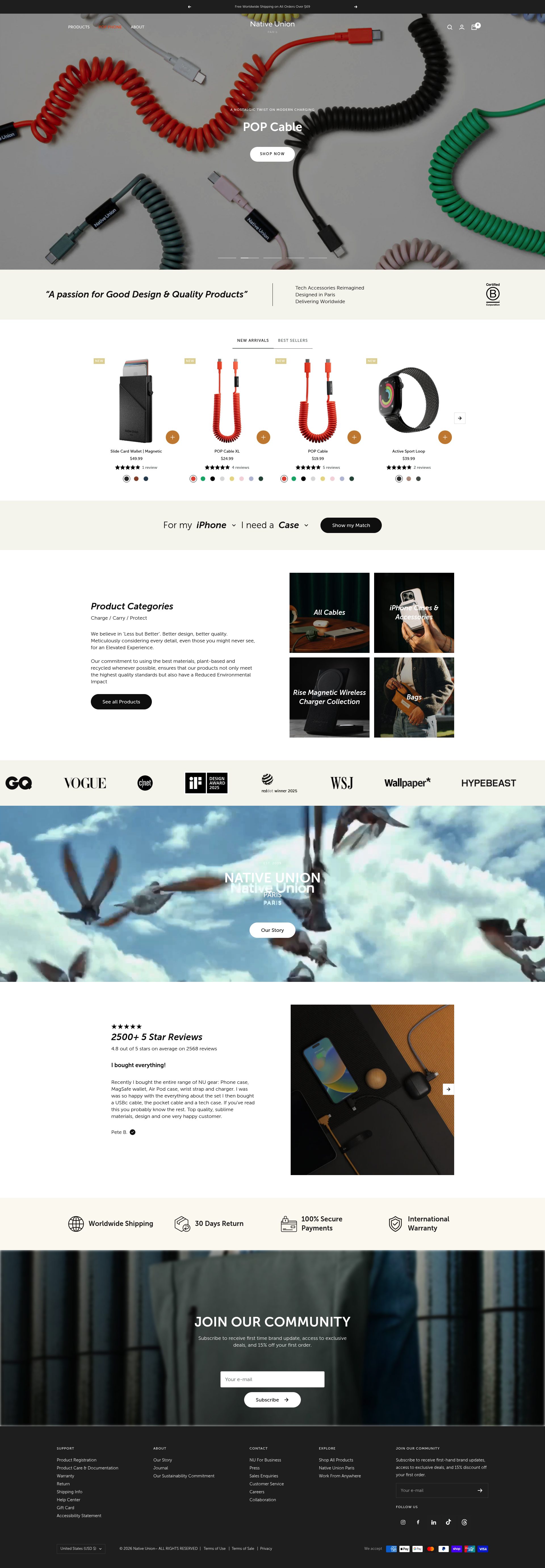
Native Union make premium cables, chargers, and desk accessories that sit comfortably in the lifestyle gap between consumer electronics and home design. Their Shopify store reflects that positioning precisely. Product pages lead with lifestyle photography that shows cables on real desks, alongside monitors and laptops, rather than isolated against white backgrounds. That context is important: it communicates scale, finish quality, and how the product fits into a workspace rather than leaving the customer to imagine it. The compatibility detail is handled through a clean device selector that narrows variant options without cluttering the page. Their "Night Cable" range, with its weighted anchor knot, is merchandised through video on the PDP that demonstrates the feature in seconds. That is the right format for a product where the key differentiator is physical behaviour rather than appearance.
2. Nomad Goods
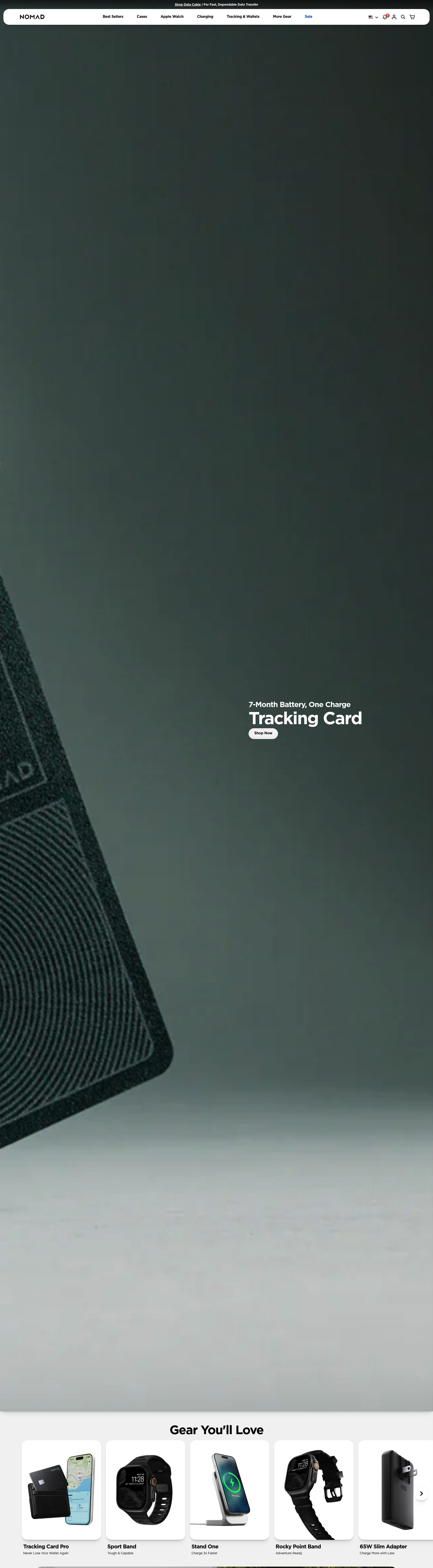
Nomad built a premium position in a category where most competitors sit at sub-£10 price points, and their Shopify store is built around justifying that gap. Every product page leads with materials provenance: Horween leather, Kevlar, fluoroelastomer. The detail is specific, not vague, and it is placed near the top of the page rather than buried in a spec accordion. Photography is dark and considered, shot with warm studio lighting that shows leather texture and hardware finish clearly. Cross-sell mechanics are well-implemented: a "Complete your setup" module below the fold surfaces complementary products with compatibility notes attached, so the recommendation feels useful rather than generic. Nomad also runs a MagSafe accessories ecosystem, and the store handles the variant relationships between base products and accessories with clear compatibility callouts.
3. Casetify

Casetify turned phone cases into a personalisation platform, and their Shopify implementation handles the complexity of that product model without breaking the browsing experience. The core mechanic, customising a case with your own photo or selecting from thousands of artist-designed prints, is surfaced early in the product page journey. The case builder is smooth and fast: upload, position, preview, and add to cart without leaving the page. Compatibility is managed through a device model selector that filters the full catalogue instantly. Casetify also collaborates at volume, with fashion brands, artists, and entertainment IP, and each collab gets a dedicated landing page that sits within the store's navigation structure rather than breaking off into a separate microsite. Collection drops with countdown timers create urgency without requiring discounting.
4. Moft
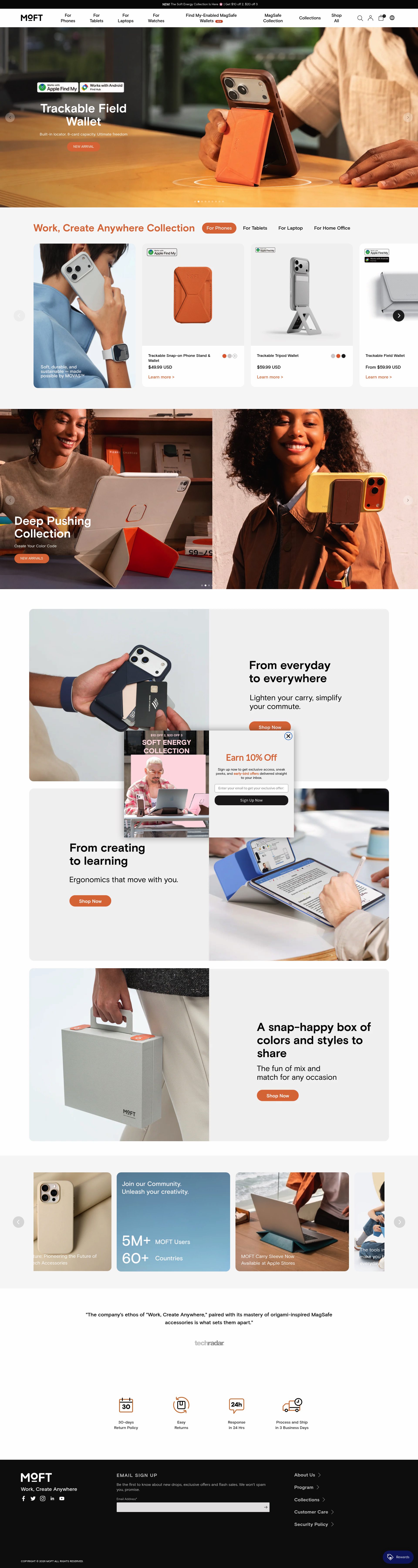
Moft make ultra-slim laptop stands, phone wallets, and MagSafe accessories built around the idea that the best gear is the gear you do not notice carrying. Their Shopify store leads with that tension: products that look minimal but solve real problems. The PDP structure is unusually thorough for a brand at this price point. Each product gets a dedicated features section with annotated diagrams and short video clips showing the folding mechanisms in action. That level of explanation matters for products where the value is not immediately visible from a static image. Moft's compatibility matrix is handled through a filterable collection page rather than a device selector on individual PDPs, which works for a range where many products span multiple device generations. Their bundle pricing, three products at a meaningful discount, is surfaced at cart level with a clear threshold progress bar.
5. Moment
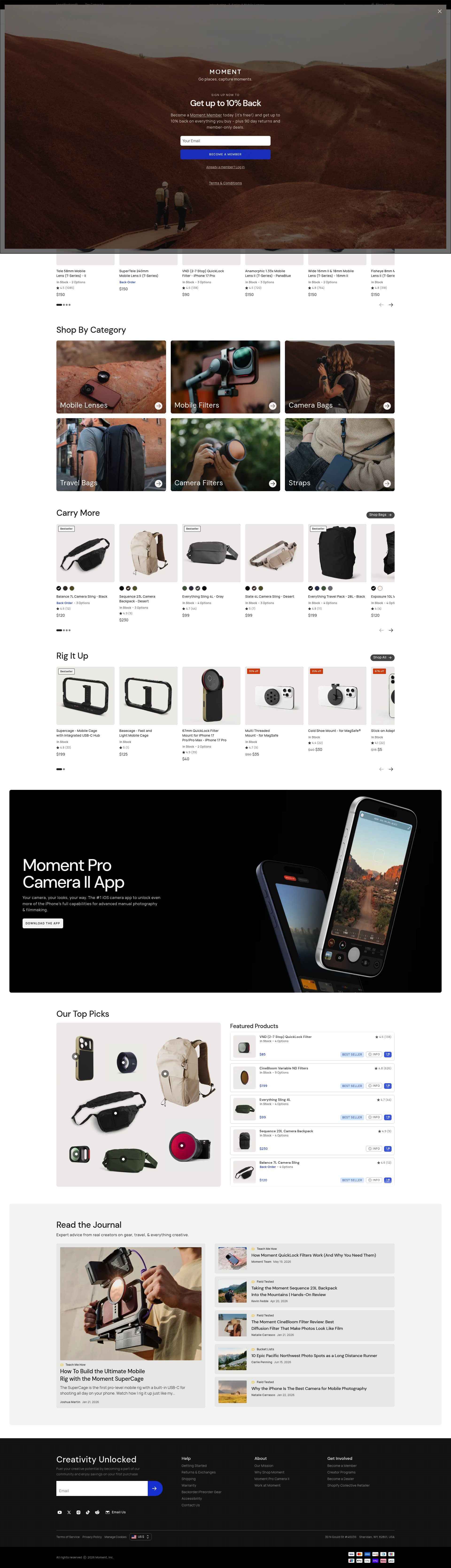
Moment started as a phone lens brand and have expanded into a full photography accessories ecosystem covering lenses, cases, filters, and camera straps. Their Shopify store works as an editorial platform as much as a product catalogue. Category landing pages include buying guides, comparison charts, and compatibility explainers that rank well in organic search and also do genuine conversion work once a customer lands. The "which lens is right for me?" content is integrated into the navigation rather than siloed in a blog, which keeps it in the purchase journey. Product pages for lenses include sample images captured with that specific lens, which is the most direct and useful form of product photography for a photography accessory. Their creative community angle, tutorials, filmmaker features, is woven into the store without turning it into a content site that happens to sell products.
6. Peak Design
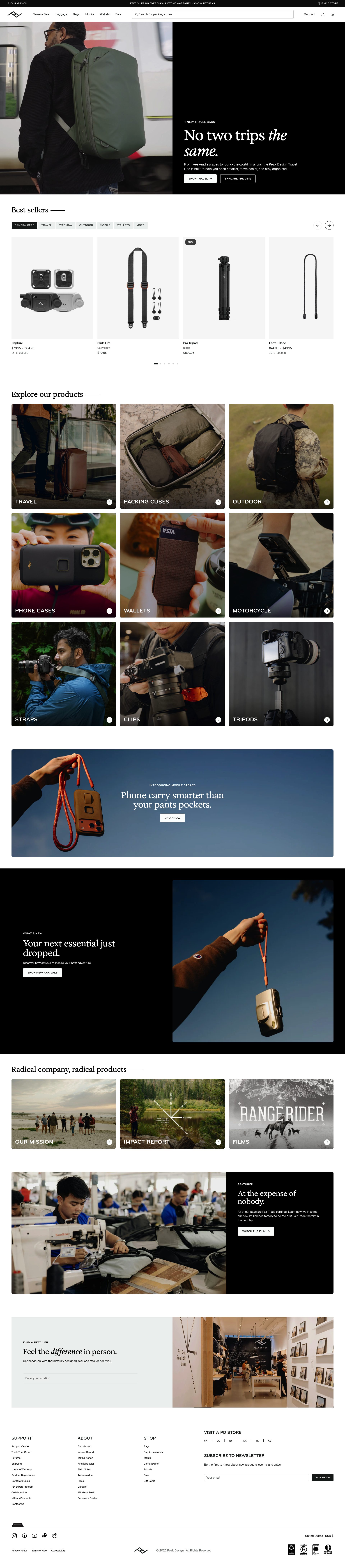
Peak Design make camera bags, straps, and carry systems used by working photographers and outdoor enthusiasts. Their Shopify Plus store handles a technically complex product range with genuine care. The Capture Clip, their best-known product, is explained through a dedicated product page with embedded video that shows the mechanism, the load rating, and the real-world use cases in under two minutes. That is faster and more persuasive than spec tables alone. Their ecosystem approach, products designed to work together through a shared attachment standard, is communicated clearly through compatibility callouts and "works with" product modules. Peak Design also runs a strong sustainability narrative backed by specific numbers: recycled materials percentages, carbon offset details, repair programme terms. The copy is specific throughout, which builds trust in a category where "built to last" has been devalued through overuse.
7. Orbitkey
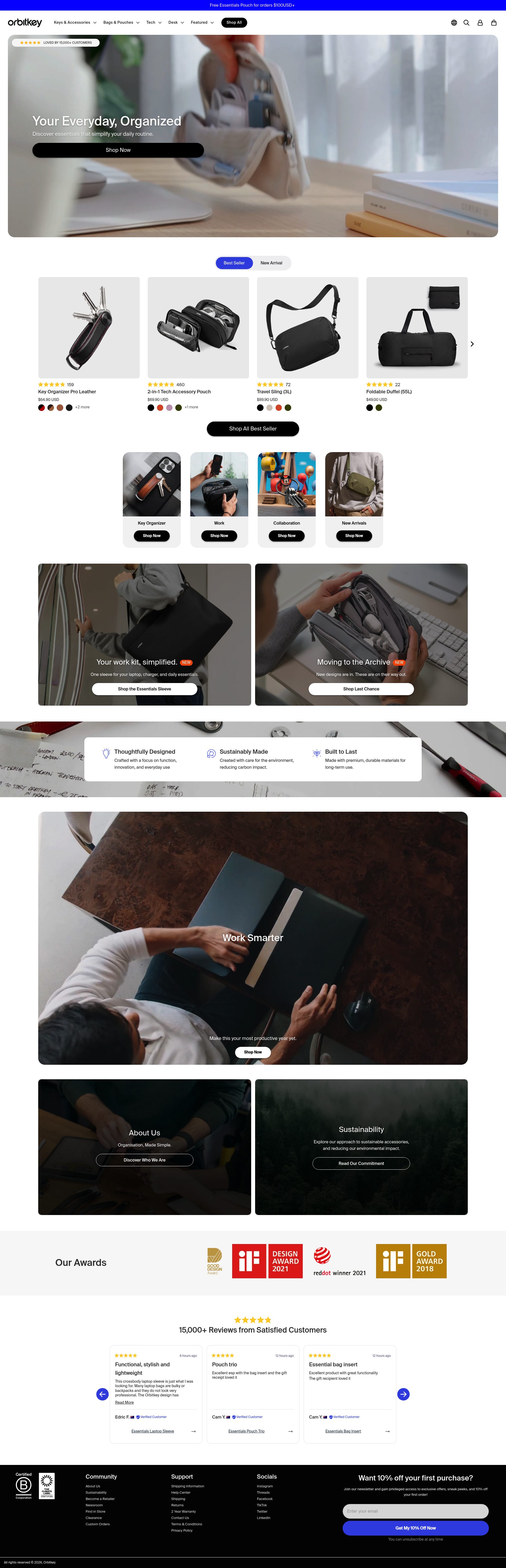
Orbitkey make key organisers, desk mats, and cable management products that target an office and carry setup audience. Their Shopify store is clean and well-structured. The key organiser configurator, where customers select the number of keys and add-on accessories like a bottle opener or multi-tool, is implemented as a smooth in-page builder with a real-time price and a preview that updates as options are selected. That mechanic lifts average order value by making upsells feel like personalisation rather than add-ons. Orbitkey's desk mat range is merchandised with flat-lay photography that shows cable routing and peripheral placement, communicating the product's organisational benefit at a glance. They handle bundle deals explicitly, showing the percentage saving against individual pricing, which performs better than a vague "bundle and save" message.
8. Twelve South
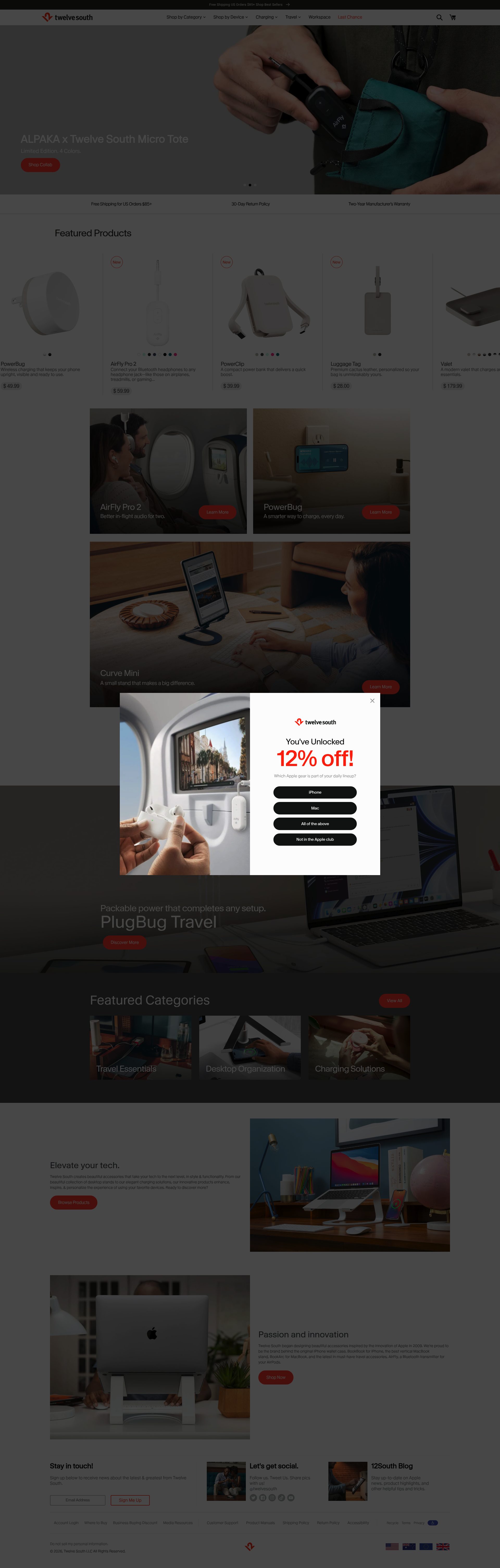
Twelve South make Apple-focused accessories: laptop stands, charging stations, AirPods cases, and leather MacBook sleeves. Their Shopify store is positioned around the Apple ecosystem, and the navigation reflects that with device-first filtering alongside product category browsing. Photography is consistent with Apple's own visual language: clean, light backgrounds, precise shadows, lifestyle context in bedrooms and desks that match their customer's environment. Their HiRise and BookArc stands are premium products in a category flooded with cheap alternatives, and the store earns the price gap through detailed material callouts, a visible warranty, and consistent reviews integration. New product launches get dedicated landing pages that function as press releases and product pages simultaneously, capturing search intent and converting it in one place.
9. Mophie
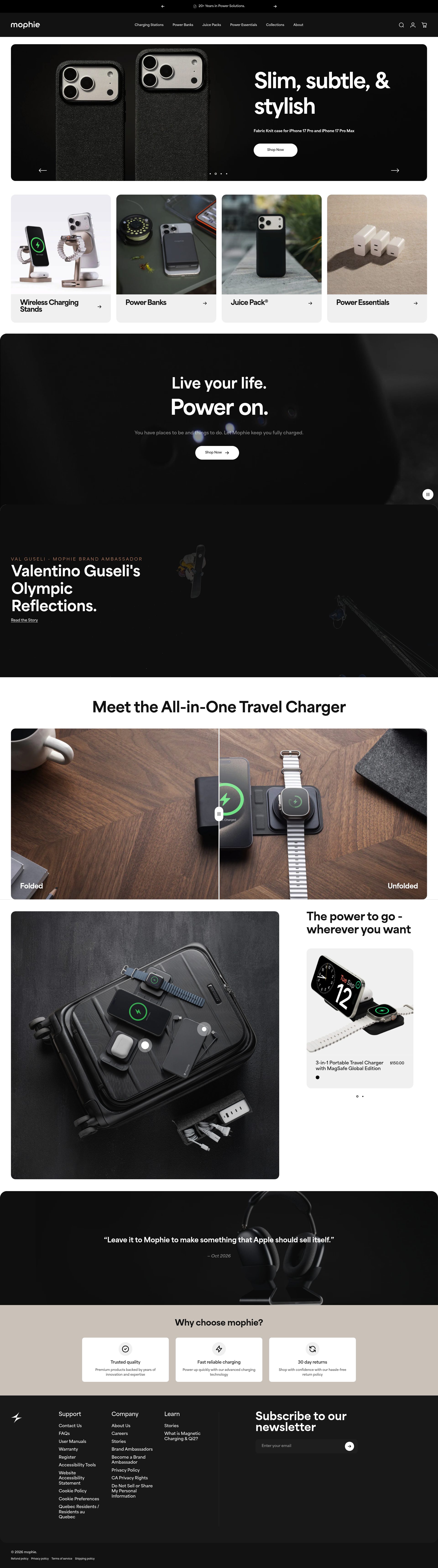
Mophie make wireless chargers, power banks, and MagSafe accessories. Owned by Zagg, they trade on an established brand name in a category where trust is genuinely scarce. Their Shopify store handles a broad product range across multiple charging standards, MagSafe, Qi2, USB-C, without letting the technical complexity bleed into the browsing experience. Collection pages use clear category headers and compatibility filters that let customers find the right charger for their device in two clicks. The MagSafe ecosystem range is grouped into a dedicated collection, which captures customers arriving with device-specific intent. Product pages lead with the key specification that drives the purchase decision: wattage output and charging speed. Trust signals, certifications, compatibility guarantees, manufacturer warranty terms, are placed at the decision point rather than relegated to a footer.
10. Ugmonk

Ugmonk make premium desk organisation products, including the Gather system, which uses custom-machined components and leather trays to organise a desk around specific tools. They are a small-batch, design-led brand and their Shopify store reflects that positioning throughout. Product pages are long and deliberate: materials are explained, dimensions are given in a way that communicates real-world scale rather than just numbers, and the photography shows the products in real workspaces rather than studio sets. Ugmonk operates waitlists for sold-out products, and that mechanic is handled through the store without requiring a third-party workaround. Their email-first approach to product launches is supported by the store's emphasis on mailing list sign-up, placed contextually in product pages for waitlisted items rather than only in a generic popup. The result is a store that feels like a direct extension of the brand, not a template populated with their products.
Comparison Table
| Brand | Niche Focus | Price Point | Shopify Standout |
|---|---|---|---|
| Native Union | Premium cables and chargers | Mid-premium | Lifestyle PDP photography, device selector |
| Nomad Goods | Leather and rugged cases | Premium | Materials provenance copy, cross-sell with compatibility notes |
| Casetify | Custom and collab phone cases | Mid | In-page case builder, drop landing pages with countdowns |
| Moft | Ultra-slim MagSafe and laptop accessories | Mid | Annotated feature diagrams, bundle threshold bar |
| Moment | Photography lenses and accessories | Mid-premium | Editorial buying guides in navigation, sample image PDPs |
| Peak Design | Camera bags and carry systems | Premium | Ecosystem compatibility callouts, sustainability specifics |
| Orbitkey | Key organisers and desk products | Mid | Live configurator with real-time preview and pricing |
| Twelve South | Apple ecosystem accessories | Premium | Device-first navigation, Apple-aligned visual language |
| Mophie | Wireless chargers and power banks | Mid | Charging standard filtering, spec-led PDP structure |
| Ugmonk | Premium desk organisation | Premium | Waitlist mechanics, long-form materials storytelling |
What These Stores Get Right
- Compatibility is a conversion lever, not a support problem. Every strong store in this category puts device compatibility front and centre, either through a selector, a filter, or an explicit callout. Customers in tech accessories arrive with a specific device; stores that make compatibility ambiguous lose the sale before the customer reaches the cart.
- The product's function needs to be demonstrated, not described. Whether it is a Moft folding stand, a Peak Design Capture Clip, or a Native Union weighted cable, the best stores use short video or annotated diagrams to show the product behaving as designed. Static photography alone cannot communicate mechanical products.
- Brand storytelling earns the price premium. At every price point above basic commodity, the brands that convert are the ones that explain why their product costs more. Materials detail, manufacturing provenance, certifications, and specific warranty terms all do more conversion work than generic quality claims.
- Ecosystem thinking lifts average order value. Nomad, Moft, Peak Design, and Orbitkey all sell ecosystems, not individual products. "Works with" cross-sells and bundle mechanics that show explicit compatibility between products consistently outperform generic "you might also like" recommendations.
- Navigation built around the customer's device, not your product catalogue, reduces friction. Customers arrive knowing their phone model or laptop. Stores that let them filter by device at collection level, rather than hunting for compatibility information on individual PDPs, remove a significant drop-off point from the purchase path.
Frequently asked questions
Which Shopify stores sell premium tech accessories without competing on Amazon pricing?
Native Union, Nomad Goods, Peak Design, and Ugmonk all hold premium price points on Shopify by competing on materials, specificity, and brand trust rather than price. Each one explains why their product costs more through provenance copy, certifications, or detailed engineering narrative — the exact opposite of the race-to-the-bottom positioning that makes accessories invisible on Amazon.
How do top tech accessories stores handle device compatibility on Shopify?
The best stores handle compatibility at different levels depending on range size. Casetify and Mophie use a device selector that filters the full catalogue. Twelve South structures navigation device-first so customers filter by Apple product before browsing by product type. Moft uses filterable collection pages rather than per-PDP selectors, which works when most of the range spans multiple device generations. The consistent principle is that compatibility is surfaced before the customer has to ask.
What product page structure works best for tech accessories with complex variants?
The strongest PDPs in this category lead with lifestyle photography that shows real-world scale, then move into a direct demonstration of the product's key differentiator — usually through a short video or annotated diagram rather than a static spec table. Orbitkey's configurator, Moft's folding mechanism clips, and Peak Design's Capture Clip video all show the product behaving as designed, which is the only format that reliably communicates mechanical or functional products.
How do tech accessory brands on Shopify increase average order value without discounting?
The most effective mechanic across this list is ecosystem cross-selling with explicit compatibility notes attached. Nomad's "Complete your setup" module, Orbitkey's configurator upsells, and Peak Design's "works with" product modules all frame additional products as natural completions rather than optional extras. Moft uses a bundle threshold progress bar at cart level. None of these stores rely on percentage-off promotions to lift order value — the upsell is built into the browsing and checkout experience structurally.
What makes Casetify's Shopify store different from other phone case retailers?
Casetify turned phone cases into a personalisation platform, and the store is built to handle that model at volume. The in-page case builder, where customers upload a photo or select from thousands of artist designs, works without leaving the PDP. Collaboration drops with fashion brands and entertainment IP each get dedicated landing pages within the main store navigation, which keeps collab traffic inside the conversion funnel. Countdown timers on collection drops create urgency without requiring a discount.