

Quick summary
Castore is the standout premium pick: clean Shopify Plus execution with technical PDPs and restrained upselling that lifts AOV without friction. Wilson is the strongest brand for limited-edition drops, using scarcity mechanics and email-gated early access to drive list growth and conversion. Babolat earns trust with serious club players through data-led product pages and an integrated stringing service that keeps buyers on-site. All Things Tennis is the best independent: in-house video reviews, expert service links in the header, and frictionless racket-plus-string bundling give it a genuine edge over mass-market platforms.
Tennis is a high-consideration category: players spend seriously on rackets, shoes, and strings, they have strong brand loyalties, and they buy year-round rather than just in season. That makes it a good testing ground for Shopify merchants who want to convert informed buyers rather than impulse shoppers. The best tennis stores understand this and build their product pages, navigation, and checkout flows around the specific decisions a tennis player needs to make before parting with money.
1. Castore
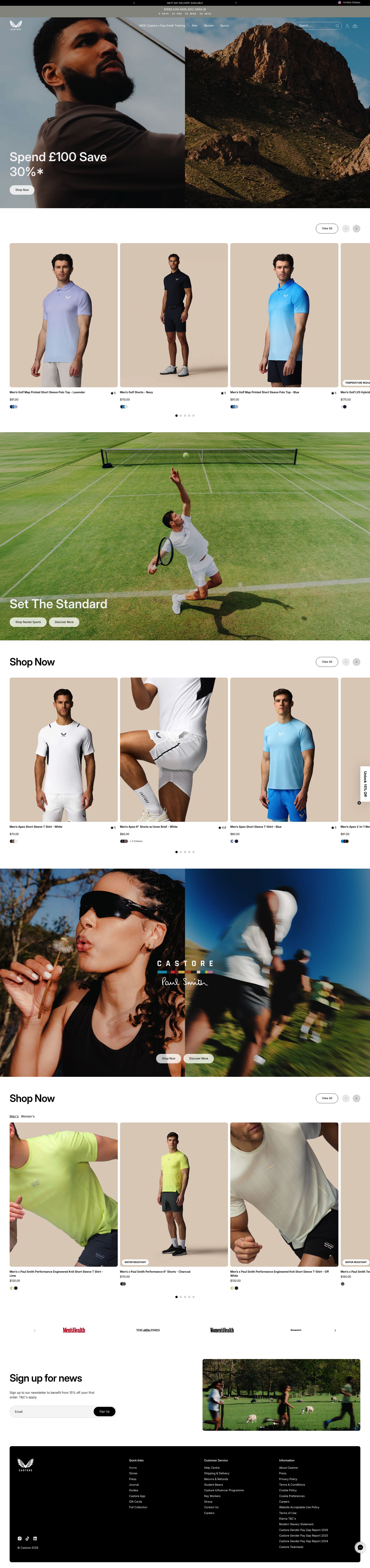
Castore has done something most sports DTC brands fail at: it built a genuinely premium positioning and made the product experience match it. On Shopify Plus, the store uses a clean grid with editorial photography that avoids the cluttered look typical of sports retailers. The navigation separates sport categories cleanly, so tennis players are not wading through cricket or golf kit to find what they need.
The product pages do real conversion work. Each item leads with a technical specification block, written in plain language rather than marketing shorthand. Fabric properties, cut details, and performance credentials are listed in a consistent format across the catalogue, which builds trust through predictability. Castore also surfaces its partnership with professional players on product pages rather than burying it in a generic "our story" page, giving social proof at exactly the right moment in the buying journey.
Their approach to upselling is restrained and effective. The "complete the kit" module below the fold suggests one or two complementary items, not a carousel of everything in the range. That selectivity respects the customer's time and tends to lift average order value without friction.
2. Head
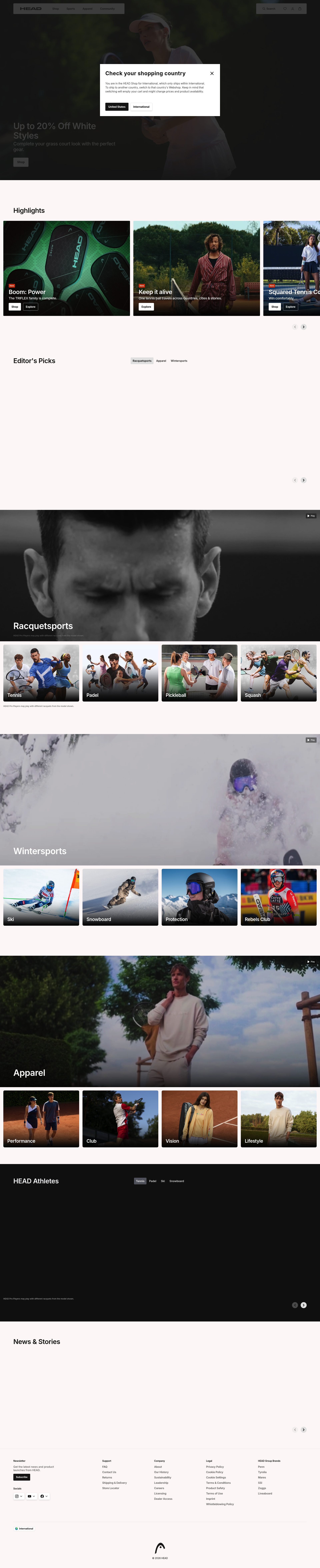
Head sells rackets, bags, shoes, and apparel through its own DTC channel on Shopify, and the store reflects the complexity of that catalogue. The challenge with a brand like Head is that the same visitor might be a junior beginner or a 5.0 club player, and the product range spans both. Head handles this with a guided navigation flow: racket pages surface a "find your racket" tool that filters by playing style and experience level before showing products.
The product detail pages for rackets are among the most technically thorough in the sport. String pattern, balance point, stiffness rating, and swing weight are all presented clearly, with short explanations for what each means in practice. This level of detail reduces pre-purchase questions, lowers return rates, and positions Head as the authoritative source rather than just another place to buy. Customers who get their questions answered on the PDP are significantly more likely to convert.
Head also uses bundle pricing well. Rackets sold with a string upgrade or a bag at a modest discount increase transaction value and reduce the chance a buyer looks elsewhere after finding the racket they want.
3. Tennis Point
Tennis Point is a specialist tennis retailer operating across multiple European markets and one of the larger Shopify-built tennis stores by catalogue size. The breadth of the catalogue is also its biggest UX challenge, and the store manages it through layered filtering that goes deeper than most sporting goods sites. Players can filter rackets by head size, weight, string pattern, balance, and brand simultaneously, which is genuinely useful and not something generic Shopify themes support out of the box.
The review system on product pages is a standout. Each review captures the reviewer's playing level and style alongside the star rating, which makes the social proof more useful than a generic five-star average. A 5.0 player's view of a beginner racket and a 2.5 player's view of the same frame are not equivalent, and Tennis Point's review structure reflects that. This is smart product data thinking applied to the trust layer.
Tennis Point also invests in racket comparison pages, a feature that pays for itself in reduced decision paralysis. Putting two or three frames side by side with a uniform attribute table accelerates the buying decision and keeps traffic on-site that might otherwise end up on a comparison blog.
4. Wilson
Wilson runs a Shopify Plus DTC operation with a catalogue spanning rackets, balls, bags, footwear, and apparel. The store does something most large sports brands do not manage well: it maintains consistent product page templates across wildly different product types. A racket page and a shoe page look structurally similar, which keeps the browsing experience predictable even when the information density varies.
Their limited-edition product drops, particularly the rackets tied to Wimbledon or Grand Slam events, are handled through a dedicated landing page format rather than a standard PDP. These pages use scarcity mechanics, countdown timers, and editorial photography to build urgency without looking cheap. The drop mechanic drives email list growth too: Wilson gates early access behind email sign-up, which is a reliable acquisition channel that converts at a higher rate than cold traffic because the buyer has already expressed intent.
The loyalty programme is integrated into the checkout flow in a way that surfaces points earned immediately after purchase, reinforcing the behaviour rather than waiting for the monthly email.
5. Slazenger
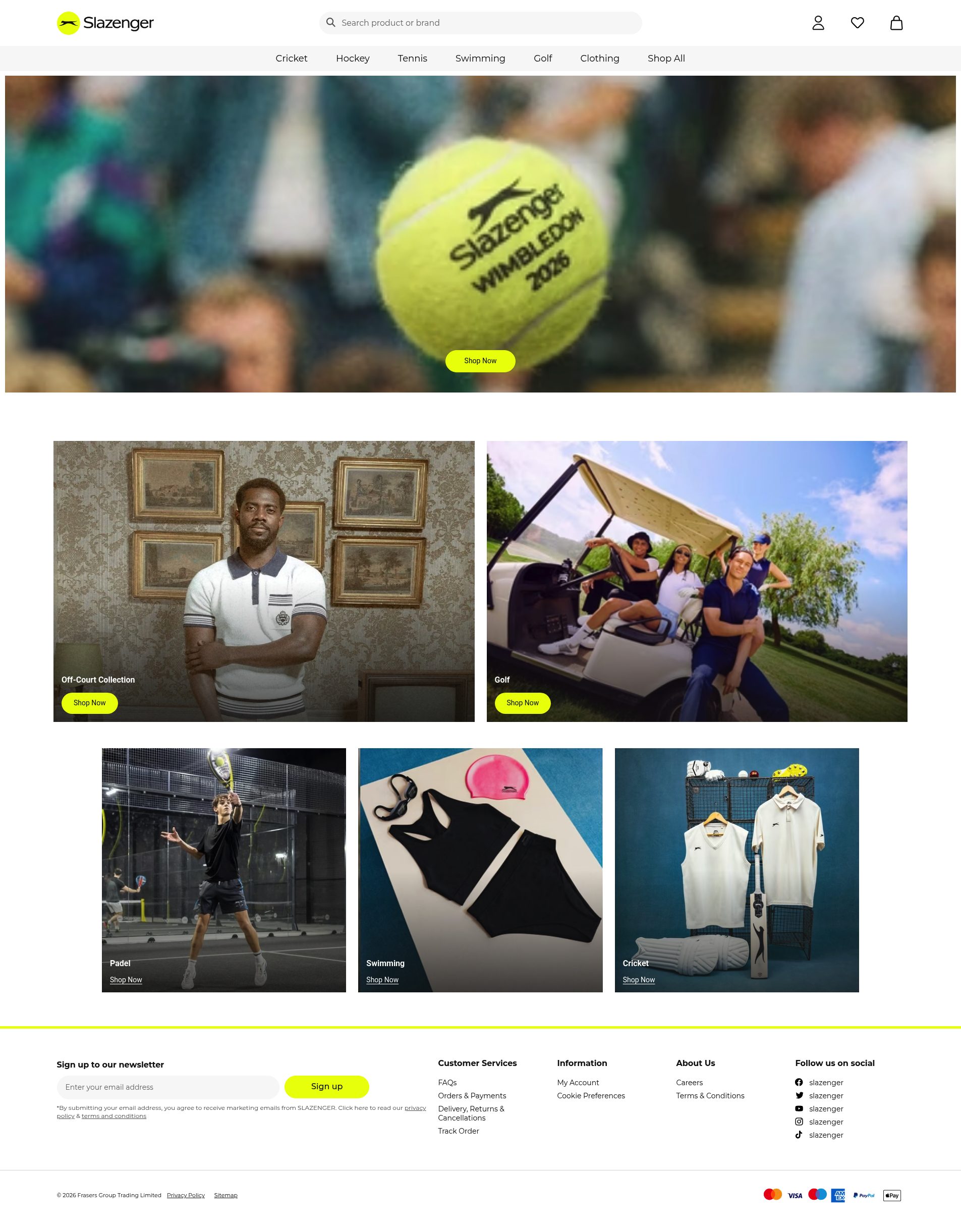
Slazenger is one of Britain's oldest sports brands, official supplier of balls to Wimbledon since 1902, and its Shopify store does a reasonable job of turning that heritage into a conversion asset. The "official Wimbledon ball" positioning is visible on the homepage, on category pages, and on relevant PDPs, rather than being buried in an about section. That consistency matters: it keeps the proof point working throughout the funnel.
The store keeps navigation straightforward with a small catalogue focused on rackets, balls, and accessories. That restraint is commercially sensible: Slazenger's brand equity in tennis is highest at the accessible end of the market, and the product range reflects that positioning. Trying to compete with Wilson or Head in premium racket territory would dilute the brand rather than extend it.
Where Slazenger earns its place on this list is in its gifting angle. Balls presented as Wimbledon gifts, with simple packaging and a short lead time, convert well around the tournament window. The store surfaces this use case explicitly, with a gift guide that does not require the buyer to know much about tennis to complete a purchase.
6. Babolat
Babolat is a French brand with a long Shopify Plus DTC history and a product range that appeals to serious club players. The store reflects the seriousness of the buyer: it leads with performance claims backed by specific data (string tension range, racket weight to the gram, swing weight index) rather than aspirational lifestyle photography.
The stringing service integration on the website is genuinely useful and differentiating. Babolat surfaces string choice, tension recommendations, and restringing intervals on racket PDPs, linking to their stringing content as a natural part of the product decision. That keeps a buyer who is ready to purchase from leaving the site to research stringing options elsewhere.
The brand also handles player endorsements well. Rather than a generic "as used by professionals" badge, specific player pages link through from relevant product pages, with editorial content about why a player chose that particular frame. It is a content strategy that serves both SEO and on-site conversion by connecting aspirational identity to a specific purchasing decision.
7. All Things Tennis
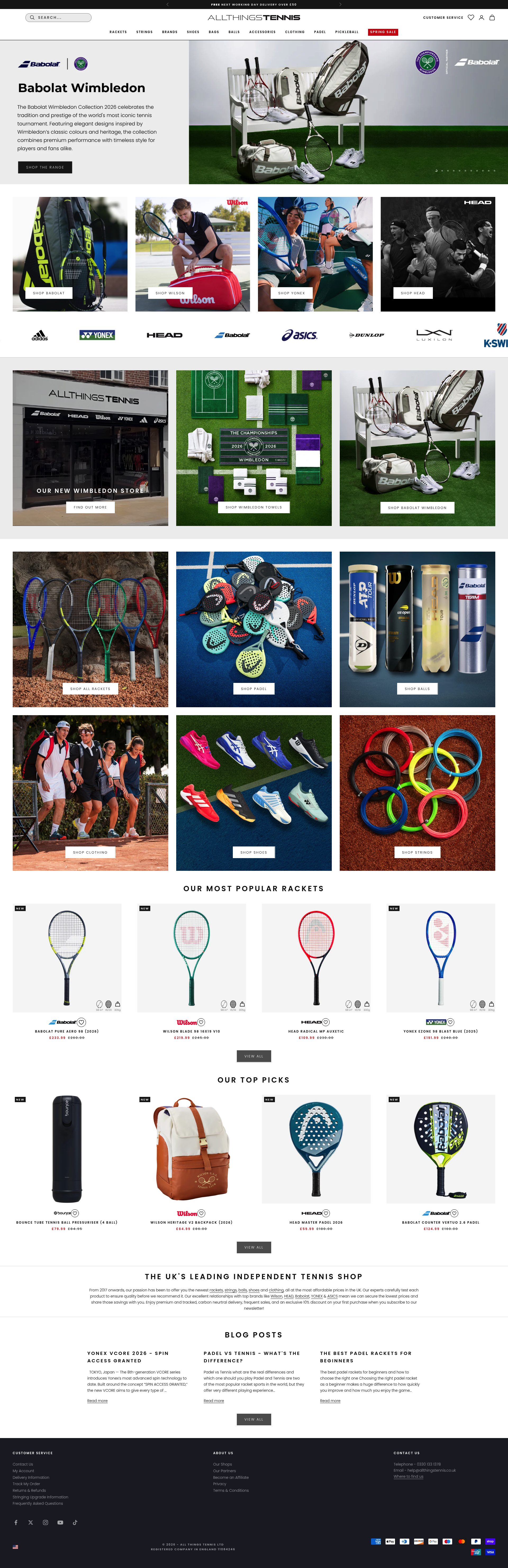
All Things Tennis is a UK independent Shopify retailer that competes against larger brands by going deeper on service and expertise than any mass-market platform can. The store's value proposition is visible immediately: free restringing advice, click and collect, demo racket hire, and human coaching links are all in the header navigation, not hidden in a footer.
The product curation is narrower than a large specialist retailer, but each product is treated with more editorial care. Racket pages include video reviews filmed in-house, which is an investment that pays back in time-on-page and reduced return rates. A player who has watched a two-minute review and still buys is a far more committed buyer than one who skimmed a spec sheet.
All Things Tennis also does a good job of cross-selling between rackets and stringing. String recommendations appear on every racket PDP with a pre-configured bundle option, so the buyer can select a string type and tension and add it to the cart in a single step. That reduces friction on what is actually a reasonably complex purchase decision for a new player.
8. Tecnifibre
Tecnifibre is a French specialist brand that has built a niche by targeting squash and tennis players who want a serious alternative to the bigger names. The Shopify store reflects that positioning: it is detailed, technically precise, and unapologetically aimed at experienced players.
The product pages for rackets include a technology breakdown section that explains the materials and engineering behind each frame, with diagrams where relevant. This depth of information is more work to produce but pays back in SEO traffic from players researching specific features, as well as in conversion rate among the technically-minded buyer segment Tecnifibre targets.
The brand uses its professional player relationships for more than badge credibility. Match-day footage, string setup details, and quotes about product performance are integrated into PDPs, which makes the endorsement feel specific to the product rather than generic to the brand. That specificity matters to the informed buyer.
9. Tennisnuts
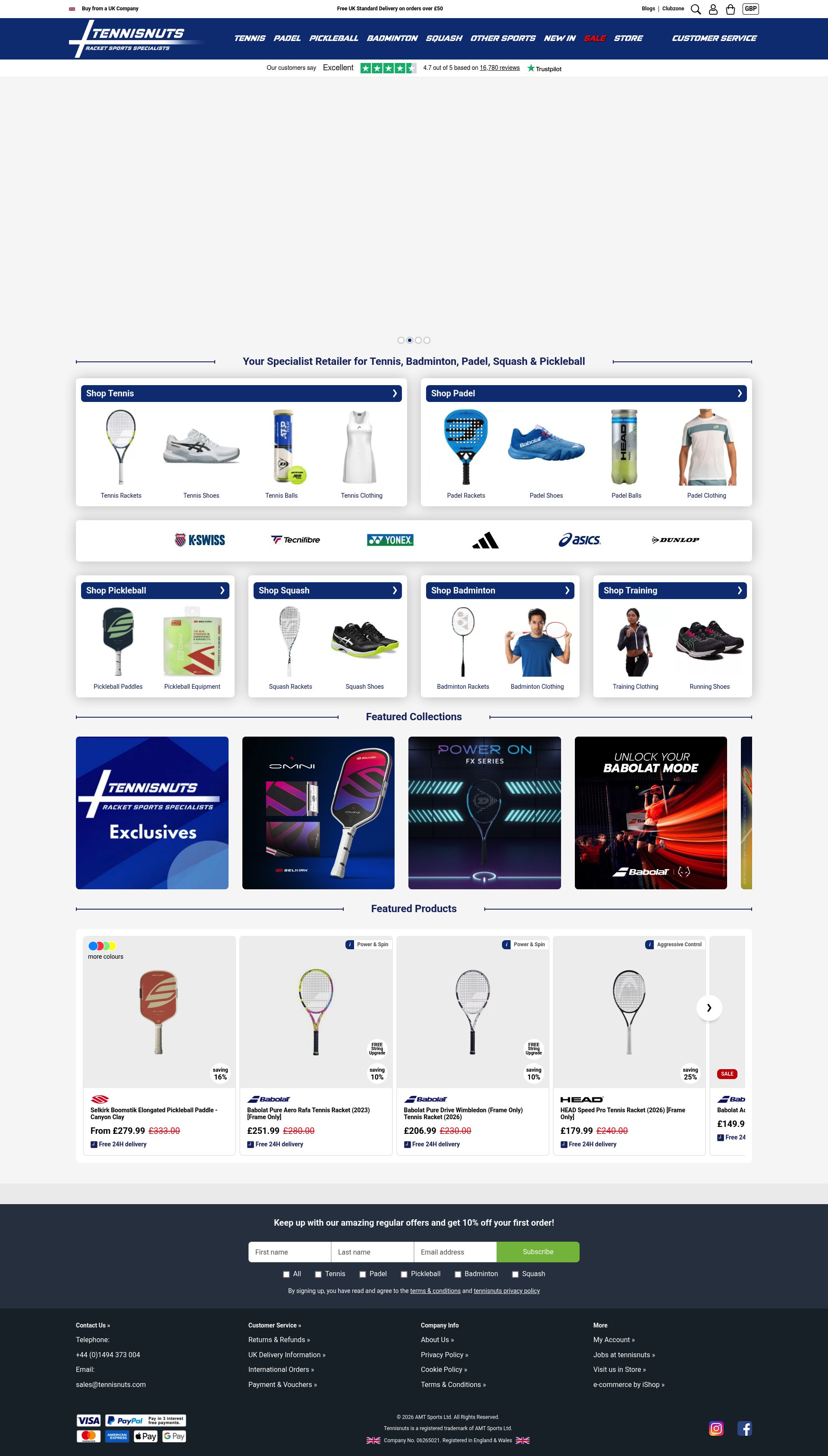
Tennisnuts is one of the UK's best-known online tennis retailers and a Shopify store that has refined its conversion mechanics over many years of operation. The homepage prioritises clearance and new arrivals in equal measure, which signals value to the bargain-hunter while keeping serious buyers engaged with new stock.
The site's strength is in its breadth combined with usable filtering. Tennisnuts carries a wider range of string brands and gauges than most competitors, and the filtering system on string pages allows players to narrow by gauge, material, playing style, and brand simultaneously. For a product category where informed buyers have strong preferences, that specificity in filtering directly reduces bounce rate.
The newsletter capture and returning customer mechanics are also well-executed. A returning buyer sees their previous orders surfaced in the account area with easy reorder options, which is particularly valuable for consumable products like strings and balls. The path from "I need more strings" to checkout is shorter on Tennisnuts than on most competitors.
10. Radical Tennis
Radical Tennis is a UK Shopify retailer with a catalogue focused on rackets and accessories, named after the Head Radical series. The store is smaller than some others on this list, but it earns its place through focused execution rather than scale.
The product photography is unusually strong for an independent retailer. Rackets are shot against clean backgrounds with consistent angles, and detail shots highlight the grip, string bed, and frame profile. That visual consistency makes the catalogue feel more premium than it has any right to at this price point, and premium perception in photography transfers to pricing power at checkout.
Radical Tennis also keeps the checkout friction low. Delivery options, return policy, and trust badges are all surfaced on the cart page before the buyer reaches checkout, which is a small structural decision that measurably reduces abandonment. The information a buyer needs to commit is available at the moment they are deciding whether to continue.
If you run a sports or specialist retail store on Shopify and want to improve your product pages, conversion rate, or checkout experience, SuttonCommerce can help: explore our Shopify design service or get in touch to discuss your store.
Frequently asked questions
Which Shopify tennis stores are best for serious club players?
Babolat and Tecnifibre are the strongest options for experienced players. Both lead with technical specification data — string tension range, swing weight, frame stiffness — and produce content that treats the buyer as informed rather than aspirational. Head's guided racket finder is also worth exploring if you want to narrow options by playing style and ability level.
Do any tennis stores on Shopify offer racket stringing services?
Babolat integrates stringing advice directly into its racket product pages, covering string choice, tension recommendations, and restringing intervals. All Things Tennis goes further for UK buyers, offering click-and-collect and a restringing service linked from the header navigation rather than buried in a footer. Both reduce the need to leave the site to research stringing separately.
How do the best tennis stores handle large product catalogues without overwhelming buyers?
Tennis Point uses deep layered filtering that lets players narrow rackets by head size, weight, string pattern, balance, and brand simultaneously. Tennisnuts applies the same principle to strings, which are notoriously hard to browse without prior knowledge. Head uses a "find your racket" tool on category pages to filter by playing level before surfacing products. The common thread is progressive disclosure: surface the filter options that matter for each product type rather than dumping the full catalogue.
What makes Wilson's limited-edition drops effective on Shopify?
Wilson uses dedicated landing pages rather than standard PDPs for Grand Slam and Wimbledon-tied racket releases. Countdown timers, scarcity copy, and editorial photography build urgency, while email sign-up gating for early access turns the drop into an acquisition channel. Buyers who sign up have already declared intent, so they convert at a significantly higher rate than cold traffic arriving after the drop goes live.
Is it worth buying tennis equipment directly from brand DTC stores rather than a specialist retailer?
It depends on what you need. Brand stores like Wilson, Babolat, and Head offer the fullest catalogue of their own products, exclusive colourways, and drop access. Specialist multi-brand retailers like Tennis Point, Tennisnuts, and All Things Tennis are better for comparing across brands, finding discounted previous-season stock, and getting independent advice. For strings and accessories, a specialist retailer almost always has more choice and more useful filtering than a brand's own store.