
Quick summary
AR product visualisation on Shopify reduces returns by 15-40% for high-consideration products like furniture, homeware, and eyewear. Shopify natively supports 3D models and AR Quick Look on iOS with no app required, using GLB/USDZ files for each product. 3D model creation costs range from £50-£300 per SKU, making it cost-effective for hero products with high return rates.
Returns are one of the most controllable costs in ecommerce, and most merchants are not controlling them.
The primary driver of ecommerce returns is expectation mismatch: the customer could not accurately judge the product from the images and description available, made a purchase, and the item did not match what they imagined. This is particularly acute for furniture, footwear, eyewear, and jewellery, where size, scale, colour accuracy, and how the item looks in context are difficult to convey through flat photography.
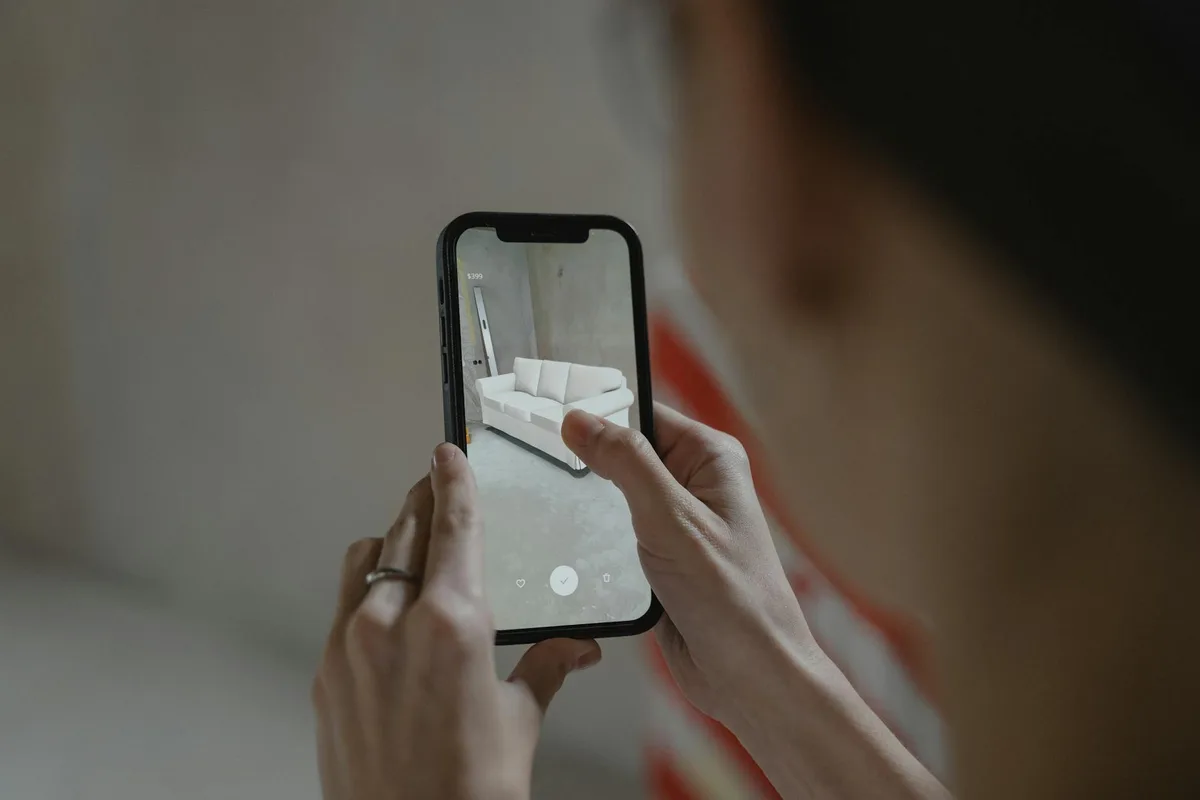
Augmented reality changes this. When a customer can view a sofa in their living room through their phone's camera before purchasing, or try on a pair of glasses using face-tracking technology, the expectation gap closes. Return rates follow.
What Does the Return Reduction Data Show?
The commercial case for AR in ecommerce is supported by consistent data across multiple studies:
- Shopify's own analysis of merchants using 3D models and AR on product pages found a 94% higher conversion rate on products with AR viewers compared to non-AR products in the same store (Shopify Engineering Blog, 2023).
- IKEA Place, one of the earliest large-scale furniture AR applications, reported a 25% reduction in returns for furniture products viewed in AR before purchase (IKEA Group Annual Report, 2022).
- A study across beauty and eyewear brands using virtual try-on found 35-40% return rate reductions for products where customers used AR try-on versus those who purchased without it (Snap Inc. AR Commerce Report, 2024).
- Customers who view a 3D model of a product are 44% more likely to add it to their basket than those viewing standard 2D images only (Shopify 3D Commerce Study, 2023).
The benchmark: AR-enabled products see a 25-40% reduction in return rates compared to the same products presented with standard photography alone. For any merchant with a return rate above 15%, that is a meaningful operational saving.
What AR Capabilities Does Shopify Support Natively?
Shopify has built 3D model and AR support directly into the platform. No third-party app is required to display 3D models or AR viewers on product pages.
3D Model Display
You can upload 3D model files (GLB or GLTF format) directly to a Shopify product. Once uploaded, the model displays in an interactive 3D viewer on the product page: customers can rotate, zoom, and inspect the product from any angle using mouse or touch input.
To add a 3D model in Shopify: go to the product in your admin, scroll to Media, and upload the GLB or GLTF file alongside your standard product images.
AR Quick Look on iOS
When a customer on an iPhone or iPad (running iOS 12 or later) views a product with an uploaded 3D model, Shopify automatically displays an "AR" button in the 3D viewer. Tapping this button launches Apple's AR Quick Look, which uses the device's camera to place the 3D model in the customer's physical environment. The customer can walk around the virtual object, resize it, and view it at scale in their own space.
This requires no additional app download from the customer. AR Quick Look is built into iOS and activates directly from the browser.
Android and AR: Android AR support requires Google's Scene Viewer, which functions similarly to AR Quick Look. Shopify supports this natively for Android customers.
AR for Desktop
Desktop AR is less developed but 3D model viewers (which allow 360-degree rotation and zoom) are fully available on desktop. The full AR placement experience requires a mobile device with a camera.
How Much Does Creating 3D Models Cost?
3D model creation is the primary cost barrier for merchants considering AR. The cost varies significantly based on the complexity of the product and the service used.
| Product Type | Complexity | Cost per Model (estimated) |
|---|---|---|
| Simple geometric product (a mug, a box) | Low | £50-£150 |
| Mid-complexity item (a chair, a lamp, a bag) | Medium | £150-£350 |
| Complex item (detailed footwear, intricate jewellery) | High | £300-£600 |
| Apparel with fabric simulation | Very High | £400-£800 |
Services for 3D model creation:
CGTrader Marketplace and 3D Services (cgtrader.com): CGTrader operates both a marketplace of existing 3D models (relevant if your product category has generic equivalents) and a 3D modelling service. Custom product models ordered through CGTrader typically cost $100-400 USD depending on complexity and turnaround.
Cappasity (cappasity.com, pricing varies): Cappasity provides a 3D content creation platform with an option to order professional 3D model creation. They specialise in ecommerce product photography and have strong coverage of fashion, footwear, and accessories. They also offer a Shopify app for displaying interactive 3D content.
Vertebrae (now owned by Snap Inc.): enterprise-focused 3D and AR creation service, better suited to large catalogues.
In-house photogrammetry: for merchants with more than 20-30 products to model, photogrammetry (creating 3D models from a set of photographs taken from multiple angles) is a viable in-house approach. The iPhone 12 Pro and later models with LiDAR scanners can produce photogrammetry-quality 3D models using apps like Polycam (from $14.99/month) or KIRI Engine (freemium). The models require some post-processing to reach AR-ready quality, but the variable cost per model is near zero once the workflow is established.
Shopify's free model viewer and built-in tools: Shopify has integrated with a network of 3D model creation partners accessible through the Shopify admin. Go to a product, click on the 3D model section, and you will see partner options for creating models directly from product images.
Which Product Categories Benefit Most from AR?
The impact of AR is not uniform across all product types. Categories where scale, fit, placement, or colour accuracy are high-anxiety purchase decisions see the greatest return reduction and conversion improvement.
| Category | Primary Customer Anxiety | AR Solution | Impact |
|---|---|---|---|
| Furniture and home decor | Will it fit? Does it suit my room? | Room placement via AR Quick Look | Very High |
| Footwear | Will it fit? What does it look like on my foot? | Virtual try-on (see apps below) | High |
| Eyewear and sunglasses | Will it suit my face? | Face-tracking virtual try-on | Very High |
| Jewellery and watches | Will it look right on me? Scale? | Wrist/hand try-on | High |
| Outdoor and sporting goods (large items, tents, bikes) | How big is it? Will it fit in my space? | 3D model + scale reference | Medium-High |
| Lighting fixtures | How will this look in my room? | Room placement | High |
| Cosmetics (foundation, lipstick) | Does this shade suit me? | Face-tracking colour try-on | High |
| Apparel (standard clothing) | Does it fit? | AR fit less developed; sizing tools more effective | Low-Medium |
Standard clothing is the one major category where AR currently has limited impact. The technical challenge of realistic fabric simulation on an AR avatar means that clothing AR is less convincing than furniture or eyewear AR. Sizing tools and detailed measurement guides are currently more effective for apparel.
AR Apps on the Shopify App Store
For merchants who want AR capabilities beyond Shopify's native 3D viewer:
Zakeke Product Customizer (from £39/month): Zakeke includes a 3D product configurator that lets customers customise product colour, material, or text and view their configuration in 3D or AR before purchasing. Particularly effective for customisable products (engraved jewellery, personalised items, furniture with variant finishes).
Auglio Virtual Try-On (pricing on request): virtual try-on specifically for eyewear and accessories. Uses face-tracking to place glasses, sunglasses, or hats on the customer's live camera view. Directly integrates with Shopify product listings.
Vertebrae/Snap AR (enterprise, pricing on request): Snap's AR platform includes a Shopify integration for beauty and eyewear try-on using Snap's industry-leading face-tracking technology. Better suited to larger brands.
Aria by Vertebrae (acquired into the Snap ecosystem): similarly enterprise-focused, with strong track record for furniture and home goods AR placement.
For most UK Shopify merchants, starting with Shopify's native 3D model support is the right approach. It is free beyond the cost of creating the models, requires no ongoing app subscription, and covers the most high-impact use case (product placement in space for furniture and decor) without additional complexity.
What Is a Realistic Implementation Path for an SME Budget?
A practical AR implementation approach for a UK Shopify merchant with 20-100 SKUs and a modest budget:
Phase 1 (months 1-2): pilot with highest-return products
Identify the 5-10 products in your range with the highest return rates. Order 3D models for these products only, using CGTrader or Cappasity at approximately £150-300 per model. Upload GLB files to Shopify and activate the native 3D viewer and AR button. Total budget: £750-3,000.
Phase 2 (month 3): measure impact
Compare return rates for AR-enabled products versus non-AR products of similar price and category. Also compare add-to-cart rates from product pages with the 3D viewer versus standard pages. Set a minimum 60-day measurement window to account for the order-to-return cycle.
Phase 3 (months 4-6): scale based on ROI
If the pilot shows a 20%+ return rate reduction or a meaningful add-to-cart improvement, extend AR to the next tier of high-return products. If you are processing more than 30 returns per month on the pilot products, the cost reduction from a 25-40% return rate improvement will typically pay back the model creation cost within 2-3 months.
In-house photogrammetry at scale: once you have validated the ROI, invest in setting up an in-house photogrammetry workflow using an iPhone Pro and Polycam. For a catalogue of 50+ products, the cost of professional model creation becomes significant, and in-house production reduces per-model cost to near zero.
Key Actions to Take Now
- Pull your return rate by product for the last six months. Rank by return rate and identify the top 10 products where customers most frequently cite "not as described" or expectation mismatch as return reasons.
- Commission 3D models for the top five products on that list using CGTrader (fastest turnaround) or Cappasity (better quality for fashion/footwear). Brief the model creator with exact product dimensions and colour references.
- Upload the completed GLB models to Shopify's product pages and verify that the AR Quick Look button appears on iOS devices.
- Send a post-purchase email sequence to customers who purchased the AR-enabled products asking them to share their AR experience, generating social content while validating usage data.
- Set up a conversion experiment: use Shopify's Analytics to compare conversion rates and return rates for the AR-enabled products versus a comparable control group over 60 days.
- If your product range includes eyewear, jewellery, or customisable items, request a demo from Auglio or Zakeke for virtual try-on capability beyond the standard AR placement viewer.
Frequently Asked Questions
Do customers actually use the AR feature?
Adoption varies by category and by how prominently the AR feature is presented. For furniture and home decor, AR usage rates of 8-15% of product page views are typical in well-configured implementations. For eyewear try-on, rates are higher because the use case is obvious. The customers who use AR convert at significantly higher rates and return at significantly lower rates, which means even moderate usage rates produce meaningful commercial impact.
How long does it take to get a 3D model created?
Standard turnaround via CGTrader or similar services is 3-7 business days for a single product model. Complex models (detailed footwear, intricate jewellery) may take 10-14 days. Rush options are typically available for an additional fee.
Is AR available on all Shopify themes?
Shopify's native 3D viewer and AR support is available in all current Online Store 2.0 themes (Dawn, Sense, Craft, etc.) without modification. Older Shopify 1.0 themes may require minor theme code updates to display the 3D viewer correctly. Check your theme documentation or contact a Shopify developer for legacy theme support.
What file format do I need for Shopify 3D models?
Shopify accepts GLB (recommended) and GLTF file formats for 3D models. GLB is a binary version of GLTF that bundles textures into a single file, making it easier to handle. Most 3D model creation services deliver in GLB format. Maximum file size is 50MB. Most product models compress well below this threshold.