
Quick summary
Fenty Beauty sets the benchmark for inclusive shade merchandising: 40+ foundation shades with skin tone filtering and model imagery that genuinely represents its customer base. Jones Road Beauty is the strongest example of founder-led editorial converting at the premium end, with Bobbi Brown's own voice replacing the need for heavy discounting. e.l.f. Cosmetics UK shows how to run an aggressive promotional calendar without cheapening the brand, with speed, loyalty integration, and viral product merchandising all working together. Natasha Denona demonstrates that product page depth, individual pan swatches, multi-lighting tutorials, and palette comparisons, can justify a £65+ price point without a single markdown.
Cosmetics is one of the most demanding categories in ecommerce. Customers cannot test products before they buy. Colour accuracy is everything. The shade that looks right on screen needs to look right on delivery. And the range is often vast: hundreds of SKUs across foundation, concealer, lip, eye, and cheek, all needing to be discoverable without overwhelming. The stores that succeed in this space do not just look good. They solve real purchase problems: wrong shade anxiety, ingredient uncertainty, and the difficulty of replicating an in-store experience online. Here are ten cosmetics Shopify stores that get this right.
1. Fenty Beauty
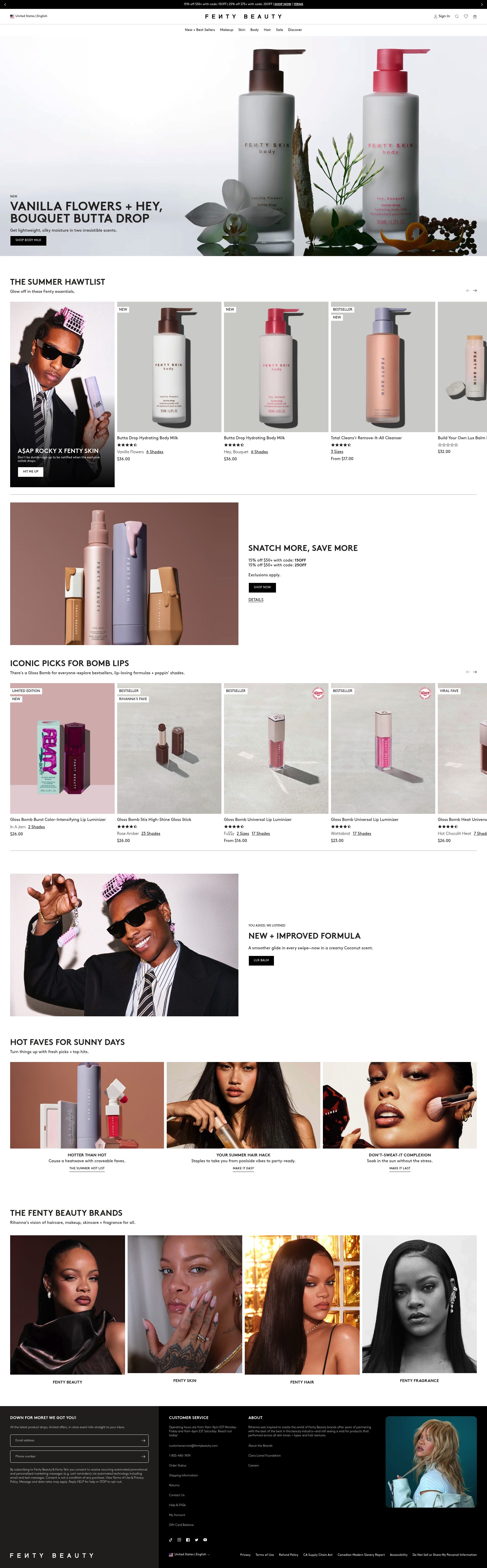
Fenty Beauty launched in 2017 with 40 foundation shades and changed what inclusive cosmetics ecommerce looks like. Their Shopify store matches that ambition: the shade range presentation on foundation product pages is among the best in the industry, with skin tone filtering, undertone labelling, and model imagery across a genuinely broad spectrum of complexions. The site does not treat deeper skin tones as an afterthought. They are front and centre in campaign imagery, navigation banners, and new launch merchandising.
The product pages carry strong social proof: verified reviews with photos, skin type filtering on review displays, and a "shades worn by our team" section that puts real people in front of the product rather than idealised studio shots. The checkout flow is tight, and the store handles high-volume launches, such as Gloss Bomb restocks, without degrading performance. Fenty Beauty is a textbook case in how to merchandise a wide range without making the experience feel overwhelming.
2. Anastasia Beverly Hills
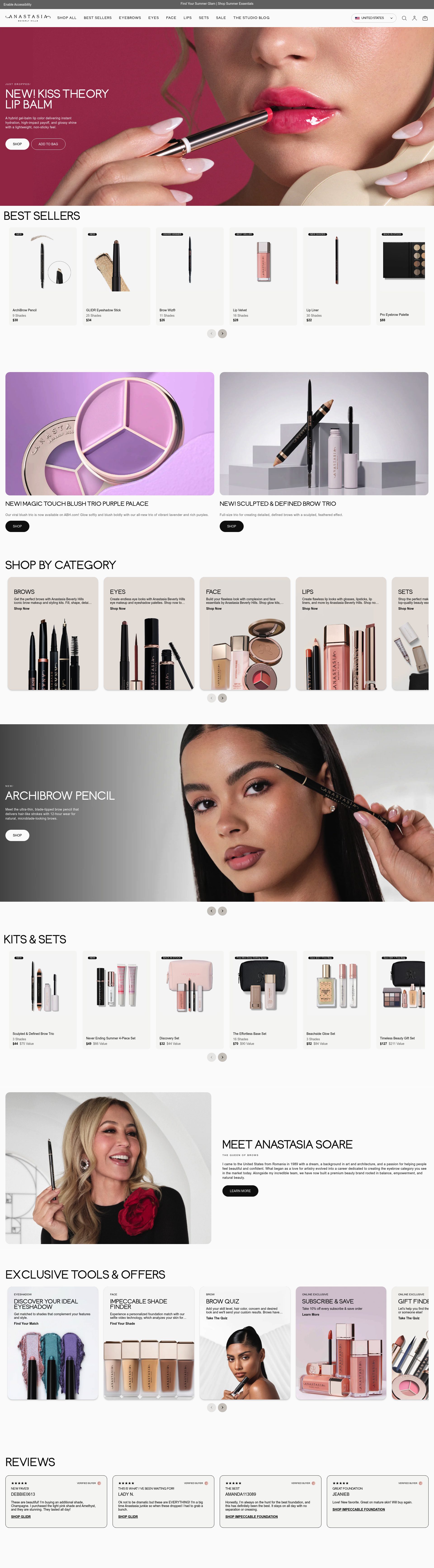
Anastasia Beverly Hills built its reputation in brow products before expanding across the full cosmetics spectrum. Their Shopify store reflects that dual identity: brow is still given hero status in navigation and homepage real estate, while the wider cosmetics range (eyeshadow palettes, liquid lipsticks, bronzers) is merchandised with the same editorial confidence. The ABH eyeshadow palette pages are particularly well executed: every shade within a palette is named and swatched, with tutorial content embedded or linked within the product page itself.
The store is strong on discovery merchandising. Curated looks and editorial collections sit alongside standard product grids, giving customers a way in that does not require them to already know what they want. The video content integrated into product pages, showing application technique and real pigmentation, does the job that in-store testers would do in a department store. For a brand selling products that require skill to apply, this is exactly the right investment.
3. Urban Decay
Urban Decay's store carries its edge-of-mainstream positioning through every design decision: dark backdrops, high-contrast typography, and campaign imagery that is deliberately less conventional than most beauty brands. The navigation structure is clean despite a very wide product catalogue, with clear category groupings across eye, lip, face, and primers. The All Nighter setting spray, their flagship product, earns its own collection page with editorial depth that explains use cases, layering with other products, and application tips.
What the Urban Decay store does well technically is handling colour variety at scale. Their eyeshadow palettes and lipstick ranges include dozens of shades, and the product pages use swatch-first presentation so customers can assess colour before reading any other detail. The zoom functionality on product images is genuinely useful, not just ornamental. Their rewards programme is surfaced consistently throughout the store without being intrusive, which is a balance many loyalty implementations get wrong.
4. NYX Professional Makeup
NYX sits at the intersection of professional quality and accessible price, and their Shopify store makes that positioning tangible. The "Pro" framing in the brand name could feel hollow, but the store backs it up: product pages reference professional use cases, MUA endorsements, and editorial application imagery that treats affordable products with the same reverence larger brands give their luxury lines. The result is a store that makes a £8 lip liner feel like a considered purchase rather than a cheap one.
The filtering and navigation on NYX's store handles a very broad SKU count well. Shoppers can filter by finish, shade family, formula, and skin concern without the filter panel becoming a maze. The UK store is localised properly: GBP pricing, UK shipping thresholds, and UK-specific promotions are handled natively rather than bolted on. For Shopify merchants dealing with large catalogues, the NYX approach to product discoverability is worth studying.
5. Huda Beauty
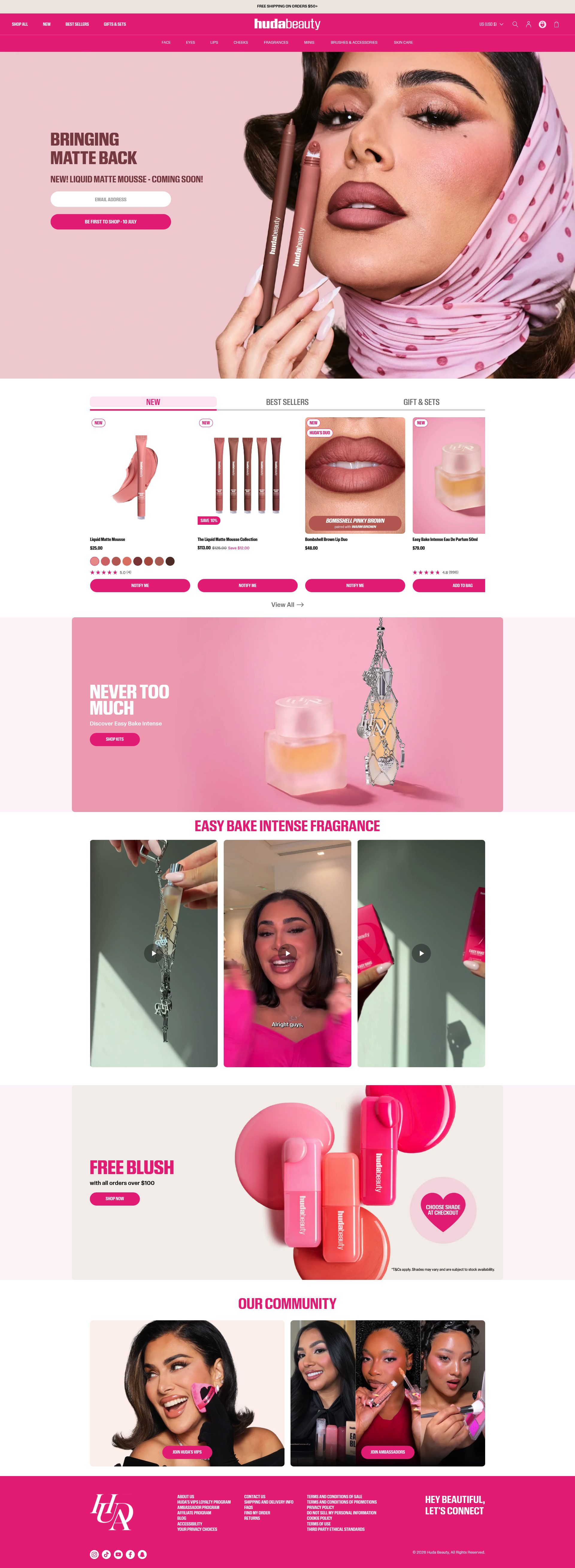
Huda Beauty launched as a blog and became one of the largest independent beauty brands in the world. The Shopify store carries that influencer-to-brand trajectory: Huda Kattan's voice and imagery are present throughout, but the store functions as a proper commerce site rather than a personal channel. Product pages for the Faux Filter foundation range include shade matching guidance, skin type recommendations, and coverage level descriptions that reduce the purchase uncertainty common with base products.
The store handles product launches particularly well. New collections are given dedicated landing pages with editorial photography, founder videos, and early review aggregation. The gift set merchandising, especially around peak seasons, is strong: bundles are logical and clearly priced with savings called out. The checkout experience is streamlined and handles multiple currencies without the friction that plagues cross-border beauty purchases on less well-configured Shopify setups.
6. Makeup Revolution
Makeup Revolution is a UK success story: a brand built on making affordable dupes and trend-led cosmetics, now selling globally. Their Shopify store manages an extraordinary product volume, adding new SKUs weekly to match trend cycles. The homepage refresh rate matches that pace, with new arrivals and trend edits updated constantly. What keeps this from feeling disposable is the review infrastructure: thousands of verified purchase reviews are organised by skin type and tone, which is the primary trust mechanism when price alone cannot justify the purchase.
The store's sale and promotional mechanics are well engineered. Tiered discount thresholds (spend X, get Y free) are communicated through a persistent cart drawer message rather than just a banner, which keeps the incentive visible at the moment it matters most. For UK Shopify merchants who need to manage high SKU counts and frequent new arrivals, Makeup Revolution's approach to collection organisation and promotional architecture is a practical reference.
7. Pixi Beauty
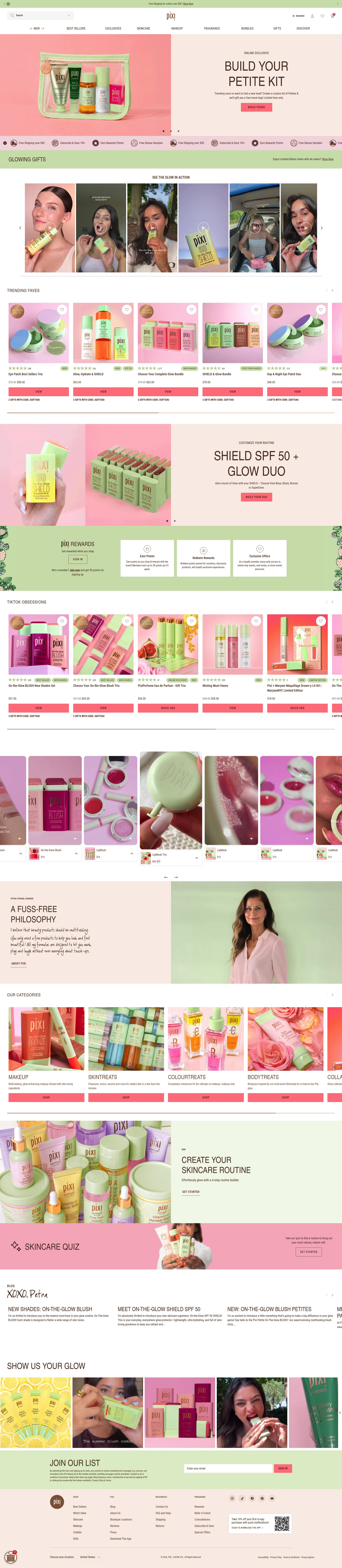
Pixi Beauty is a Swedish-founded, London-born brand best known for Glow Tonic, its glycolic acid toner. The Shopify store reflects the brand's no-fuss, results-first philosophy: product pages lead with the active ingredients and what they do, photography is bright and clean without being clinical, and the site avoids the maximalist visual noise common in the beauty category. The bestseller hierarchy is clear: Glow Tonic earns hero placement throughout, which reinforces the brand's credibility through association with a genuinely beloved product.
The Pixi store handles skincare-makeup crossover products thoughtfully. Products like illuminating primers and tinted balms are presented with both skincare benefits and makeup payoff described, which serves two different customer intents simultaneously. The routine builder content, linking toner to serum to SPF, creates natural upsell pathways without feeling like a hard sell. The gift and travel size sections are well structured for the gifting traffic the brand attracts year-round.
8. Jones Road Beauty
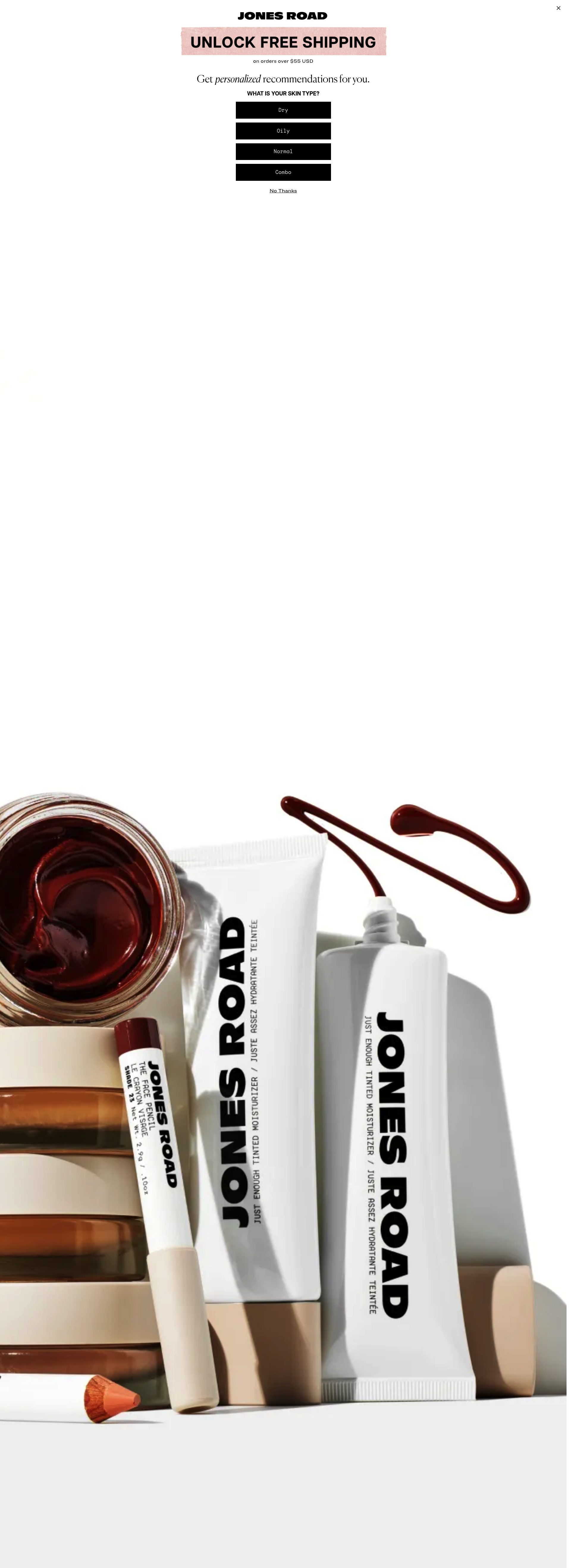
Jones Road Beauty is Bobbi Brown's post-LVMH venture: cleaner ingredients, simpler routines, and a store built for women who are done with complicated makeup. The Shopify store is a model of restraint. The product range is deliberately small, and the store makes no apology for that. Each product earns a full-page treatment with extensive how-to content, Bobbi's personal recommendations, and founder-voiced editorial copy that makes the store feel like a consultation rather than a catalogue.
The skin tone selector on the Miracle Balm range is one of the more thoughtful shade tools in the market: it surfaces the recommended shade and the reasons behind it, rather than leaving customers to guess from a colour chip. The store's editorial video content, featuring Bobbi Brown herself applying products, removes the skills barrier that often stops women in their 40s and 50s from buying cosmetics online. This is a store built around the psychology of its specific customer, and it converts accordingly.
9. Natasha Denona
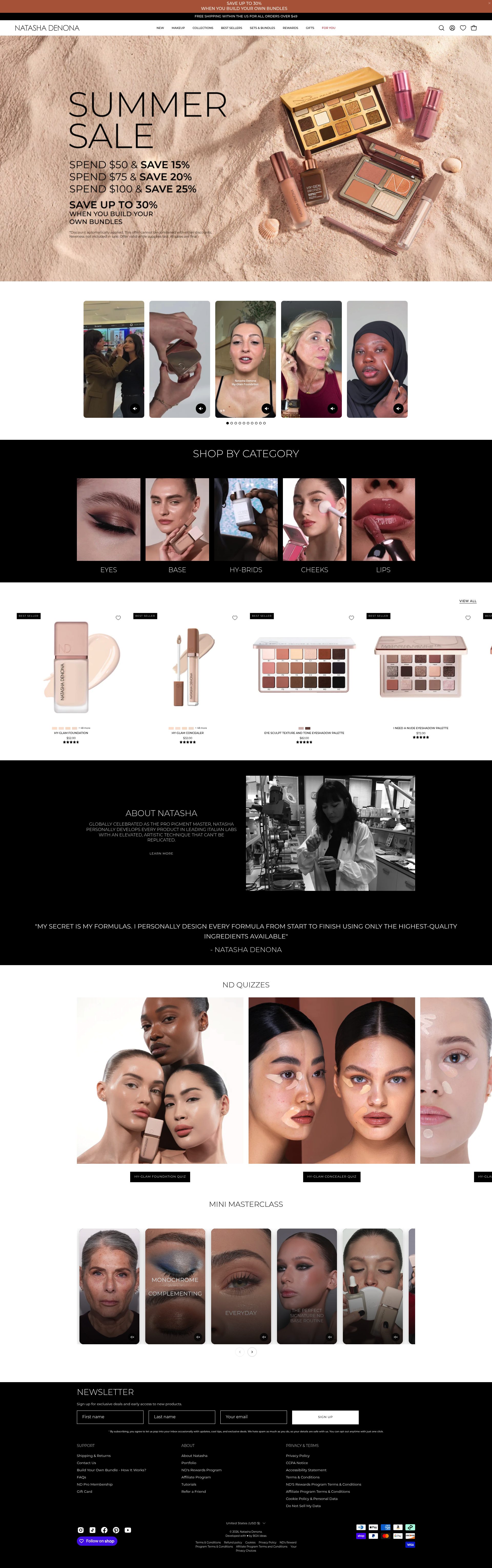
Natasha Denona makes high-performance professional eyeshadow palettes at a premium price point, and the Shopify store earns that price through depth of presentation. Every palette product page includes individual pan swatches, look tutorials shot in multiple lighting conditions, and detailed shade descriptions that go beyond shade names into pigmentation notes and finish type. The comparison content between palettes helps customers who are deciding between options without needing to consult YouTube separately.
The store does not lean on discounting to drive conversion, which requires the product presentation to work hard. It does. The review integration shows verified purchases with imagery and skin tone data, and the store's overall visual quality matches the reputation of a brand whose palettes retail at £65 and above. For Shopify merchants at the premium end of their category, Natasha Denona is a useful benchmark for how product page depth can justify price point without resorting to margin-eroding promotions.
10. e.l.f. Cosmetics UK
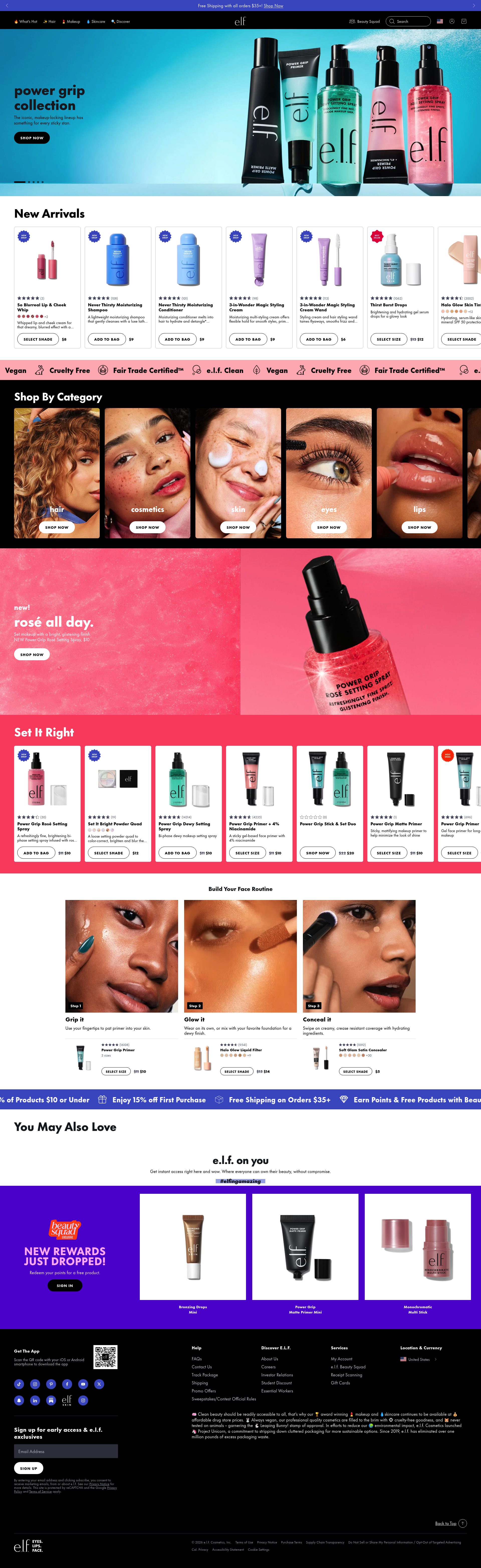
e.l.f. Cosmetics built one of the most viral beauty brands of the decade by understanding its customer better than most: young, digitally native, trend-aware, and not prepared to pay luxury prices for basics. The Shopify store reflects that understanding in its speed and energy. Pages load fast. New arrivals are surfaced immediately. Viral products, Halo Glow, Putty Primer, Bronzing Drops, are given dedicated editorial space that bridges the gap between social content and product purchase.
The loyalty programme integration within the UK store is a strong point: points balance, reward thresholds, and referral mechanics are visible in the account area without requiring a separate login or app. The promotional calendar is aggressive but well executed, with clear offer mechanics and countdowns that create urgency without feeling cheap. For a brand at this price point, the store communicates quality and trend relevance consistently, which is the harder of the two to achieve.
How These Cosmetics Stores Compare
| Brand | Niche Focus | Price Point | Shopify Standout |
|---|---|---|---|
| Fenty Beauty | Inclusive full-face cosmetics | Mid to premium | Shade range presentation and inclusive merchandising |
| Anastasia Beverly Hills | Brow and eye cosmetics | Mid to premium | Tutorial integration within product pages |
| Urban Decay | Edge-of-mainstream eye and lip | Mid | Colour-first UX for high-volume shade ranges |
| NYX Professional Makeup | Pro-quality affordable cosmetics | Affordable | Filtering at scale across large catalogue |
| Huda Beauty | Full-face with influencer depth | Mid to premium | Launch page editorial and gift set merchandising |
| Makeup Revolution | Trend-led affordable cosmetics | Budget | Review volume and promotional cart mechanics |
| Pixi Beauty | Skincare-cosmetics crossover | Mid | Routine builder and hero product positioning |
| Jones Road Beauty | Clean minimalist makeup | Premium | Founder-voiced editorial and shade guidance |
| Natasha Denona | Premium professional palettes | Premium | Product page depth to justify high price |
| e.l.f. Cosmetics UK | Trend-led affordable cosmetics | Budget | Speed, loyalty integration, viral product merchandising |
What These Stores Get Right
- Shade confidence at scale. Every store on this list solves the shade selection problem differently: skin tone filters, undertone labels, model imagery, or guided tools. Customers who cannot find shade guidance do not buy. These stores remove that blocker.
- Editorial content as a conversion tool. Tutorial videos, founder recommendations, and look guides are not marketing add-ons. They are product page infrastructure that replaces the in-store tester experience.
- Review quality over review quantity. Verified purchase photos, skin type filters on review displays, and structured review data (coverage, longevity, finish) convert better than thousands of unfiltered star ratings.
- Promotional mechanics that do not erode the brand. The strongest stores on this list use tiered thresholds, loyalty points, and editorial-style sale pages rather than discount banners that cheapen the brand perception.
- Speed and catalogue management at volume. Cosmetics catalogues are large and grow constantly. The stores that perform best invest in navigation, filtering, and collection architecture that keeps discovery fast even when the product count runs into the hundreds.
If your cosmetics or beauty Shopify store is not converting at the level these brands achieve, the gap is usually product page depth and shade confidence tools. Talk to our Shopify design team about what that looks like for your range.
Frequently asked questions
What makes a cosmetics Shopify store convert well?
The biggest conversion drivers in beauty ecommerce are shade confidence tools and product page depth. Customers who cannot identify their shade, or who cannot replicate an in-store tester experience, do not buy. Stores like Fenty Beauty and Jones Road Beauty solve this with skin tone filters, guided shade selectors, and founder-voiced application content that removes the skills barrier.
How do the best cosmetics stores handle large product catalogues on Shopify?
The strongest performers, NYX and Makeup Revolution in particular, invest in navigation architecture and filtering that keeps discovery fast across hundreds of SKUs. Filtering by finish, shade family, formula, and skin concern is standard. Collection pages are structured around customer intent, such as new arrivals or trend edits, rather than just product type, which reduces catalogue overwhelm.
Do cosmetics brands on Shopify need a loyalty programme?
For brands with repeat purchase cycles, yes. e.l.f. Cosmetics UK and Urban Decay both surface their loyalty mechanics throughout the store, not just at checkout, which keeps the incentive visible at the moment it influences the cart. The key is integration: loyalty points and reward thresholds need to be visible in the account area and cart drawer, not buried in a separate app.
How do premium cosmetics brands justify high price points without discounting?
Natasha Denona is the clearest example: product pages carry individual pan swatches, tutorials in multiple lighting conditions, and detailed pigmentation notes that make a £65 palette feel like an informed, low-risk purchase. Jones Road Beauty uses Bobbi Brown's own voice and application video to remove the skills barrier. Both stores prove that product page depth is a more sustainable margin strategy than promotional discounting.
What can UK beauty Shopify merchants learn from these stores?
Three things stand out. First, inclusive imagery is not optional: customers who do not see themselves represented in model photography do not convert. Second, editorial content, tutorials, founder videos, routine builders, is product page infrastructure, not a marketing add-on. Third, promotional mechanics need to stay brand-consistent: tiered cart thresholds and loyalty points outperform blanket discount banners for brands that want to hold their perceived value long term.