
Quick summary
Liquid Death is the standout for brand-driven DTC, turning canned water into a $1.4 billion business through a merchandise subscription model that outperforms discount-first retention. Athletic Brewing leads the non-alcoholic category with product page copy and photography that earns the lifestyle positioning rather than just asserting it. OLIPOP is the strongest reference for functional beverage merchants, with a mix-and-match subscription mechanic that directly addresses flavour fatigue. Ghia and Seedlip both demonstrate how to sell premium non-alcoholic drinks on Shopify by building customer education into the UX rather than leaving it to a buried FAQ.
Drinks and beverages is one of the most demanding categories in DTC ecommerce. You are asking customers to pay a premium over what they could pick up in a supermarket aisle, often for a product they cannot taste before buying. The stores that convert in this space earn that trust through sharp brand identity, intelligent product pages, and subscription mechanics that make reordering frictionless. Several of the biggest DTC success stories of the last five years have come from this category, and the craft they bring to Shopify is worth studying regardless of what you sell.
Here are ten drinks and beverages brands using Shopify to build serious ecommerce operations.
1. Liquid Death
Liquid Death sells canned mountain water. On paper, that is one of the hardest possible products to differentiate. In practice, their Shopify Plus store is one of the most distinctive in any category. The brand commits completely to its heavy metal aesthetic: black-on-black layouts, irreverent copy, limited-edition can artwork, and merchandise that treats "murder your thirst" as a design brief rather than a tagline. Product pages carry that energy without sacrificing clarity on what is actually in the can.
What makes the store technically strong is how it handles the gap between brand entertainment and conversion. Liquid Death runs a subscription programme built around the incentive of exclusive branded merchandise, which has meaningfully reduced churn compared to discount-first retention tactics. The store surfaces flavour variety packs prominently, lowering the commitment barrier for first-time buyers who are sampling the range. Limited-edition drops operate on a launch model that drives urgency without feeling manufactured.
Liquid Death reached a $1.4 billion valuation on a product that costs pennies to produce because the brand and the store work together. No other drinks brand on Shopify has built a more coherent world around such an unlikely product.
2. Athletic Brewing Company
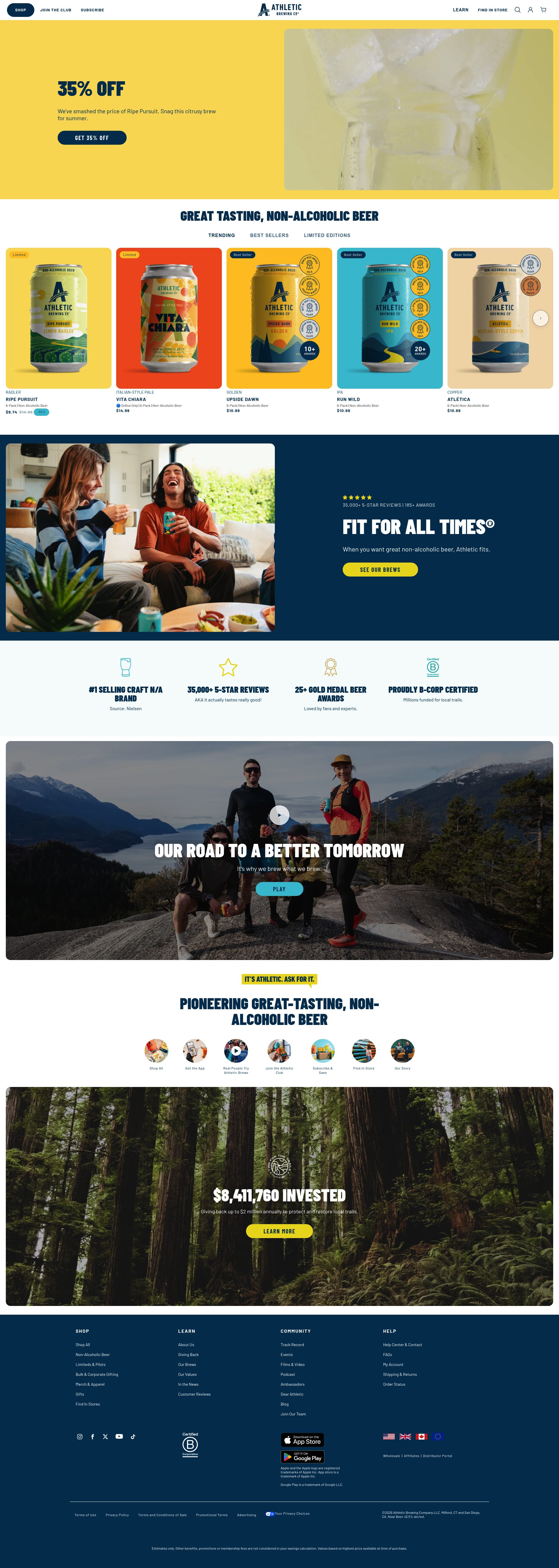
Athletic Brewing makes non-alcoholic craft beer and operates one of the most polished Shopify Plus stores in the beverages category. The store is built around the insight that their customer is not buying a consolation prize for not drinking: they are buying genuinely good beer that fits an active lifestyle. Every page reinforces that positioning, from product photography shot in trail-running and cycling contexts to editorial content about training and recovery alongside taste.
The shop structure rewards browsing: you can filter by style (IPA, golden, dark, stout) or by occasion, and the variety pack mechanic is well executed, allowing customers to build their own mixed cases. Subscription is integrated at the product level rather than buried in an account section, with clear per-unit savings displayed inline. Athletic Brewing has expanded from beer into sparkling hop water and athletic nutrition, and the navigation handles that breadth without losing focus.
As the leading non-alcoholic beer brand in the US, Athletic Brewing demonstrates that positioning and product page copy can do more for conversion than discounting. Their store converts sceptical visitors because every claim is specific and every photograph earns the lifestyle positioning rather than asserting it.
3. OLIPOP
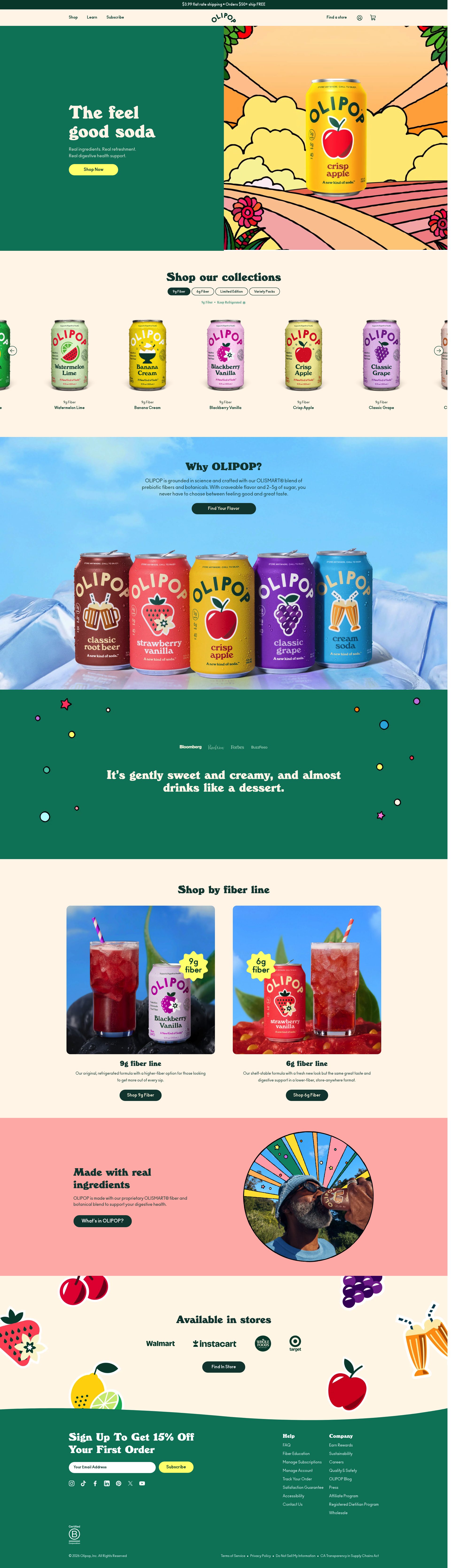
OLIPOP makes prebiotic soda and has built a Shopify store that makes functional beverages feel genuinely enjoyable rather than medicinal. The design is bright and flavour-led: each SKU has its own illustrated colour world, and the collection page uses those palettes to create a grid that communicates variety and energy at a glance. OLIPOP understands that their customer is buying partly on taste and partly on health rationale, so product pages lead with flavour and follow with the gut health credentials rather than the other way around.
The subscription mechanic is front and centre: a 15% discount and the ability to mix and match flavours per delivery, which addresses the main reason people abandon beverage subscriptions (flavour fatigue). OLIPOP has been featured in Shopify's own case studies for their approach to DTC growth, with their product development story centred on actually solving a consumer problem, namely the gap between soda people enjoy drinking and soda that is good for them.
The brand has scaled rapidly into retail alongside its DTC channel, and the store supports that by encouraging customers to find OLIPOP locally while keeping the subscription programme as the primary owned-channel relationship.
4. Chamberlain Coffee
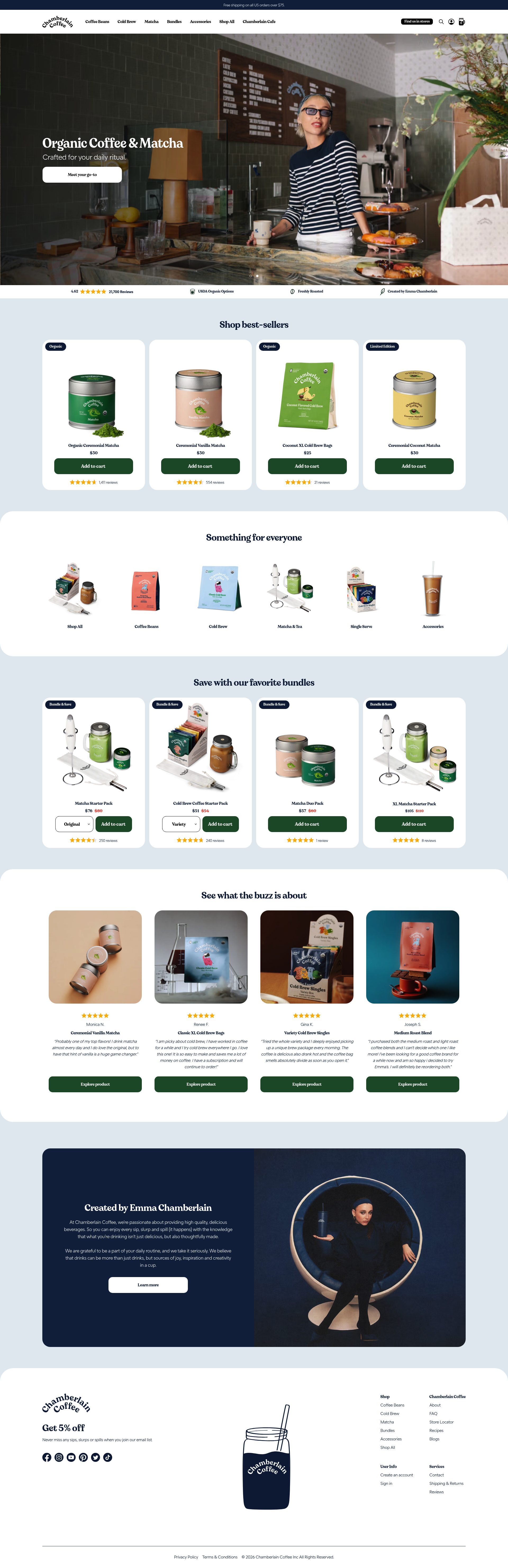
Chamberlain Coffee was built on Shopify from its first sale and has grown into a genuine lifestyle brand built around coffee culture. The store's strength is its product range breadth handled cleanly: whole beans, ground coffee, matcha, cold brew, accessories, and branded merchandise coexist without the store feeling fragmented. Collections are logically structured and the navigation does not force you to know the brand vocabulary before you can find what you are looking for.
What Shopify made possible here, as Chamberlain Coffee has noted publicly, is a thoughtfully designed interface that brings the brand experience online without compromising it. The product photography is consistent and high-quality throughout: lifestyle images that communicate the brand's relaxed, curious tone rather than generic coffee-brand visual clichés. Subscription options are available on all consumable products, and the accessories range adds average order value without requiring a separate visit.
For merchants thinking about how to build a brand, not just a product, Chamberlain Coffee is a useful reference. The store feels like an extension of a world rather than a catalogue, and that is achievable with disciplined photography and copy even without influencer founder recognition.
5. Ghia
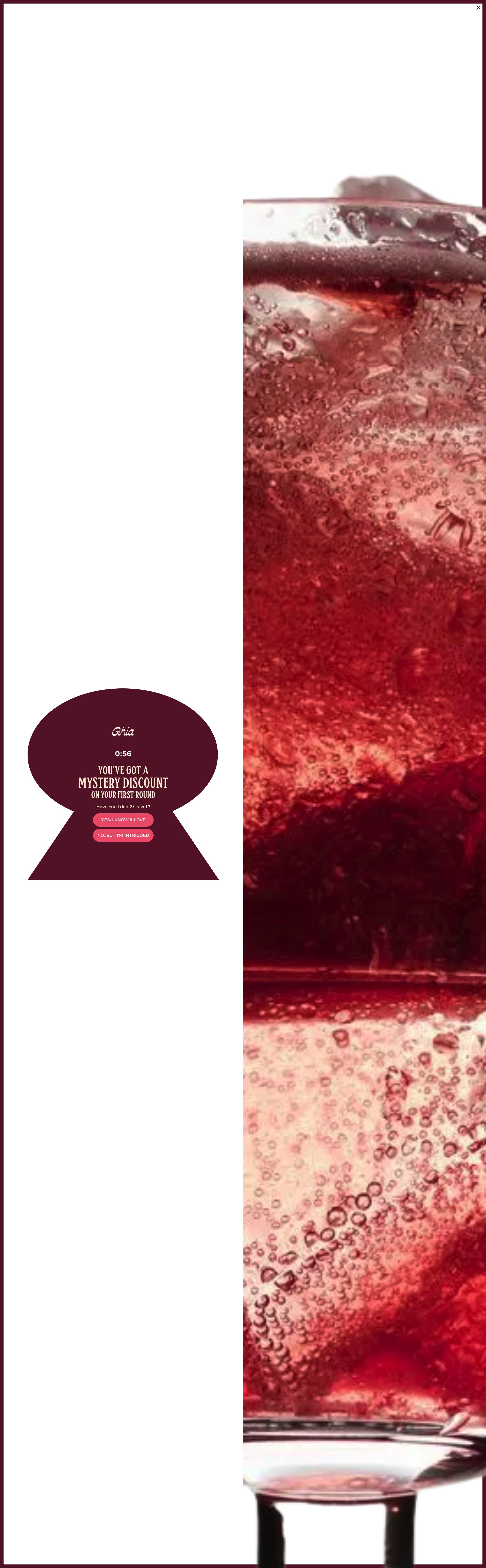
Ghia makes non-alcoholic aperitifs and has earned a place in Shopify's own editorial as an example of how to build a category that does not yet have mainstream awareness. The brand was founded on the premise that the ritual of drinking, the social moment, the flavour complexity, the glassware, matters independently of the alcohol. The Shopify store carries that argument through every design decision.
The product page for Ghia's flagship Le Spritz leads with occasion rather than ingredient: you see it in a beautiful glass in a sunlit setting before you read the botanicals. The copy explains the experience you are buying, not the chemistry. Bundles and discovery sets are structured as genuine introductions to the range rather than volume discount plays, and they are priced accordingly. The brand has also used Shopify's platform to execute limited-edition flavour releases that drive email list growth and create urgency without eroding the brand's premium positioning.
Ghia is a store worth analysing if you sell a product that requires customer education. The entire UX is designed to answer "why would I buy this?" before the customer has to ask.
6. Recess
Recess sells sparkling water infused with hemp extract and adaptogens, positioned squarely at a customer experiencing stress and looking for a functional alternative to alcohol or energy drinks. The store's visual language, pastel gradients, calm typographic treatment, and unhurried page rhythm, is a direct translation of the product's promise. This is harder to execute than it looks: many wellness brands produce pages that feel anxious in their effort to communicate calm.
Over 50% of Recess sales come through ecommerce, which is exceptional for a beverage brand now stocked in 18,000 US retail locations. The DTC channel retains that share because the store does things retail cannot: mix-and-match variety, subscription customisation, and direct communication with the customer about new product launches. Recess has expanded from sparkling hemp water into magnesium beverages and zero-proof mocktails, and the store handles that expansion by category rather than forcing customers to navigate a combined SKU list.
The store is a strong example of how visual coherence at the brand level compounds into commercial advantage. Recess does not just describe calm, the store creates it.
7. Haus
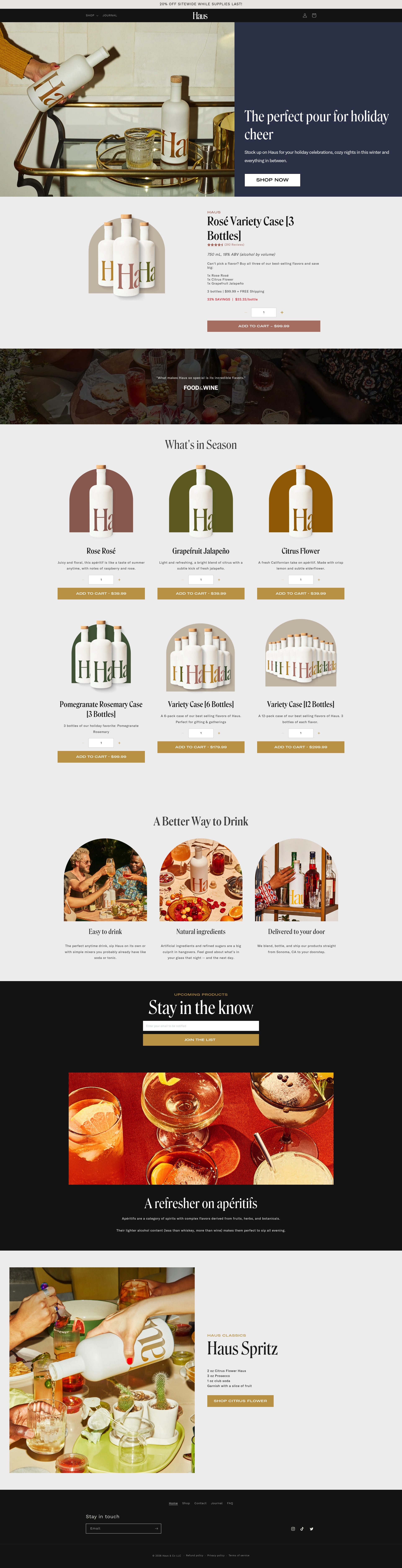
Haus builds farm-to-bottle aperitifs using grape wine as a base, keeping alcohol content under 24% to sell direct to consumers in most US states without navigating the traditional three-tier liquor distribution system. That structural insight, use Shopify to bypass the middlemen that make DTC alcohol nearly impossible, is what made Haus one of the most talked-about beverage launches in recent years, growing 800% in sales during 2020 alone.
The store at drink.haus is clean and ingredients-forward. Product pages list every ingredient, the farm source where possible, and the occasion each aperitif suits best. The overall effect is transparency as brand positioning: nothing to hide, everything to explain. A variety case is the primary entry point, designed as a considered purchase for someone who wants to try the range before committing to a single bottle. The membership model, which Haus has leaned into for its core subscription revenue, rewards returning customers with early access to new releases.
For merchants looking at how to use Shopify's DTC capability to disrupt a heavily intermediated category, Haus is the most direct case study available.
8. Seedlip
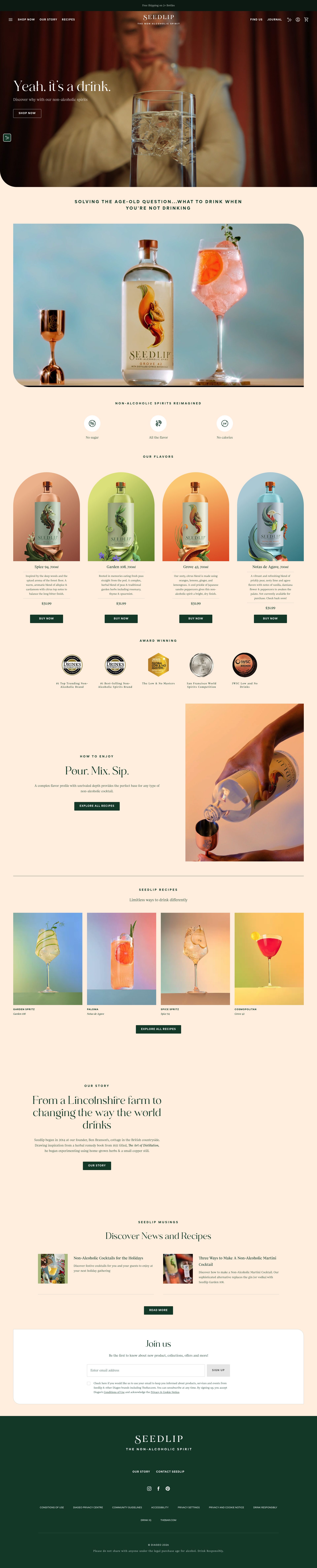
Seedlip is the UK brand that created the non-alcoholic spirits category. Founded by Ben Branson in 2014 from a cottage in the British countryside, inspired by a 1651 herbal remedy book, the brand was acquired by Diageo after its first product sold out in three weeks. The Shopify store reflects the brand's heritage credentials without leaning on nostalgia in a way that would make it feel dated.
The product range is small and deliberately so: Spice 94, Garden 108, and Grove 42, plus the newer Notas de Agave, each with a clear flavour profile and cocktail pairing guidance. Product pages do not oversell. The copy is precise and the photography is clean and botanical rather than lifestyle-heavy, which suits a brand whose authority comes from product rather than personality. The store's serve suggestions, specific cocktail recipes pairing each Seedlip with particular mixers and garnishes, are genuinely useful and do the job of reducing the uncertainty a customer faces when buying something they cannot taste first.
As a UK brand with genuine category-defining credentials, Seedlip represents what is possible when a Shopify store reflects the actual character of the product rather than defaulting to ecommerce conventions.
9. Adnams
Adnams is a Suffolk brewery and distillery with 150 years of heritage, and their Shopify Plus store, built by Blubolt, is one of the most sophisticated multi-category drinks ecommerce operations in the UK. The range covers beers, spirits, wines, ciders, accessories, kitchenware, and gifting, and the navigation manages that breadth through clear category architecture rather than a single overwhelming catalogue.
The Shopify Plus implementation introduced click-and-collect from Adnams' retail stores across East Anglia, which is a meaningful conversion driver for local customers who can browse the full range online and collect same-day. The store uses Okendo for customer reviews, Boost Commerce for collections and search, and DotDigital for email, all integrated cleanly enough that the seams do not show to the customer. Out-of-stock products are hidden rather than shown as unavailable, which keeps the browsing experience clean.
For UK merchants in food and drink with a broad catalogue and physical retail presence, Adnams shows what a mature, thoughtfully-built Shopify Plus store can do. The brand heritage is present throughout without being used as a crutch.
10. Cawston Press
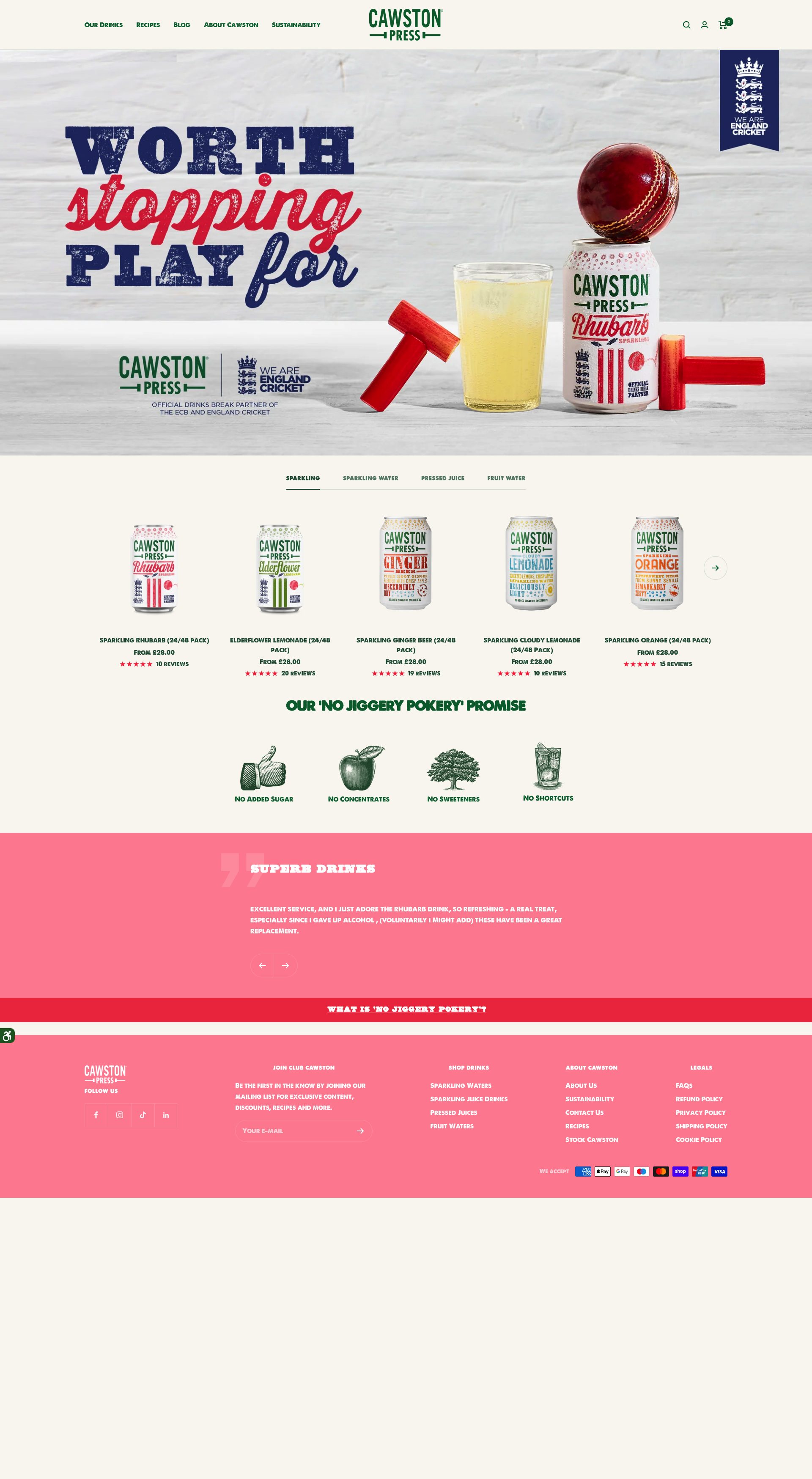
Cawston Press makes pressed fruit juices, sparkling soft drinks, and kids' drinks using real fruit and no added sugar or concentrates. It is a British brand with strong independent trade and retail presence, and their Shopify store extends that reach into direct sales with a product range that holds its premium positioning clearly.
The store is product-led and honest about what it is: a range of genuinely good soft drinks, not a wellness brand making functional claims it cannot substantiate. Product pages foreground the ingredients list and the sourcing story without overcomplicating either. The range is well organised by category: adult sparkling, pressed juices, and kids drinks each occupy their own clear space. Multipacks and mixed cases are the primary purchasing format online, which makes commercial sense for a product with a relatively low unit price and high repeat purchase rate.
Cawston Press is worth studying by UK merchants in food and drink who want to see how to operate a focused, premium product range online without over-engineering the store experience.
Comparison Table
| Brand | Niche Focus | Price Point | Shopify Standout |
|---|---|---|---|
| Liquid Death | Canned water, sparkling water | Budget to mid | Brand world, merchandise subscription, limited drops |
| Athletic Brewing | Non-alcoholic craft beer | Mid | Style-based filtering, subscription at product level |
| OLIPOP | Prebiotic soda | Mid | Flavour-led design, flexible mix-and-match subscription |
| Chamberlain Coffee | Coffee, matcha, accessories | Mid | Lifestyle brand breadth, clean navigation |
| Ghia | Non-alcoholic aperitif | Premium | Occasion-led PDP, category education UX |
| Recess | Functional sparkling water | Mid | Visual calm as brand, multi-category DTC |
| Haus | Farm-to-bottle aperitifs | Premium | DTC distribution model, ingredient transparency |
| Seedlip | Non-alcoholic spirits | Premium | Serve guides, precision copy, UK heritage |
| Adnams | Beer, spirits, wine, gifts | Mid to premium | Multi-category Shopify Plus, click-and-collect |
| Cawston Press | Premium soft drinks and juices | Mid | Clean product focus, multipack structure |
What These Stores Get Right
- They do not discount their way to conversion. The strongest performers here use subscription perks, merchandise incentives, discovery sets, and variety packs to retain customers. They protect margin and build loyalty simultaneously.
- Product pages answer the question the customer is actually asking. In beverages, that question is usually "what does this taste like and why should I spend more than I would in a shop?" The best stores answer that through photography, specific copy, and serve suggestions rather than generic health claims.
- Subscription mechanics are integrated at the product level, not hidden in account settings. When a customer can see the per-unit saving on the product page itself, subscription take-up increases significantly.
- Brand consistency is non-negotiable. Every store on this list has a visual language that carries from homepage to checkout. The colour palette, the typography, and the photography direction are coherent across every touchpoint. That coherence is not expensive to achieve on Shopify, it is a discipline decision.
- Category education is built into the UX for newer product types. Ghia, Recess, Seedlip, and Haus all sell products that require some explanation. Each of them has structured their stores so that explanation happens before the customer needs to ask, not in a pop-up or a FAQ buried in the footer.
Frequently asked questions
Can drinks and beverages brands actually sell well on Shopify?
Yes, and several of the most successful DTC beverage brands in the world run on Shopify Plus. Liquid Death reached a $1.4 billion valuation on Shopify. Athletic Brewing built the leading non-alcoholic beer brand in the US on the platform. The challenge is convincing customers to pay a premium over supermarket prices, which comes down to product page depth, brand consistency, and subscription mechanics rather than the platform itself.
What subscription model works best for drinks brands on Shopify?
Mix-and-match subscriptions that let customers change flavours per delivery consistently outperform fixed-SKU subscriptions for beverage brands. OLIPOP uses this approach with a 15% discount and it is the primary reason their churn is low. Liquid Death uses exclusive branded merchandise as the subscription incentive rather than a price discount, which protects margin while rewarding loyalty. Both approaches work; the right one depends on your margin structure and whether your brand has the identity to make merchandise desirable.
How do non-alcoholic drinks brands handle customer education on Shopify?
The strongest non-alcoholic stores, Ghia, Seedlip, and Recess, build the answer to "why would I buy this?" directly into the product page before the customer has to ask. Ghia leads with occasion rather than ingredients. Seedlip uses specific serve suggestions and cocktail pairings. Recess uses visual design to communicate the product's calming effect before a word is read. Education through UX design consistently outperforms education through FAQ pages or pop-ups.
What Shopify apps do the best drinks stores use?
Adnams uses Okendo for reviews, Boost Commerce for collections and search filtering, and DotDigital for email. Athletic Brewing integrates subscription at the product level rather than routing customers to a separate app interface. For drinks brands, the most impactful apps are typically a subscription platform (Recharge or Skio), a reviews app with photo support (Okendo or Yotpo), and a search and filter tool if you carry more than 30 SKUs.
How do UK drinks brands on Shopify differ from US brands?
UK brands like Seedlip, Adnams, and Cawston Press tend to lead with product heritage and ingredient provenance rather than lifestyle positioning. Adnams integrates click-and-collect from physical retail stores, which is a meaningful conversion driver that US-first DTC brands rarely need to build. Seedlip's copy is precise and botanical rather than personality-led, which reflects a UK consumer who is more sceptical of lifestyle branding and more responsive to product credentials. Both approaches convert, but the creative direction is distinctly different.
Related reading
- Best food Shopify stores
- Best coffee Shopify stores
- Best health and wellness Shopify stores
- How to increase Shopify subscription revenue
- Shopify for food and drink brands: full guide
If your drinks brand is not converting at the level these stores achieve, the gap is usually product page depth and subscription mechanics. See our Shopify design service or get in touch to talk through what is possible.