
Quick summary
Huel leads the field with use-case-first navigation and a genuinely flexible subscription portal that reduces churn without sacrificing conversion. Ritual is the strongest example of ingredient transparency done at scale: every nutrient is sourced and justified, which earns trust in a category full of vague wellness claims. AG1 has built the most aggressive subscription-first funnel in the supplement space, with a product page structured to answer every objection before the buyer reaches the cart. Heights stands out for betting everything on a single product and winning, with a subscription-only model and content-led retention that keep customers far longer than most wellness brands manage.
Health and wellness is one of the most demanding verticals in ecommerce. Customers are buying products they put in their bodies or build their daily routines around, and they are sceptical by default. Claims need to be verifiable, ingredients need to be transparent, and the store needs to earn trust before the first purchase, not just after it. The brands that win here are not simply the ones with the best products. They are the ones that have built Shopify stores capable of converting sceptical, research-led buyers into loyal repeat customers. These ten stores span nutrition, supplements, fitness, and wellbeing and each one has something worth taking apart.
1. Huel
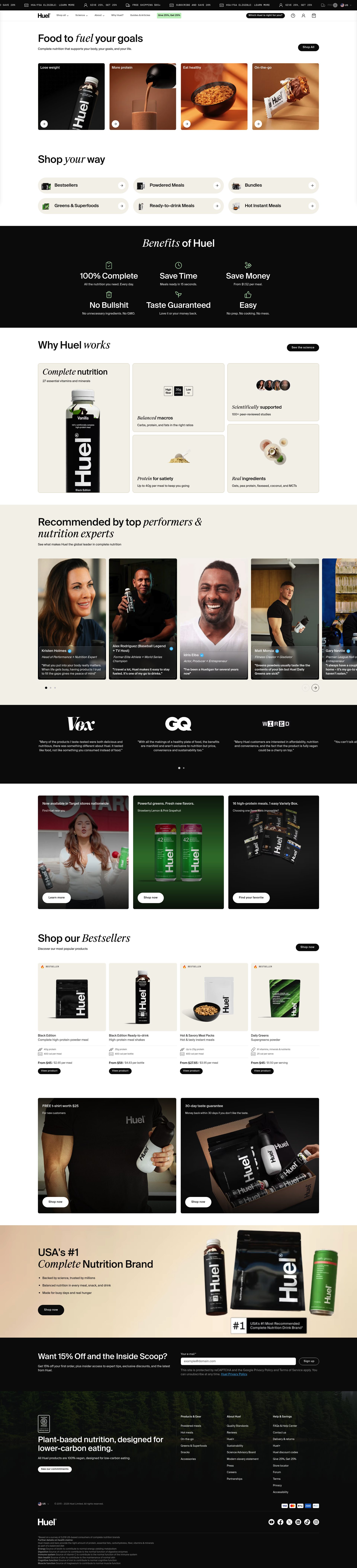
Huel is the UK's most commercially successful complete nutrition brand, built entirely on Shopify Plus, and their store is a masterclass in handling product complexity without sacrificing conversion. The range spans powdered complete meals, ready-to-drink, protein bars, hot and savoury meals, and now greens supplements, and the store navigates this breadth through a clean primary navigation structured around use case (meal replacement, high protein, quick nutrition) rather than product format. That is the correct choice for a brand whose customer comes with a goal, not a product type, in mind.
Product pages lead with the nutritional headline (27 essential vitamins and minerals, all macros in one meal) before presenting the SKU options, which reinforces the functional purchase rationale before the buyer has to make a format or flavour decision. The subscription mechanic is prominent without being aggressive: subscribe-and-save is presented clearly, the monthly saving is shown in pounds, and the subscription management portal is highlighted as genuinely flexible. That last point matters because subscription churn in the nutrition category is often driven by inflexibility rather than dissatisfaction with the product itself.
2. Ritual
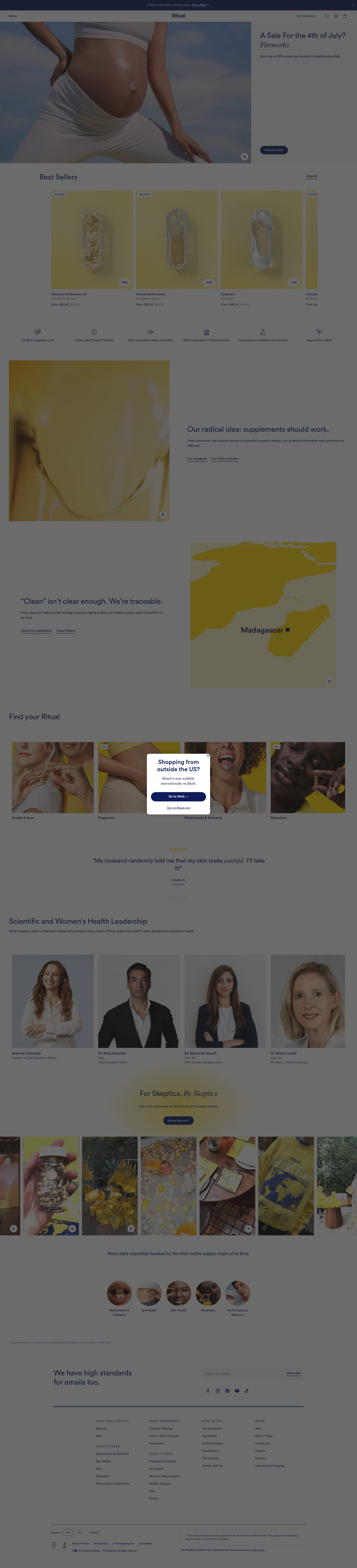
Ritual is a US-based Shopify Plus brand that built its business around ingredient transparency in the vitamin category, starting with a women's multivitamin and expanding into a full-stack supplement range covering protein, synbiotics, and men's health. The store's conversion strategy is built on one idea: every ingredient is traceable to its source. Each product page lists not just what is in the capsule but where each nutrient comes from, why that specific form was chosen over cheaper alternatives, and what the clinical dosing rationale is. That depth of transparency, executed consistently across the entire product range, is what separates Ritual from the hundreds of supplement brands selling commoditised multivitamin formulas at lower price points.
The Shopify implementation reflects the brand's positioning: the store is clean, clinical, and confident without being cold. Subscription is the primary purchase mode, with one-time purchase available but not foregrounded, and the checkout journey is deliberately minimal, reducing the number of decisions a buyer has to make between the product page and payment. Ritual's capsule-in-oil visual is a recognisable design asset and the store makes it central to the photography on every page, which reinforces brand recognition across retargeting touchpoints.
3. Form Nutrition
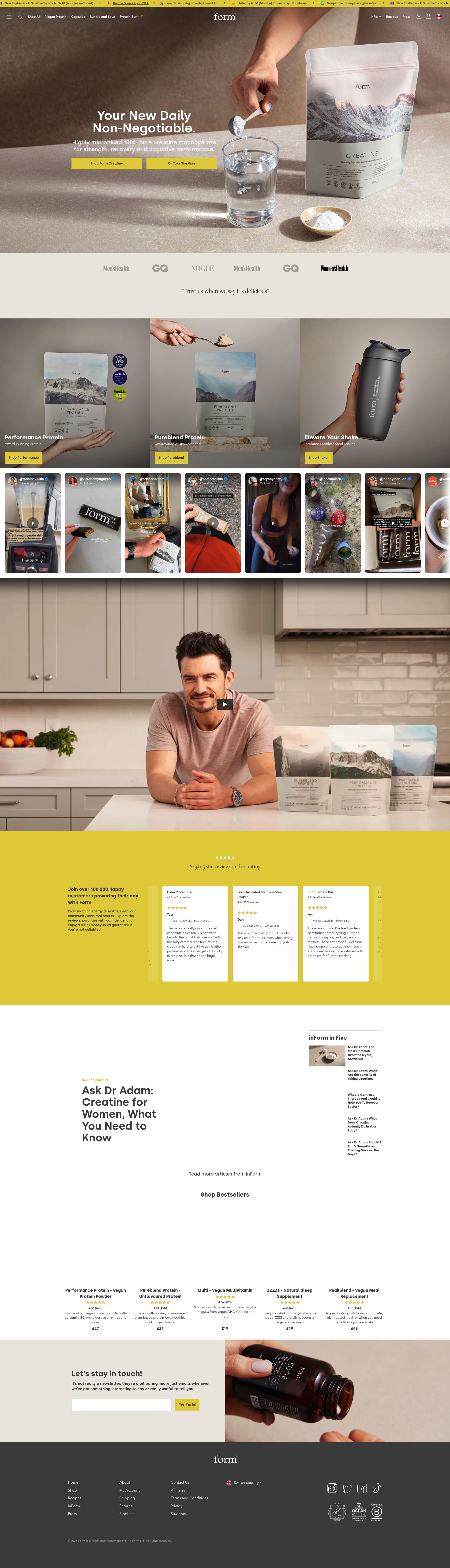
Form Nutrition is a UK Shopify Plus brand built around plant-based performance nutrition, and their store design is among the most considered in the supplement category. The layout is restrained and typographically precise, giving each product enough space to communicate without the visual clutter that plagues multi-SKU supplement stores. That restraint is itself a positioning signal: it reads as confident and premium rather than promotional, which is the right register for a brand selling to an educated buyer who has tried a lot of supplements and is done with brands that overpromise.
Product pages handle ingredient transparency with genuine rigour. Each ingredient is listed with its function, its source, and its clinical dose justification, not as a supplement facts table but as readable prose that a customer can scan in 30 seconds and walk away from feeling informed. Form's photography integrates product and lifestyle context, with athletes and creatives rather than bodybuilders, which positions the brand within a broader wellness and performance audience than traditional sports nutrition. Bundle mechanics are present and well-framed, with stacks built around goals (performance, recovery, daily nutrition) rather than arbitrary discount structures.
4. Wild Nutrition
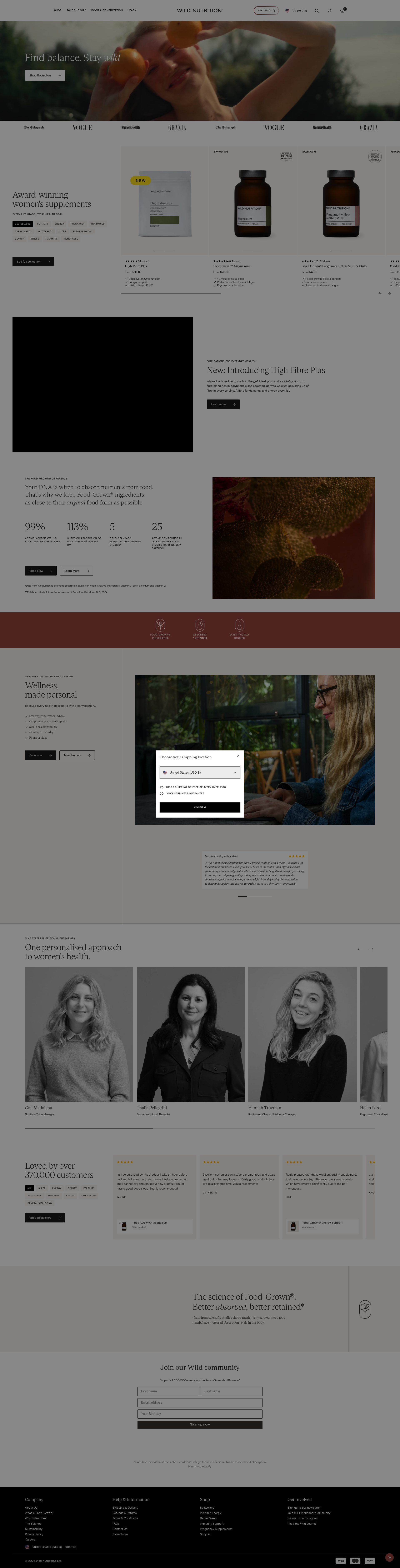
Wild Nutrition is a UK Shopify brand that occupies a specific and defensible position in the supplement market: Food-Grown nutrients, a trademarked approach that bonds vitamins and minerals to organic wholefoods during fermentation rather than using synthetic isolates. That single ingredient philosophy gives the store an anchor point for all of its product education, and it is used consistently across every product page, collection description, and brand content piece. The positioning clarity means a buyer who understands and agrees with the Food-Grown rationale is extremely well-served by the store, and buyers who do not understand it yet are given the explanation before they are asked to buy.
The store handles a health-condition-led product range, covering women's hormonal health, thyroid support, menopause, children's nutrition, and sport, without becoming disorganised. The primary navigation routes by life stage and health goal, which is how customers in this category actually think: a woman in perimenopause is not looking for "vitamin D3 plus K2," she is looking for menopause support. Wild Nutrition's navigation architecture reflects that. Subscription is available across the range, and the educational blog content is deeply integrated into the product discovery journey through contextual internal linking.
5. AG1 (Athletic Greens)
AG1 is one of the most commercially aggressive Shopify brands in the global supplements market, and the store architecture reflects a business built almost entirely on subscription acquisition. The homepage is built around a single offer: the starter kit, which combines a month's supply of the greens blend with a shaker, travel packs, and a subscription prompt framed as a health decision rather than a purchase. Every element of the store experience, from the above-the-fold hero to the product page, is designed to convert a first-time visitor into a subscriber rather than a one-time buyer. The direct-to-subscription funnel is more aggressive than most Shopify wellness brands use, and it works at scale because the product's price point and LTV justify high acquisition costs.
The trust architecture is built on three pillars: a comprehensive ingredient deck (75 vitamins, minerals, whole-food ingredients), athlete and doctor endorsements that are named and specific, and a free returns and pause policy that removes the commitment anxiety that holds back high-price supplement subscriptions. The product page is long, detailed, and structured to answer every objection in sequence before a buyer reaches the add-to-cart button. It is one of the more sophisticated conversion page implementations in the supplement category, and studying the scroll structure and objection sequencing is useful regardless of price point.
6. Puresport

Puresport is a UK DTC sports wellness brand on Shopify that has built a credible position at the intersection of sports nutrition and mainstream wellness. Their range covers CBD, protein, sleep support, recovery supplements, and adaptogens, and the store navigates this multi-category structure through goal-led collection pages rather than product-format navigation. The CBD positioning is handled carefully: the store is compliant with UK advertising restrictions, makes no therapeutic claims, and routes clinical questions to an educational content hub, which is the correct approach in a regulated ingredient category.
The product pages are clean and evidence-aware, naming extract standards (KSM-66 ashwagandha, Informed Sport certification on protein products) that carry weight with an athletic buyer who has learned to read labels. Social proof is handled well: reviews include specific context, weight, sport, and training volume rather than just generic ratings, which is more persuasive for a sports buyer assessing whether a product will work for someone like them. The store's checkout is streamlined and Apple Pay and Google Pay are prominent, which matters for a mobile-first customer base.
7. Heights
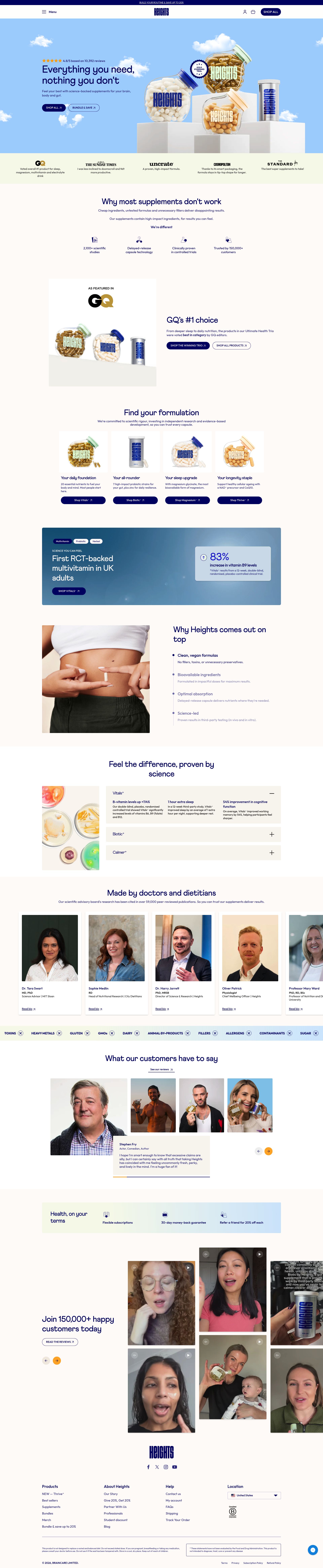
Heights is a UK Shopify brand built around a single hero product: the Smart Supplement, a comprehensive daily stack covering omega-3, vitamin D3, B12, magnesium, lion's mane, and a range of supporting micronutrients in a single daily pouch. That single-product focus is a deliberate commercial strategy: instead of building a broad range and hoping customers navigate to the right combination, Heights sells the answer to "what should I take every day" as a pre-built decision. That simplicity is the primary conversion lever, and the product page is structured to defend it against the obvious objection, why not just buy the individual ingredients separately, with a detailed cost and efficacy comparison.
The store is subscription-only by design: there is no one-time purchase option for the core product. That is an unusual and commercially aggressive choice, but it reflects the brand's positioning (a long-term investment in your brain health, not a trial product) and their customer acquisition economics. The subscription management experience is well-built, with pause, swap, and cancel controls surfaced clearly in the member portal rather than buried in support flows. Content marketing is strong, with a blog and newsletter built around brain health, cognitive performance, and the science of the ingredients, which attracts a high-intent audience and supports both SEO and retention.
8. Whoop

Whoop is a US fitness technology brand that sells a wearable health tracker and an accompanying membership subscription through Shopify, and the store is built to handle a product category that is fundamentally harder to sell online than a supplement: a hardware device with a software subscription where the value only becomes clear over weeks of use. The product page solves this with a heavy investment in video content: strain tracking, HRV monitoring, sleep performance, and recovery data are all demonstrated in short looping clips that show the wearable in use rather than just describing its features. That demonstration reduces the imagination gap that kills conversion on complex technology products.
The membership model, where the device hardware is subsidised and the revenue is in the recurring monthly or annual subscription, creates a commercial logic that shapes the entire store experience. The checkout is optimised to capture the subscription commitment alongside the hardware purchase rather than presenting them as two separate decisions. Testimonial content features specific recovery metrics and performance gains from named athletes, which is the most credible social proof format for a performance tracking device. The store handles international commerce well, with localised currency and shipping options that do not require the customer to navigate to a separate regional site.
9. Myprotein
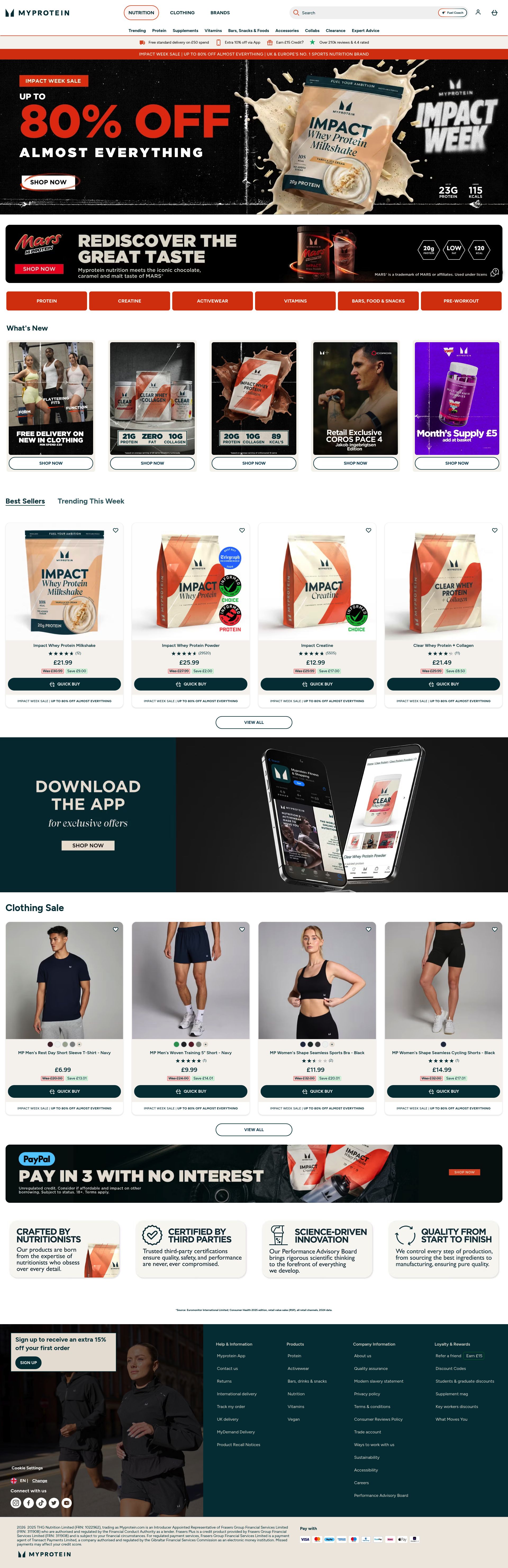
Myprotein is a UK-founded Shopify brand and one of the world's largest sports nutrition retailers, with a product catalogue spanning thousands of SKUs across protein, vitamins, snacks, and performance supplements. The store operates at a scale that most wellness brands will never reach, and studying it is useful for understanding how a Shopify implementation handles catalogue complexity without breaking the customer experience. Faceted filtering by goal, product type, flavour, and dietary requirement is precise and fast, which is critical when the alternative is a customer abandoning a 2,000-product catalogue after 90 seconds.
The pricing architecture is worth examining for any brand that runs regular promotions. Myprotein runs persistent discount mechanics, including bundle savings, multi-buy offers, and loyalty programme price tiers, but these are surfaced in a way that maintains perceived value rather than signalling that the full price is never real. The loyalty programme, MP Rewards, integrates cleanly into the checkout flow, and the points balance is visible in the cart, which reinforces the retention mechanic at the highest-intent moment. Product page depth is good for a high-volume retailer: nutritional information, Informed Sport batch testing certification, allergen information, and flavour reviews are all present.
10. Innermost

Innermost is a UK Shopify brand that has built a differentiated position in a crowded sports nutrition market through intelligent product naming and goal-led formulation. The range is organised entirely by outcome: The Strong Protein, The Lean Protein, The Recover Powder, The Detox Booster, and so on. Every product name is a benefit statement, which means a first-time visitor to the store can understand the entire range without reading a single product description. That naming strategy is one of the highest-leverage UX decisions available to a supplement brand, and it directly reduces the time to purchase for a buyer who arrives knowing their goal but not their SKU.
The store's design is clean, modern, and consistent across desktop and mobile, with product photography that positions Innermost in a design-forward lifestyle space rather than a gym-centric one. That positioning widens the addressable audience beyond the core gym-goer to include the broader wellness buyer who cares about what a product looks like on their kitchen counter. Bundle mechanics and quiz-based personalisation are both present, and the quiz experience is well-calibrated: four questions, a specific product recommendation, and a clear add-to-cart path with no unnecessary friction between the quiz result and the checkout. The blog content is high quality, written to a research-curious audience, and it supports both organic search acquisition and post-purchase retention.
Comparison
| Brand | Niche Focus | Price Point | Shopify Standout |
|---|---|---|---|
| Huel | Complete nutrition, meal replacement | Mid | Use-case navigation, flexible subscription portal, format breadth |
| Ritual | Vitamins, supplements | Mid-premium | Ingredient traceability, clean checkout flow, subscription defaults |
| Form Nutrition | Plant-based performance nutrition | Mid-premium | Ingredient transparency prose, design restraint, goal-led bundles |
| Wild Nutrition | Food-Grown vitamins and supplements | Premium | Life-stage navigation, condition-led collection architecture |
| AG1 | Greens supplement, daily nutrition stack | Premium | Subscription-first funnel, long-form objection handling on PDP |
| Puresport | CBD, sports supplements, recovery | Mid | Goal-led collections, Informed Sport trust signals, mobile checkout |
| Heights | Brain health supplement stack | Premium | Single-product clarity, subscription-only model, content-led retention |
| Whoop | Fitness tracker, health membership | Hardware + membership | Video-led PDP, hardware-subscription checkout integration |
| Myprotein | Sports nutrition, protein, vitamins | Budget-mid | Catalogue filtering at scale, loyalty programme at checkout, bundle pricing |
| Innermost | Sports nutrition, wellness supplements | Mid | Benefit-first product naming, quiz personalisation, lifestyle positioning |
What These Stores Get Right
-
They lead with goals, not ingredients. The stores that convert best in health and wellness route the customer through what they want to achieve, better sleep, more energy, faster recovery, before presenting a product or ingredient. Wild Nutrition, Heights, and Innermost all navigate by outcome, which is how buyers actually think.
-
Subscription mechanics are built into the product page, not added at checkout. Huel, Ritual, AG1, and Heights all treat subscription as the primary purchase mode and make the monthly saving concrete, visible in pounds rather than percentages, at the point where the buyer is deciding. That single decision carries a disproportionate impact on long-term revenue.
-
Ingredient transparency is the trust signal, not brand storytelling. In a category where buyers have been burned by underdosed or mislabelled products, specific and verifiable claims outperform emotional brand narrative. Form Nutrition, Wild Nutrition, Ritual, and Puresport all lead with formulation specifics. Vague wellness language is an active conversion liability.
-
Product education is built into the purchase flow, not siloed in a blog. The most effective product pages in this list handle the education problem inline, FAQ sections, ingredient breakdowns, how-to-use guidance, so the customer never has to leave the page to answer a question that is holding them back from buying.
-
Simplicity is the premium signal. Across price points, the stores that feel most premium are the ones that are most disciplined about what they remove from the page rather than what they add. Form Nutrition, Ritual, and Heights all convert at premium price points with minimal visual clutter, because a clean store signals confidence in the product.
If your health and wellness store is not converting the way these brands do, the gap is usually in the product page architecture, the subscription experience, or the trust signals. See our Shopify design service or get in touch to talk through what is possible.
Frequently asked questions
Which health and wellness brands use Shopify?
Huel, Ritual, Form Nutrition, Wild Nutrition, AG1, Puresport, Heights, Whoop, Myprotein, and Innermost all run on Shopify or Shopify Plus. Shopify Plus is the dominant platform in this vertical because it handles subscription mechanics, high-volume catalogue management, and international commerce without requiring a fully custom build.
What makes a health and wellness Shopify store convert well?
The highest-converting stores in this space share three things: goal-led navigation that routes buyers by outcome rather than product format, subscription mechanics embedded in the product page rather than introduced at checkout, and ingredient transparency that is specific and verifiable rather than vague. Brands like Ritual, Form Nutrition, and AG1 lead with formulation specifics because buyers in this category have been burned by underdosed products and trust concrete claims over brand storytelling.
How do health supplement brands handle subscriptions on Shopify?
The best implementations, Huel, Ritual, Heights, and AG1, treat subscription as the primary purchase mode and make the monthly saving visible in pounds at the point of decision. Heights goes furthest by offering no one-time purchase option at all. The subscription management portal matters as much as the sign-up flow: churn in this category is usually driven by inflexibility, not dissatisfaction with the product, so pause and swap controls surfaced clearly in the member portal are a direct retention lever.
What trust signals work best for health and wellness ecommerce?
Third-party testing certifications are the highest-trust signals available: Informed Sport batch certification is cited by Puresport and Myprotein, and it carries significant weight with athletic buyers who have learned to read labels. Beyond certification, traceable ingredient sourcing (Ritual's approach), named clinical dosing rationale, and specific athlete endorsements with performance metrics all outperform generic five-star reviews. Vague wellness language and unverifiable claims are active conversion liabilities in this category.
How should a health and wellness store structure its product pages?
Lead with the functional headline, what this product does for the buyer, before presenting SKU options or flavour choices. Handle ingredient education inline rather than linking out to a blog, because customers who leave the product page to answer a question rarely return. Place subscription savings in concrete pound amounts next to the add-to-cart button. AG1 and Heights both use long-form product pages that sequence through every major objection before the buyer reaches checkout, and this structure correlates directly with conversion at premium price points.