
Quick summary
Bulk sets the benchmark for protein ecommerce in the UK: subscribe-and-save pricing surfaced inline on the PDP, a goal-led mega-menu, and a loyalty scheme integrated directly into the basket. Huel takes the subscription model furthest, defaulting every PDP to subscribe rather than one-off purchase, which is why the majority of their revenue comes from repeat customers. Form Nutrition is the standout pick for premium plant-based protein, with ingredient-provenance copy and photography that justifies a higher price point without relying on gym imagery. Purition leads on niche positioning, targeting low-carb and satiety buyers with a quiz-based product finder that converts better than a generic bestseller surface.
Protein powder is a commodity product trying hard not to be. The brands that win on Shopify in this space are the ones that have turned a functional purchase into a considered one: using product page depth to justify premium pricing, subscription mechanics to protect repeat revenue, and flavour selectors, bundle builders, and compare tools to lift average order value. Here are ten stores doing that well.
1. Bulk
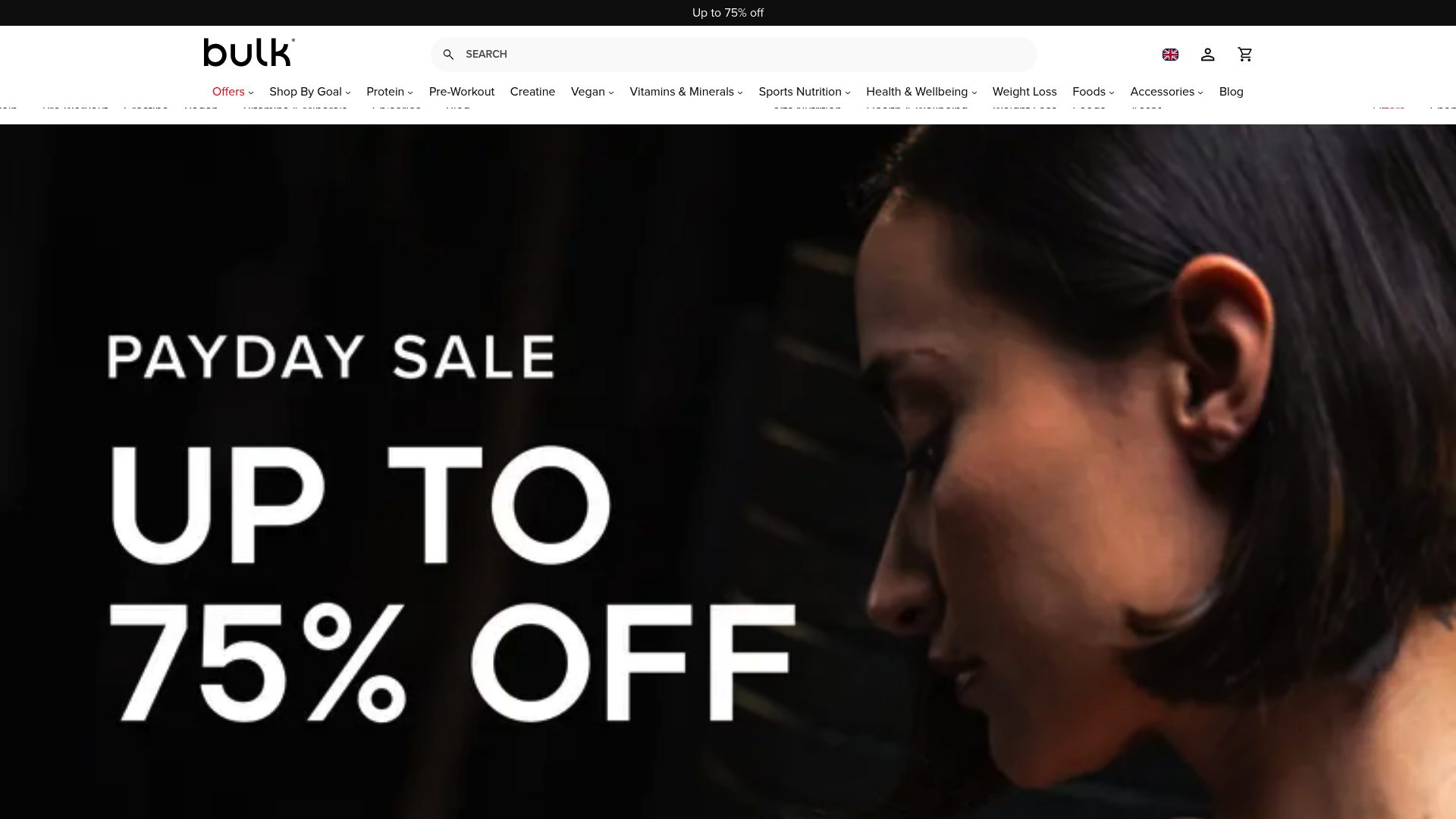
Bulk (formerly Bulk Powders) is the benchmark for high-volume supplement ecommerce in the UK. Their Shopify Plus store handles one of the widest supplement catalogues of any DTC brand and does it without the navigation becoming unmanageable: a mega-menu structured by goal (build, perform, recover) runs alongside a browse-by-product-type route, covering both customer mindsets in a single header. Product pages show per-serving macros prominently above the fold, which is the right call for a customer who has already decided to buy protein and is now comparing options. The flavour selector loads variant images rather than just swapping a colour swatch, which reduces the uncertainty that kills conversions in this category.
Bulk surfaces their subscription offering aggressively: subscribe-and-save pricing is shown inline on the PDP before a customer adds to cart, not buried in a separate landing page. That placement matters. Customers who see the subscription discount at the moment of decision are far more likely to opt in than those who encounter it post-purchase. The loyalty points programme is integrated into the basket, showing the points earned on each order in real time, which reinforces the value of buying direct over Amazon.
2. Myprotein
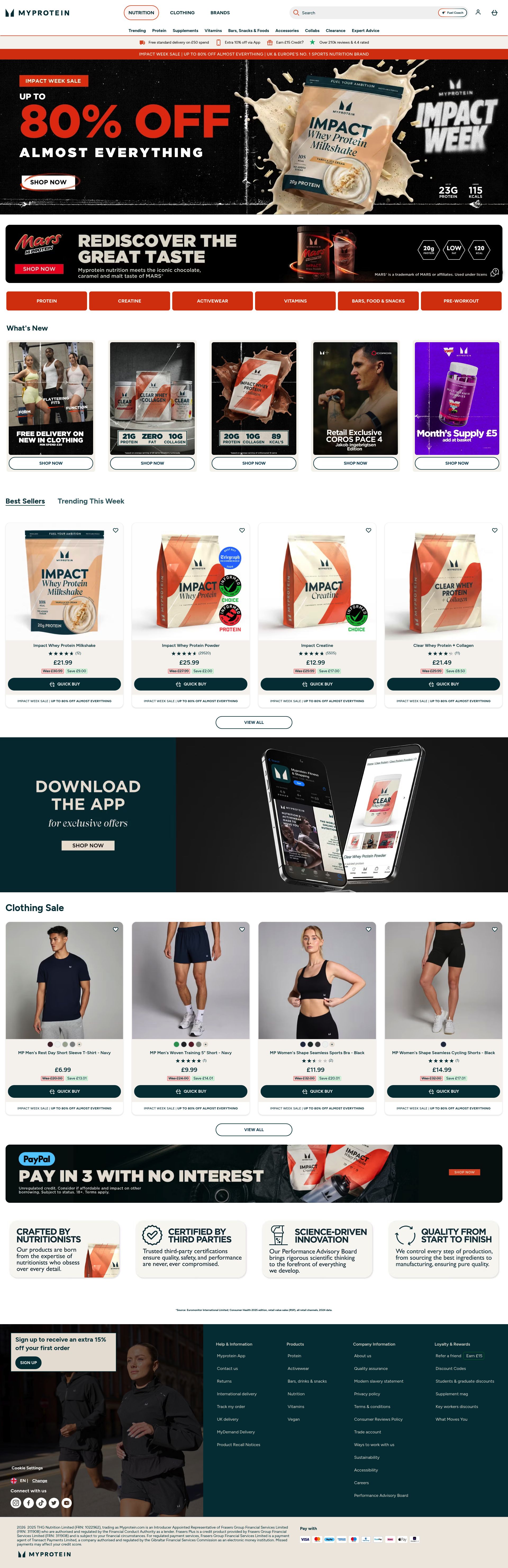
Myprotein operates at a scale that few supplement brands reach, and their Shopify Plus infrastructure reflects it. The store's primary conversion mechanic is volume discount: bundle pages, multi-bag deals, and tiered pricing are prominent across collection and product pages. For a price-sensitive customer buying in bulk, this framing works well. The "Mega Deal" and "Sale" navigation items sit at the top level of the menu, which tells you exactly who Myprotein is optimising for.
Their product pages carry a heavy amount of content: nutritional panels, third-party certifications (Informed Sport), detailed ingredient breakdowns, and a large volume of customer reviews. The review system allows filtering by goal and flavour, which makes it more useful than a standard star-rating aggregation. The flavour range on Impact Whey Protein (over 40 flavours) is a conversion risk as much as a selling point; Myprotein manages it through a sticky flavour selector bar that keeps the most popular options visible without scrolling. The bundle builder for starter packs is a smart entry-point for new customers who do not yet know what they need.
3. Huel
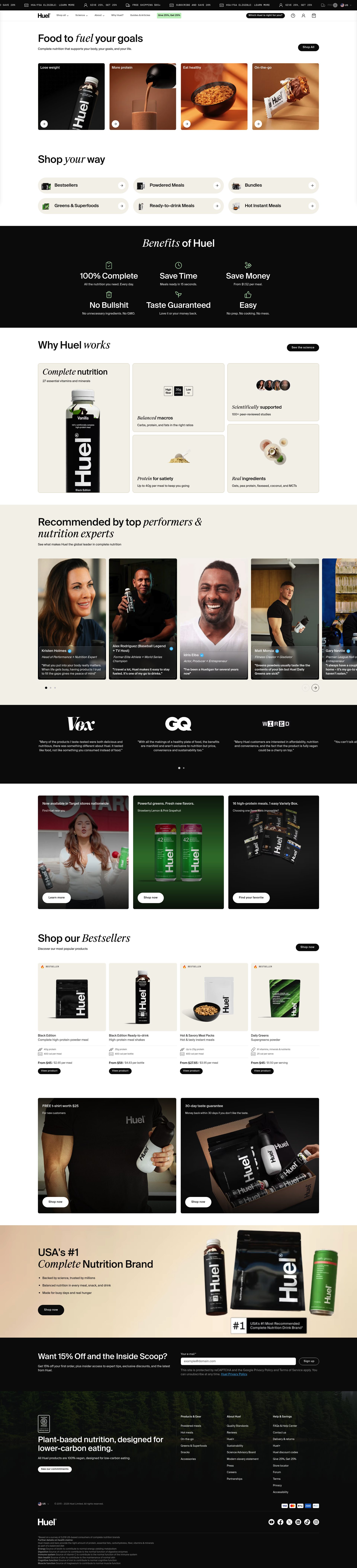
Huel is not a traditional protein brand, but their store is one of the most studied DTC ecommerce builds in the UK supplement space. The subscription-first model is hardwired into how the store presents product: the default state on every PDP is the subscribe option, with one-off purchase as the secondary choice. This is the opposite of most stores, and it shifts the opt-in rate significantly. Huel reports that the majority of their revenue comes from subscribers, and the store architecture is designed to produce that outcome.
Their product pages make a credibility-first argument: complete nutrition profiles, third-party testing references, and a product comparison table that positions each SKU clearly. The checkout upsell offers single-serve samples at low cost, which is a low-friction way to drive trial of adjacent products. Huel's blog and nutrition hub sits within the same Shopify domain and feeds SEO traffic directly into the store funnel, which keeps acquisition costs contained.
4. Form Nutrition
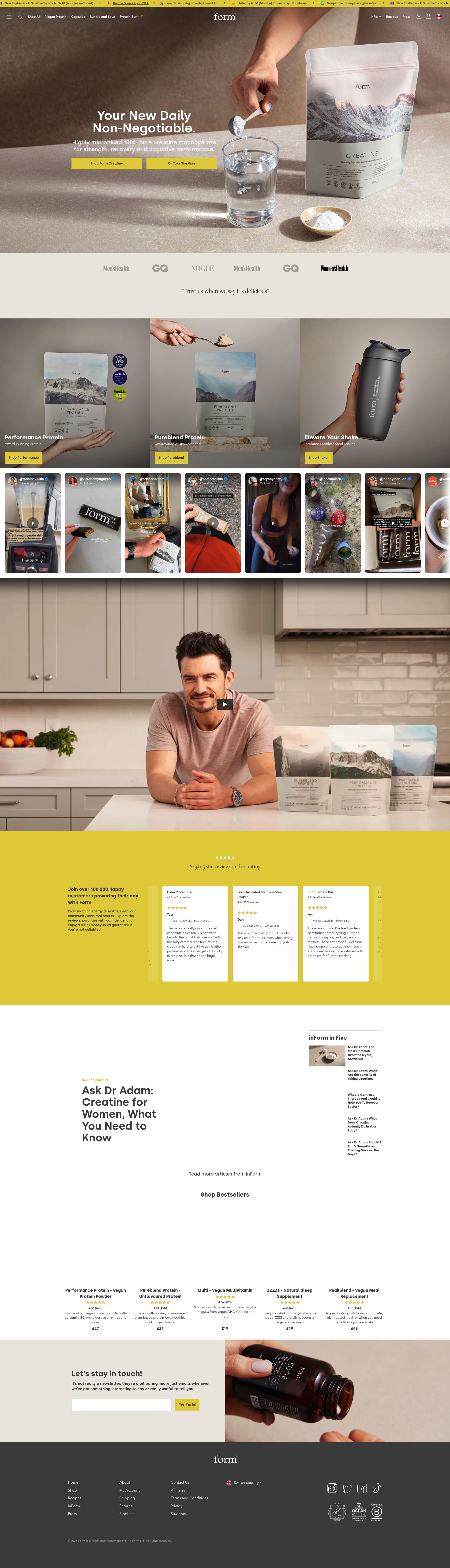
Form Nutrition targets the premium end of the protein market: plant-based, clean-label, aesthetically considered. Their store reflects that positioning in every design decision. The PDP layout puts ingredient provenance first: where each protein source comes from, why it was chosen, and what it is free from. This is a different information architecture from mass-market protein stores, and it is calibrated to a buyer who reads labels and distrusts vague health claims.
Subscription mechanics are clean and prominent without being aggressive: the subscribe option shows a clear percentage saving and the option to adjust delivery frequency before subscribing. That control reduces subscription anxiety, particularly for a first-time buyer who is not yet certain about how quickly they will use the product. Form's photography is consistently high quality throughout: styled product shots on minimal backgrounds, no in-your-face gym imagery, which reinforces the lifestyle positioning and justifies the price premium.
5. Purition
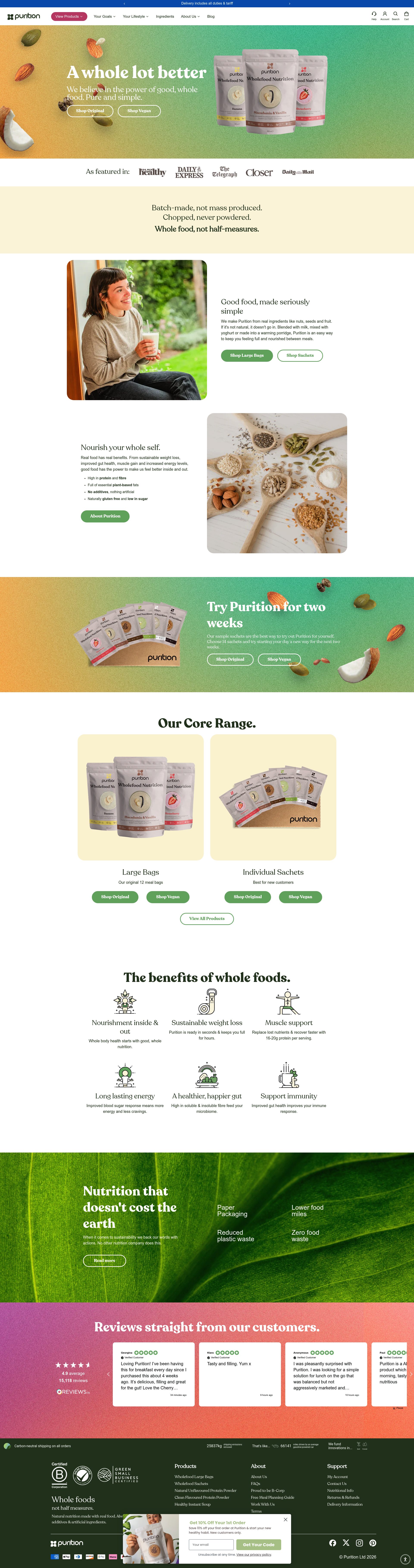
Purition occupies a distinct niche: real-food wholefood protein shakes aimed at people interested in low-carb eating and satiety rather than muscle gain. Their store is a strong example of niche positioning done well in Shopify. The homepage leading message is not about protein grams or gym performance; it is about fullness and clean ingredients. That framing immediately filters for the right customer and reduces bounce from people who are looking for a mass-gainer.
Their quiz-based recommendation flow is one of the better product finder implementations in this category: it asks about goals (weight loss, energy, sport) and dietary preferences, then surfaces two or three relevant products with a brief explanation of why each was recommended. This converts better than a generic "best seller" surface because it makes the recommendation feel personalised. Product pages carry detailed ingredient breakdowns and a short paragraph explaining each key ingredient, which builds trust with a health-conscious audience that is sceptical of supplement marketing.
6. Innermost

Innermost has built a supplement brand around the idea that most protein products contain ingredients they do not need. The store opens with that argument, and every product page reinforces it: short ingredient lists, each ingredient explained in plain English, no proprietary blends. For a buyer who has become cynical about the supplement industry, this positioning is compelling.
Their product quiz does what the best product finders do: it narrows a broad catalogue into a personalised recommendation without requiring the customer to understand supplement jargon. The bundle builder is structured around goals (the "The Strong Bundle", "The Lean Bundle") rather than forcing the customer to assemble combinations themselves. This reduces decision fatigue and lifts AOV simultaneously. Innermost also uses a smart cross-sell on the cart page: a complementary product shown with a brief explanation of why it works alongside the item already in the basket.
7. Phd Nutrition
Phd Nutrition's Shopify store sits in the middle of the market: more performance-focused than Huel or Form, more premium than Myprotein or Bulk. Their PDP structure is built around sport-specific positioning: product pages for pre-workout, whey, and recovery products each carry use-case copy that goes beyond generic claims, naming specific training contexts. That specificity narrows the audience but increases conversion rate among buyers who identify with the described use case.
Their Informed Sport certification is displayed prominently across relevant products, which matters for the competitive athlete segment where third-party testing is a genuine purchase criterion rather than a marketing footnote. The store handles a large SKU count through effective filtering on collection pages, including a protein type filter (whey, casein, plant) that sits above the grid rather than in a sidebar, reducing the number of clicks to find the right category.
8. Neat Nutrition
Neat Nutrition's store is a clean, focused DTC build with a short catalogue and high clarity. The homepage communicates three things in under ten seconds: clean ingredients, UK-made, and flavours designed for taste rather than just function. Product pages carry honest nutrition panels and short copy that does not overclaim. For a brand competing on quality rather than price, this restraint is the right move: it signals confidence in the product rather than compensating for mediocrity with marketing language.
Their repeat purchase retention is handled through a loyalty scheme surfaced clearly in the account area and in post-purchase email flows. The store's bundle option pairs a protein with a complementary product at a small saving, which is a simple but effective AOV lever for a brand with a small catalogue. Customer photography is integrated throughout collection pages, which adds social proof in a format that feels authentic rather than staged.
9. Protein Works
Protein Works competes directly with Bulk and Myprotein on price and range breadth, and their store reflects that: the primary CTA on the homepage is a multi-buy offer, and collection pages lead with deal-stacked product cards. Their flavour range is extensive and the flavour selector is prominent, with a "most popular" label used selectively to reduce paralysis in a large option set. Bundles are structured by training goal and presented with a clear saving versus buying individual items.
Their product pages carry a detailed FAQ section below the fold, addressing common questions about protein type, sourcing, and suitability for dietary requirements. This reduces pre-purchase friction for a newer buyer while not cluttering the above-the-fold conversion zone for the returning customer who already knows what they want. Protein Works runs frequent discount promotions, and their email capture popup offers an immediate first-order discount, which is effective for a price-led brand where the acquisition discount has a high conversion rate.
10. Optimum Nutrition
Optimum Nutrition's Gold Standard Whey is arguably the best-known protein product in the world, and their Shopify store has to carry that brand weight while competing with DTC-native brands who have more flexible infrastructure. The store handles the challenge reasonably well: the PDP for Gold Standard Whey is detailed, with a large volume of customer reviews, clear macros, and a size selector (1lb, 2lb, 5lb) that is prominent in the variant picker. Informed Sport certification is displayed inline, which is important at a price point where buyers want reassurance about product integrity.
The subscription option is present but less prominently positioned than on Huel or Bulk, which likely reflects the brand's older customer base and its distribution through third-party retail. The store's navigation benefits from a tight core catalogue: Gold Standard Whey drives the majority of traffic, and the store does not try to bury it in a sprawling product architecture. For a legacy brand competing with DTC-native challengers, that simplicity is the right call.
If your supplement or nutrition store is not converting at the level these brands achieve, the difference is usually down to PDP structure, subscription UX, and how clearly you surface value. See our Shopify design service or get in touch to talk through what is possible.
Frequently asked questions
Which protein powder brands use Shopify?
Bulk, Huel, Form Nutrition, Purition, Innermost, PhD Nutrition, Neat Nutrition, and Protein Works all run on Shopify or Shopify Plus. Myprotein operates on a custom platform at scale, while Optimum Nutrition uses Shopify for their direct-to-consumer store alongside their retail distribution.
What makes a high-converting protein powder product page?
Per-serving macros visible above the fold, a flavour selector that loads variant images rather than just swapping a colour swatch, and subscribe-and-save pricing shown inline before the customer adds to cart. Brands that bury subscription options in a separate landing page see significantly lower opt-in rates than those surfacing the offer at the moment of decision.
How do protein powder stores handle large flavour ranges without hurting conversion?
The strongest implementations use a sticky flavour selector bar that keeps the most popular options visible without scrolling, combined with a "most popular" label to reduce paralysis in a large option set. Myprotein uses this approach across their Impact Whey range which has over 40 flavours. Showing customer reviews filterable by flavour also reduces purchase anxiety for less familiar options.
What subscription models do the best protein Shopify stores use?
Huel defaults the PDP to subscribe rather than one-off purchase, making subscription the path of least resistance. Bulk shows subscribe-and-save pricing inline on the product page before add-to-cart. Form Nutrition lets customers set delivery frequency before subscribing, which reduces first-time subscription anxiety. All three approaches outperform the standard model of surfacing subscription only in post-purchase flows.
How do premium protein brands justify higher prices on Shopify?
Form Nutrition and Innermost both lead with ingredient provenance: where each protein source comes from, why it was chosen, and what it is free from. Innermost displays short ingredient lists with plain-English explanations for each ingredient, directly addressing buyer scepticism about proprietary blends. Neat Nutrition relies on restraint: short copy that does not overclaim, honest nutrition panels, and customer photography throughout collection pages rather than staged gym imagery.