
Quick summary
Cowboy leads the field with the cleanest high-ticket DTC execution in Europe: real-world battery range framing, zero checkout friction, and a subscription servicing model introduced at exactly the right moment post-decision. Lectric eBikes is the strongest pick for volume DTC at accessible price points, with review content and comparison cards that do the conversion work most e-bike stores leave to the customer. Ribble Cycles stands out for its live-updating built-to-order configurator, which reduces returns and lifts confidence on bikes priced up to £3,500. Tern is the best content-led example in the category, with cargo model pages that remove every consideration-stage objection for parents evaluating an e-bike as a car replacement.
E-bikes are one of the highest average order value categories in DTC ecommerce: a typical commuter e-bike sits between £1,500 and £4,000, and some cargo models push past £7,000. Selling at that price point online demands more than good photography. The stores that convert well here understand that the customer has specific concerns — battery range, build quality, warranty, and servicing — and they answer those concerns at every step of the funnel. These ten do it better than most.
1. Cowboy

Cowboy's Shopify Plus store is one of the cleanest high-ticket DTC executions in the European market. The homepage leads with the product without apology: full-bleed video, a single hero CTA, and no category clutter. Their product pages do the heavy lifting on spec anxiety: battery range is presented as real-world distance by commute scenario rather than lab figure, which is a smarter conversion choice than publishing a raw Wh number most buyers cannot interpret. The connected app integration is woven into the product story throughout rather than treated as a feature footnote.
Cowboy uses a subscription servicing model layered on top of the one-time purchase, and the store introduces this at the right moment: after the product decision is made, not before. Pricing is presented without ambiguity, and the checkout does not introduce unwanted friction with excessive upsells. Returns and warranty information is detailed without being buried in a footer link.
2. Ribble Cycles
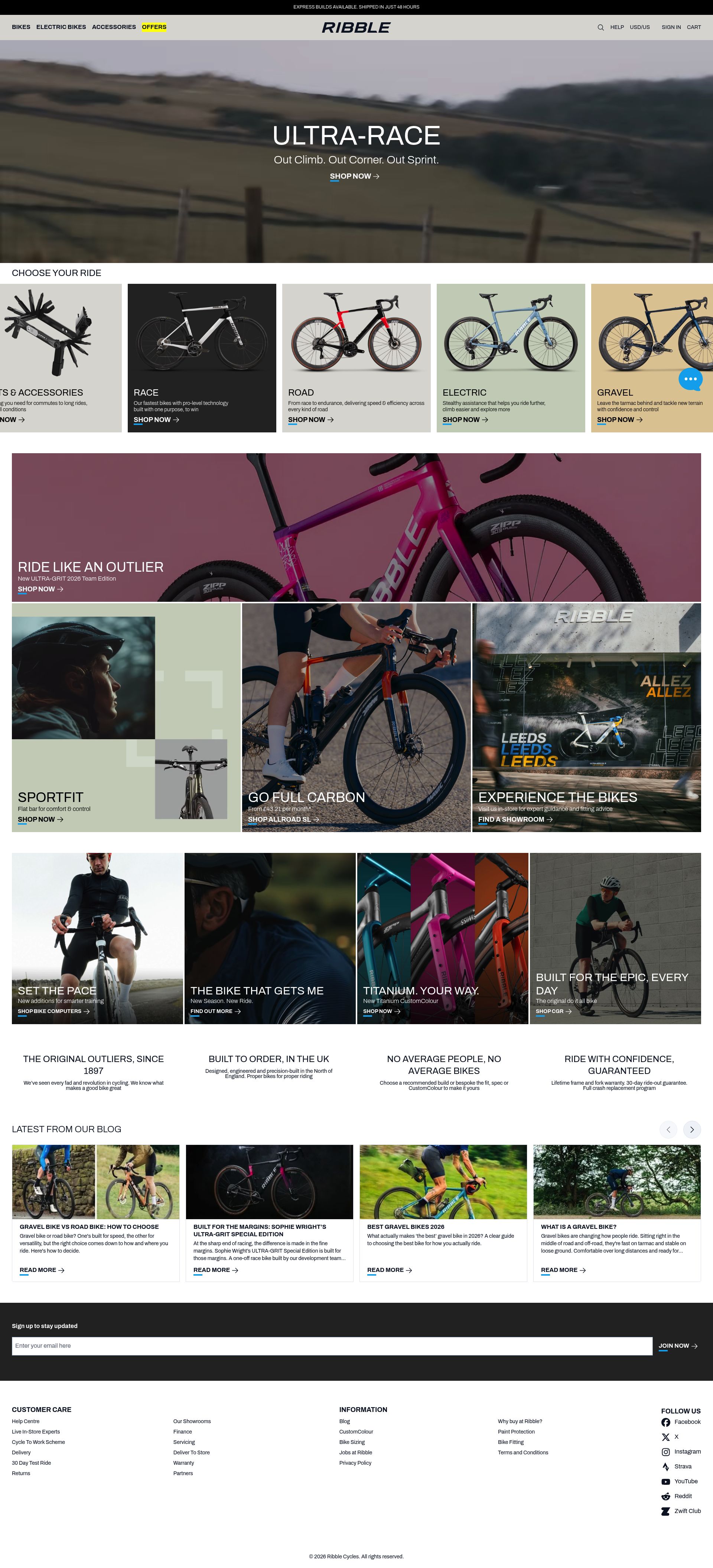
Ribble's e-bike range sits within a broader cycling store, but the e-bike category pages are well separated and the range is genuinely strong. Their built-to-order configurator is the most powerful conversion tool on the site: customers can choose frame size, colour, groupset, and wheel specification before buying, which reduces returns and increases purchase confidence at a price point where both matter. The configurator output is reflected live in product images, which is a UX detail that most Shopify cycling stores do not match.
Ribble's financing integration is prominent throughout. A £3,500 bike is presented alongside a monthly payment figure on the product card, not just on the PDP. That placement matters because many customers filter by affordability before they even click into a product. The brand's Lancashire heritage is used consistently in copy and imagery without tipping into nostalgia cliche.
3. Gocycle

Gocycle sells a premium folding e-bike at prices that start above £2,000, and their store is built to justify that positioning. Product pages open with clean industrial photography that communicates precision engineering before the spec sheet. The folding mechanism is demonstrated via short looping video embedded directly in the PDP, which removes the biggest consideration-stage question without requiring the customer to watch a YouTube video and risk losing them.
Their comparison page sets Gocycle models against each other, not against competitors, which is a deliberate framing choice: it keeps the buyer inside the Gocycle ecosystem and positions the decision as which model, not whether to buy. This is a smart tactic for a brand at the premium end of a niche category. Dealer localisation helps convert customers who want to test ride before committing.
4. Lectric eBikes

Lectric eBikes is the largest e-bike DTC brand in the United States and a strong case study in volume DTC at accessible price points. Their store manages a broad range of models, including cargo, fat tyre, and folding variants, without creating navigation confusion. Collection pages use consistent comparison cards showing range, payload, and price side by side, which is the right information architecture for a customer arriving without strong brand familiarity.
Customer review volume is a key asset: most PDPs show hundreds of verified reviews with specific use-case detail (daily commuting, trail riding, towing children) rather than generic five-star comments. That specificity does more conversion work than star rating alone. Bundle deals, accessories upsells, and financing options are all surfaced within the PDP without disrupting the primary purchase flow.
5. Volt Bikes

Volt Bikes is one of the strongest UK-focused e-bike DTC stores and a useful reference for any British merchant selling in the £1,000 to £2,500 range. Their product pages are built around commuter use cases: urban photography, route-specific range claims, and specific callouts about the Cycle to Work scheme make it easy for a buyer to see the bike in their own context. The Cycle to Work scheme banner is persistent across the store, which is the right call given how many UK commuter buyers use this route to finance a purchase.
Volt's returns policy and home trial option are presented as primary selling points alongside the product, not confined to a policy page. That positioning shifts the purchase risk perception significantly. Customer support quality is referenced in review quotes on key landing pages, which adds trust signals for a high-consideration purchase.
6. Amp Bikes
Amp Bikes sells premium urban e-bikes with a design-led positioning that targets the same customer as Cowboy. Their Shopify store reflects that with restrained typography, generous whitespace, and photography that favours lifestyle context over spec sheets. The brand's focus on simplicity is carried into the product architecture: a small, curated range means the customer is never overwhelmed by choice. Each model page is given the depth it needs rather than spreading attention across twenty SKUs.
Financing integration and a detailed FAQ section covering battery degradation, charging infrastructure, and UK e-bike regulations round out the key concern points for a buyer weighing up a significant purchase. Post-purchase content, including a dedicated owner resource area, supports retention and reduces support enquiries.
7. MATE Bike
MATE Bike is a Danish DTC brand with strong European reach, and their Shopify Plus store is built for international scale. The model range covers city, folding, and cargo formats with clear differentiation between them on collection pages. Their homepage merchandising prioritises the hero products without trying to surface the full catalogue immediately, which is the right choice when AOV is above £2,000 and the customer needs to be guided rather than overwhelmed.
MATE's brand storytelling emphasises family and city living rather than performance metrics, which positions the product as infrastructure rather than a gadget. That framing attracts a different, often less price-sensitive buyer than performance cycling brands. Accessory and bundle cross-sells are well integrated into the PDP without pushing the customer into a separate upsell funnel.
8. Specialized
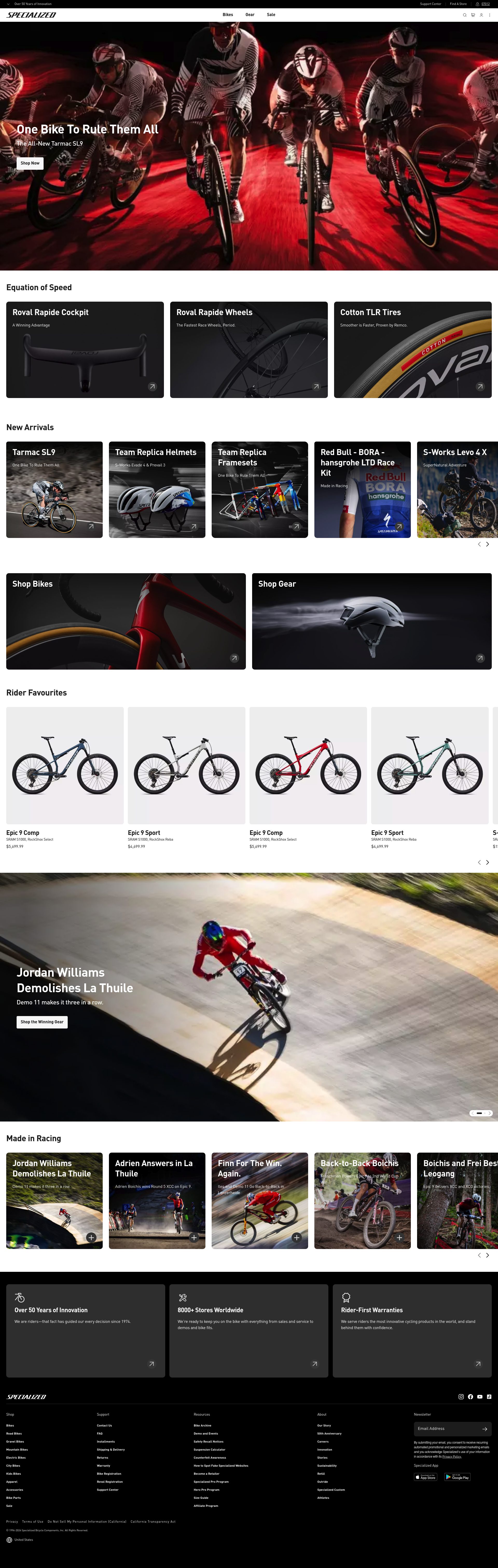
Specialized sells e-bikes as part of a broader performance cycling range, and the e-bike category pages reflect serious product investment: Turbo models are marketed with motorsport-level performance data, specific trail and road use-case claims, and detailed geometry comparisons. Their Shopify store handles a complex multi-currency, multi-region operation while maintaining product page quality that a pure-play DTC brand would struggle to match.
The Specialized Turbo finder tool deserves specific attention: it asks the customer about riding style, terrain, and intended use before recommending a model, which reduces decision paralysis at a price point where choice anxiety is a real conversion blocker. Review integration surfaces both professional test ride data and owner reviews, which serves two different buyer psychology profiles in the same PDP.
9. Trek Bikes
Trek's e-bike range on Shopify covers everything from urban commuters to full-suspension trail bikes with electric assist, and the product discovery architecture reflects that breadth. The e-bike category filter system allows customers to sort by motor type, range, intended use, and price simultaneously, which is essential when a catalogue runs to several hundred SKUs. PDPs carry motor and battery spec data in a consistent format across the range, making comparison easier for the informed buyer.
Trek's retailer finder integration connects online browsing to local stock availability, which is a sensible choice for a high-ticket product where test riding matters. Financing options are surfaced at the category level, not just the PDP, and the brand's global reputation is used throughout as a trust anchor without overexplaining its provenance.
10. Tern
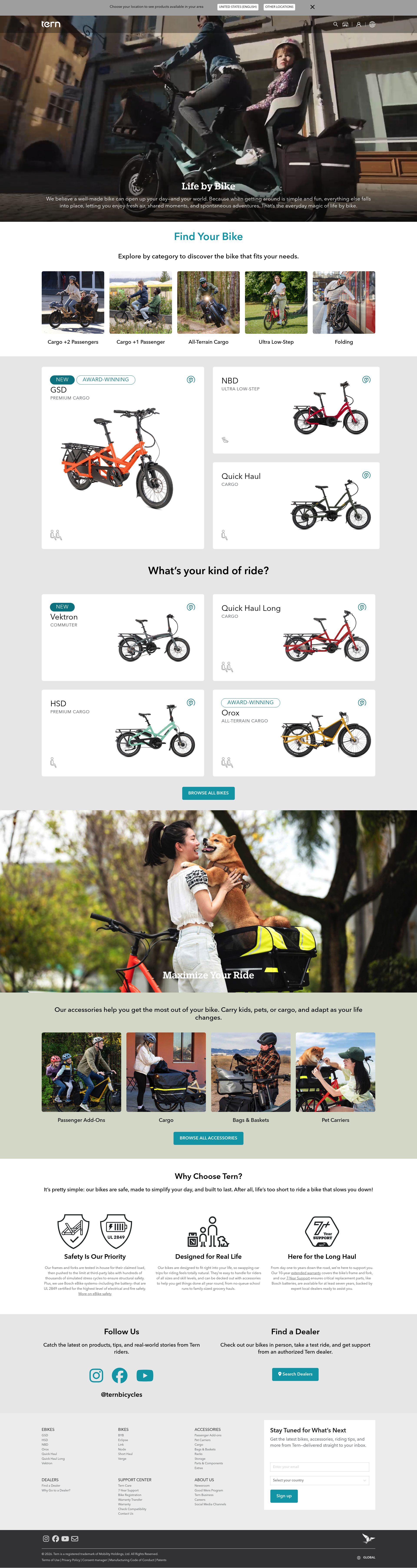
Tern specialises in cargo and folding e-bikes, and their store is one of the best examples in the category of content-led conversion for a niche product. The GSD cargo model, which can carry two children and up to 200kg, has a dedicated product page that leads with parent-focused use cases, school run photography, and specific safety certification callouts. That content focus removes the biggest consideration-stage objections for a parent evaluating a cargo e-bike as a car replacement.
Tern's dealer network integration means the store functions as both a DTC sales tool and a retailer referral system depending on the customer's location. Configurator options for accessories, child seats, and panniers are integrated into the PDP, which increases AOV while keeping the primary product the focus. Long-form use-case content, accessible from within the product pages, builds purchase confidence for what is often a major household transport decision.
If your Shopify store is selling e-bikes or other high-ticket products and you want to close the conversion gap between browsers and buyers, our Shopify design team can help. Get in touch to talk through your project.
Frequently asked questions
Do e-bike brands actually sell direct on Shopify or just use it as a brochure?
Most of the leading e-bike DTC brands — including Cowboy, Lectric eBikes, Volt Bikes, and MATE Bike — run full transactional Shopify or Shopify Plus stores with checkout, financing, and accessories. Brands like Trek and Specialized use Shopify for direct sales alongside their dealer network, with retailer finder tools integrated into the product pages.
How do high-ticket e-bike stores handle price anxiety at checkout?
The best stores surface financing options at the product card level, not just on the PDP — so a £3,500 bike shows a monthly payment figure before the buyer even clicks in. Volt Bikes leads on Cycle to Work scheme messaging, which is a major purchase route for UK commuters. Cowboy's approach is the cleanest: transparent pricing, no excessive upsells in checkout, and warranty terms presented as a feature rather than buried in a footer.
What makes an e-bike product page convert better than a standard ecommerce PDP?
Three things separate the converting e-bike PDPs from the average ones: presenting battery range as real-world commute distance rather than raw Wh figures, embedding a short demo video of the key mechanical feature (folding, motor assist) directly in the page, and surfacing customer reviews that include specific use-case detail rather than generic star ratings. Lectric eBikes does all three consistently across hundreds of SKUs.
Should e-bike stores use a configurator or keep the product range small?
It depends on your positioning. Ribble Cycles uses a full built-to-order configurator with live image updates because their customer is buying a performance-spec bike and wants control over the outcome. Gocycle and Amp Bikes take the opposite approach: a small, curated range removes choice paralysis for a buyer who does not want to spec a bike. Both work — the mistake is offering a large range without a configurator, which creates friction with no payoff.
How important is dealer integration for an e-bike Shopify store?
Very important for any brand above £2,000 where test riding influences the purchase decision. Trek and Specialized both integrate retailer finder tools that surface local stock from within the product page — keeping the customer in the buying mindset rather than sending them off to Google a local dealer. Tern uses dealer localisation to convert customers who want a hands-on experience before committing to a cargo e-bike purchase of £3,000 or more.