

Quick summary
Vitamix leads this list for turning a premium price point into a conversion asset, anchoring every product page around a ten-year warranty rather than specs alone. Lodge Cast Iron is the strongest reference for heritage brand execution on Shopify, with inline care guides that remove the main barrier to first-time cast iron purchases. KitchenAid UK is the benchmark for accessory ecosystems, surfacing compatible attachments directly on the stand mixer PDP at the moment of highest intent. Sous Chef is the standout for editorial-to-commerce integration, converting recipe content and specialist knowledge into purchases across 4,500-plus SKUs.
Kitchen and cookware is one of the most commercially challenging niches in ecommerce. Products span a wide range of price points, materials require explanation, compatibility matters, and gifting drives a significant share of annual revenue. Buyers arrive with research already done, and the stores that convert them are the ones that meet that intent with depth rather than marketing noise. These ten Shopify stores do that well. Each one has made specific, deliberate decisions about product education, navigation, and trust that are worth studying if you operate in this space.
1. Vitamix

Vitamix sells blenders at price points that most kitchen appliance brands would consider impossible to justify online. Their Shopify Plus store handles that challenge head-on by making the case for longevity, not just performance. Every product page leads with the ten-year full warranty, positioning it as the centrepiece of the value argument rather than a footnote in the returns section. The "why Vitamix" content is embedded directly in the buying journey, not tucked behind an About page: comparison tables show the specific difference between commercial and household models, and the certified reconditioned range gives price-sensitive buyers a credible entry point without diluting the brand.
The store's trade and commercial section is well-separated from the consumer journey, which means restaurant buyers and domestic buyers each land in a relevant experience without one audience polluting the other. Refurbished product merchandising is particularly smart: Vitamix presents its certified reconditioned blenders as a curated category with their own photography and full warranty inclusion, removing the stigma that usually comes with secondary market product on a brand site.
2. Lodge Cast Iron
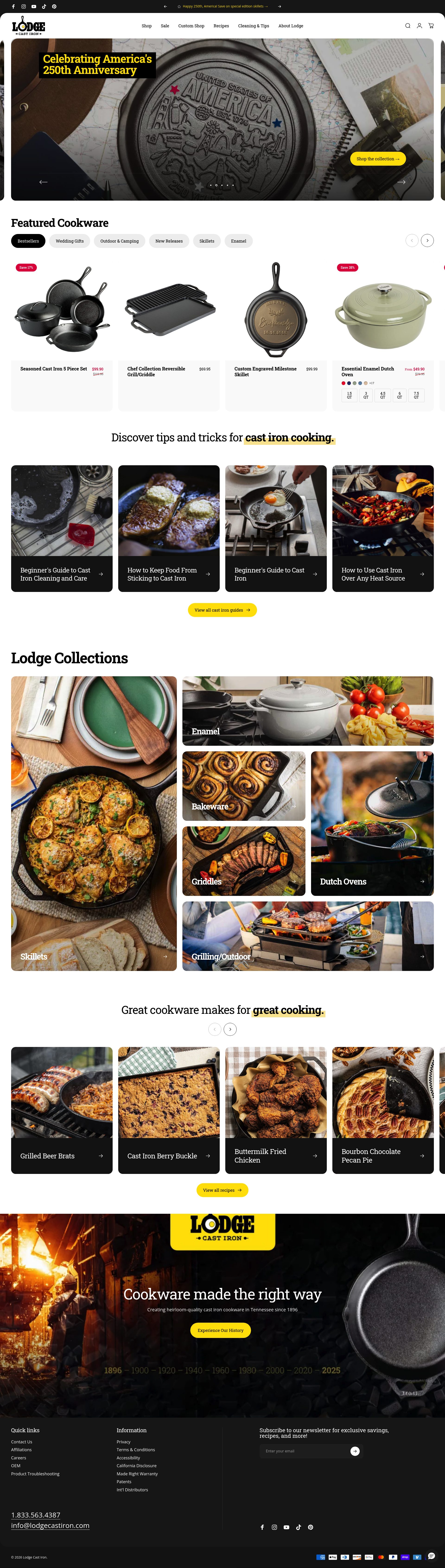
Lodge Cast Iron is the oldest cookware manufacturer still operating in the United States, and their Shopify store manages the tension between heritage brand and modern DTC commerce better than most. The navigation leads with product type, skillet, Dutch oven, griddle, before introducing range or collection, which reflects how buyers actually search in this category. Product pages include seasoning instructions and care guidance inline, not buried in a separate FAQ section, which reduces the main barrier to purchasing cast iron for first-time buyers: the perceived difficulty of maintenance.
The store's content investment pays off in the recipe and field-to-table sections, which attract organic traffic from cooking queries and link back to specific products in context. Lodge is transparent about the fact that their skillets arrive pre-seasoned from the foundry in South Pittsburg, Tennessee, which is a provenance detail that earns trust with buyers who are sceptical of mass-produced cookware. Bundle mechanics, combining skillets with recipe books and silicone handle holders, are cleanly executed at the cart stage rather than pushed aggressively on the product page itself.
3. OXO
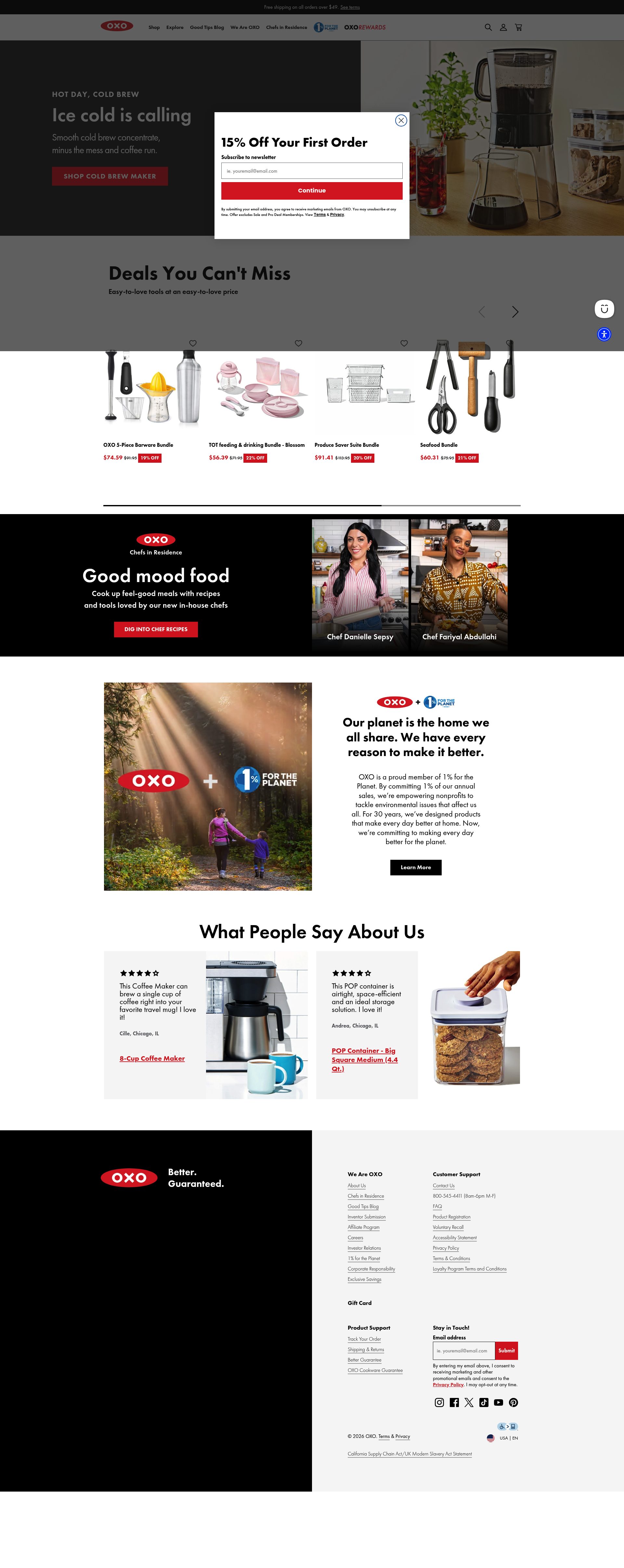
OXO operates across more than 1,000 kitchen product SKUs on Shopify Plus, and their store manages that range without becoming difficult to navigate. The filtering experience on collection pages is genuinely useful: buyers can narrow by product category, material, colour, and compatibility in combinations, which mirrors how a buyer at a kitchen shop would work through a shelf of options. That kind of filtering precision matters at scale because it converts browsing into purchasing intent rather than letting buyers fall off a long category page.
Product pages are concise and action-oriented. OXO relies on the brand's reputation and the physical simplicity of the products, so PDPs do not need to carry heavy educational content. Instead, the detail investment goes into photography: multiple angles, lifestyle settings, and images showing the product in actual kitchen use. Their Good Grips guarantee is surfaced at the product level, which is the right placement for a brand where the quality proposition is the primary purchase reason. OXO also handles kitchen gifting well: curated gift sets by recipient type, cook, baker, bartender, are easy to find and clearly priced.
4. KitchenAid UK
KitchenAid UK runs a Shopify Plus store that handles one of the most complex ecommerce challenges in the appliance category: selling products that are highly personal (buyers choose colours, finishes, and bowl capacities based on their kitchen aesthetic) alongside a deep accessories ecosystem that drives ongoing revenue well beyond the initial machine purchase. The colour selector on the stand mixer product pages is one of the cleaner implementations of a visual variant selector in UK ecommerce: it shows the colour name, live stock status, and updates the product image in real time without a page reload.
The accessories architecture is the commercial engine of the store. KitchenAid surfaces compatible attachments directly on the stand mixer PDP, priced and described at the point of maximum intent, and the "compatible with your model" language removes the compatibility anxiety that normally costs accessory sales. Seasonal bundle pages, combining a mixer with a pasta attachment or a citrus juicer, are timed to gifting peaks and built as standalone collections rather than ad-hoc promotions. For any merchant selling a hero product with a long accessories tail, the KitchenAid UK store is one of the strongest reference points available.
5. Joseph Joseph
Joseph Joseph is a British kitchenware brand that has built one of the most design-consistent Shopify stores in the category. Their product range spans chopping boards, food storage, bakeware, and kitchen organisation, all unified by the signature colour-coded aesthetic that makes Joseph Joseph immediately recognisable and highly giftable. The store does a strong job of merchandising complementary products together: a chopping board collection page will surface the board care oil, the knife set, and the storage stand as natural extensions rather than unrelated upsells.
Their gifting section is well-structured, with price-point filters that help buyers working to a budget land quickly on appropriate options. The Editions range, limited colourways and materials at higher price points, is presented as a distinct collection rather than mixed into the main catalogue, which protects the premium positioning without hiding it. Joseph Joseph's product photography is consistent across every SKU, with the same white background, consistent angle, and uniform scale, which makes collection pages feel cohesive even when the product range is diverse. For kitchen merchants looking to tighten up visual consistency across a wide catalogue, this store is worth spending time with.
6. Zwilling
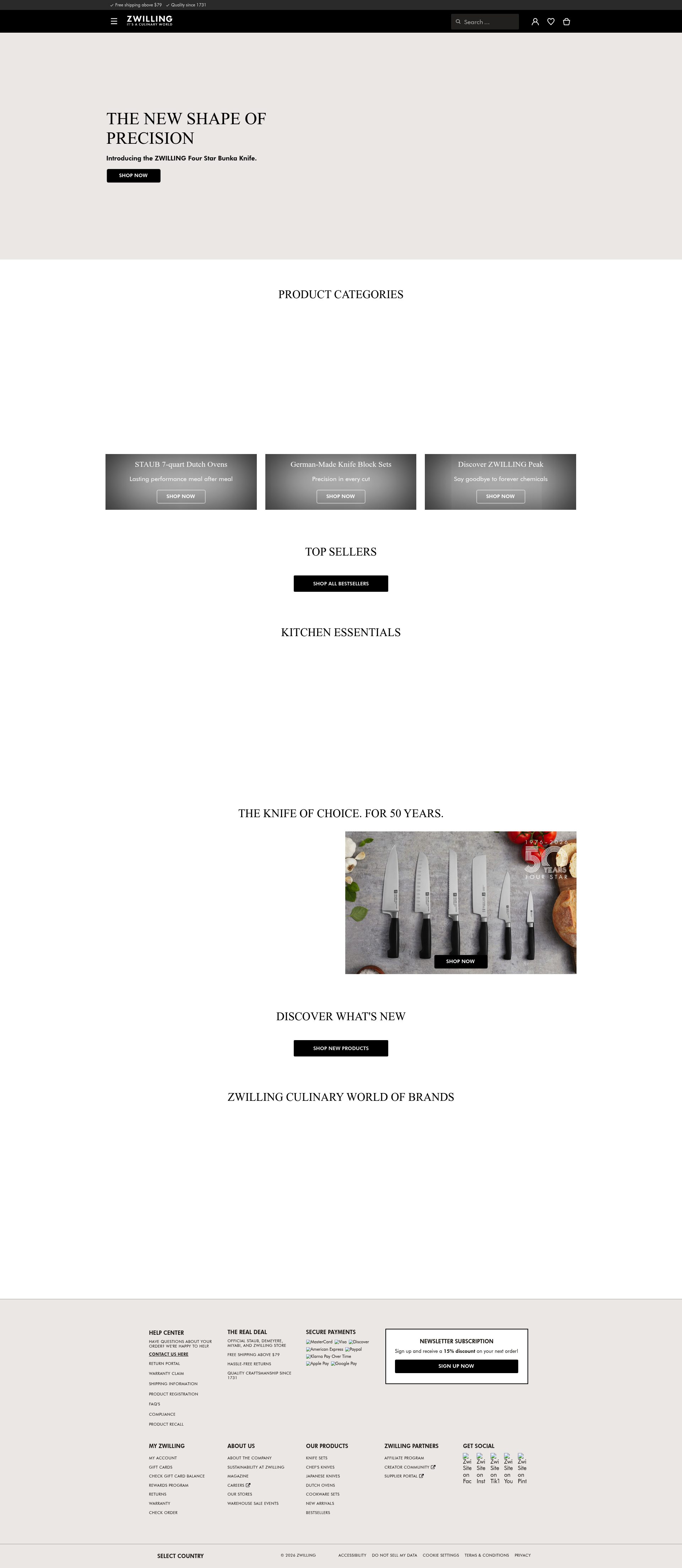
Zwilling is a 290-year-old German knife and cookware manufacturer, and the UK Shopify store reflects both the brand's breadth and its heritage without becoming unwieldy. The navigation separates knives, cookware, and kitchen accessories at the top level, then breaks each category by range within the dropdown: Zwilling, Staub, Ballarini, and Miyabi all sit under one roof but are presented as distinct brands with their own identity. That brand architecture on a single Shopify store is technically and editorially well-executed, and it means buyers arrive in a relevant experience regardless of which brand brought them to the domain.
Product pages for the Staub cast iron range are particularly strong: the cooking medium and heat source compatibility guide sits above the fold, which is the right priority for cookware that works on induction, oven, and open flame but needs explaining clearly. Zwilling's gift boxing service is offered at product level with a clear price, and the corporate gifting section is a separate conversion path for trade buyers. The store's "made in" labelling is prominent on relevant products, with Solingen-made German steel and Japanese-forged Miyabi blades called out by manufacturing location in a way that justifies the price point before the buyer reaches the add-to-cart button.
7. GreenPan
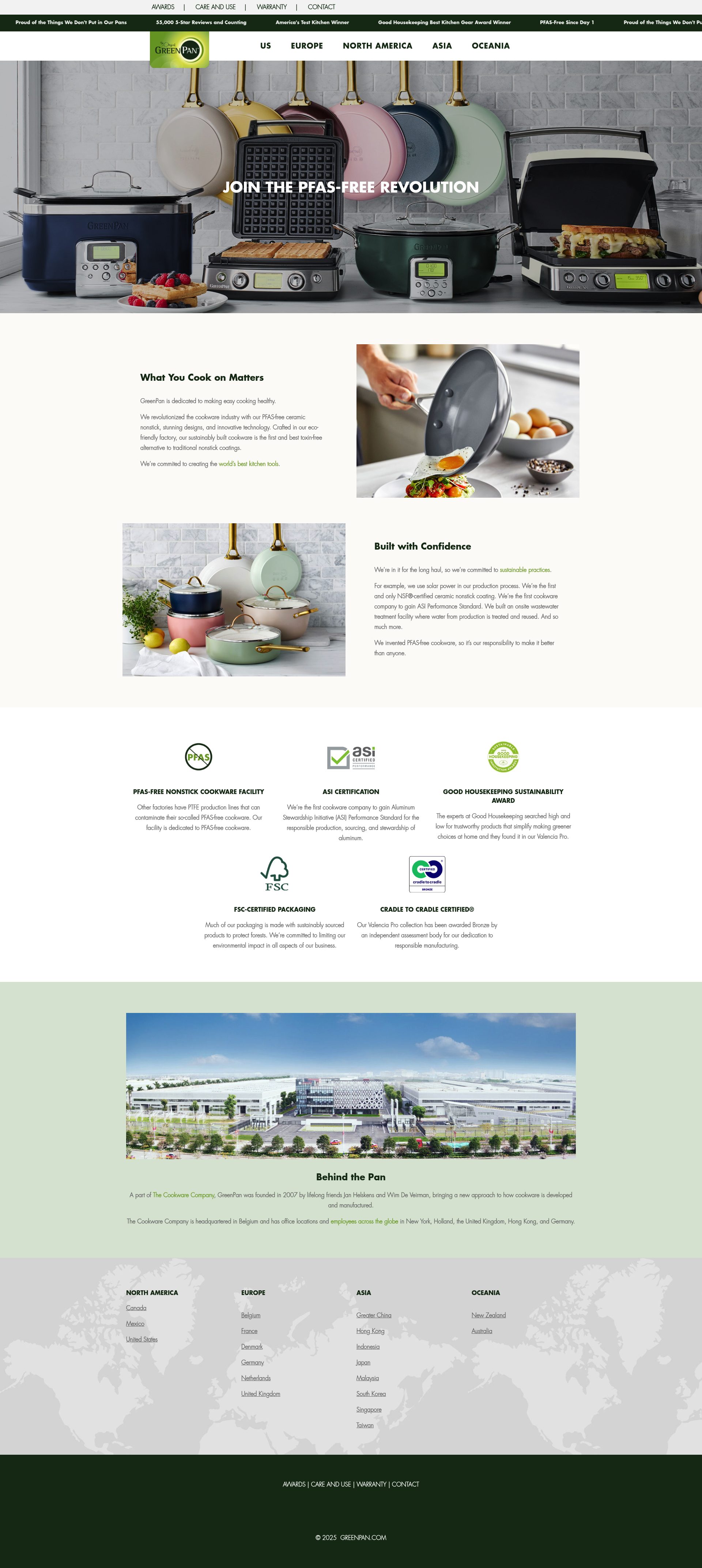
GreenPan built its Shopify store around a single differentiating claim: the world's first non-toxic, PFAS-free ceramic non-stick cookware. Every element of the store reinforces that claim. The homepage leads with the Thermolon ceramic coating technology, explained in accessible language without scientific jargon, and the "why ceramic" section is embedded in the product pages rather than isolated in a brand story section that buyers rarely visit. This means the conversion argument for the technology is present at exactly the moment a buyer is weighing up whether to spend more than they would on a standard non-stick pan.
The range architecture separates entry-level and premium lines clearly, with a comparison table on collection pages that shows coating durability ratings, oven temperature limits, and compatibility by line. That structure helps buyers self-select upwards into higher-margin products rather than defaulting to the cheapest option. GreenPan's sustainability credentials, recycled packaging, carbon offset commitments, are surfaced in a dedicated section but not overloaded across every page, which keeps the conversion focus on the product while allowing the brand to speak to an audience that genuinely cares about environmental credentials.
8. Sous Chef
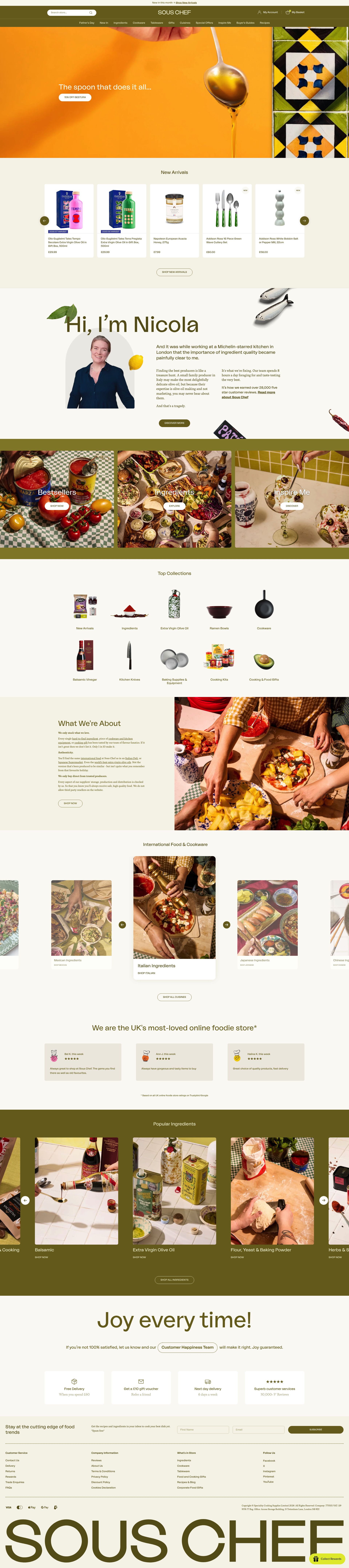
Sous Chef is a UK specialist ingredient and kitchen equipment retailer whose Shopify store is one of the strongest examples in the category of how to turn editorial expertise into commercial outcomes. The store sells over 4,500 SKUs across pantry ingredients, cookware, and kitchen tools, and the navigation manages that range through curated collections, recipe-led editorial, and chef-endorsed selections that give buyers a route in based on interest rather than just product category. A buyer who arrives via a recipe for miso-glazed aubergine is routed to the miso, the miso-compatible cookware, and a curated Japanese pantry selection in a way that feels like guidance rather than upselling.
Product descriptions are written to a standard that is genuinely unusual in UK ecommerce: they name the ingredient origin, explain the flavour profile, and suggest specific uses rather than defaulting to generic marketing copy. That depth of product knowledge builds trust and reduces returns in a category where buying the wrong thing is common. The gift box builder, allowing customers to create custom ingredient hampers with Sous Chef branding, is a particularly strong revenue stream that the Shopify store supports well. For any kitchen or food merchant who has domain expertise, Sous Chef is the reference point for turning that knowledge into a conversion asset rather than leaving it in a blog nobody reads.
9. All-Clad
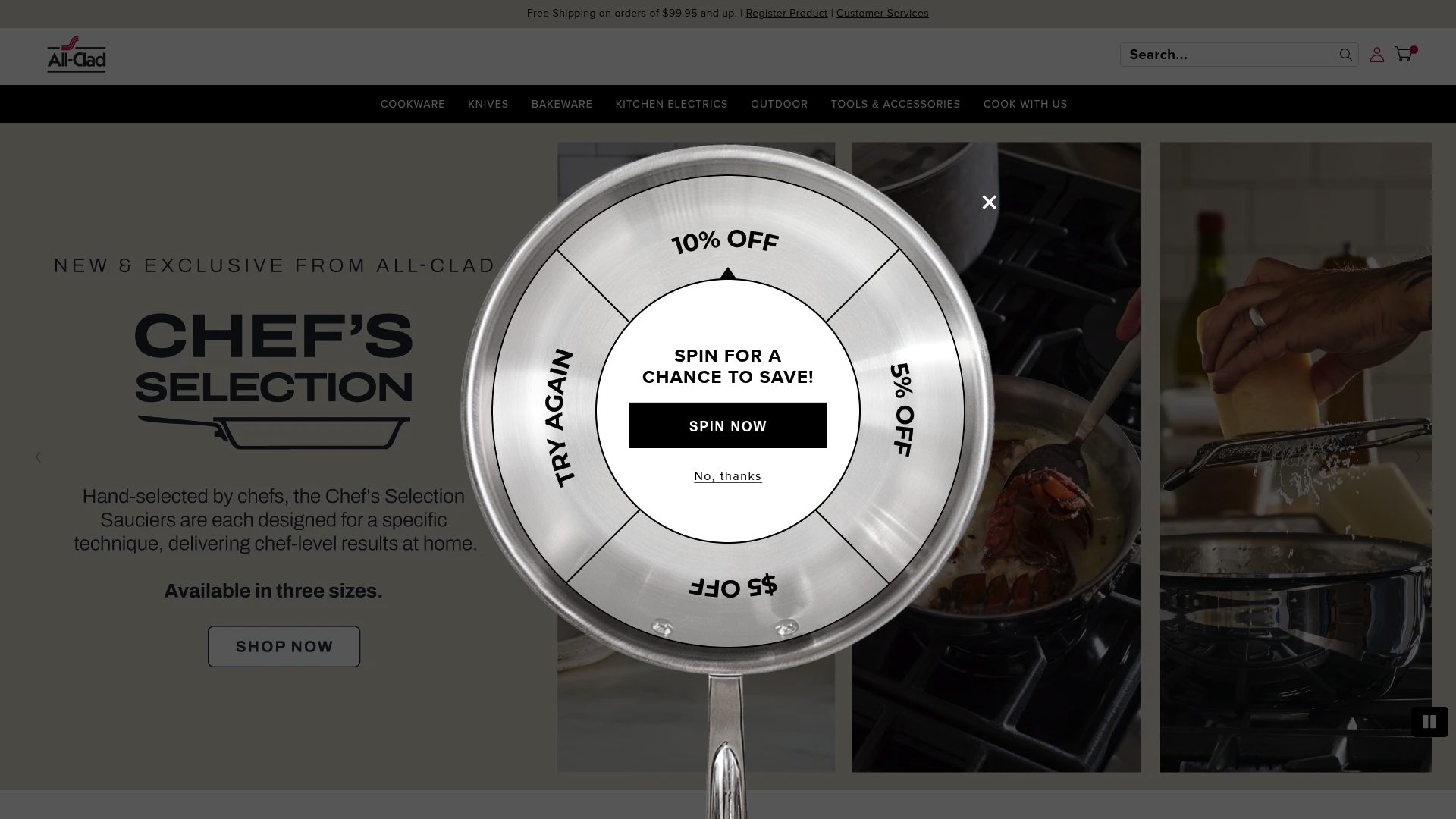
All-Clad manufactures bonded stainless steel cookware in Canonsburg, Pennsylvania, and their Shopify store handles a difficult ecommerce challenge: selling cookware that starts at $150 per piece and goes well above $500 for a complete set, entirely on the strength of manufacturing credentials and cooking performance. The approach that works for them is specificity. Product pages carry the layer count and material composition for each bonded steel construction, whether three-ply, five-ply, or copper core, with a visual cross-section that makes the internal construction readable at a glance rather than described in paragraph form.
The factory story is integrated into the buying experience rather than isolated in a separate brand section: images of the Canonsburg plant and the rolling and bonding process appear on the About page and are referenced in collection landing pages. All-Clad's Seconds Shop, discounted first-quality products with minor cosmetic imperfections, is a commercially smart Shopify execution that captures price-sensitive buyers without discounting the main range or damaging brand perception. The Seconds Shop has its own merchandising logic: each product page clarifies that the cooking performance is identical to the full-price version, which removes the main objection for a category where performance is the purchase reason.
10. Breville

Breville (sold as Sage in the UK, with Breville the international brand) runs a Shopify Plus store that handles one of the most technically complex appliance categories in ecommerce: espresso machines. The way their store structures the buying decision for a product that ranges from £200 to over £1,500 is worth studying regardless of what you sell. A "find my machine" quiz on the homepage routes buyers by experience level, budget, and workflow preference to a shortlist of three to four models, removing the paralysis that comes from browsing a full catalogue of fifteen espresso machines without guidance.
Product pages carry comparison tables that benchmark each model against the one below and above it in the range, so buyers can see exactly what additional capability they are paying for. Video demonstrations show each machine's specific feature in operation, from automatic milk frothing to dual boiler temperature control, which is the only way to communicate those differences credibly without the buyer standing in front of the machine. Breville's store handles accessories and parts well: a "compatible accessories" section on each PDP surfaces the relevant portafilter, tamper, and cleaning kit rather than requiring buyers to navigate a separate accessories section. For any merchant in the premium appliance space, this is the benchmark execution.
Comparison
| Brand | Niche Focus | Price Point | Shopify Standout |
|---|---|---|---|
| Vitamix | High-performance blenders | Premium (£400+) | Certified reconditioned category, 10-year warranty as hero conversion argument |
| Lodge Cast Iron | Cast iron cookware | Mid (£30–£200) | Inline care guides on PDPs, heritage provenance built into conversion |
| OXO | Kitchen tools and gadgets | Accessible (£10–£60) | Advanced filtering across 1,000+ SKUs, gift sets by recipient type |
| KitchenAid UK | Stand mixers and accessories | Premium (£300–£600) | Colour variant selector, compatible accessories surfaced at PDP level |
| Joseph Joseph | Design-led kitchen tools | Mid (£15–£100) | Photography consistency at scale, gifting architecture with price filters |
| Zwilling | Knives and cookware (multi-brand) | Premium (£60–£400+) | Multi-brand architecture on one store, Staub-specific compatibility guides |
| GreenPan | Ceramic non-stick cookware | Mid (£40–£200) | Technology explanation embedded in PDP, range comparison table on collection pages |
| Sous Chef | Specialist ingredients and equipment | Mid (£5–£200) | Editorial-to-commerce integration, custom gift box builder |
| All-Clad | Bonded stainless steel cookware | Premium (£150–£500+) | Seconds Shop execution, visual cross-section of construction on PDP |
| Breville | Espresso machines and appliances | Mid to premium (£200–£1,500+) | Machine finder quiz, model-to-model comparison tables |
What These Stores Get Right
-
Product education is the conversion lever. In kitchen ecommerce, buyers who understand the product are buyers who commit. Every store on this list invests in explanation, whether that is cast iron care guides, ceramic coating science, or espresso machine comparisons. Merchants who treat product pages as data sheets rather than buying guides leave conversion on the table.
-
Navigation mirrors how buyers think, not how warehouses are organised. OXO filters by use case. KitchenAid filters by compatible model. Sous Chef routes by cuisine and occasion. In every case, the navigation structure serves the buyer's mental model, not the merchant's internal taxonomy.
-
Bundle and accessory mechanics drive average order value without discounting. KitchenAid's attachment ecosystem, Lodge's skillet-and-seasoning bundles, and Vitamix's certified reconditioned range all lift revenue per customer without relying on percentage-off promotions. The mechanism is relevance, not discount.
-
Trust signals are placed where the purchase decision happens. All-Clad's Canonsburg provenance appears on collection pages. Vitamix's ten-year warranty is the headline of every PDP. KitchenAid's colour stock status is visible at variant selection. None of these brands bury their strongest credibility signals in the footer.
-
Gifting infrastructure converts seasonal revenue into a repeatable channel. Joseph Joseph's price-point filters, Sous Chef's custom hamper builder, and Zwilling's gift boxing service all treat gifting as a distinct conversion path, not an afterthought. For kitchen brands, where high-ticket gifting occasions like Christmas, weddings, and housewarming account for a significant portion of annual revenue, this is a structural decision worth making early.
If your kitchen or cookware brand is ready to close the gap between where your Shopify store is now and what the stores above have built, our Shopify design service is built for exactly this. Get in touch to talk through what your store needs.
Frequently asked questions
Which Shopify stores are best for selling premium kitchen appliances?
Vitamix and Breville are the strongest references for premium appliance ecommerce on Shopify. Vitamix anchors its conversion argument on a ten-year warranty rather than specs, while Breville uses a machine-finder quiz to route buyers through a £200–£1,500 range without decision paralysis.
How do the best kitchen Shopify stores handle product education on PDPs?
The top stores embed education at the point of purchase rather than hiding it in separate FAQ pages. Lodge includes cast iron seasoning and care instructions inline on product pages, GreenPan explains its Thermolon ceramic technology directly on PDPs, and All-Clad uses visual cross-sections to show internal steel construction without requiring buyers to read dense copy.
What is the best Shopify store for kitchen gifting?
Joseph Joseph and Sous Chef are the strongest references for gifting execution. Joseph Joseph uses price-point filters and a distinct Editions collection for premium gifting, while Sous Chef's custom gift box builder lets buyers create branded ingredient hampers, turning domain expertise into a repeatable high-margin revenue stream.
How do multi-brand kitchen stores manage navigation on Shopify?
Zwilling is the clearest example: it houses Zwilling, Staub, Ballarini, and Miyabi under one domain but presents each as a distinct brand within the navigation and collection architecture. Buyers arrive in a relevant brand experience rather than a generic catalogue, and product pages carry brand-specific trust signals like Solingen provenance for German steel and Japanese forging for Miyabi.
How should a cookware Shopify store handle accessories and bundles?
KitchenAid UK is the benchmark: compatible attachments are surfaced directly on the stand mixer PDP with "compatible with your model" language that removes the main objection. Lodge handles bundles at the cart stage rather than pushing them on the PDP itself. Both approaches lift average order value through relevance rather than discounting.