
Quick summary
Laneige leads the category by building its entire Shopify store around a single hero SKU — the Lip Sleeping Mask — and using bundles to lift AOV without discounting. Burt's Bees is the strongest pick for benefit-led navigation and subscribe-and-save mechanics, with ingredient storytelling that justifies a premium in a commodity market. Ilia Beauty stands out for colour-confidence execution, using diverse shade-on-skin imagery to reduce hesitation on tinted lip products. Hurraw! Balm shows how to handle a 30-plus variant range with a flavour guide that doubles as a retention tool for loyal repeat buyers.
Lip care is a high-repeat, low-barrier category: customers discover a product, run out, and come back. The stores that dominate this niche understand that acquisition is cheap if retention is dialled in. The best ones use subscription mechanics, ingredient transparency, and strong visual identity to turn a £5 balm into a lifetime customer. Here are ten Shopify stores doing it well in 2026.
1. Laneige
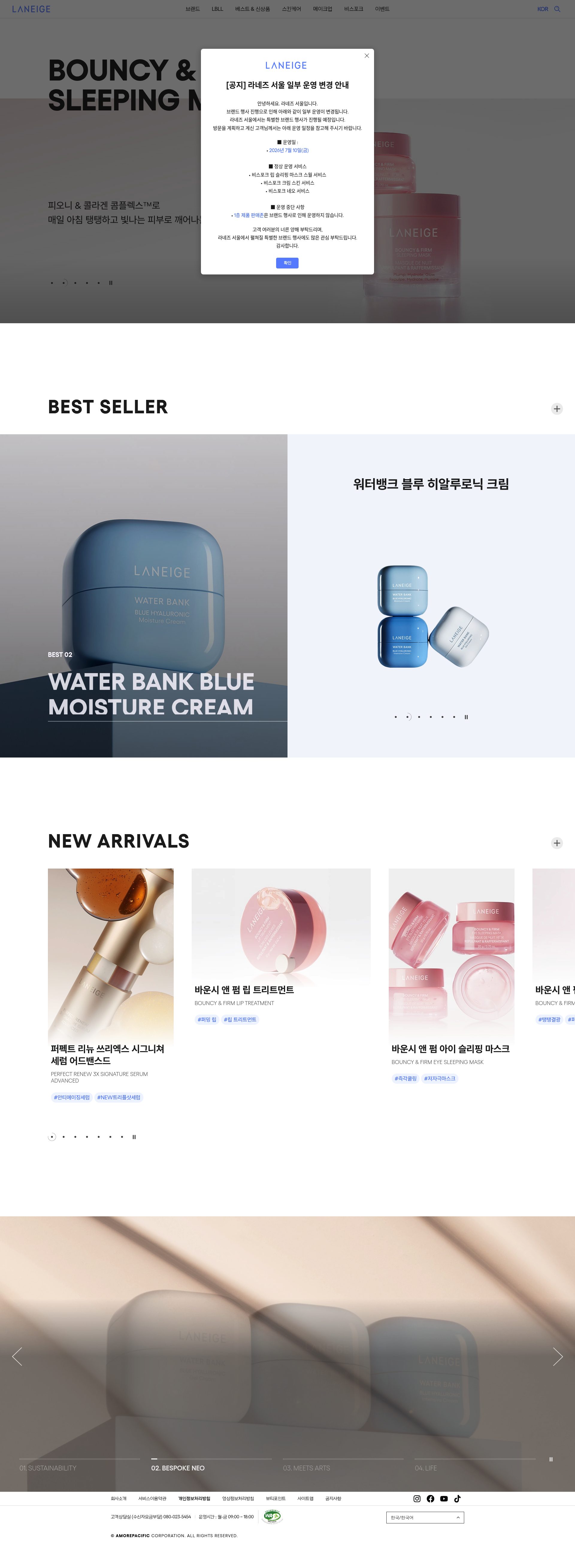
Laneige built its international reputation on a single hero product: the Lip Sleeping Mask. Its Shopify store leans directly into that product focus, placing the Lip Sleeping Mask at the top of the homepage hierarchy, in the navigation, and in every cross-sell recommendation. That kind of single-SKU dominance is a clear ecommerce decision, not an accident.
The product page itself is a case study in managing flavour and format variants without overwhelming the buyer. Laneige uses a clean swatch selector with clear variant names, and the page loads fast on mobile, which matters when a significant portion of its traffic comes from TikTok and Instagram discovery. The bundle mechanic, grouping the Lip Sleeping Mask with the Lip Glowy Balm, increases average order value without any discounting.
Laneige also uses its Shopify store to handle the brand's transition from Korean beauty niche to mainstream beauty shelf, with press badges and stockist logos placed strategically to validate the brand for customers who are not already fans.
2. Burt's Bees
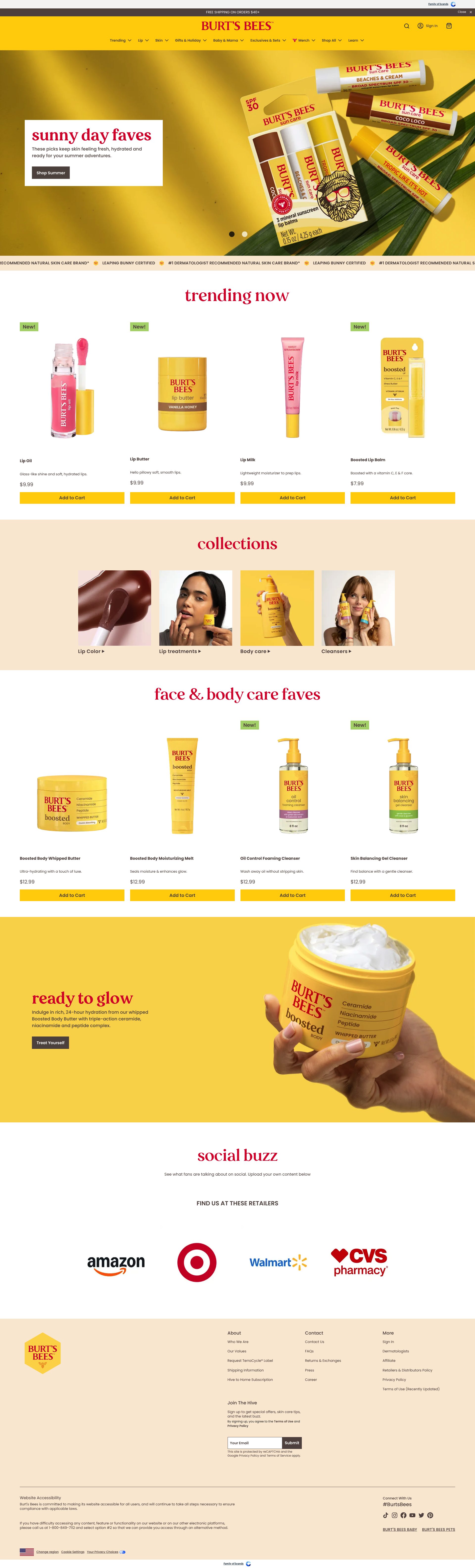
Burt's Bees has been selling lip balm since the 1980s, but its Shopify store is structured like a contemporary DTC brand rather than a legacy personal care company. The navigation leads with product benefit categories: moisturising, tinted, medicated, overnight. That taxonomy matches how customers search, not how the warehouse is organised.
The product pages are strong on ingredient storytelling. Beeswax, rosehip oil, and shea butter are explained in plain language, not just listed, which gives the brand room to charge a premium in a category full of £1 competitors. The "99% natural origin" claim is front and centre, backed by visible third-party certification rather than just a badge.
Subscription is available on most SKUs with a clear 10% saving, and the prompt is shown inline on the product page rather than after checkout. That placement matters: customers are more likely to commit to subscribe-and-save when they are still in buying mode.
3. Lush
Lush's Shopify store handles one of the harder challenges in beauty ecommerce: selling products that are primarily a tactile and sensory experience. Their approach is to over-invest in description: every lip scrub, balm, and tint includes a detailed scent description, texture note, and usage ritual. For a customer who cannot smell the product, that copy does a lot of work.
The brand's zero-packaging and fresh cosmetics story is integrated into the product page rather than buried in a sustainability tab, with exact ingredient origins, use-by date logic for fresh products, and explicit cruelty-free status per product. This level of product transparency functions as a conversion signal for the core Lush customer.
Bundles and gifting are a meaningful revenue driver for Lush, and the Shopify store reflects that. Gift sets are surfaced prominently year-round, not just seasonally, and the basket experience allows custom gift messages alongside product combinations, which increases perceived value without a price increase.
4. Bybi Beauty

Bybi Beauty targets a customer who reads ingredient labels and expects brand transparency as standard. The Shopify store delivers on that expectation consistently. Every product page shows a clean ingredients breakdown with a sourcing explanation for each key active, and the brand's carbon-neutral certification is visible on the product page, not just on an about page that most customers never read.
Bybi has made a smart structural decision with its navigation: lip care sits within a "face" category alongside serums and moisturisers, not isolated in a separate lip section. That placement signals that Bybi's Lip Butter Balm is a treatment product rather than a commodity item, which supports the pricing.
The store also does well with its blog content, which ranks for ingredient-led search terms and feeds into the product pages via inline links. That content loop, editorial to product page to conversion, is a deliberate Shopify structure, not a content team operating independently of the commercial site.
5. Ilia Beauty
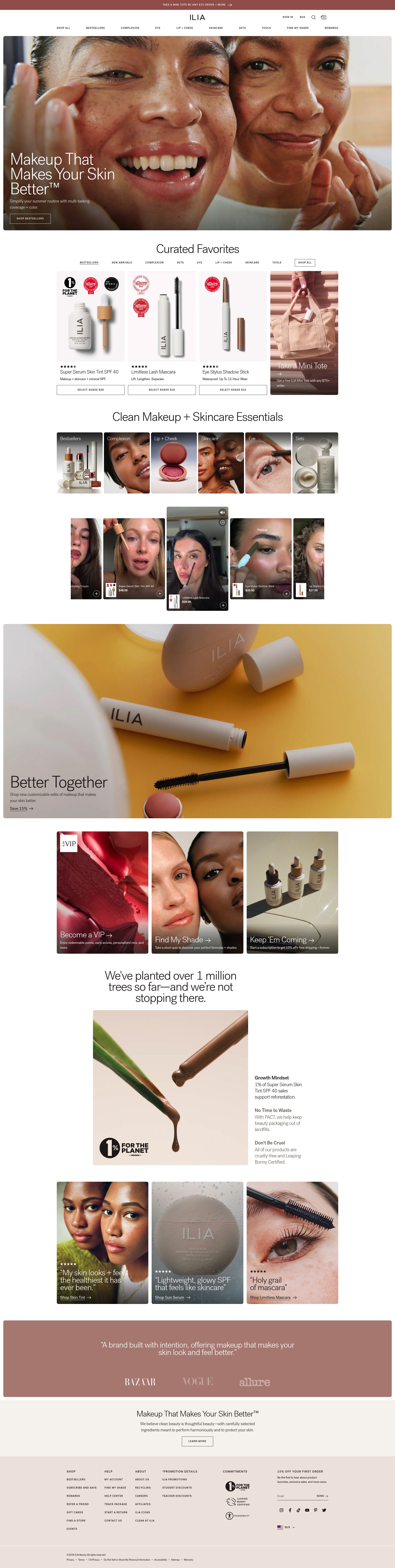
Ilia positions itself at the intersection of clean beauty and high performance, and its Shopify store executes that positioning with above-average production quality. The lip product pages use model imagery that is ethnically diverse, showing each shade against multiple skin tones, which directly reduces the hesitation customers feel when buying colour products online.
The shade selector on Ilia's Lip Tint and Balmy Gloss pages shows each swatch with a name that communicates wearability: names like "Heartbeats" and "In My Arms" are soft enough for everyday wear, which helps customers self-select. Ilia does not ask the customer to decode a shade system; the copy does the positioning work.
Ilia's subscription and loyalty mechanics are integrated tightly with its Shopify checkout. The brand uses a points-based system that surfaces reward progress on the cart page, which nudges customers toward completing the purchase rather than abandoning. That placement, at the point of maximum intent, is more effective than a separate loyalty dashboard.
6. Carmex
Carmex has a pharmacist-led heritage and its Shopify store reflects that with a medical credibility aesthetic: clear clinical claims, SPF callouts on relevant products, and a product range structured around specific lip conditions such as cold sores, severely chapped lips, and sun protection. That specificity is a strong search intent match.
The store keeps the buying experience extremely simple, which fits the brand. Carmex customers are not browsing; they are replenishing. The product pages are short, the variant selection is limited, and the checkout path has minimal friction. For a repurchase-driven product, that simplicity is a feature.
One area where Carmex's store performs well is bundle pricing. Multi-packs are front-loaded in the product listing, with per-unit cost shown alongside the bundle price. That comparison framing drives multi-pack adoption and increases average order value without requiring a discount mechanic.
7. Nourish Beaute
Nourish Beaute takes a natural and nutrient-rich positioning that it supports with detailed product page copy covering each key ingredient's benefit. The lip product pages include a specific callout section for key actives, written for a customer who knows what vitamin E or argan oil does but wants confirmation it is present in a meaningful concentration.
The store uses customer photo reviews prominently on lip product pages, which is a deliberate choice in a category where results are visible and customers expect proof. User-generated content in lip care performs strongly because buyers want to see shade payoff and texture on a real person, not a studio model.
Nourish Beaute's email capture flow, triggered on exit intent, offers a discount on first purchase, which is a straightforward but well-executed conversion mechanic. The pop-up is clean, loads quickly, and does not reappear on subsequent visits, which avoids the friction that repeated pop-ups create.
8. Lip Lab
Lip Lab is a custom lip colour brand, and its Shopify store is built around a unique commerce mechanic: in-store appointments and take-home kits that let customers create bespoke lip shades. The Shopify store serves two audiences simultaneously: customers booking an in-person experience and customers purchasing the at-home kit, and the navigation separates those two journeys clearly.
The product page for the at-home kit uses a step-by-step visual layout showing the customisation process, which reduces uncertainty for customers who have never experienced the brand in person. That kind of pre-purchase education is essential when the product itself is more complex than a standard SKU.
Lip Lab's gifting proposition is strong. Custom lip colour is an inherently high-perceived-value gift, and the store plays into that with specific gift messaging, gift wrapping options, and a clean gift landing page that can be shared directly. The Shopify gift card mechanic is used effectively to give recipients flexibility in their appointment booking.
9. Bulldog Skincare
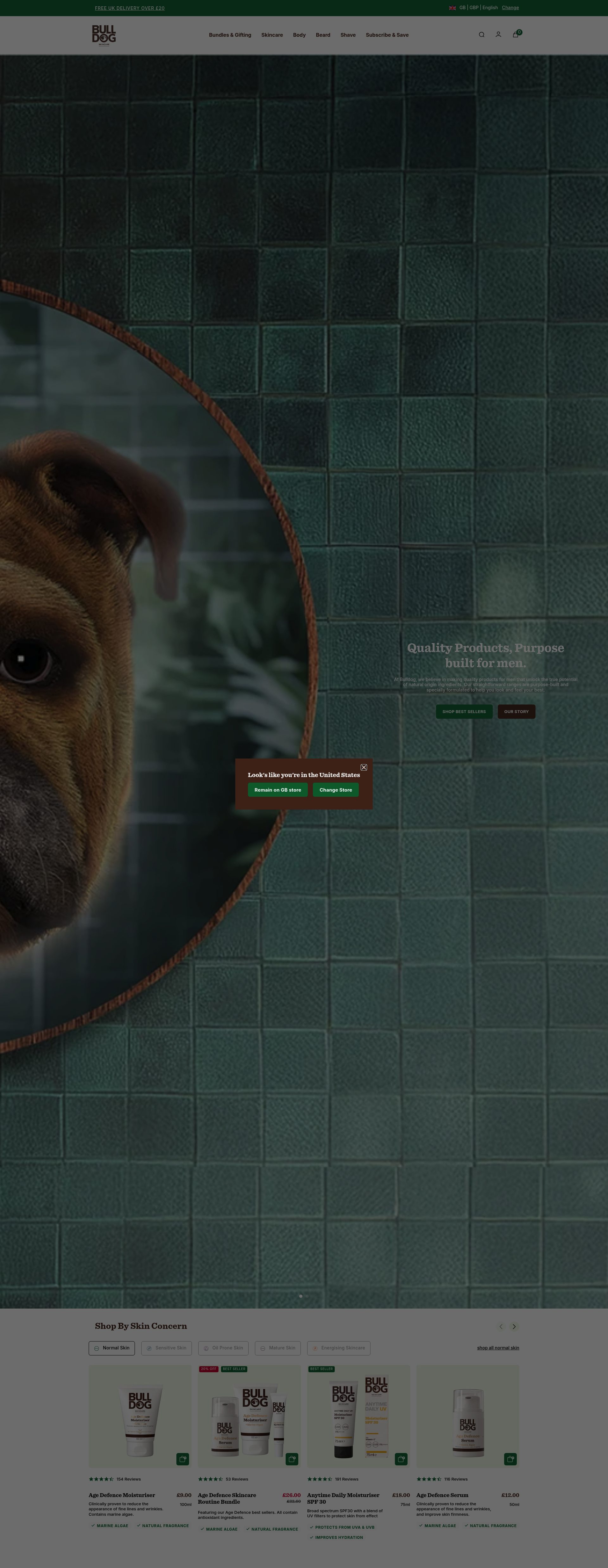
Bulldog is primarily a men's skincare brand, but its lip balm SKU has strong standalone traction as a no-fuss, daily-use product, and the Shopify store positions it accordingly. The navigation keeps lip care within the face category alongside moisturisers and SPF, which reinforces the idea that lip care is part of a minimal but effective routine rather than a separate purchase consideration.
Bulldog's product pages are deliberately brief. The brand has built a reputation on simplicity, and the store reflects that: short copy, prominent ingredient highlights, and a fast path to checkout. There is no complicated shade selection or variant matrix. That decisiveness reduces friction for a customer base that is not interested in browsing beauty content.
The store uses bundle prompts effectively, pairing the lip balm with other face products to build a starter routine, which increases basket size and reinforces the routine-selling strategy. The bundle pricing shows a modest saving that is visible without being the primary message, keeping the focus on the routine rather than the discount.
10. Hurraw! Balm

Hurraw! Balm has built a following on the back of raw, vegan, and certified organic ingredients, and the Shopify store leads with that story at every touchpoint. The ingredient sourcing page is linked directly from the product page navigation, which is an unusual structural choice that signals the brand's confidence in its transparency.
The product range is wide, with over 30 flavour variants, and Hurraw! manages that breadth through a clean category structure and a prominent flavour guide that helps new customers navigate. Variant discovery is a real challenge in lip care when the range is this large, and the flavour guide page doubles as a retention tool by giving existing customers a reason to browse SKUs they have not tried.
Hurraw!'s Shopify store keeps checkout friction low for returning customers, with a persistent cart and account-based reorder functionality. For a brand whose customers are highly loyal and repurchase frequently, that reorder experience is a commercial priority, and the store treats it as such.
These stores succeed because they treat lip care as a relationship category, not a commodity one. Subscription mechanics, ingredient transparency, shade guidance, and effortless reorder flows are the shared tactics of stores that retain their customers past the first purchase. If you want to build a lip care or beauty Shopify store that converts and retains, see our Shopify design services or get in touch to talk through your project.
Frequently asked questions
What makes a lip care Shopify store convert well?
The highest-converting lip care stores lead with ingredient transparency, clear variant navigation, and subscribe-and-save mechanics placed on the product page rather than post-checkout. Shade-on-skin imagery and bundle prompts that build a routine rather than discount a single product are the two highest-impact CRO levers specific to this category.
Which lip care brands sell direct-to-consumer on Shopify?
Laneige, Burt's Bees, Bybi Beauty, Ilia Beauty, Carmex, Nourish Beaute, Lip Lab, Bulldog Skincare, and Hurraw! Balm all operate direct Shopify stores alongside retail and marketplace channels. Lush runs its own ecommerce platform. Most use Shopify Plus at scale to handle subscription, loyalty, and bundle mechanics.
How do lip care brands handle shade selection on Shopify?
The better stores use named swatches that communicate wearability rather than abstract colour codes, and show each shade on multiple skin tones. Ilia Beauty is the benchmark here — its Lip Tint pages show ethnically diverse model imagery per shade, which directly reduces colour hesitation and return rates for online lip colour purchases.
Is subscription worth setting up for a lip care Shopify store?
Yes — lip care is one of the highest-repeat beauty subcategories because customers run out on a predictable cycle. Stores like Burt's Bees show the subscribe-and-save option inline on the product page with a clear percentage saving, which drives significantly higher subscription adoption than post-checkout prompts or a separate subscription landing page.
How do lip care Shopify stores manage large product ranges?
The key is category taxonomy that matches how customers search — by benefit (moisturising, tinted, medicated, SPF) rather than by product type. Hurraw! Balm, with over 30 flavour variants, uses a dedicated flavour guide page to help new customers navigate and give existing customers a reason to browse unexplored SKUs, which supports both acquisition and retention.