

Quick summary
Canterbury leads the field with integrated team kit customisation and position-specific fit guidance that reduces returns on technical apparel. Castore Rugby is the strongest premium pick, publishing exact GSM weights and bonded seam specs on product pages that treat serious players as technical buyers. Gilbert's 200-year provenance is used strategically to drive both DTC and club B2B conversion within the same store. Lovell Rugby shows what a well-executed multi-brand rugby retailer looks like at scale, with transparent clearance pricing and filtering that holds up under a genuinely broad catalogue.
Rugby is a category where brand loyalty runs deep and the purchase decision involves technical performance, fit, and safety in a way that most apparel niches do not. The best Shopify stores in this space have figured out that conversion comes from trust: specific product claims, clear size guidance, and a brand voice that speaks to people who actually play the game. Here are ten that do it well.
1. Canterbury
Canterbury is the closest thing to a household name in rugby apparel, and their Shopify Plus store carries the weight of that heritage without letting it become complacent. Product pages are built around performance claims backed by specific fabric technologies, with VapoDri moisture management and their cold-gear range explained in plain terms rather than marketing vague-ness. Navigation splits cleanly between playing kit, training gear, leisurewear, and team supply, which reflects how their customer base actually segments: club buyers, individual players, and casual fans all have a clear entry point.
Their team kit customisation flow is a standout conversion tool. Rather than directing large orders off to a separate B2B portal, Canterbury integrates the team supply journey into the main store experience, reducing friction for club kit managers and keeping revenue inside the same purchase flow. Size guides include both body measurement charts and practical notes on playing position fit, which is a detail that reduces returns in a category where a loose collar on a front-row player is a real problem.
2. Castore Rugby
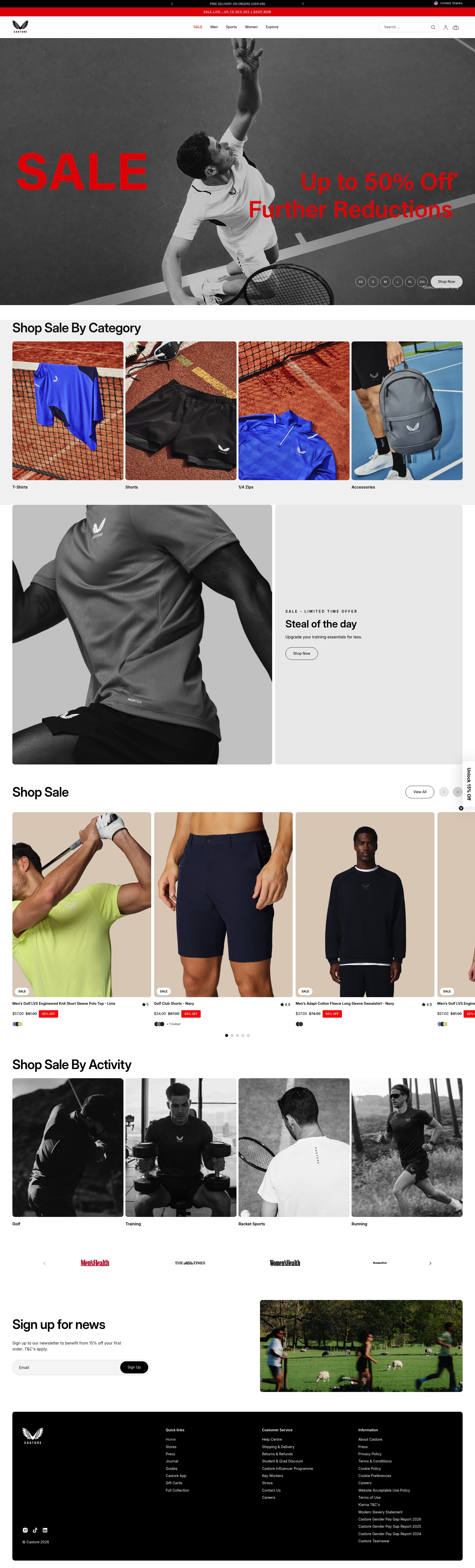
Castore's move into rugby has been aggressive: they now hold kit contracts with several Premiership clubs and Test nations, and their DTC store reflects the same technical premium positioning they brought from cricket and football. Product pages lead with fabric specification: exact GSM weights, bonded seam construction details, and anti-abrasion ratings for match jerseys. These are claims that serious players evaluate, and Castore states them clearly rather than burying them in a fabric care accordion.
The store structures its rugby range by use case: match, training, and travel, with each category carrying consistent visual language. Their ambassador and team partnership content is integrated into product pages where the connection is direct, adding credibility without feeling like a sponsorship badge dump. Pricing sits firmly at the premium end, and the store makes that positioning coherent: there is no discount bin, no clearance carousel on the homepage. Every page signals that this is performance kit priced accordingly.
3. Rugbystore
Rugbystore operates as a multi-brand retailer rather than a DTC label, and their Shopify store is built to handle the complexity that comes with stocking Canterbury, Adidas, Gilbert, Mitre, and hundreds of individual products across boots, pads, balls, and kit. Their navigation and filtering deserve attention: faceted search lets customers narrow by position, age group, playing level, and price simultaneously, which is the right approach for a catalogue this broad. A poorly structured navigation would lose the customer who knows they need U14 scrum caps but does not know where to find them.
Their buying guides are integrated into the shopping flow rather than siloed in a blog: on the boots collection page, there is contextual guidance on which sole type suits different pitch conditions. This reduces decision paralysis without requiring the customer to leave the product environment. Reviews are surfaced prominently, with verified purchase filters available, and the volume of reviews across core SKUs gives the store a social proof density that newer single-brand stores cannot match.
4. Gilbert Rugby
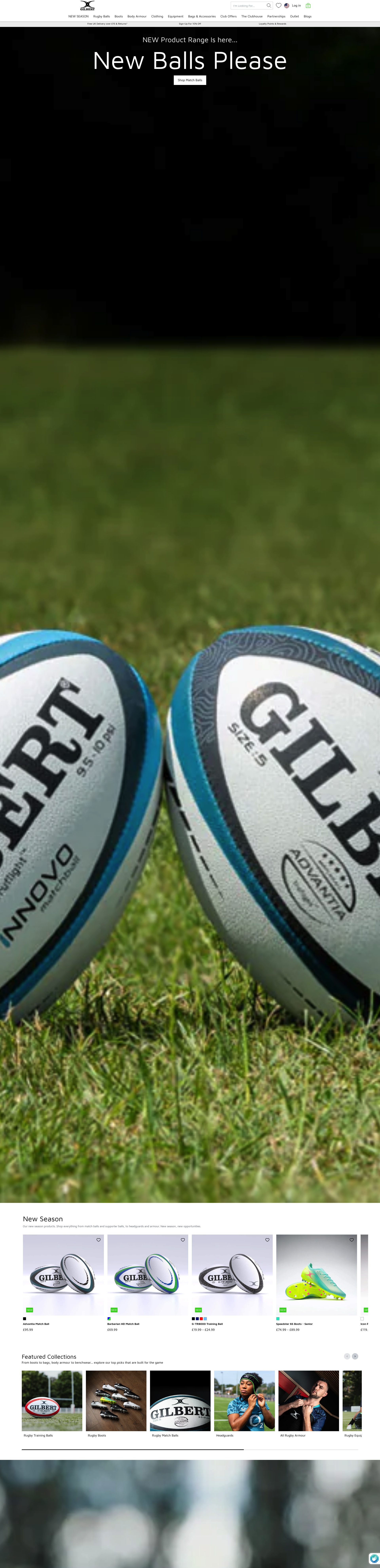
Gilbert has made rugby balls since 1823 and the official World Cup ball since 1995, and their Shopify store uses that provenance strategically. The homepage leads with tournament heritage rather than product SKUs, which is the right call for a brand whose name is already embedded in the sport. Where the store earns conversion credit is on product pages: match balls, training balls, and mini balls are distinguished by their use case and by the certification level each carries, from IRB-approved match balls down to recreational sizes for young players.
Their club and school supply channel mirrors Canterbury's approach of keeping B2B within the consumer store experience. Gilbert's personalisation options, names and squad numbers on balls and kit, are surfaced at the product level rather than requiring a separate enquiry, which lifts the average order value on gift and club purchases. The international shipping setup is smooth, which matters for a brand with genuine global recognition: the store handles currency and delivery for overseas clubs and schools without creating obvious friction.
5. BOX Rugby
BOX Rugby is a smaller operation than the established kit brands, but their Shopify store punches above its size. Their protective equipment range, including body armour, headguards, and shoulder pads, is where the store does its best product page work: each item is matched to a World Rugby regulation level, which eliminates the buyer's uncertainty about whether a piece of kit is legal for their age group or competition format. That information is specific and immediately useful, and it reduces the most common pre-purchase question in this category.
BOX leans into the independent specialist identity: their copy is written by people who clearly understand the game, and the product descriptions go beyond manufacturer copy to include practical notes on how each product performs under match conditions. That editorial voice, rare in Shopify sports kit stores, builds trust with club players who have bought cheap kit that failed them before.
6. Kooga
Kooga is one of the more recognisable UK rugby kit brands with a long history in grassroots club rugby, and their store handles the tension between club supply scale and individual player purchases with reasonable clarity. Their club kit section, offering custom colours, crests, and player numbering, is the commercial engine of the store and it shows in how prominently it is featured in the navigation. Individual players buying off-the-shelf kit are served through standard collection pages, while club administrators have a clear path into the custom order flow.
Their seasonal sale mechanics are aggressive: old season club stock is discounted clearly, with previous and current price displayed in a format that meets UK consumer pricing regulations. That transparency is worth noting in a category where clearance pricing on club kit can confuse buyers about whether they are getting discontinued or current stock. Kooga labels discontinued colourways explicitly, which reduces the return rate from buyers who discover post-purchase that their club no longer uses that colour scheme.
7. Rhino Rugby

Rhino's Shopify store is focused almost entirely on equipment rather than apparel: tackle bags, training poles, scrum machines, posts, and balls. That specialist positioning makes the navigation and product hierarchy unusually clean for a sports retailer. A club groundskeeper looking for post padding and a coach looking for tackle shields are served by completely different sections, and neither has to wade through the other's inventory to find what they need.
Their product pages for high-ticket training equipment include detailed installation notes and compatibility information: which tackle bags suit contact training at what age group, weight specifications for posts, and ground fixing options for different pitch types. These are the details that a head of rugby at a school or a club facilities manager needs before raising a purchase order, and Rhino surfaces them without requiring a sales call. For a B2B-heavy product category, that self-service depth is a strong conversion lever.
8. Samurai Sportswear
Samurai is a UK kit manufacturer that has built a significant club rugby client base on the strength of their customisation range and turnaround times. Their Shopify store is oriented primarily around the club and school supply journey, with custom kit as the primary commercial offer and individual player items available but secondary. The kit builder integration allows clubs to select from base templates, add crests, and specify player names and numbers in a self-service flow, which removes the back-and-forth that traditionally made custom kit orders slow and error-prone.
What the store does particularly well is transparency on minimum order quantities and lead times, displayed at the product level rather than only at checkout or enquiry. A club kit manager deciding between Samurai and a competitor can make that comparison on the product page without a phone call. That friction reduction matters in a purchase category where the sales cycle is long and the buyer is often a volunteer with limited time.
9. School of Rugby
School of Rugby sits in an interesting position: they publish rugby coaching content and sell coaching resources, drills packs, and session plans through Shopify. The store is built around digital products rather than physical kit, which means their conversion mechanics are different from every other store on this list. The product pages for session plan bundles are built around outcomes: what age group the session suits, what skills it develops, how long it takes to run. That specificity mirrors how coaches actually buy: they are looking for something that solves a specific problem for Saturday's session, not a generic skills library.
Their email capture and membership offer is well integrated into the store, with a free starter pack used as a lead generation tool that then feeds a paid subscription product. For a Shopify store operating in a content and education niche, that subscription mechanic is the right commercial model, and the store is built to support it: the free offer is prominent without being aggressive, and the upsell from free to paid is logical rather than jarring.
10. Lovell Rugby
Lovell Rugby operates as a multi-brand sports retailer with a specific focus on rugby, and their Shopify store demonstrates what a well-executed specialist retailer looks like at scale. The product range is broad: boots from Adidas, Nike, Canterbury, and Gilbert sit alongside club kit, protective equipment, and training gear from across the market. What keeps the store coherent is the filtering and navigation: customers can narrow by brand, position, playing level, and pitch type on key categories, and the site search returns relevant results with enough context to be useful.
Their clearance and sale mechanics are some of the most transparent on this list: previous prices are shown alongside sale prices, and the date of the most recent price reduction is displayed. That detail matters for UK retailers subject to ASA guidelines on pricing claims, and it also builds buyer confidence that a deal is genuine. Loyalty points and multi-buy deals are surfaced consistently throughout the category pages, which lifts average order value across both individual and bulk purchases.
If you run a rugby brand or sports equipment business and want a Shopify store built around the commercial mechanics above, take a look at our Shopify design services or get in touch with the team.
Frequently asked questions
Do top rugby brands use Shopify?
Yes. Canterbury, Castore, Gilbert, Rhino, and Lovell Rugby all run on Shopify or Shopify Plus. The platform handles their product catalogue complexity, team kit customisation flows, and multi-currency international shipping without requiring a custom-built commerce stack.
What makes a rugby Shopify store convert well?
Position-specific size guidance, regulation compliance information on protective kit, and integrated club or team supply journeys are the three biggest conversion levers. Rugby buyers are technical: they want to know whether a headguard is World Rugby approved for their age group and whether a jersey collar fits a prop rather than a winger. Stores that answer those questions on the product page rather than behind a contact form win the sale.
How do rugby stores handle custom team kit on Shopify?
The best stores, including Canterbury, Gilbert, Kooga, and Samurai, keep club kit customisation inside the main Shopify storefront rather than pushing club buyers to a separate B2B portal or enquiry form. Self-service kit builders with base template selection, crest upload, and player numbering handle most of the configuration, with minimum order quantities and lead times displayed at the product level so club administrators can make decisions without a phone call.
Which rugby stores are best for grassroots clubs buying in bulk?
Samurai Sportswear and Kooga are the strongest options for grassroots clubs. Both publish minimum order quantities and lead times on product pages, offer custom colourways and cresting, and have pricing that works at club volume. Canterbury and Gilbert are better for clubs that need IRB-certified match balls or premium match jersey standards alongside custom kit.
How important is regulation compliance information on rugby product pages?
It is the single most important product page element for protective equipment. World Rugby approval levels for headguards, body armour, and shoulder pads are not optional details: a buyer who cannot confirm compliance on the product page will not purchase, because buying non-compliant kit for a junior player is a safeguarding issue, not just a preference. BOX Rugby handles this better than most stores on this list by matching every protective item to its regulation level.