

Quick summary
Sauce Shop leads the UK condiment category with a clean PDP structure, smart heat and flavour filtering, and gifting pages that consistently outperform at Christmas and Father's Day. Hunter & Gather is the strongest pick for health-positioned sauces, with subscription mechanics, per-serving savings framing, and content-to-commerce loops that most food brands get wrong. Cholula handles the mass-brand DTC challenge better than almost any comparable name, using bundle builders and recipe content to justify the direct channel over Amazon. Bunsters is the standout for extreme hot sauce, turning Scoville data into a brand identity and building gift mechanics around novelty purchase intent.
Sauce is one of the most competitive food niches in DTC ecommerce. Margins are tight, repeat purchase is the entire commercial model, and the visual challenge of making a glass bottle look premium on a screen is harder than it sounds. The brands that win are the ones that nail product discovery, surfacing the right SKU to the right customer fast, and build subscription and gifting mechanics that justify a direct channel over Amazon. These ten Shopify stores show how it is done.
1. Sauce Shop
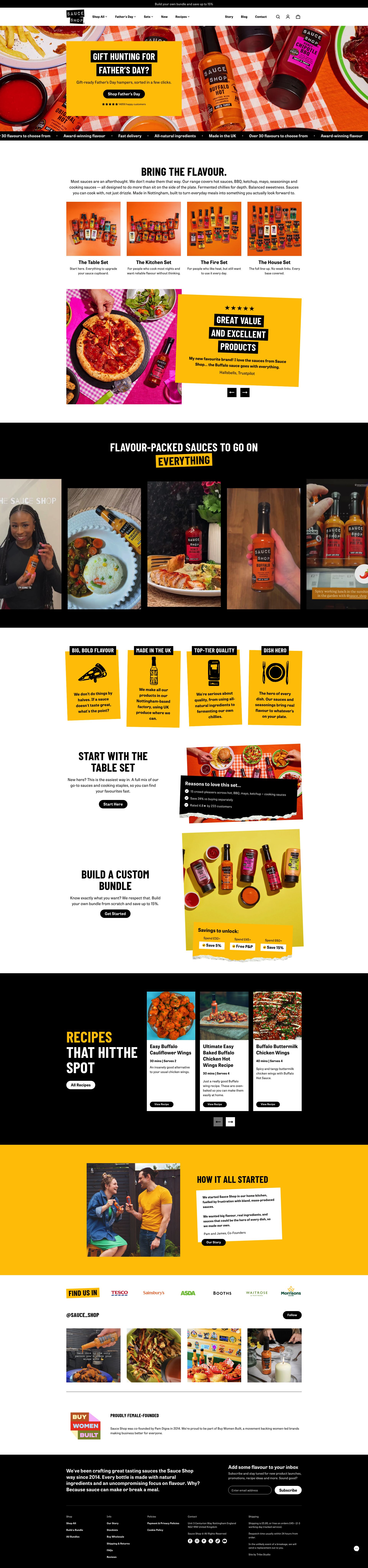
Sauce Shop started in a Nottingham market and is now one of the UK's most recognised independent condiment brands, with 35+ products spanning ketchup, BBQ sauces, buffalo sauce, and sriracha. Their Shopify store is a textbook execution of a brand-led condiment business. The homepage leads with the award count and the "made in Nottingham" provenance in the same sentence, which does conversion work in three words. Category structure handles a wide SKU range cleanly: sauces are filterable by flavour profile and heat level, so a customer who wants something mild and tangy can find it in seconds rather than scrolling through thirty bottles.
Product pages are where Sauce Shop really earns its place on this list. Each PDP includes pairing suggestions (which dishes the sauce works with), an ingredient breakdown that leans into the "no nasties" positioning, and a prominent "great on" section that expands use cases beyond the obvious. That content answers the most common question a new customer has: "will I actually use this?" The free UK shipping threshold sits at a level that naturally pulls a two-item basket to three. Gifting is structured with its own landing page, tiered from single-sauce testers to branded gift boxes, and the pages are optimised for seasonal traffic around Christmas and Father's Day.
The brand story is present throughout without dominating: a short Founders note on the About page, the market-stall origin referenced in product copy, and the Nottingham identity used as a differentiator without being overplayed. For a sauce brand, that balance between product functionality and brand personality is difficult to get right. Sauce Shop gets it right.
2. Bunsters

Bunsters is an Australian hot sauce brand best known for its Shit Hot sauce, which sits at 550,000 Scoville units and markets itself aggressively on that number. Their Shopify Plus store is one of the strongest examples of single-product brand amplification in the sauce category globally. The heat level is turned into a brand identity rather than just a product attribute: every element of the UX, from the typography choices to the product photography, reinforces the extreme-heat positioning.
Hot Sauces
Bunsters sits in the extreme end of the hot sauce spectrum and their Shopify store handles that positioning with unusual precision. The PDP for their flagship product includes a heat comparison chart showing Scoville ratings for commonly known references (jalapeno, habanero, ghost pepper) with Bunsters sitting comfortably above all of them. That context transforms an abstract number into a meaningful buying signal: the customer understands what they are ordering, which reduces returns and increases gifting confidence. Gift messaging is available at checkout and the "for someone who thinks they can handle it" angle makes the product an obvious novelty gift choice.
Subscription mechanics are integrated cleanly: the monthly hot sauce club presents value in terms of bottles per month and price per bottle, not just the headline figure. For a product with high repeat purchase potential among heat-seekers, that structure keeps customers on plan rather than reverting to one-off purchases. For a dedicated deep-dive into hot sauce brands specifically, see our best hot sauce Shopify stores guide.
3. Fable Food Co.
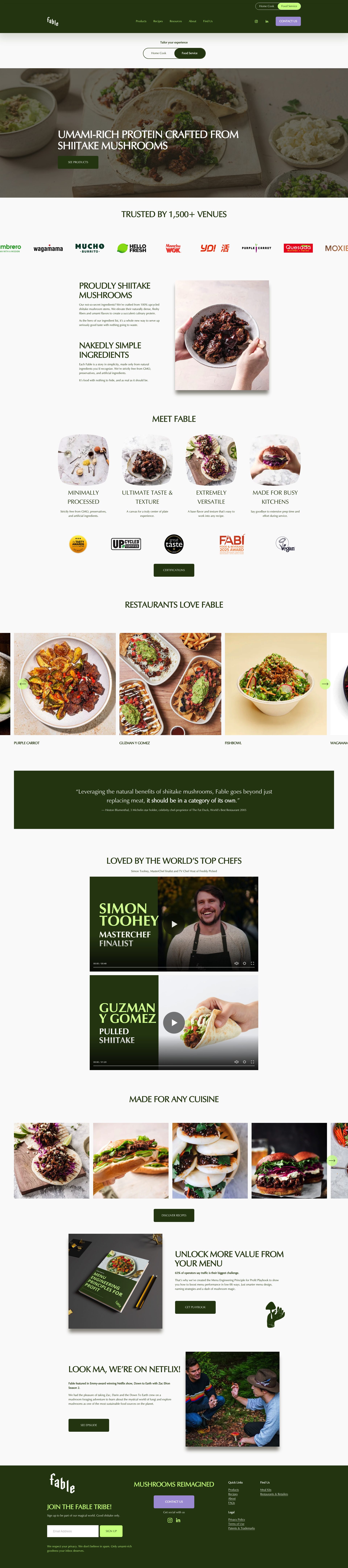
Fable Food Co. is an Australian plant-based food brand whose Shopify store is worth studying for its product education architecture. Their shiitake mushroom-based "pulled" sauces and ready meals require buyers to understand a new product category before converting. The store handles that challenge by leading every product page with a "what it is" statement, a cook time, and a comparison to the meat-based equivalent it replaces. That framing reduces friction for a first-time buyer who has never cooked with mushroom-based pulled meat before.
The category structure separates sauces from ready-to-cook products clearly, which matters because the two audiences shop differently: someone wanting a pour-on sauce has different intent from someone planning a slow-cook recipe. Navigation reflects that split. Stockist and recipe content sits on the same domain and is linked from product pages, so a customer who arrives from a recipe search lands inside the brand experience rather than on an external blog. For a challenger brand selling a novel product format, that continuity between content and commerce is a meaningful conversion asset.
4. Dorset Naga
Dorset Naga is one of the UK's most respected chilli growers, with a strong DTC Shopify presence built around provenance and heat expertise. The brand grows some of the world's hottest chillies on a farm in Dorset and that farm-to-bottle story is central to every product page. The PDP structure prioritises heat data, Scoville scores, and growing method information over generic marketing copy, which positions the brand correctly for its core buyer: a serious chilli enthusiast who wants facts, not flavour poetry.
The dried chilli and seed range on the same Shopify store opens a secondary revenue stream with a different purchase frequency. A buyer who starts with a fresh sauce order and then discovers the dried chilli and seed catalogue is being moved into a higher lifetime value bracket without any active upsell mechanic needed. The navigation handles this range expansion clearly, with products grouped by format rather than heat level, which reflects how the brand thinks about its category depth.
5. Cholula

Cholula is one of the world's best-known hot sauce brands, produced in Mexico and distributed globally. Their Shopify store manages the challenge of being a mass-market brand trying to operate a credible DTC channel. The product range is organised clearly by flavour variant, each with a distinct colour-coded label, and the PDP structure includes food pairing suggestions that go beyond the obvious. The "Build Your Own Bundle" mechanic is well-executed: customers choose three or more flavour variants and receive a discount, which increases average order value while teaching new buyers about the range depth.
The brand story section does useful conversion work for a product that most buyers already know from restaurants: it contextualises the history, the arbol and pequin chilli blend, and the 50+ years of production without being self-congratulatory. The recipe section is the strongest content asset on the site, pulling in SEO traffic from meal-planning searches and landing those visitors inside a commerce environment rather than on a third-party recipe site. For a brand with this level of recognition, the DTC channel has to justify its existence against Amazon and supermarkets. Cholula's Shopify store does that by offering bundle mechanics and recipe content that those channels cannot match.
6. The Foraging Fox
The Foraging Fox is a UK condiment brand best known for its Beetroot Ketchup, a product that occupies a genuine gap in the market: a British ketchup with real vegetable provenance and a flavour profile that differentiates cleanly from Heinz. Their Shopify store is an excellent example of how a challenger condiment brand can convert the natural food buyer without alienating the mainstream one. The navigation leads with product, not story, which is the right choice for a brand where the product is the differentiator.
Product pages include the ingredient provenance, the production method, and a comparison with conventional ketchup that does not read as defensive. The "gift hamper" section pulls together complementary products into curated sets, with gift wrapping available and lead times clearly communicated. That operational transparency builds trust: the customer knows when their order will arrive and what the returns process looks like before they check out. For a brand selling a premium product into a commodity category, transparency and provenance are the conversion drivers. The Foraging Fox Shopify store understands that and structures the buying journey around it.
7. Stokes Sauces
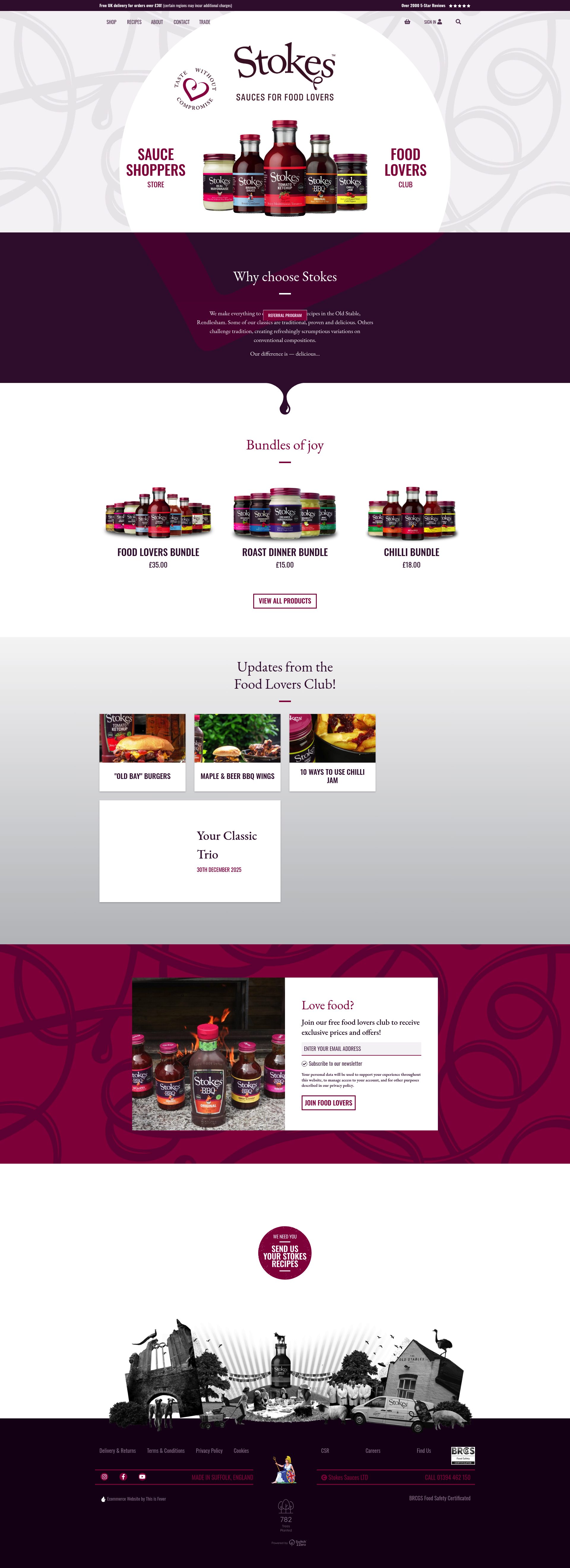
Stokes Sauces is a Suffolk-based condiment brand producing real mayonnaise, ketchup, salad creams, and dressings with a premium positioning. Their Shopify store is built around the "proper ingredients" message: every PDP lists the quality markers that distinguish Stokes from supermarket alternatives, free-range eggs in the mayo, vine-ripened tomatoes in the ketchup, no artificial thickeners. That specificity does conversion work that generic "premium" labelling cannot.
The trade and wholesale section of the site sits behind a login but is clearly signposted, giving the store a dual-channel structure that serves retail buyers and catering customers from the same platform. That B2B functionality on a Shopify storefront is worth noting: many food brands run separate wholesale infrastructure, which adds complexity and cost. Stokes keeps both audiences on one Shopify instance, simplifying operations. The subscription option on core SKUs is presented as a convenience purchase rather than a discount-led pitch, which is the correct framing for a product where the buyer is replacing a supermarket weekly shop rather than discovering something new.
8. Encona
Encona is a UK hot sauce and condiment brand with Caribbean heritage and one of the longest track records in the British supermarket condiment aisle. Their Shopify store exists to serve a DTC audience that cannot always access the full range in retail and to target gifting occasions. The range is organised by heat level and region of origin, which is a smart taxonomy for a brand whose products span Caribbean, West African, and Asian flavour traditions. A buyer who arrives looking for a Trinidad-style hot pepper sauce and a buyer looking for a Thai sweet chilli sauce both reach their product in two clicks.
The brand heritage section does strong trust work: founded in 1971, Caribbean provenance, family recipes. For a product competing in a category with dozens of new craft entrants, provenance and longevity are genuine differentiators and Encona's store uses both effectively without making the About page feel like a history lesson. Gift set bundles are photographed well and priced accessibly, making Encona a credible gifting option for food lovers on a mid-range budget.
9. Hunter & Gather
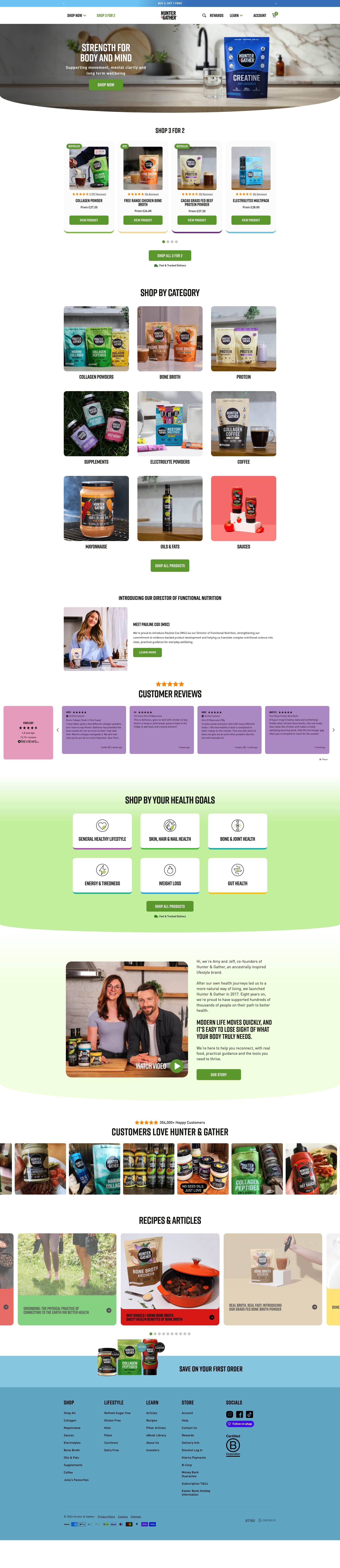
Hunter & Gather is a UK food brand with a strong Shopify Plus presence, producing avocado oil mayonnaise, ketchup, and dressings free from refined sugar, seed oils, and additives. Their store is one of the best executions of health-positioning in the condiment category. The PDP structure leads with what is not in the product rather than what is: no refined sugar, no vegetable oil, no starch. That negative-ingredient framing is counterintuitive but it works for a buyer who is specifically looking for a clean-label alternative to supermarket sauces.
Subscription mechanics on Hunter & Gather are handled better than most Shopify food brands: the subscribe-and-save option is visible on the PDP without being the dominant CTA, and the savings calculation is shown in pence per serving rather than a percentage, which is a more concrete framing. The brand runs a loyalty programme that rewards points on subscription orders at a higher rate than one-off purchases, creating a structural incentive to stay on plan. The content strategy is tightly integrated: recipes and nutrition articles are linked from relevant product pages, keeping buyers in the Shopify environment rather than sending them to external sites. For a brand in the premium health condiment space, that content-to-commerce loop is a material conversion driver.
10. Wing Yip
Wing Yip is the UK's leading Chinese grocery brand, established in 1970, with a well-developed Shopify ecommerce store covering sauces, pastes, noodles, and store-cupboard essentials. Their sauce range, covering oyster sauce, soy sauce, hoisin, black bean, and dozens of specialist Asian cooking sauces, is one of the most comprehensive available through a DTC channel in the UK. The site handles range complexity well by organising products by cuisine type first and sauce category second, which mirrors how buyers actually think when they are stocking an Asian pantry.
Product pages include cooking guidance notes and suggested dishes, which transform commodity sauce SKUs into considered purchases. The "store cupboard essentials" bundle mechanic bundles complementary sauces for a specific cuisine style (Thai, Chinese, Korean) at a modest discount, lifting average order value and introducing buyers to products they would not have sought individually. For a brand with this level of range depth, the bundle strategy is one of the highest-leverage conversion tools available. Wing Yip's Shopify store also carries strong social proof via recognisable brands from across Asia, which gives buyers confidence when purchasing unfamiliar products.
If you sell sauce, condiments, or specialty food products and want to improve conversion on your Shopify store, our Shopify design service is built around exactly these kinds of commercial outcomes. Get in touch to talk through what your store needs.
Frequently asked questions
Which Shopify sauce stores have the best subscription mechanics?
Hunter & Gather and Bunsters are the two strongest. Hunter & Gather shows savings in pence per serving rather than a percentage, which is more concrete, and rewards subscription orders at a higher loyalty rate than one-off purchases. Bunsters frames its monthly hot sauce club around bottles per month and price per bottle, which reduces cancellation intent compared to a simple headline discount.
How do the best sauce brands handle a wide product range on Shopify?
The strongest stores use functional taxonomy rather than brand story as the primary navigation layer. Sauce Shop filters by flavour profile and heat level. Wing Yip organises by cuisine type first and sauce category second. Encona sorts by heat level and region of origin. All three approaches mirror how buyers actually think when shopping for sauce, which reduces the time to product and increases conversion.
What gifting mechanics do the top sauce Shopify stores use?
Sauce Shop, The Foraging Fox, and Encona all run dedicated gifting sections with curated bundle tiers, gift wrapping options, and clearly communicated lead times. Bunsters leans into the novelty angle with "for someone who thinks they can handle it" messaging on its extreme heat gift sets. The common thread is that gifting is treated as a distinct purchase mode with its own landing page and copy, not just a multi-pack deal.
How do smaller UK sauce brands compete with supermarket alternatives on Shopify?
Provenance and ingredient specificity are the two most effective levers. Stokes Sauces names the specific ingredients that differentiate it from supermarket versions on every PDP: free-range eggs in the mayo, vine-ripened tomatoes in the ketchup. The Foraging Fox leads with vegetable provenance and production method. Dorset Naga anchors every page in farm-to-bottle credibility. None of these brands compete on price — they compete on verifiable quality signals.
Is Shopify a good platform for food and sauce brands?
Yes — Shopify and Shopify Plus handle the core requirements of food DTC well: subscription apps, gifting mechanics, bundle builders, B2B wholesale portals, and recipe content integration all work cleanly. Stokes Sauces runs both retail and trade wholesale from a single Shopify instance, which reduces operational overhead significantly. The main limitation is that complex nutritional labelling or EU-compliant allergen display sometimes needs a custom app, but for most sauce brands the out-of-the-box feature set is sufficient.