
Quick summary
Allies of Skin leads the list with ingredient-literate PDPs and routine-logic bundling that lift AOV without discounting. Augustinus Bader converts at the luxury end by putting professor credentials and TFC8 science front and centre rather than lifestyle imagery. Biossance is the strongest example of ingredient-led brand architecture, with every page built around a single squalane positioning. Pestle & Mortar shows how a hero-product halo — 10,000+ reviews on one serum — can anchor an entire Shopify range with tightly controlled cross-sells.
Serums sit at the highest-margin, highest-consideration end of skincare ecommerce. Customers spend longer on product pages, ask harder questions, and expect proof. The Shopify stores that win in this category do not rely on brand awareness alone: they optimise for ingredient credibility, reduce decision paralysis, and turn a one-off purchase into a subscription. Here are ten doing it well in 2026.
1. Allies of Skin

Singapore-founded Allies of Skin runs a lean DTC operation on Shopify Plus with product pages that function more like evidence dossiers than standard PDPs. Each serum lists active percentages, clinical study references, and skin concern tags — the kind of specificity that converts a sceptical, ingredient-literate customer who has already read five Reddit threads before arriving. The navigation groups products by skin concern rather than format, which collapses the journey from intent to basket for shoppers who know their problem but not their SKU.
The store also uses a "Bundle and Save" mechanic tied to routine logic rather than arbitrary discounts. You are not just buying two things for less; you are buying a morning and evening routine, with the store doing the pairing for you. This lifts AOV without cheapening the brand.
2. The Ordinary
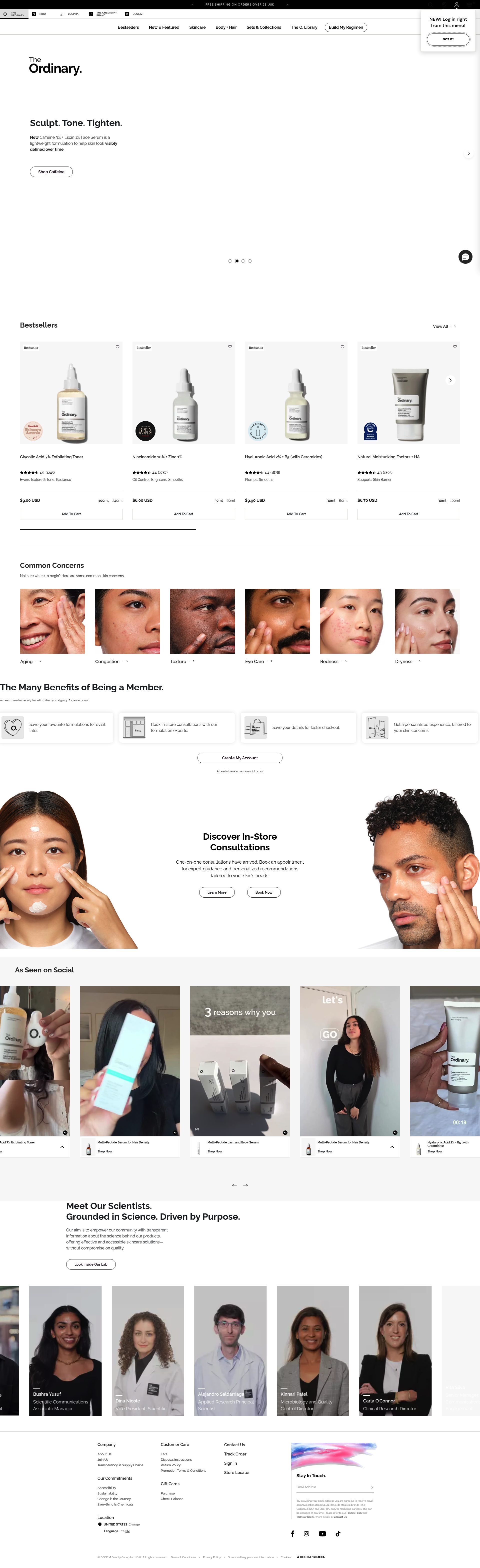
The Ordinary's Shopify store is one of the most studied DTC builds in beauty, and for good reason. Deciem built a product range of over 60 serums and then solved the navigation problem that should have broken the brand: the Regimen Builder. Rather than letting customers drown in choice, the tool routes them to a short curated routine, reducing abandoned baskets driven by indecision.
Product pages use deliberately plain design — white background, INCI-style naming, clinical copy — which functions as a trust signal rather than a shortcut. The low price point combined with clinical credibility creates a very difficult position for competitors to attack. Subscription uptake is high because the barrier to first purchase is low and routine repeat-buy behaviour is built into the product logic.
3. Nini Organics
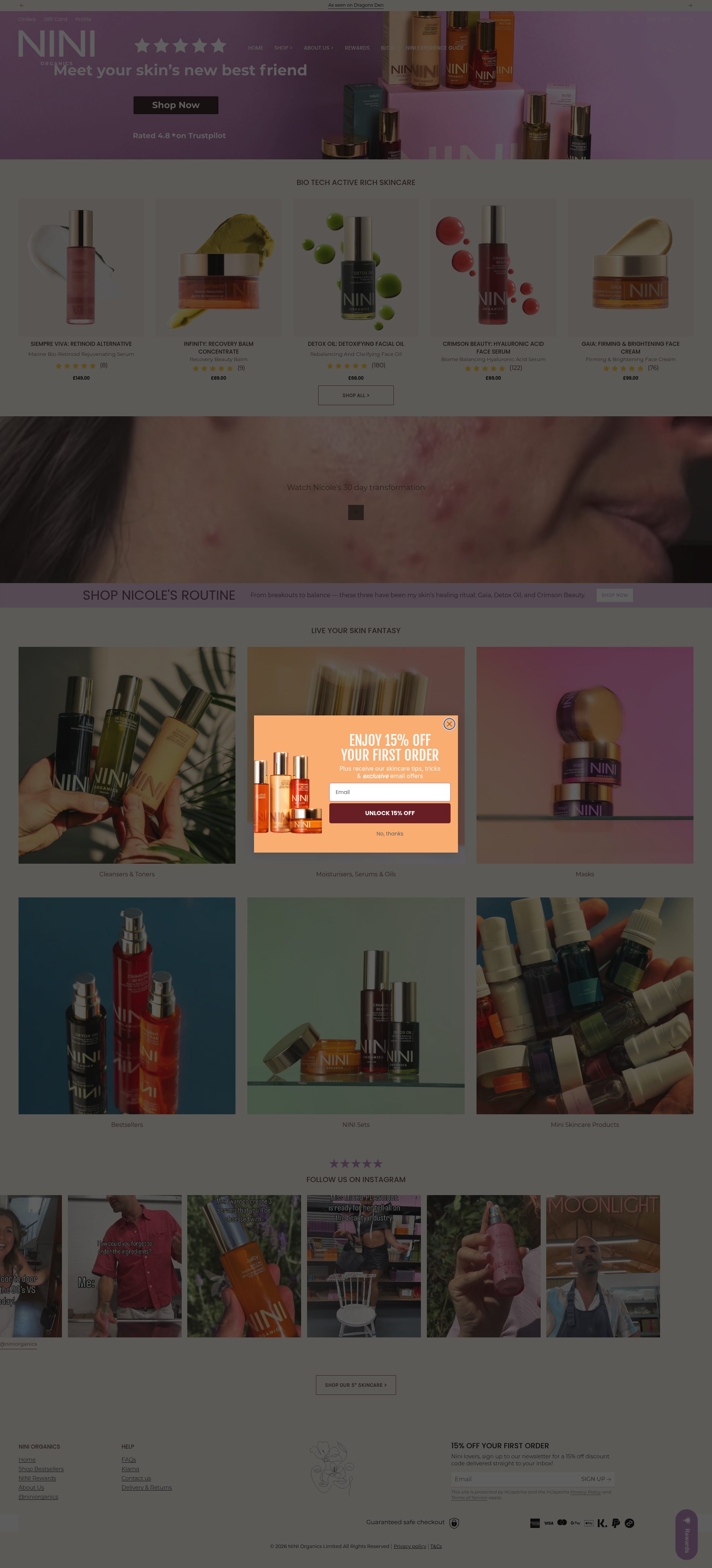
Nini Organics is a smaller UK indie brand and a useful case study in how a tight product range can outperform much larger competitors through story clarity. The Shopify store leads with founder narrative and Ayurvedic sourcing, which does two things: it differentiates from the science-led majority, and it gives each product a provenance story that justifies a premium price.
The product pages are compact but dense with value: ingredient origin maps, short videos of processing methods, and customer reviews filtered by skin type. The brand uses email capture aggressively on exit intent, with a small-but-targeted discount offer. For a brand with limited paid media budget, this retention mechanic is doing the heavy lifting on LTV.
4. Augustinus Bader
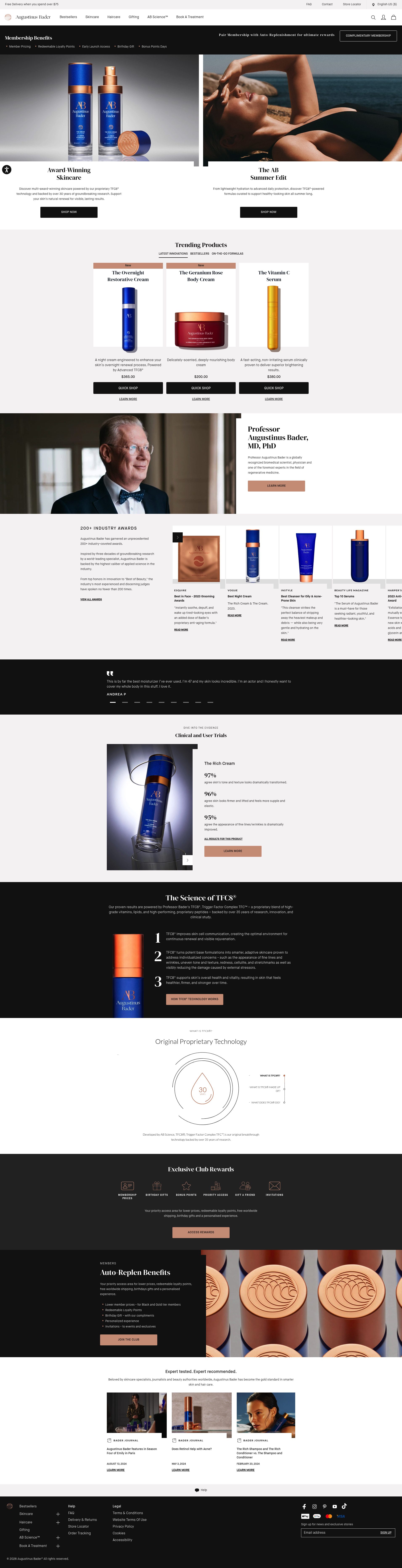
Augustinus Bader sits at the luxury end of the serum market, and the Shopify store is calibrated accordingly. Page load speed, mobile typography, and product photography are all premium-tier. But the most interesting ecommerce decision is the use of scientific credibility as the primary conversion lever, not celebrity endorsement or luxury lifestyle imagery.
Professor Bader's stem cell research background is front and centre: the mechanism of action for The Rich Cream and The Serum is explained clearly, with links to the academic foundation of the TFC8 technology. This approach filters for high-intent, high-spend customers and reduces price objection without discounting. The subscription programme is priced with a meaningful saving, which is essential at this price point where customers think carefully before committing to monthly spend.
5. Biossance
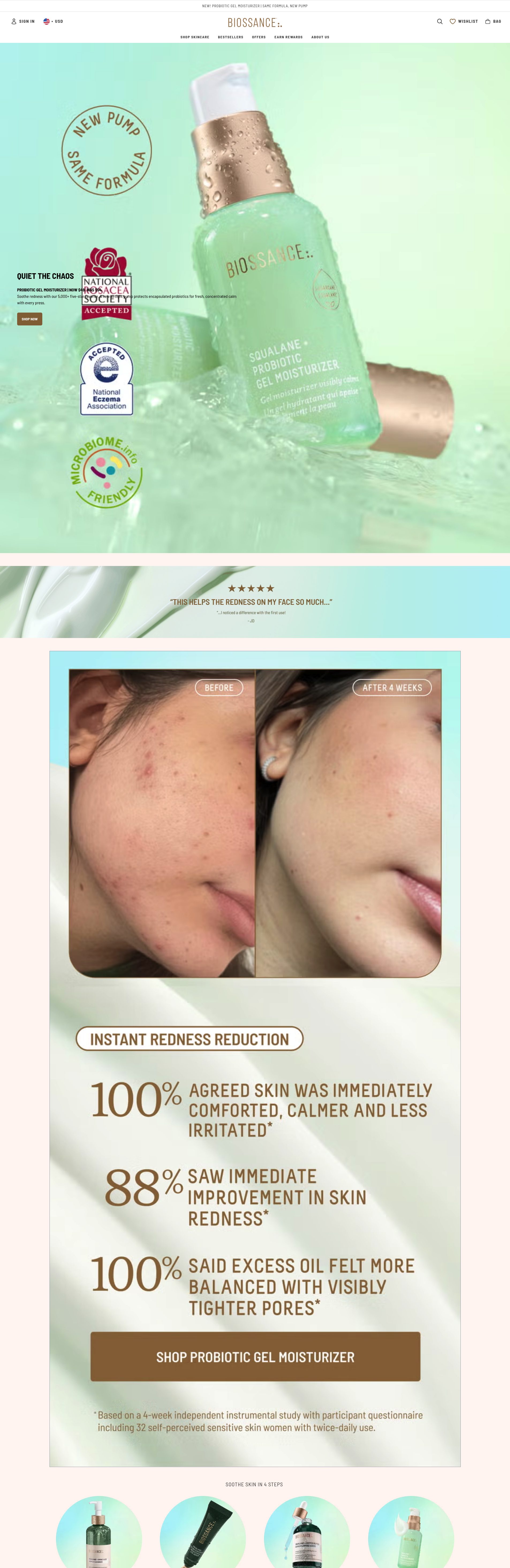
Biossance built its brand around one ingredient: squalane derived from sugarcane. The Shopify store has been architected entirely around this positioning, which makes every page feel coherent and every product feel like a logical extension of the same idea. This is a masterclass in ingredient-led brand architecture on Shopify.
The product pages use a "Why It Works" section that explains the biochemistry at a level accessible to a curious but non-expert customer. Ingredient sourcing, sustainability credentials, and Sephora stockist badges appear at mid-page to provide third-party validation before the add-to-cart. The store also runs a strong loyalty programme integrated directly into the Shopify checkout, with points visible at basket stage to nudge completion.
6. Glow Recipe
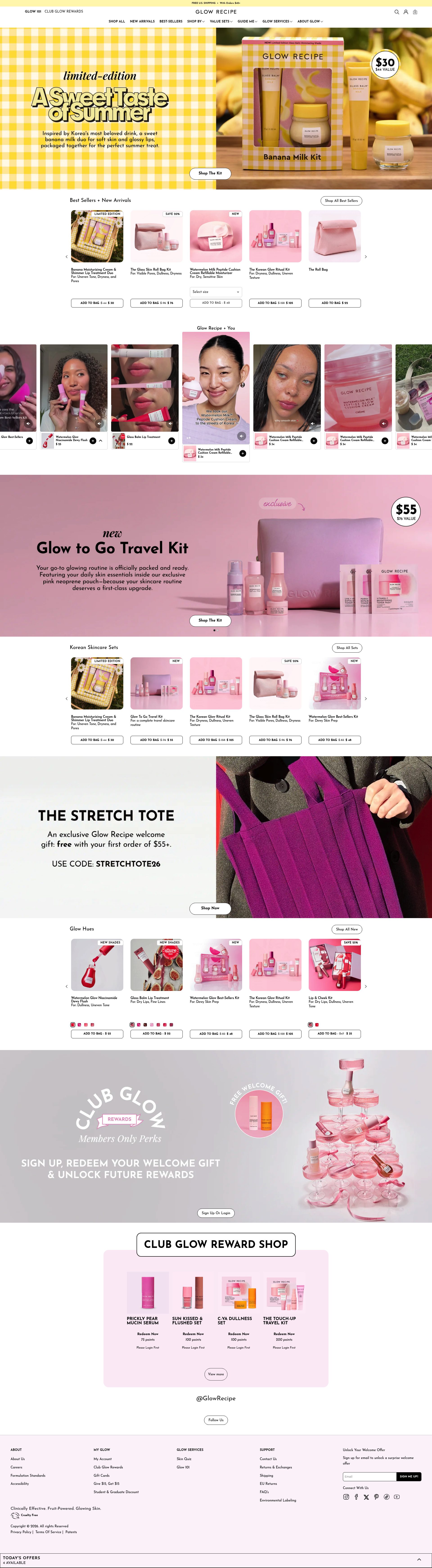
Glow Recipe's store is one of the best examples of social-native product design translating directly into a high-converting Shopify build. The pastel, fruit-themed aesthetic originated on Instagram and TikTok, and the store amplifies rather than dilutes it: product carousels, before/after UGC, and video embeds are woven throughout the PDP without slowing page performance.
The Korean beauty positioning gives the brand a credible differentiation angle in a crowded US and UK market. The serum product pages are structured around "The Results" first, then ingredients, then reviews: a sequence that mirrors how this customer makes decisions. The waitlist mechanic on limited-edition SKUs drives email capture at high intent points, building the owned list alongside the DTC transaction.
7. Typology
Typology is a French DTC brand with a clinical approach to cosmetics: every formula is stripped to its minimum viable ingredient list, with a transparency score on each product page. The Shopify store reflects this in its design — sparse, grid-based, and deliberately undecorated — which reinforces the brand's claim that there is nothing unnecessary in the product.
The pricing architecture is worth studying. Products are priced low enough to compete with mass market, but the brand experience is premium enough that customers feel they are getting something better for less. This is a value perception play, and the store design is central to it: the clinical aesthetic signals quality without requiring a luxury price. Subscription conversion rates are strong because the clean formulations attract customers with sensitive skin who want predictability in their routine.
8. Pestle & Mortar

Irish brand Pestle & Mortar built its reputation on a single hero product: the Pure Hyaluronic Serum. The Shopify store is structured to capture that brand authority and then extend it across the range without diluting the halo effect of the original. The hero product page is among the most detailed on this list: mechanism of action, layering guide, skin type compatibility chart, and over 10,000 reviews.
The cross-sell logic on the PDP is tightly controlled. Rather than showing every product in the range, the store surfaces a two-step "Complete Your Routine" module showing products that work directly with the serum the customer is viewing. This lifts AOV with a relevant suggestion rather than a scatter-gun upsell. The brand also runs a referral programme that surfaces inside the post-purchase confirmation email, targeting the moment of highest satisfaction.
9. Alpyn Beauty
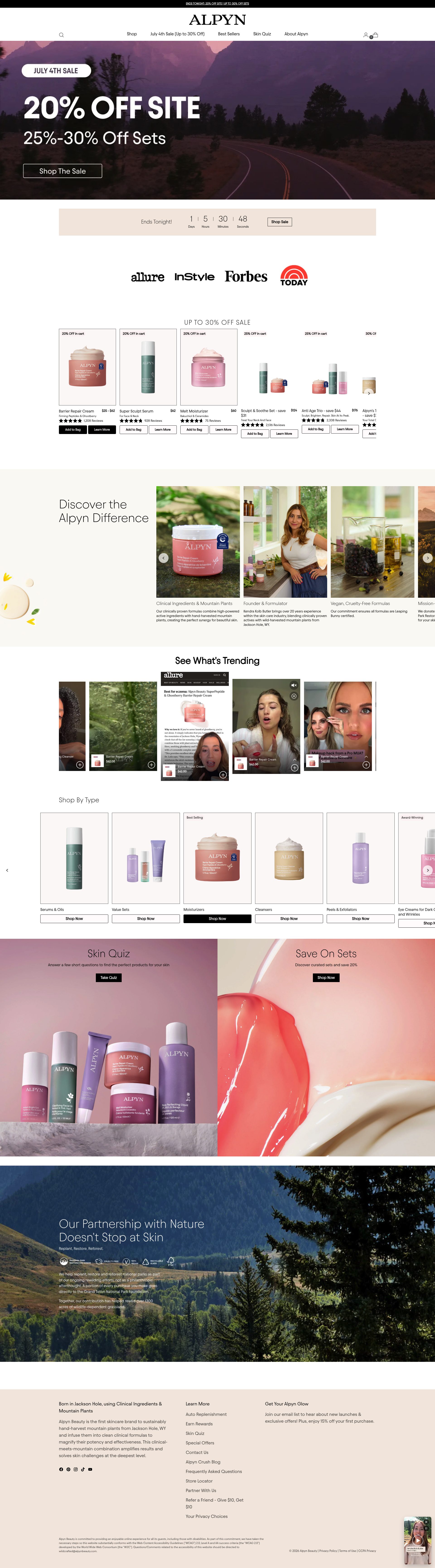
Alpyn Beauty is built around a genuinely unusual sourcing story: wild-harvested botanicals from the Rocky Mountains. The Shopify store makes this tangible in ways that most natural beauty brands fail to manage. Product pages include ingredient maps showing where each botanical is harvested, videos of the founder sourcing in Wyoming, and altitude and seasonal data for key actives.
This level of provenance storytelling solves a real conversion problem in the natural beauty space: customers are sceptical of vague "natural" claims, and Alpyn answers that scepticism with geographic specificity. The store also handles the clinical credibility side well, with dermatologist quotes and trial data embedded mid-page. The combination of wild-harvested story and clinical validation gives the brand two distinct trust levers to pull.
10. Bioeffect

Icelandic biotech brand Bioeffect runs a Shopify store built almost entirely around one ingredient: EGF, or Epidermal Growth Factor, produced via barley plants in a geothermal greenhouse in Iceland. The origin story is specific, verifiable, and genuinely unusual, and the store leverages it on every page.
The product range is intentionally small, which means the store can invest in depth rather than breadth on each PDP. The EGF serum page includes a mechanism animation, clinical study excerpts, a 28-day before/after gallery, and a FAQ section that addresses the most common sceptical objections about growth factors in skincare. The conversion path is long but the close rate is high because the store has done the work of answering every question a serious buyer might have before they need to ask it.
Every store on this list converts at a higher rate because it earns trust before asking for the sale, whether through ingredient transparency, scientific credibility, or provenance storytelling. If you want to build a serum or skincare Shopify store that performs at this level, see our Shopify design services or get in touch to talk through what your store needs.
Frequently asked questions
Are the best serum brands on Shopify or do they use custom platforms?
Most premium and indie serum brands run on Shopify Plus, including Allies of Skin, Biossance, Glow Recipe, and Pestle & Mortar. The platform handles high-volume subscription programmes, multi-currency checkouts, and complex PDP builds without requiring a custom stack — which is why DTC skincare has consolidated heavily on Shopify over the last three years.
What makes a high-converting serum product page?
The stores on this list treat PDPs as evidence dossiers, not product listings. That means active ingredient percentages, mechanism-of-action explanations, dermatologist or clinical study references, skin concern tags, and before/after content — all above or near the fold. Customers shopping for serums are ingredient-literate and sceptical; they need to have their objections answered before they reach the add-to-cart button.
How do the best serum Shopify stores handle subscriptions?
The strongest subscription programmes on this list are built around routine logic rather than blanket discounts. Allies of Skin pairs morning and evening routines as a subscription bundle. The Ordinary's low barrier to first purchase means subscription sign-up is a natural next step at checkout. Augustinus Bader offers a meaningful saving on repeat orders at a price point where customers think hard before committing monthly spend.
Is a small product range a disadvantage for serum brands on Shopify?
No — several of the best-performing stores on this list run tight ranges deliberately. Bioeffect built its store around a single hero ingredient, EGF, across a handful of SKUs. Pestle & Mortar anchored the business on one hero serum before expanding. A focused range allows you to invest in depth on each PDP rather than spreading editorial and photography budget thin across dozens of products.
How do serum brands use storytelling to justify premium prices?
The brands on this list use three main credibility levers: ingredient provenance (Alpyn Beauty's Rocky Mountain botanicals, Bioeffect's Icelandic geothermal greenhouses), scientific authority (Augustinus Bader's TFC8 stem cell research, Biossance's sugarcane squalane biochemistry), and community proof (Pestle & Mortar's 10,000+ reviews, Glow Recipe's UGC and TikTok before/afters). Each approach reduces price objection without requiring a discount.