
Quick summary
Christy is the strongest UK heritage play, using its Wimbledon partnership and GSM-level product detail to justify premium pricing against supermarket alternatives. Bamboa leads on eco-fabric conversion, surfacing OEKO-TEX certifications and antimicrobial specs on the PDP rather than burying them in an About page. Hug In A Towel shows how category clarity — splitting children, adults and babies upfront — removes the main friction point for gift buyers. Canningvale is the best example of managing a broad catalogue without losing buyer focus, using editorial curation on category pages to drive buyers to bestsellers.
Towels sit in an awkward spot in ecommerce: low average order value on their own, but high repeat purchase potential and strong gifting demand. The brands below have figured out how to sell something tactile, unglamorous and commoditised at a price that sustains a DTC business. Here are 10 of the best towel Shopify stores worth studying.
1. Christy
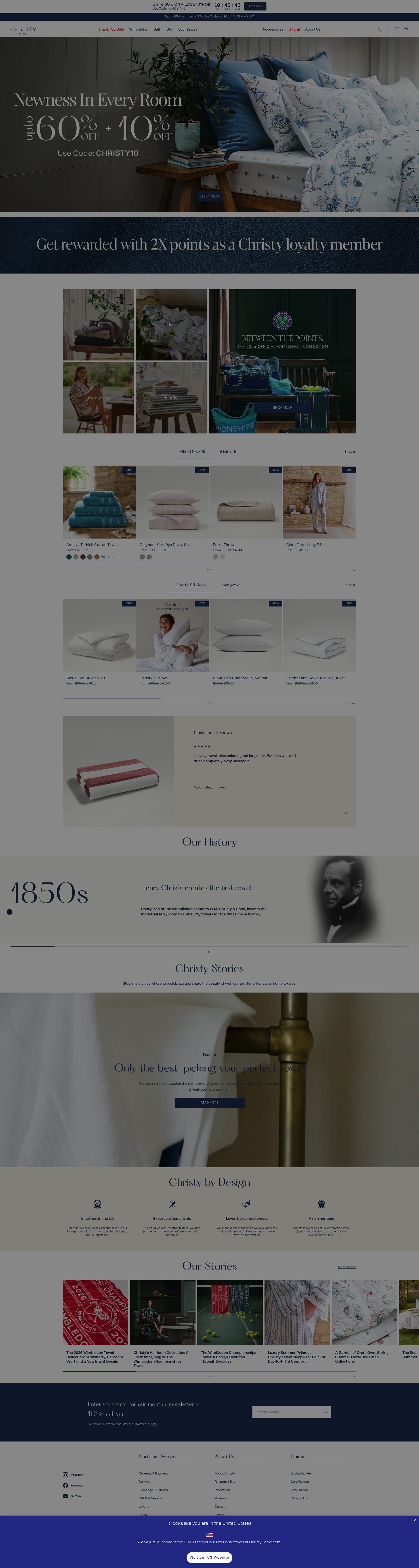
Christy is one of the oldest textile brands in Britain, founded in 1850, and the Shopify store makes that heritage work without letting it become a liability. The homepage balances archive imagery with clean product photography, and the Wimbledon partnership is woven throughout category pages as a credibility anchor rather than a distraction. Product pages surface thread count, GSM weight and care instructions early, which is exactly what a buyer choosing between a £20 supermarket towel and a £45 Christy one needs to see.
The navigation splits sensibly between towels, bedding and gifting, which broadens basket potential without muddying the product proposition. The gift wrap upsell is prominent on PDPs — smart for a brand with strong gifting demand year-round.
2. Bamboa
Bamboa is a specialist in bamboo home textiles and the Shopify store is built to convert buyers who arrive sceptical of the "eco fabric" pitch. The homepage leads with a clear value proposition — softer, faster-drying, more sustainable — backed by specific callouts on antimicrobial properties and GSM ratings. That specificity does more conversion work than any lifestyle image.
The PDP structure is tight: hero image stack, key benefit icons, full material breakdown, then social proof. There is no wasted scroll. The brand also surfaces its sustainability certifications (OEKO-TEX, FSC) in the product description itself rather than burying them in an About page, which is the right call for a category where trust is the primary purchase barrier.
3. Soak & Sleep
Soak & Sleep stocks towels across an unusually wide range of fabrics and weights, from lightweight waffle weave to plush Egyptian cotton, and the Shopify store handles that breadth well. The navigation uses fabric type and intended use as primary filters rather than just price, which helps buyers who know what they want but are not sure what it is called.
The product pages use "weight guide" tooltips to explain GSM to buyers unfamiliar with the spec, reducing pre-purchase confusion and likely lowering returns. The bundle builder, which allows customers to mix towel sizes at a discount, is a reliable AOV lever and Soak & Sleep executes it cleanly without the heavy-handed "SAVE 30%" urgency that cheapens premium positioning.
4. ESPA
ESPA is primarily a spa skincare brand, but its towels and robes occupy a strong position in the "spa at home" gifting market. The Shopify store understands that most towel buyers here are buying an experience, not a product, and the copy and photography reflect that. The hero images show bathrooms that look like four-star hotel rooms rather than product shots on white, and the copy talks about how the towel feels rather than what it is made from.
The gifting mechanics are well developed: pre-built gift sets, personalisation options surfaced on the PDP, and a gift message field in the cart. For a brand operating in the premium gifting segment, those features directly protect conversion at the checkout stage when buyers are deciding whether to go to ESPA or John Lewis.
5. The White Company
The White Company is the standard-bearer for aspirational home textiles ecommerce in the UK and the towel category is no exception. The photography is consistent, the palette is restrained and every product page is built around the same principle: show the product in context, then justify the price with material detail and customer reviews.
The cross-sell logic on towel PDPs is particularly strong. The "Complete the Look" module recommends matching bath mats, flannels and robes within the same colour range, increasing basket size without requiring any add-to-cart friction. The loyalty scheme, White Company Plus, is surfaced in the cart at a point where the discount incentive is most likely to land.
6. Abyss & Habidecor

Abyss & Habidecor is a Portuguese luxury brand and one of the few towel brands that genuinely operates at the ultra-premium end of the market with a Shopify store built to match. The homepage communicates exclusivity through restraint: minimal text, large format photography and a colour selector that lets buyers configure their towel before viewing it. That colour personalisation is front and centre because it is the brand's primary product differentiator.
At this price point (bath towels from £60 to £120), the PDP needs to do serious conversion work. Abyss & Habidecor achieves this through material storytelling — detailed copy on Egyptian cotton construction and the weaving process — and a returns policy that is prominently placed to reduce purchase anxiety on a high-value item.
7. Hug In A Towel
Hug In A Towel is a British DTC brand best known for its children's hooded towels and adult poncho styles, and the Shopify store is a clean example of category clarity driving conversion. The navigation immediately separates children, adults and babies, which removes the most common friction point for gift buyers who are not sure where to start. Product pages lead with the lifestyle use case — beach, pool, kids after swimming — rather than product specs, which is the right call for an impulse and gifting purchase.
The brand uses a loyalty points mechanic and a referral scheme prominently in the footer and on account pages. For a product with strong word-of-mouth potential — parents recommend useful kids' products constantly — making the referral mechanic visible is a low-cost retention and acquisition lever.
8. Biscuit Clothing
Biscuit Clothing is a children's brand with a strong towel and swimwear offer, and its Shopify store demonstrates how a focused niche brand can outperform larger competitors in a specific subcategory. The personalisation option — embroidered names on children's towels and robes — is surfaced early on the PDP and drives meaningful AOV uplift because parents buying for children are highly motivated to personalise.
The photography is uniformly excellent: real children in real water, which builds trust faster than studio shots for a product parents are assessing for durability and practicality. The size guide for children's towels includes age ranges rather than just dimensions, which reduces pre-purchase uncertainty for a gift buyer.
9. Hydrocotton
Hydrocotton is a specialist brand with a single defining product claim: towels that get softer with every wash. That clarity of proposition is rare in the towel category and the Shopify store is built entirely around proving it. The homepage opens with the core claim, then backs it up with wash cycle data and customer testimonials referencing longevity, not just initial softness.
The subscription model is surfaced on the PDP as a modest auto-replenishment option rather than a pushy upsell, which suits a product that is genuinely repurchased on a long cycle. The trial pack, a lower-cost entry point with a single hand towel, reduces the financial barrier for first-time buyers reluctant to spend £60 on a bath towel from a brand they have not used before.
10. Canningvale
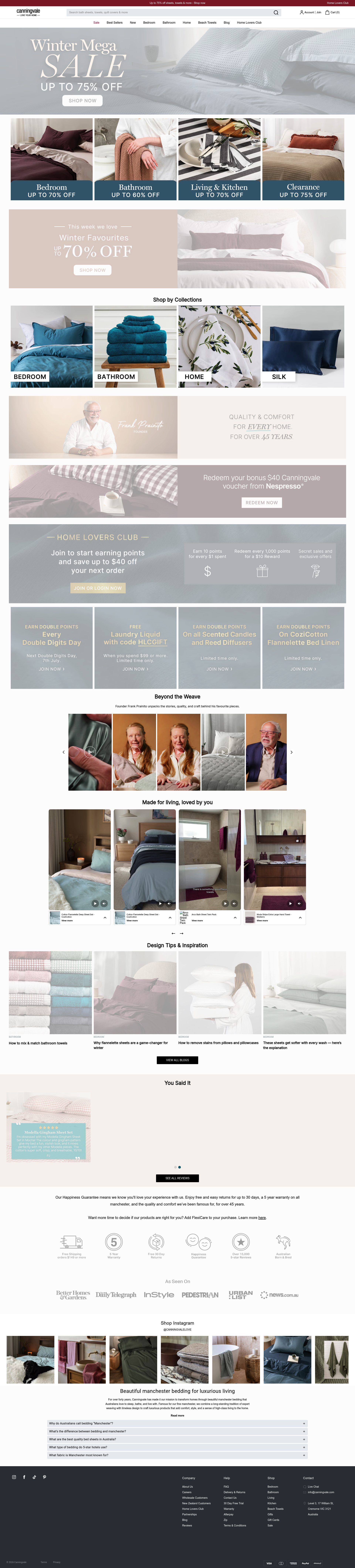
Canningvale is an Australian home textiles brand with a strong Shopify Plus setup and an international DTC presence. The store is a good study in how to manage a broad catalogue — towels, bedding, robes, table linen — without losing focus on the core buyer journey. Category landing pages use editorial callouts to direct buyers to bestsellers, which prevents the paralysis that comes from a 200-product category page with no curation.
The sale mechanics are handled well: the discount is shown as a percentage saving on the PDP rather than just a crossed-out price, which communicates value more clearly. The product bundle builder allows customers to create linen sets across categories, increasing average order value without requiring customers to navigate back through the catalogue.
If your towel or home textiles brand is ready for a Shopify store that converts browsers into buyers, take a look at our Shopify design service or get in touch to discuss your project.
Frequently asked questions
Which Shopify stores sell the best quality towels in the UK?
Christy and Soak & Sleep are the strongest picks for quality at different price points. Christy justifies its premium with GSM ratings, thread count detail and a heritage story that holds up on the PDP. Soak & Sleep covers more fabric types — Egyptian cotton, waffle weave, bamboo — and uses weight guide tooltips to help buyers choose confidently without needing to know the specs upfront.
What makes a towel Shopify store convert well?
The highest-converting towel stores do three things: they surface material specs (GSM, fabric type, care instructions) early on the PDP so buyers can justify the price over cheaper alternatives; they use bundle builders or size mix options to increase average order value; and they handle gifting mechanics — gift wrap, personalisation, gift message — cleanly at checkout. Christy, The White Company and Biscuit Clothing all execute this well.
Are bamboo towels worth selling on Shopify?
Yes, but the conversion challenge is that most buyers are sceptical of eco-fabric claims. Bamboa is the best example of how to handle this: it leads with specific, verifiable benefits (antimicrobial properties, faster drying, GSM ratings) and surfaces sustainability certifications like OEKO-TEX on the product page itself rather than a separate About section. Specificity converts; vague eco-claims do not.
How do towel brands on Shopify handle gifting?
The best towel stores treat gifting as a distinct purchase journey rather than an afterthought. ESPA pre-builds gift sets and surfaces personalisation on the PDP. The White Company uses a loyalty scheme surfaced at cart stage to convert gifters into repeat buyers. Biscuit Clothing drives AOV through embroidered name personalisation, which is especially effective for children's towels where parents are highly motivated to customise.
What average order value tactics work for towel ecommerce?
Bundle builders are the most reliable AOV lever in the towel category: Soak & Sleep lets customers mix towel sizes at a discount, and Canningvale extends this across categories with a linen set builder. Cross-selling within colour ranges, as The White Company does with its "Complete the Look" module on PDPs, is the other high-impact tactic — it increases basket size without requiring buyers to navigate back through the catalogue.