

Quick summary
Dirtea is the standout UK adaptogen brand, with product pages built around functional benefits, transparent extraction ratios, and a subscription mechanic that anchors savings in real pound values rather than percentages. Four Sigmatic earns its place through category-defining positioning, turning 'take a mushroom supplement' into 'replace your morning coffee' and restructuring their entire Shopify store around that framing. Apothekary leads on personalisation, using a quiz funnel that segments by concern and lifestyle to produce recommendations that outperform browse-led navigation. Adaptogen Apothecary is the strongest pick for specialist credibility, with study citations, self-selection copy, and an education-first email sequence that filters toward high-LTV customers.
Adaptogens are one of the fastest-growing supplement categories in ecommerce, but the category has a problem: most shoppers do not know what they are buying or why. The stores that convert best are the ones that solve the education problem before asking for the sale. These ten Shopify merchants sell reishi, rhodiola, lion's mane, maca, and more, and each one has made deliberate ecommerce decisions that are worth studying.
1. Dirtea
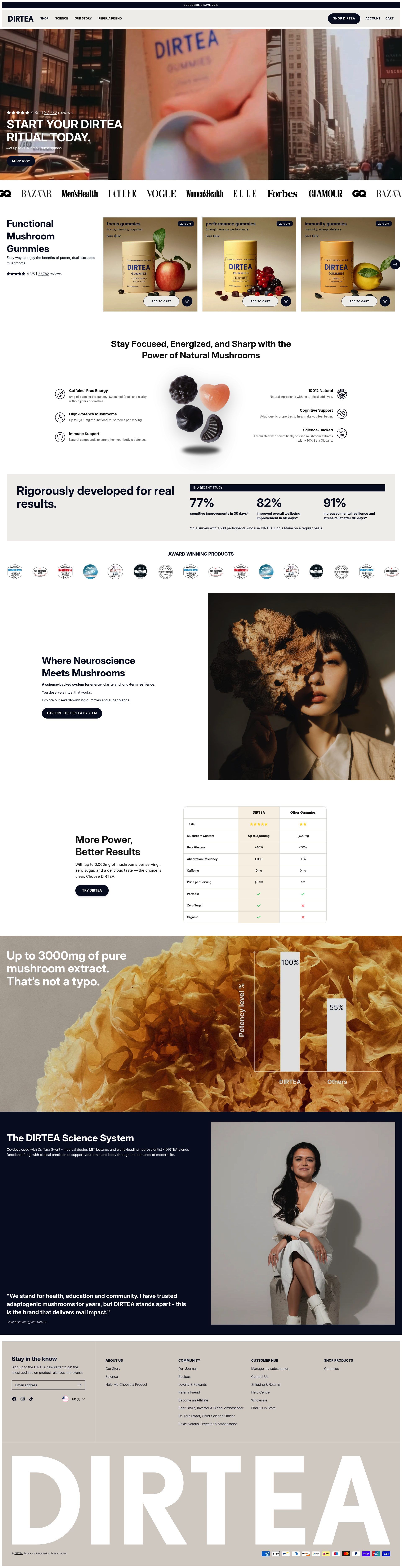
Dirtea is a UK-founded mushroom adaptogen brand built entirely on Shopify Plus, and their store reflects a clear understanding that premium pricing requires premium justification. Product pages lead with functional claims (sleep, focus, immunity) before diving into mushroom species specifics, which means the customer understands the benefit before they encounter the ingredient. The extraction ratio and beta-glucan percentage are listed prominently on every product, giving shoppers with supplement knowledge the technical proof points they want without burying casual buyers in jargon.
Their subscription mechanic is well-executed: the subscribe-and-save prompt appears in the product hero with the percentage discount displayed as a concrete monthly saving in pounds rather than a percentage, which is more persuasive because it anchors to a real number. Dirtea also uses a bundle builder that groups mushroom blends by goal, "sleep stack," "focus stack," which increases average order value and reduces the cognitive load of building a routine from scratch.
2. Four Sigmatic

Four Sigmatic pioneered the mushroom coffee category and their Shopify store carries the authority that comes with being the brand that had to explain adaptogens to a mass audience from scratch. Their product pages are structured around the daily ritual angle: the entry point is "replace your morning coffee" rather than "take a supplement," which dramatically widens the addressable audience. That positioning shift changes how the collection pages are organised, by meal occasion and daily moment rather than by ingredient or SKU type.
The store handles ingredient education through embedded FAQ sections on product pages rather than linking out to a separate learn section, which keeps the customer in the purchase flow. Their bundle discount structure is transparent, with the savings shown in the cart on a per-unit basis, and their subscription programme offers a custom delivery frequency selector (every 2, 4, 6, or 8 weeks) rather than a fixed cadence. That flexibility reduces churn for customers who use products at different rates.
3. Moon Juice
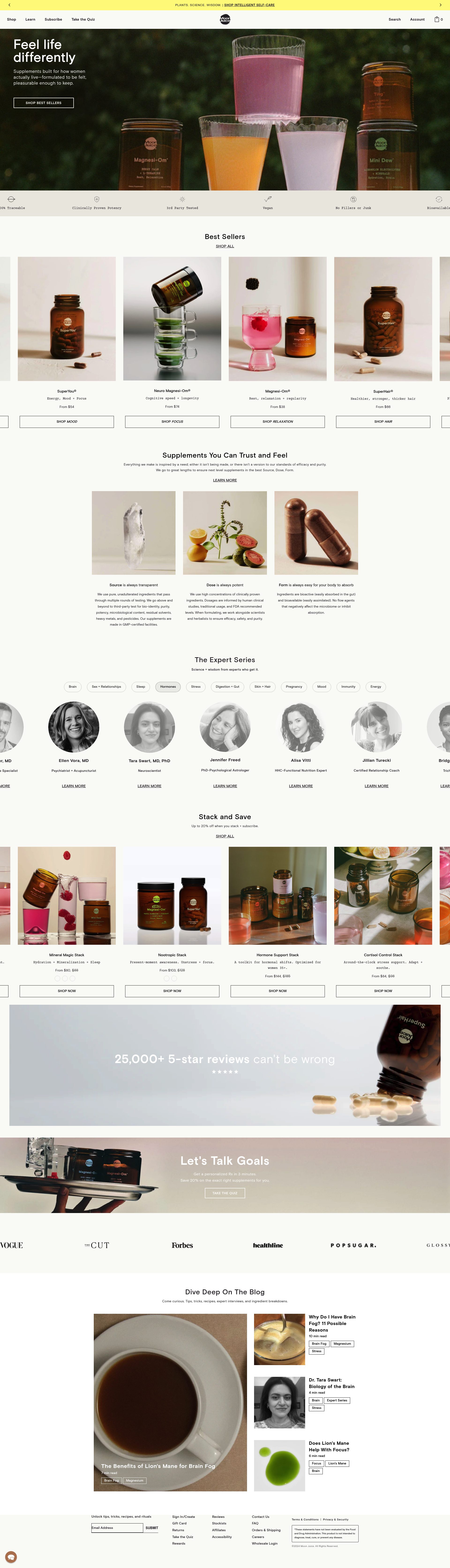
Moon Juice is a US-based Shopify Plus brand that has built a distinct visual identity around adaptogenic wellness, and their store converts that visual equity into revenue through strong cross-sell architecture. Their "Super You" ashwagandha adaptogen blend sits alongside maca, shatavari, and rhodiola products, and the collection page groups products by desired outcome rather than ingredient. The outcome-led navigation is the correct choice in a category where most customers cannot name the ingredient they need but can name the problem they are trying to solve.
Product pages feature a "How to Use" section integrated directly into the main content area, not hidden in a tab, because Moon Juice understands that consumption complexity is a barrier in the supplement category. They also surface clinical study references on the product page itself, with short summaries rather than just footnote links, which builds credibility without requiring customers to click away. Their loyalty programme is integrated into the product page via a points reminder shown at checkout entry.
4. Ryze Superfoods
Ryze Superfoods is a direct-to-consumer mushroom coffee brand that has scaled aggressively on Shopify through a tightly optimised acquisition and retention funnel. Their homepage is built around a single conversion action: starting the subscription. Unlike brands that offer both one-time purchase and subscription with equal visual weight, Ryze defaults to subscribe on the product page and requires an active click to switch to one-time purchase. That default choice architecture has a measurable impact on subscriber acquisition rates.
Their onboarding experience post-purchase includes an email sequence that educates on adaptogen benefits over the first 30 days of use, which serves a dual purpose: it sets expectations correctly (adaptogens build up over time, not overnight) and it pre-empts the most common cancellation reason in the category, "I didn't notice a difference." Social proof is handled through a dedicated results page showing before/after energy and focus testimonials rather than standard star ratings, which is more persuasive for a functional supplement category.
5. Botanic Lab
Botanic Lab is a UK functional beverage brand with a Shopify store built around the on-trade crossover between functional drinks and premium soft drinks. Their adaptogen lattes and reishi blends are positioned as coffee alternatives, and the store design reflects that premium beverage positioning rather than a supplement aesthetic. This is a meaningful distinction: the product photography features lifestyle images in café and kitchen settings rather than gym and workout contexts, which opens a broader consumer audience.
Their collection page uses a mood filter, "calm," "focus," "energy," that allows customers to browse by how they want to feel rather than by ingredient. That UX decision maps directly to how consumers think about functional beverages. They have also integrated a subscription bundle that mirrors a monthly beverage subscription box rather than a standard supplement auto-ship, which increases perceived value by framing the recurring purchase as a curated delivery rather than a restocking chore.
6. Naturya
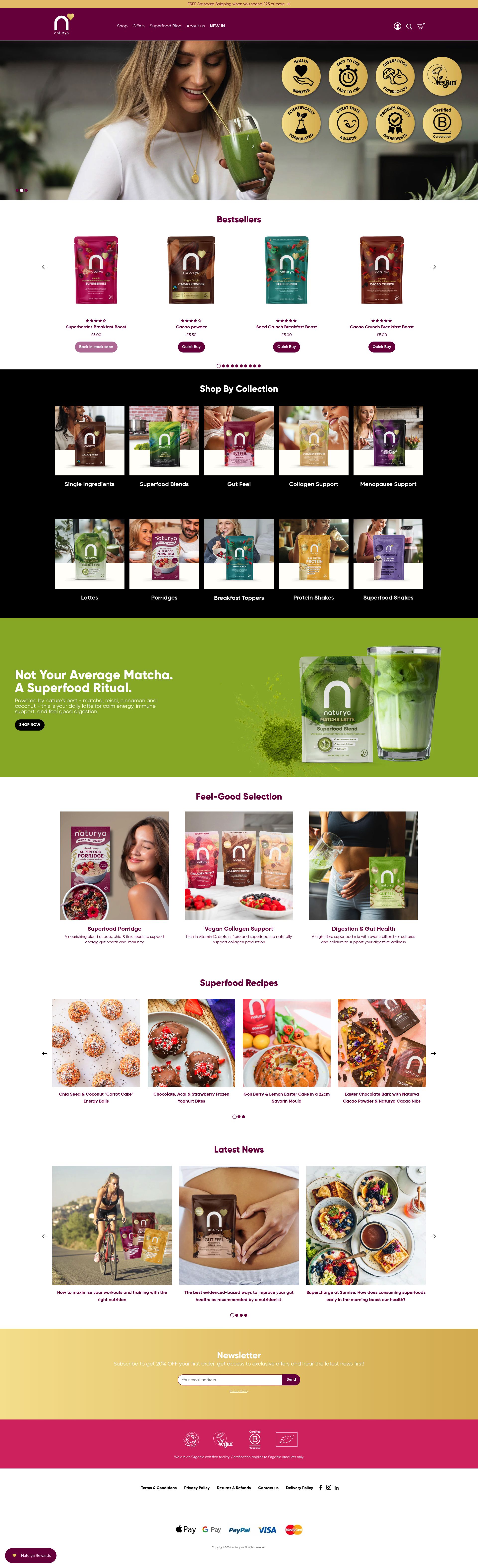
Naturya is a UK superfoods brand that covers adaptogens alongside a broader range of functional ingredients, and their Shopify store handles breadth-of-range well. Wide product catalogues are a conversion problem in the supplement category because choice overload increases bounce rates, but Naturya addresses this through a well-structured collection taxonomy: adaptogens, superfoods, and protein blends each have their own dedicated collection with consistent product card formatting and filtering by health goal.
Their product pages lead with the ingredient origin story, which is the right approach for a brand whose differentiator is ingredient sourcing quality. Maca powder pages explain the difference between gelatinised and raw, rhodiola pages specify the standardised rosavins percentage, and ashwagandha pages reference the KSM-66 extract standard. These specifics give customers who have done their research a reason to prefer Naturya over a cheaper private-label alternative. The Trustpilot integration on product pages is well-placed, appearing directly above the add-to-cart button.
7. Wunder Workshop
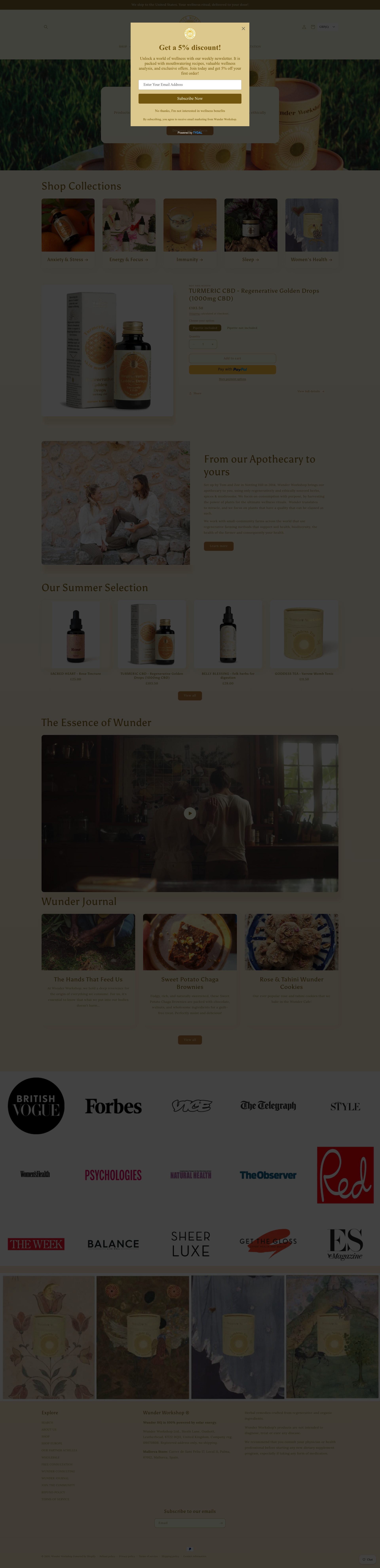
Wunder Workshop is a UK turmeric and adaptogen brand that has built a Shopify store around provenance storytelling. Their golden mylk blends and adaptogen teas are positioned through an origin-to-cup narrative: each product page includes sourcing information that names the specific farm or cooperative and the country of origin. That level of supply chain transparency is unusual in the supplement category and functions as a credibility signal that justifies premium pricing.
Their recipe content is integrated into the product pages rather than siloed in a separate blog section, which serves both SEO and conversion purposes. A customer reading about a reishi latte recipe is already one click from the product, and the content answers the "how do I use this" question at the point of maximum purchase intent. Wunder Workshop also uses a subscription model with a "ritual reminder" framing, positioning the auto-ship as a reminder to maintain a daily habit rather than as a cost-saving mechanic.
8. Sun Potion
Sun Potion is a US Shopify brand that has built a premium adaptogen range around tonic herbs, including he shou wu, tocos, and pearl powder alongside more mainstream options like lion's mane and reishi. Their store is designed for a customer who already understands the adaptogen category and is looking for quality and rarity rather than introductory education. This is the opposite of most adaptogen store strategies, and it works because the target customer exists and is willing to pay premium prices for rare ingredients.
Product pages are minimal by supplement category standards: no comparison tables, no extensive FAQs, just a clear ingredient description, sourcing information, and suggested use. That restraint is itself a positioning signal. The Shopify store handles international shipping to the UK and EU through a localised currency display, which reduces friction for non-US customers who are the largest premium adaptogen buyer segment outside North America.
9. Apothekary

Apothekary is a US Shopify Plus brand that has made the quiz funnel its primary acquisition tool, and the implementation is more sophisticated than most supplement quiz experiences. The quiz segments by specific concern (stress, sleep, hormones, energy) and by lifestyle factors including diet type and existing supplement routine, producing a personalised recommendation rather than a generic category page. That personalisation is functionally a product recommendation engine, and it converts better than browse-led navigation for customers who do not already know what they need.
Their product naming strategy is designed for word-of-mouth: "Take the Edge Off," "Like Butter," and "Bye Bye Bloat" are all names that function as benefit statements and are shareable without explanation. The Shopify store supports this with a strong gifting mechanic: products are presented with gift set options and personalised message cards at checkout, which extends the customer acquisition channel to the gifting occasion.
10. Adaptogen Apothecary
Adaptogen Apothecary is a UK specialist brand focused exclusively on adaptogenic herbs, and their narrow focus is the store's greatest asset. With a smaller SKU count than generalist supplement brands, the store can invest more page space per product in education and proof. Each product page includes a detailed "What the research says" section that cites specific studies with plain-language summaries, a "Who it's best for" paragraph that helps customers self-select, and a comparison with related adaptogens in the range.
Their email capture is handled through a 10-day adaptogen education sequence rather than a standard discount offer, which attracts customers who are genuinely interested in the category rather than discount hunters. That filters the subscriber list toward higher lifetime value customers. Their blog doubles as a searchable ingredient glossary, which captures informational search traffic for queries like "what is rhodiola good for" and funnels that intent toward relevant product pages through contextual internal linking.
If you are building or scaling a Shopify store in the health and wellness space, the decisions these brands have made, on education architecture, subscription framing, and ingredient transparency, are directly applicable to your store. Talk to our team about Shopify design or explore our Shopify design and development services.
Frequently asked questions
Which adaptogen Shopify stores are the best for beginners?
Four Sigmatic and Ryze Superfoods are the strongest picks for beginners because both position their products as coffee replacements rather than supplements, which lowers the education barrier. Their product pages lead with the daily ritual angle and handle the "what does this actually do" question without requiring customers to seek out a separate learn section.
Do adaptogen stores on Shopify use subscriptions?
Most leading adaptogen stores use subscriptions as their primary revenue model, and the best ones frame them carefully. Dirtea shows monthly savings in pound values rather than percentages, Ryze defaults the product page to subscribe rather than one-time purchase, and Wunder Workshop uses "ritual reminder" language to position the auto-ship as a habit support tool rather than a billing event.
How do the best adaptogen Shopify stores handle ingredient education?
The top stores integrate education directly into product pages rather than linking to a separate blog. Naturya lists the standardised extract percentage (KSM-66 for ashwagandha, rosavins for rhodiola) in the product description itself. Adaptogen Apothecary includes a "What the research says" section with plain-language study summaries. Four Sigmatic embeds FAQ blocks on product pages to answer ingredient questions without breaking the purchase flow.
What makes an adaptogen product page convert well on Shopify?
The highest-converting adaptogen product pages lead with the functional outcome the customer wants (sleep, focus, energy), then back that claim with an ingredient-level proof point (extraction ratio, beta-glucan percentage, standardised extract). Social proof placed directly above the add-to-cart button outperforms proof buried in a reviews tab. A "Who it's best for" paragraph, as used by Adaptogen Apothecary, reduces purchase uncertainty for customers choosing between related products.
Are UK adaptogen Shopify brands worth buying from compared to US brands?
UK brands like Dirtea, Naturya, Wunder Workshop, and Botanic Lab have a practical advantage for UK buyers: no customs charges, faster delivery, and products formulated to UK and EU regulatory standards. Dirtea and Wunder Workshop in particular are built for the UK premium wellness market and price and position accordingly, whereas US brands like Sun Potion and Moon Juice can add 20-30% to the landed cost once VAT and import fees are included.