

Quick summary
Naylors is the standout for sheer scale, with omnichannel stock availability on product pages that reduces hesitation on big-ticket items. Just Horse Riders converts better on protective equipment than most competitors, surfacing PAS and BETA safety standards at collection level rather than burying them in descriptions. Imperial Equestrian owns the premium end with editorial photography and a tight brand curation that signals luxury without a single extra word. Equiport is the smartest commercial model in the group, pairing stocked European brands with its own in-house horsewear line to drive traffic and protect margins simultaneously.
The UK equestrian market is worth over £4 billion annually, with British Horse Society data consistently showing that horse ownership and riding participation hold strong despite economic headwinds. That commercial weight means equestrian Shopify stores are competing hard, and the best ones have built genuinely thoughtful shopping experiences around complex buying decisions: protective equipment with safety standards, horse products matched to breed and size, and repeat-purchase consumables like feed, supplements, and bedding.
These 10 stores are worth studying. Each has made deliberate choices about how to present a demanding product range, build trust with experienced buyers, and turn browsers into repeat customers.
1. Naylors
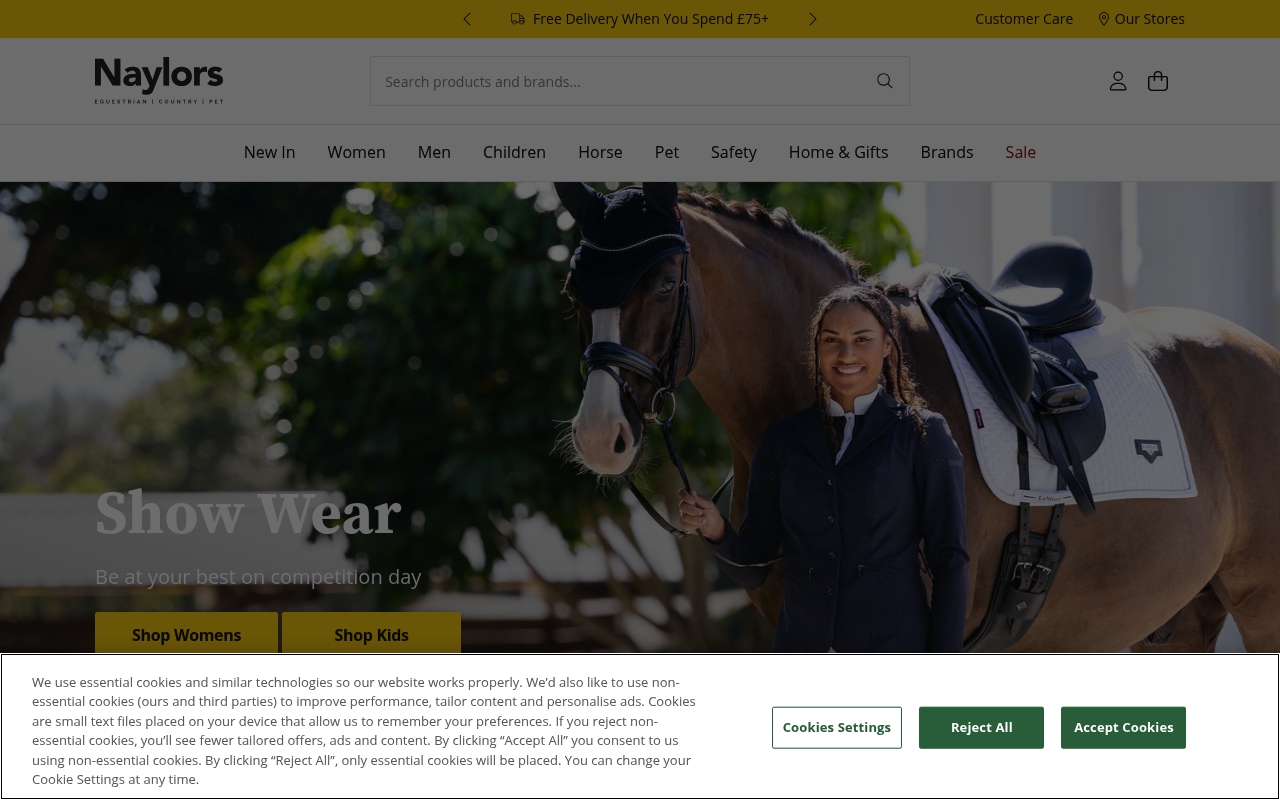
Naylors is the largest UK equestrian retailer on Shopify, operating from a 15,000 sq ft flagship superstore in Rochdale alongside concessions across the country. On Shopify, the store handles an enormous catalogue spanning riding boots, horse rugs, tack, and country clothing, with discipline-specific filtering that lets riders navigate to dressage, showjumping, or hacking gear without wading through unrelated stock. The "check availability in your nearest store" feature on product pages is a strong omnichannel touch that reduces hesitation on higher-ticket items. Naylors also runs a well-executed sale and clearance section with dedicated horse rug clearance, which drives repeat traffic from bargain-conscious yard owners.
What to learn: Stock availability shown per store location, integrated into the product page, reduces the friction that kills conversion on big-ticket items.
2. Just Horse Riders
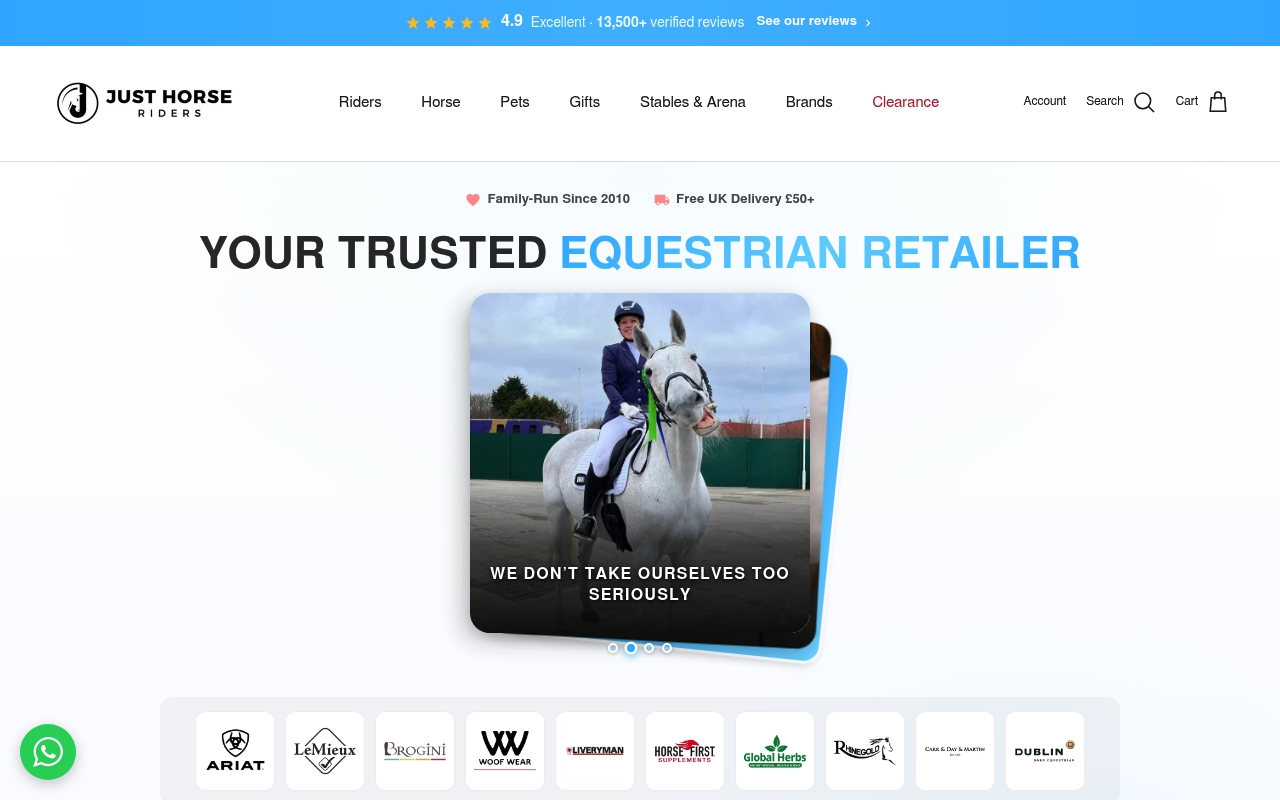
Just Horse Riders runs a focused, tightly merchandised Shopify store covering rider clothing, horse tack, stable supplies, and pet products. What stands out is how cleanly they handle size-critical categories: riding hats carry explicit safety standard callouts (PAS 015, BETA 2018) directly on the collection and product pages, which matters enormously to buyers who understand the difference. Their approach to brand presentation is strong too, with dedicated brand landing pages that help customers who already know they want, say, a specific Ariat or Horseware product navigate directly to it. Trust signals throughout, including Trustpilot ratings on key pages, reinforce the buying decision for new customers.
What to learn: Safety standard information shown at collection level, not just in product descriptions, removes a key barrier for protective equipment purchases.
3. Robinsons Equestrian
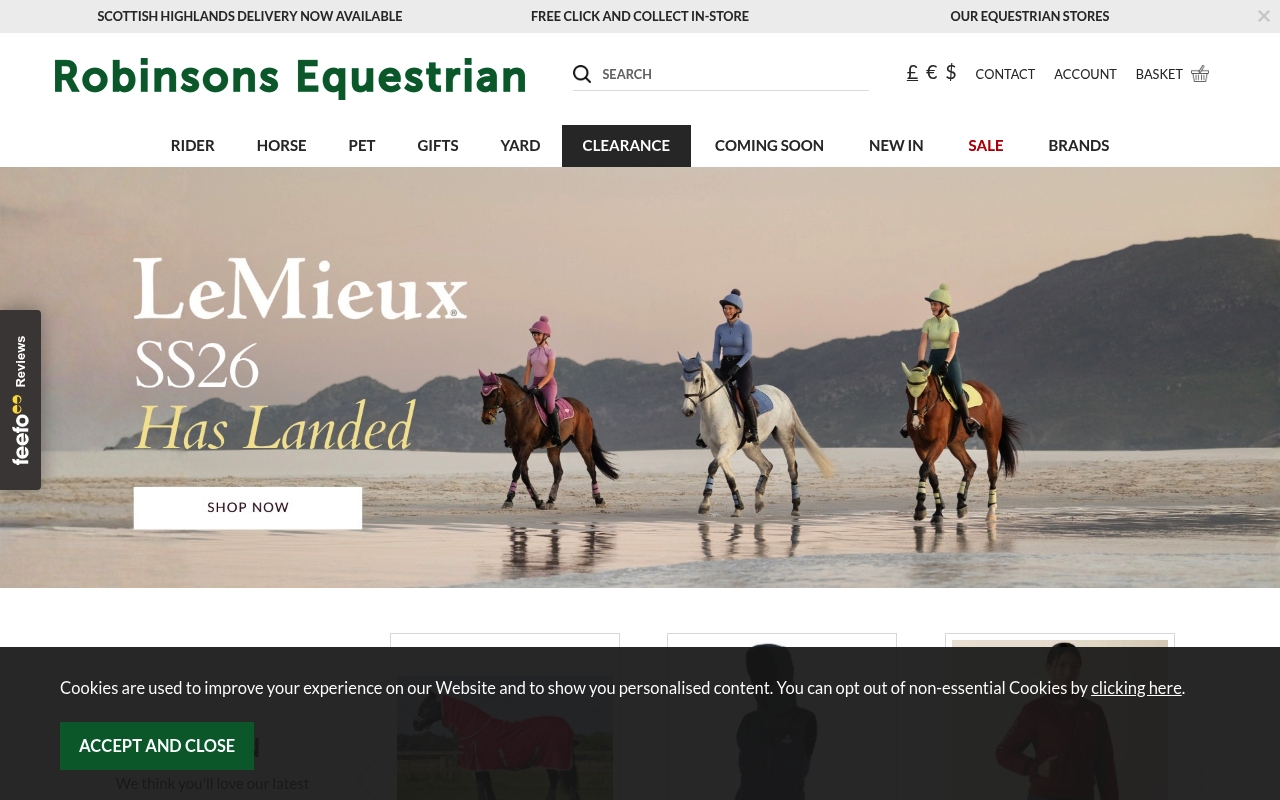
Robinsons is one of the most established names in UK equestrian retail, with physical stores and a Shopify site that reflects decades of category knowledge. The store's navigation is built around horse and rider separately, which mirrors how equestrians actually shop: buying for their horse is a different mental mode to buying for themselves. Product pages for horse rugs include detailed tog ratings, fill weights, and neck cover compatibility notes, addressing the technical questions that experienced buyers ask before they purchase. Robinsons also maintains a content hub with buying guides and care advice, which drives organic traffic and positions the store as an authority rather than just a retailer.
What to learn: Separating horse and rider navigation reflects real purchasing behaviour and reduces cognitive load for customers shopping in one mode or the other.
4. Horze UK
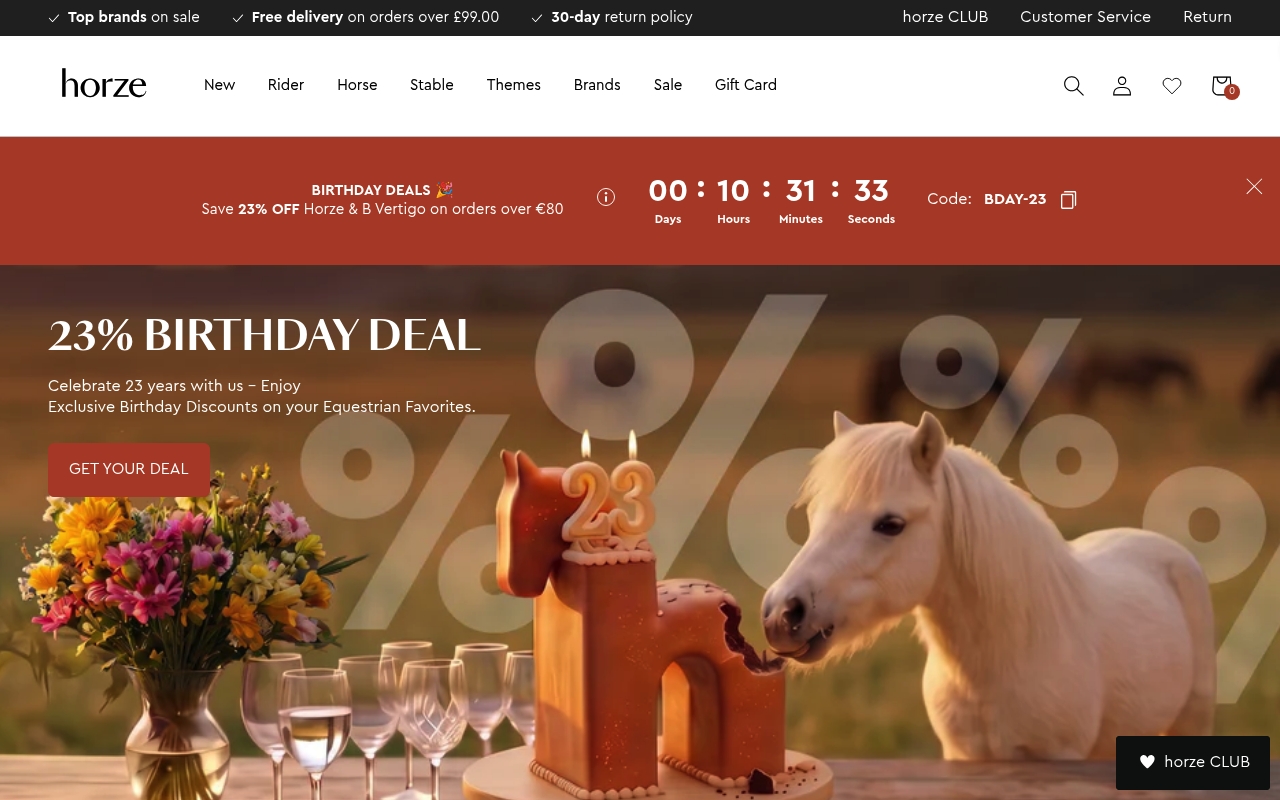
Horze is a Scandinavian brand with a strong UK presence, and their Shopify store stocks over 30,000 products across more than 150 brands. The breadth of range is managed through layered filtering by discipline, product type, brand, and horse versus rider, which stops a large catalogue becoming overwhelming. Horze uses Shopify Payments for checkout, keeping customers on a clean, fast payment flow without third-party redirects. The store also runs a well-structured rewards programme, which suits the repeat-purchase nature of equestrian spending: customers who buy supplements, grooming products, and bedding regularly are exactly the audience that responds to points-based loyalty mechanics.
What to learn: Layered filtering across discipline, product type, and recipient (horse or rider) is essential when managing catalogues of this scale. Without it, bounce rates on collection pages climb fast.
5. R&R Country
R&R Country is based in Melton Mowbray, Leicestershire, the heartland of UK hunting and equestrian country, and their Shopify store reflects that heritage positioning. The store covers equestrian clothing and equipment alongside country attire and field sports, which works because their target customer often shops across all three categories in a single visit. Product pages for riding boots include fit guides and width options, addressing a category where returns are high and poor fit is the main cause. R&R also carry an unusually broad range of country occasionwear alongside practical yard clothing, which differentiates them from pure equestrian specialists and extends the average basket.
What to learn: Cross-category thinking, combining equestrian, country, and occasionwear, increases basket size by matching the real-life purchasing habits of the target customer.
6. Imperial Equestrian
Imperial Equestrian focuses on premium and luxury equestrian brands: Pikeur, PS of Sweden, Cavalleria Toscana, Kentucky Horsewear, Roeckl, Montar. The Shopify store is built around brand authority and premium positioning, with clean product photography and minimal visual clutter that lets the product quality speak. For high-ticket items like competition jackets and premium saddle pads, Imperial uses detailed sizing information and, on select lines, a fit consultation option, which directly addresses the hesitation buyers feel when spending over £200 on a garment they cannot try on. The store's curation, stocking fewer SKUs at higher price points, means their search and filtering needs are simpler, which they execute well.
What to learn: For premium positioning, editorial-quality photography and sparse page layouts signal luxury more effectively than feature-heavy page templates.
7. Equus
Equus offers a wide range of high-end equestrian clothing, footwear, and horsewear, positioning themselves at the quality end of the market. Their Shopify implementation benefits from strong brand architecture: each brand gets its own landing page with brand story, product range overview, and key collection links. This works well for discovery because equestrian shoppers are often brand-loyal; a customer looking for Dublin boots or Caldene jodhpurs will search for those terms specifically. Equus also uses clear free delivery thresholds prominently in the header, which is standard but effective in a category where items are often purchased with a specific spend in mind.
What to learn: Brand-level landing pages capture brand-loyal search traffic and give the browsing experience a cleaner entry point than going straight into collection filters.
8. Redpost Equestrian
Redpost Equestrian operates from Totnes in Devon and runs a broad Shopify store covering horse riding clothing, horse rugs, country clothing, and pet supplies. What makes Redpost notable is their local community positioning within an online context: clear delivery messaging, UK-focused brand selection, and a tone that feels less corporate than larger national retailers. For a store competing against Naylors-scale operations, differentiation on service and trust signals matters as much as product range. Their product photography is clean and consistent across the catalogue, which improves the browsing experience when a customer is comparing multiple rugs or jackets side by side.
What to learn: For regional or independent equestrian stores, trust signals around delivery, UK focus, and service quality can be the conversion differentiator against larger competitors.
9. Equiport
Equiport, based in Knutsford, Cheshire, is a specialist equestrian store with a strong reputation for European and international brands. Their Shopify store carries leading brands including Busse, Kentaur, and HKM alongside an in-house bespoke horsewear range, which gives them a genuine point of difference. The combination of branded product and own-brand manufacturing is a smart commercial model on Shopify: branded lines drive organic search traffic and build credibility, while own-brand products carry better margins. Equiport's product pages for protective equipment include clear safety certification details, and their stable and yard equipment range, which includes large items only available for in-store collection, is well-managed with prominent availability notes.
What to learn: Own-brand product lines alongside stocked brands is one of the most effective margin strategies for specialist equestrian stores, and Shopify handles both models cleanly within the same storefront.
10. Equestore
Equestore bills itself as one of the UK's most extensive online equestrian stores, operating from London with a catalogue that spans tack, clothing, horse care, and stable equipment. The breadth of their range means their Shopify navigation and search have to work hard, and they have invested in category architecture that keeps customers from getting lost. Their product pages for saddles and bridles include detailed fit information and compatibility notes, which reduces return rates in a category where wrong fit is expensive for both the customer and the retailer. Equestore's content around horse care and tack maintenance also builds the kind of topical authority that drives repeat visits from customers who want advice alongside product.
What to learn: In a broad-catalogue equestrian store, investing in category architecture and on-page fit guidance pays back in lower return rates and higher conversion on technical tack products.
What the best equestrian Shopify stores get right
A few patterns emerge across all 10 stores:
- Discipline-based filtering. Dressage, showjumping, hacking, and hunting buyers want different things. Stores that filter by discipline see higher engagement than those that rely on product type alone.
- Safety standard transparency. For helmets, body protectors, and riding boots, PAS and BETA certification information at collection level, not buried in product descriptions, directly impacts conversion.
- Horse versus rider separation. Equestrian customers switch between buying for themselves and buying for their horse. Navigation that reflects this reduces friction.
- Size and fit guidance. Boots, hats, and protective gear require detailed size guides. Stores that invest here cut return rates significantly.
- Repeat-purchase mechanics. Feed, supplements, and bedding are consumables. Subscription options or loyalty programmes capture the recurring revenue that makes equestrian stores commercially resilient.
If your equestrian brand is ready to improve conversion or overall Shopify experience, our Shopify design service is built around exactly these kinds of commercial outcomes. Get in touch to talk through what your store needs.
Frequently asked questions
Which equestrian stores use Shopify in the UK?
Several of the UK's largest equestrian retailers run on Shopify, including Naylors, Just Horse Riders, Robinsons Equestrian, Horze UK, and Equestore. Shopify handles the complex filtering requirements of equestrian catalogues well, particularly discipline-based and horse-versus-rider navigation.
What makes an equestrian Shopify store convert well?
The biggest conversion drivers in equestrian ecommerce are safety standard transparency at collection level, accurate size and fit guidance for boots and hats, and clear horse-versus-rider navigation. Stores that surface PAS and BETA certification information before the product page consistently outperform those that bury it in descriptions.
How do equestrian stores handle large catalogues on Shopify?
The best equestrian stores use layered filtering across discipline, product type, and recipient — horse or rider — rather than relying on a single product category tree. Horze UK manages over 30,000 products this way, and Equestore uses the same approach to keep a broad tack-to-clothing catalogue browsable without overwhelming customers.
Do equestrian Shopify stores offer subscription or loyalty programmes?
Some do, and it makes strong commercial sense given how much repeat-purchase spending happens in equestrian — supplements, bedding, and feed are monthly necessities for most horse owners. Horze UK runs a structured rewards programme specifically targeting this behaviour, and it is one of the more effective retention mechanics in the sector.
How should an equestrian store handle riding hat and body protector sales online?
The key is putting safety standard information — PAS 015, BETA 2018, BETA Level 3 for body protectors — at collection level, not just inside product descriptions. Just Horse Riders does this well. Customers buying protective equipment are safety-aware and will leave a page if they cannot immediately verify a standard meets their discipline's requirements.