
Quick summary
Astrid and Miyu lead the UK jewellery DTC category with a multi-image PDP system and an in-page mix-and-match feature that increases basket size without requiring a separate landing page. Mejuri set the standard for fine jewellery photography, shooting every piece on models with a range of skin tones so customers can actually predict how a gold tone reads on their own wrist. Monica Vinader's live engraving preview, embedded directly in the product page, removes the single biggest anxiety around personalised gift purchases. Annoushka sits at the top of the market with editorial-weight PDPs and an in-store appointments flow integrated alongside add-to-cart, which is the honest architecture for jewellery selling at four-figure price points.
Jewellery is one of the highest-stakes categories in ecommerce. The margin is strong, the purchase is emotional, and the product is almost impossible to evaluate from a photograph alone. Customers cannot feel the weight of a ring, assess the warmth of a gold tone, or judge whether a necklace sits at the right point on their collarbone. The stores that win in this category have engineered their way around that problem: deep product photography, layering visualisers, detailed material specs, strong review signals, and checkout flows that match the gravity of the purchase. These ten Shopify stores are doing it better than most.
Astrid and Miyu

Astrid and Miyu are one of the strongest jewellery DTC brands operating on Shopify in the UK. Their product pages are a model for how to handle a catalogue that spans everyday layering pieces and occasion-specific fine jewellery simultaneously. Each product carries multiple image types: clean studio shots on white, styled editorial images showing the piece worn, and close-up detail shots that communicate finish quality and scale. For a category where scale misreads are a primary return driver, this is not optional — it is table stakes.
Their "mix and match" system, which suggests complementary pieces based on what is currently being viewed, is implemented directly within PDPs rather than as a standalone "shop the look" page. That distinction matters: it captures the customer's attention while they are already evaluating a product, rather than requiring them to navigate away. Their in-store piercing experience is promoted through the online store as a differentiator that pure-play competitors cannot match.
Mejuri
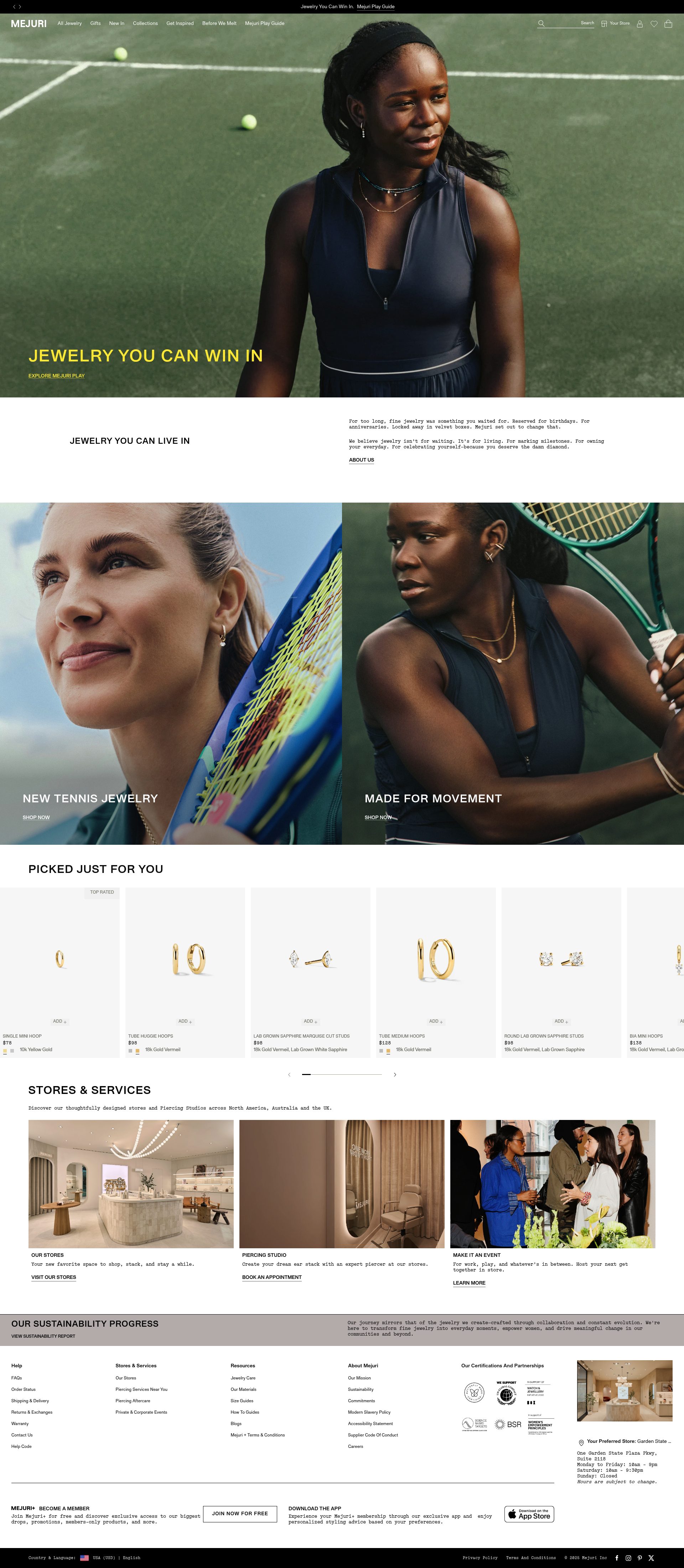
Mejuri built a nine-figure DTC jewellery business on Shopify Plus, and their store reflects the operational rigour behind it. Their product photography is consistent and precise: pieces are shot on models with a range of skin tones, which addresses one of the most persistent trust gaps in fine jewellery online — customers cannot predict how a gold tone will read against their own skin. The "Fine Crew" loyalty programme is surfaced throughout the browse and cart experience rather than only on a dedicated membership page, which increases enrolment without requiring an additional navigation step.
Metal and stone variant selectors use visual swatches rather than text dropdowns. Ring sizing guidance is built into the PDP with a downloadable sizing tool and a recommendation to size up for comfort. These are not frills — they are conversion decisions that directly address the reasons jewellery customers abandon without buying.
Monica Vinader
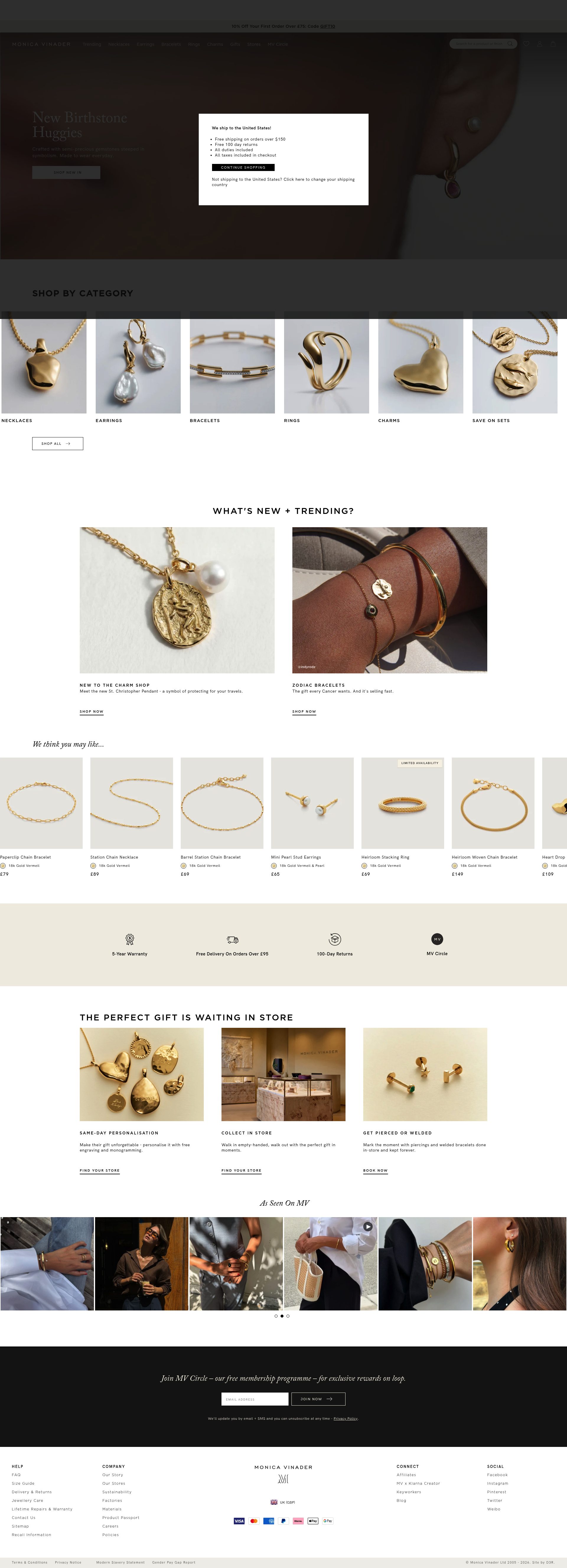
Monica Vinader's Shopify Plus store handles personalisation at scale, which is one of the hardest execution challenges in jewellery ecommerce. Their engraving tool, available on the majority of their catalogue, lets customers preview their text input on the actual product before adding to cart. That live preview eliminates a significant source of post-purchase anxiety around personalised gifts. The tool is embedded in the PDP rather than surfaced only at checkout, which means it is a selling feature as much as a functional one.
Their gifting architecture is unusually strong. Gift message, complimentary gift wrapping, and a dedicated "give a hint" share-your-wishlist feature are all accessible from the cart without requiring a customer account. At their price point, a significant proportion of purchases are gifts, and the store is built around that reality.
Pandora
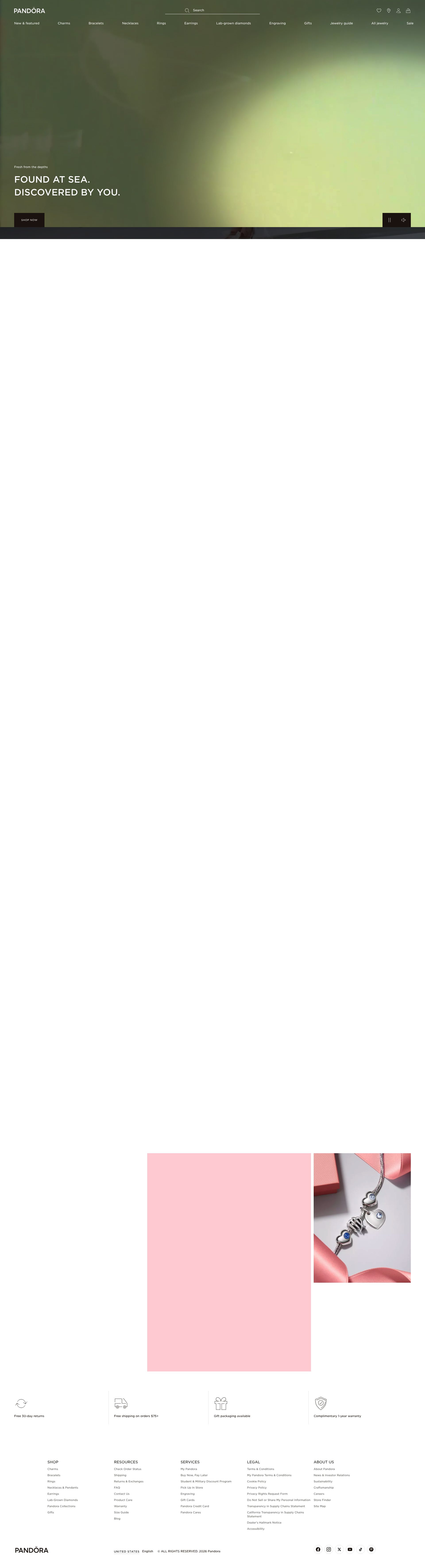
Pandora's Shopify Plus operation is one of the more technically ambitious direct-to-consumer jewellery stores in the world. Their charm finder — a filterable, browseable tool that lets customers discover charms by theme, collection, and compatibility with their existing bracelet — is the kind of feature that takes a complex catalogue and makes it navigable. Without it, a catalogue of thousands of charms would be unusable for a new visitor; with it, discovery becomes the point.
Their product pages use 360-degree product spin on hero images for key pieces, which is a meaningful investment in helping customers understand the three-dimensional form of a charm or ring. Trust and provenance signals — hallmarking details, metal content, stone type — are specified clearly in product details rather than hidden in a general FAQ. For a brand selling at Pandora's volume, the store's coherence across localised UK pricing, UK promotional events, and UK delivery messaging is a notable operational achievement.
Missoma
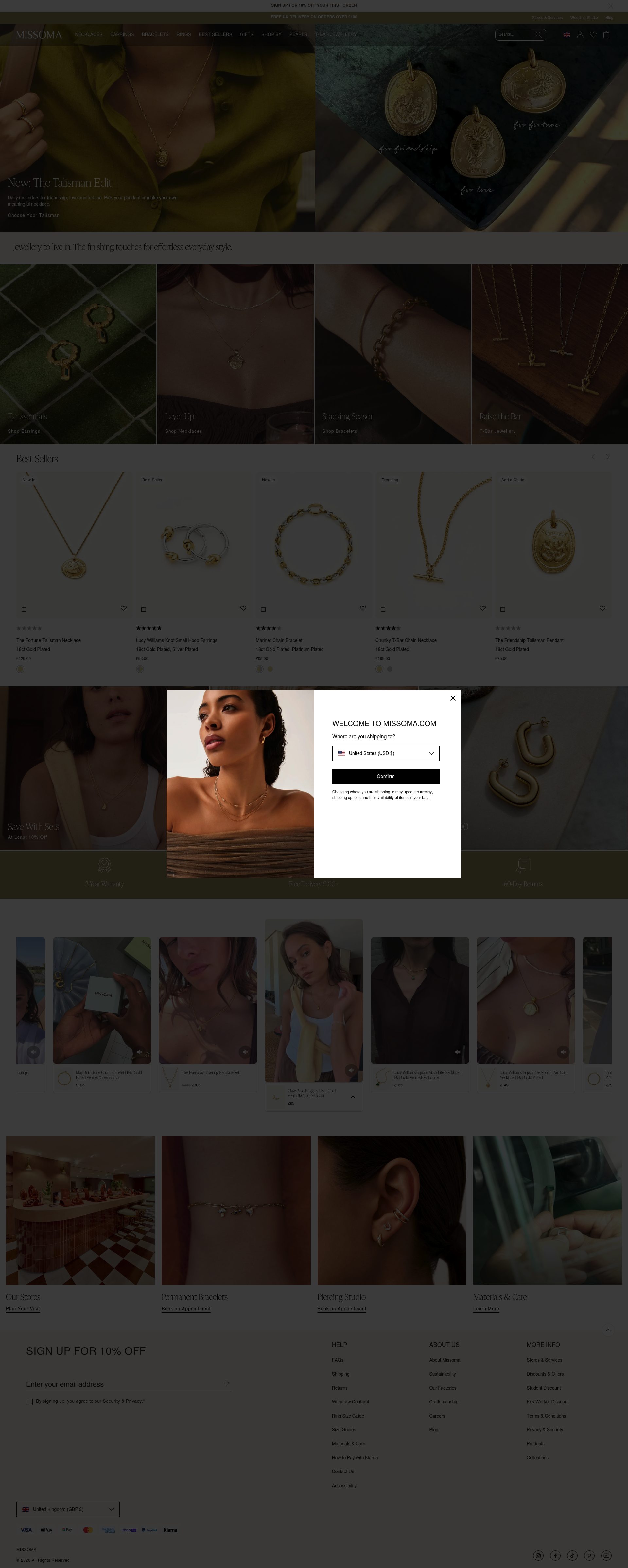
Missoma's Shopify store is a good example of a UK fine jewellery brand using editorial content and influencer collaboration as conversion tools without letting the marketing overwhelm the commerce. Their "as seen on" placement, showing which pieces have appeared in editorial or on known faces, is implemented at the product level rather than collected on a press page. For a customer in the awareness stage, that social proof is relevant at the moment of product evaluation — not on a separate page they will never visit.
Their layering guide, which demonstrates how to combine necklaces at different chain lengths with different pendant weights, is one of the more genuinely useful pieces of content in UK jewellery ecommerce. It is not a blog post. It is a shoppable page linked from the navigation, which means it captures customers who arrive knowing they want to layer jewellery but unsure how to build the look.
Beaverbrooks

Beaverbrooks are a UK fine jewellery and watch retailer that have built a Shopify Plus store capable of handling diamond engagement rings at the high end and everyday gifting pieces at the accessible end. Their diamond filter, which lets customers specify cut, carat, clarity, and colour simultaneously with price range, gives customers the same kind of specification control they would expect from a bricks-and-mortar consultation. That level of filter depth is standard in high-ticket jewellery, and its absence in a competitor's store is immediately noticeable.
Their engagement ring builder — selecting the stone and the setting separately — is handled as a guided flow rather than a static PDP, which suits the considered purchase behaviour of that customer segment. Delivery and returns information specific to high-value orders, including insured shipping and in-store return options, is surfaced in the PDP rather than requiring the customer to navigate to a policies page.
Wolf and Badger
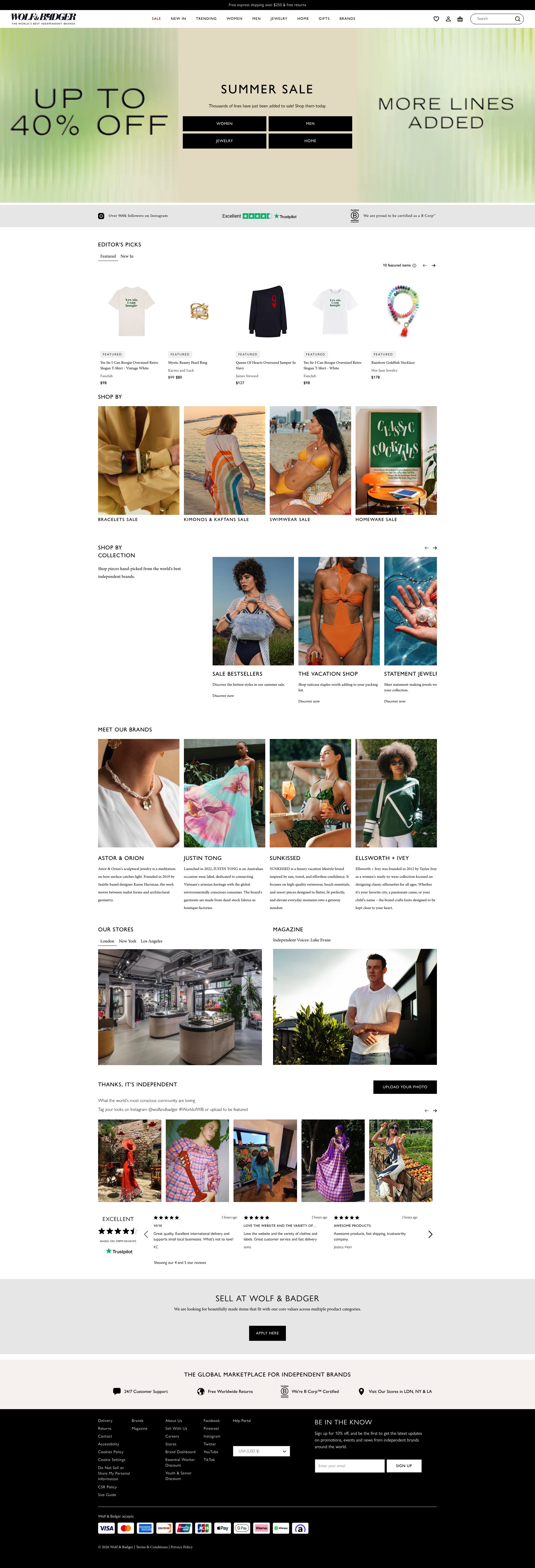
Wolf and Badger is a curated marketplace for independent jewellery designers, built on Shopify, that solves the multi-vendor presentation problem better than most platforms in this space. Their filtering system handles category, price, material, stone type, and sustainability credentials simultaneously, which means a customer looking for a recycled gold ring with an ethical stone can arrive at a relevant shortlist in seconds rather than scrolling an undifferentiated catalogue.
Each maker's story is integrated at the product level: clicking through from a product to a brand page gives you the designer's background, philosophy, and studio provenance without navigating away from the commerce flow. That matters in independent jewellery, where the person who made the piece is part of what the customer is buying. Independent jewellery shoppers are rarely looking for the lowest price; they are looking for meaning, and the store's architecture reflects that.
Edge of Ember
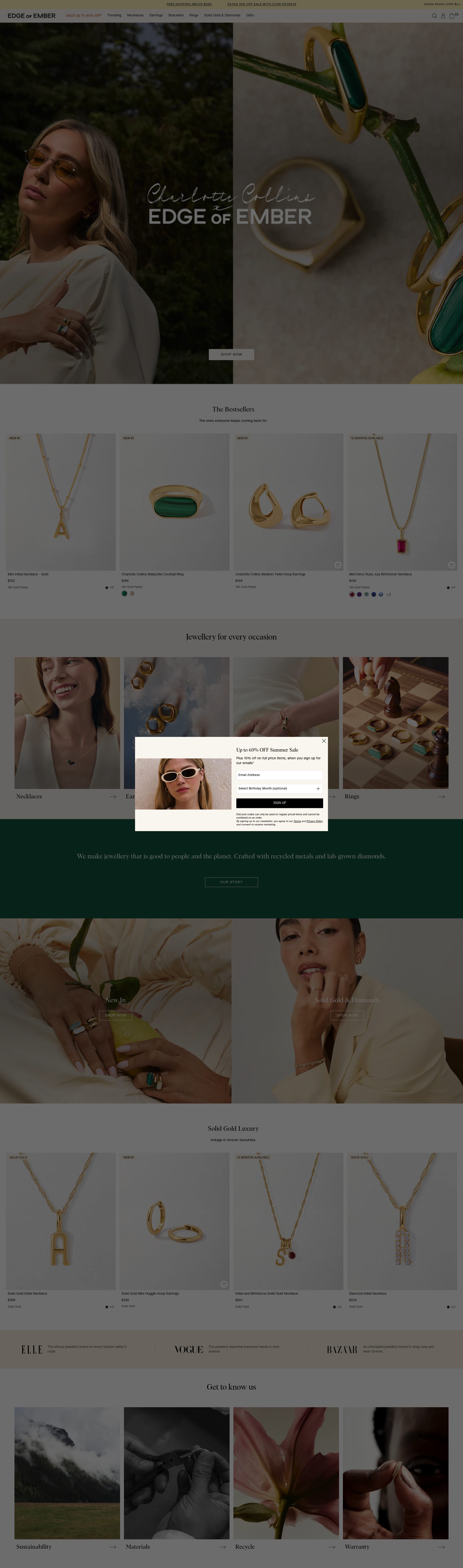
Edge of Ember's Shopify store sits at the mid-to-fine jewellery point and handles it with a level of material honesty that converts sceptical buyers. Their product descriptions specify gold fill versus solid gold, vermeil standards, and stone origin on every relevant piece, rather than using vague premium language. In a category where customers are routinely burned by misleading quality claims, that specificity is a trust signal rather than a compliance exercise.
Their "made with you in mind" personalisation offer, covering engraving and bespoke commissions, is surfaced within the main navigation rather than relegated to a footer link or a separate landing page. That positioning signals that personalisation is a core part of the business, not an afterthought. Their loyalty programme tracks repeat purchase behaviour and is promoted at cart as a reason to create an account, increasing CRM capture at the highest-intent moment.
Catbird
Catbird are a Brooklyn-based fine jewellery brand whose Shopify store has developed a strong international following, including a significant UK customer base. Their product photography is notably consistent across a large catalogue: all pieces are shot on hands or necks at the same light temperature and camera distance, which makes browsing a coherent experience rather than a visual patchwork. That consistency is harder to achieve than it looks, and the effect on perceived brand quality is significant.
Their "stack" concept, showing customers which rings work together on one hand and how many to buy for a full look, is integrated into collection pages rather than limited to editorial. A customer browsing rings sees stack examples alongside individual product listings, which naturally increases average order value without requiring a bundle mechanic. Their commitment to recycled gold and ethical sourcing is documented with specifics rather than general sustainability language, which is the minimum requirement for credibility on that claim in 2026.
Annoushka
Annoushka's Shopify Plus store operates at the top end of fine jewellery, with pieces priced from several hundred to several thousand pounds. At that price point, the store's job is not to sell jewellery — it is to justify the conversation that leads to a sale. Their product pages are long, detailed, and deliberately slow: multiple image types, video of the piece being worn and moved, stone and hallmark details, and Annoushka's own design notes explaining the inspiration behind the piece. That editorial weight signals that the brand considers the piece worth explaining, which is what a customer spending four figures needs to believe before they commit.
Their appointments service, offering in-person consultations at their boutiques, is integrated into the store as a primary conversion option alongside add to cart. Not every jewellery purchase at this level happens online without a prior conversation, and the store is honest about that rather than forcing a digital-only purchase flow.
Comparison Table
| Brand | Niche Focus | Price Point | Shopify Standout |
|---|---|---|---|
| Astrid and Miyu | Everyday and fine layering jewellery | Mid | In-PDP mix-and-match, multi-image product pages |
| Mejuri | Solid gold fine jewellery | Mid-premium | Skin-tone model photography, loyalty in PDP |
| Monica Vinader | Personalised fine jewellery | Mid-premium | Live engraving preview, gifting architecture |
| Pandora | Charm and fashion jewellery | Accessible-mid | Charm finder tool, 360-degree product spin |
| Missoma | Semi-fine and fine jewellery | Mid | Editorial social proof at product level, shoppable layering guide |
| Beaverbrooks | Fine jewellery and watches | Mid-premium | Diamond filter depth, ring builder as guided flow |
| Wolf and Badger | Independent designer jewellery | Mid-premium | Multi-vendor filtering, maker stories at product level |
| Edge of Ember | Solid gold and ethical jewellery | Mid | Material honesty in specs, loyalty at cart |
| Catbird | Fine and stacking jewellery | Mid | Photography consistency, stacking guides in collection pages |
| Annoushka | Luxury fine jewellery | Premium | Editorial PDP depth, in-store appointments integrated |
What These Stores Get Right
- Photography addresses scale and tone uncertainty. Every store on this list shoots pieces on models with a range of skin tones and invests in multiple image types per product. A flat studio shot on white does not tell a customer how a gold tone reads on their wrist or whether a pendant sits at the right point on their collarbone. The stores that convert fix this with lifestyle photography and on-model shots, not by writing longer descriptions.
- Material specs are stated precisely, not vaguely. The difference between gold fill and solid gold, between 9ct and 18ct, between natural and lab-grown stone — customers in fine jewellery know these distinctions matter, and stores that use vague language lose trust to stores that do not. Specificity is not pedantry; it is conversion.
- Personalisation is surfaced where the customer is buying, not where it is easiest to build. Engraving previews, charm finders, and ring builders are built into PDPs and collection pages — not hidden in a separate "customise" flow accessed after checkout or from a footer link. The mechanics are harder, but the revenue difference is material.
- Gifting is a primary use case, not an afterthought. Gift message options, gift wrapping, wishlist sharing, and curated gift edits appear within the main purchase flow rather than in a dedicated gift section most customers never find. In jewellery, gifting drives a significant proportion of transactions, and the stores that acknowledge this in their architecture convert more of them.
- Trust signals are placed at friction points, not in the footer. Returns policies, hallmarking details, ethical sourcing statements, and review counts appear near the add-to-cart button for the specific product being evaluated. General trust content in footers and FAQs does not reduce hesitation at the moment of purchase; specific trust content on the PDP does.
Frequently asked questions
Which jewellery brands use Shopify?
Astrid and Miyu, Mejuri, Monica Vinader, Missoma, Pandora, Beaverbrooks, Wolf and Badger, Edge of Ember, Catbird, and Annoushka all run on Shopify or Shopify Plus. Shopify Plus has become the dominant platform for DTC fine jewellery brands at mid-to-premium price points because it handles high-volume personalisation, multi-currency, and complex product variants without the overhead of a custom build.
What makes a jewellery Shopify store convert well?
The two biggest conversion drivers in jewellery ecommerce are photography depth and PDP-level trust signals. Customers cannot assess scale, gold tone, or finish quality from a single studio shot, so the stores that convert invest in on-model lifestyle images across a range of skin tones, close-up detail shots, and in some cases 360-degree spin or video. Trust signals — hallmarking details, metal content, returns policy for high-value orders — need to appear near the add-to-cart button, not buried in a footer FAQ.
How do top jewellery stores handle personalisation on Shopify?
The best implementations embed personalisation tools directly in the product page rather than surfacing them only at checkout. Monica Vinader's engraving preview shows the customer's text on the actual product before adding to cart, which eliminates post-purchase anxiety on gifts. Pandora's charm finder and Beaverbrooks' ring builder both operate as guided flows within the store rather than as separate configurators, keeping the customer inside the purchase journey throughout.
What price points work best for DTC jewellery on Shopify?
The mid to mid-premium range — roughly £50 to £500 per piece — is where Shopify DTC jewellery is most competitive. Brands like Mejuri, Missoma, and Edge of Ember have built strong businesses in this range because the purchase can be completed online without a prior consultation. At higher price points, brands like Annoushka and Beaverbrooks integrate in-store appointment options alongside add-to-cart, acknowledging that not every four-figure purchase happens without a conversation.
How should a jewellery Shopify store handle gifting?
Gifting should be built into the main purchase flow, not relegated to a separate gift section. The stores on this list surface gift message options, complimentary gift wrapping, and wishlist-sharing features from the cart without requiring a customer account. Monica Vinader's "give a hint" feature lets customers share a wishlist item with a partner via link, which increases the likelihood of the right item being purchased as a gift. These mechanics capture a significant proportion of jewellery transactions that would otherwise convert below their potential.
Related reading
If your jewellery store is not converting at the level these brands achieve, the gap is usually photography depth and PDP detail. See our Shopify design service or get in touch to talk through what your store needs.