
Quick summary
Start-Rite is the standout for fit confidence, with width-specific filtering and a school shoe range built around term-time campaigns that no competitor matches. Bobux leads on developmental framing, turning paediatric science into a cross-sell mechanic that keeps parents inside the brand through every foot stage. Livie & Luca shows how seasonal drops can drive repeat purchase in a category where most stores only see the customer when a child grows a size. Inch Blue proves that a narrow catalogue with strong provenance story and well-placed social proof converts just as effectively as a broad one.
Kids' footwear is one of the most considered purchases a parent makes online: fit anxiety is high, returns are expensive, and trust is built or lost before a single click-to-cart. The Shopify stores that succeed in this category solve those friction points head-on, with sizing tools, age-based navigation, and product pages that do the job a shop assistant would do in person.
1. Start-Rite
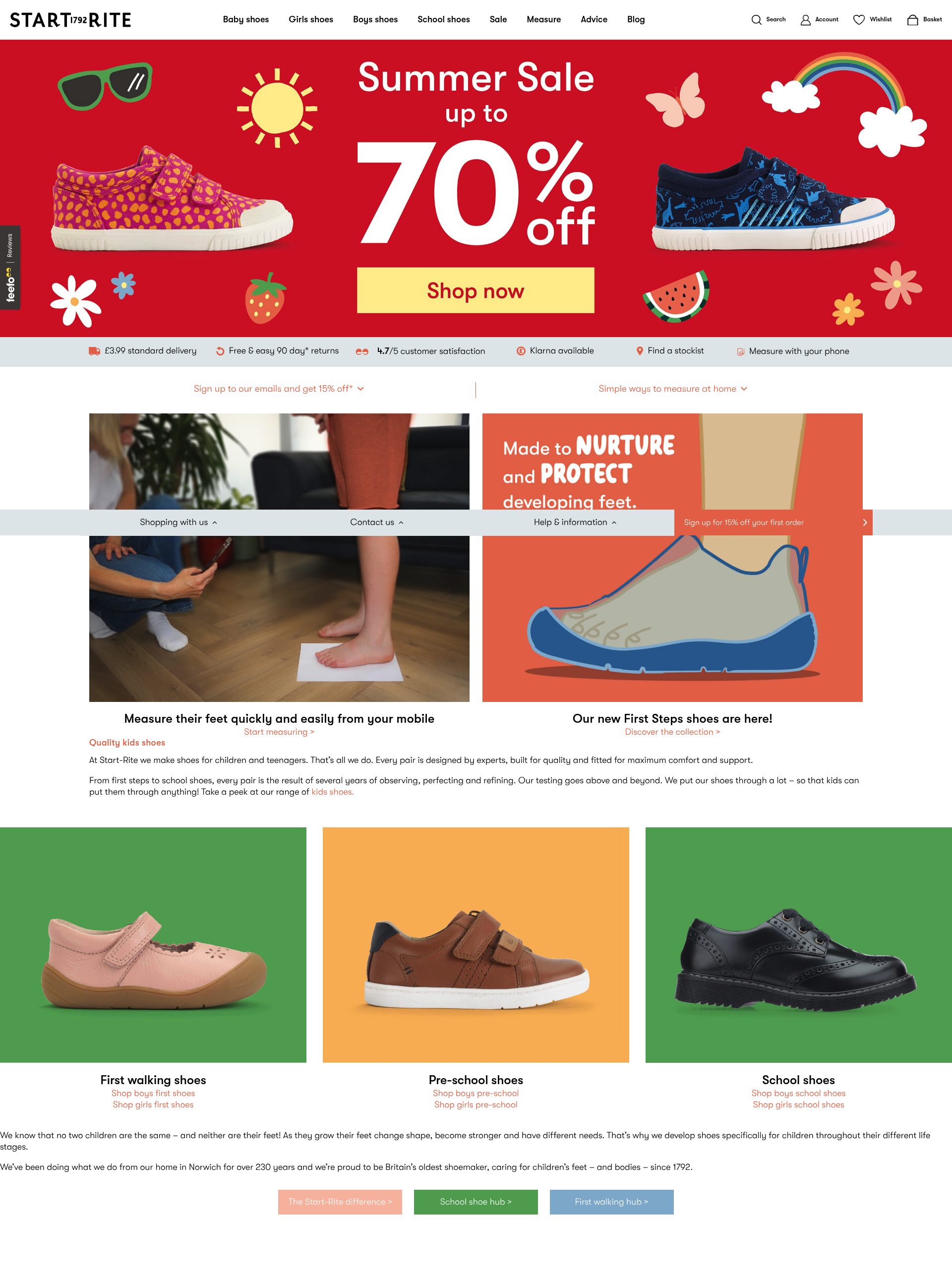
Start-Rite has been making children's shoes since 1792 and their Shopify store reflects that credibility without hiding behind heritage. The product pages are built around the brand's proprietary width-fitting system, with each listing displaying fit category (narrow, standard, wide, extra wide) as a primary filter, not a footnote. That decision alone distinguishes Start-Rite from most competitors in the category, where width sizing is either absent or buried.
The navigation is structured by age bracket and foot stage (pre-walker, first walker, toddler, school age) rather than by style, which mirrors how parents search. A parent shopping for a first walker does not know what size they need, and the store addresses this with a downloadable foot-measuring guide and a persistent link to their fitting advice pages.
Start-Rite also runs a school shoe range with a dedicated term-time campaign structure: seasonal landing pages, back-to-school bundles, and fitted shoe locator functionality that bridges online and their network of independent stockists. The dual-channel approach, DTC plus wholesale, is handled cleanly with clear messaging about where to buy in-store versus online.
2. Bobux
Bobux is a New Zealand-born kids' footwear brand with a strong UK presence and a Shopify Plus store that leads on developmental science. Every product page frames the shoe within a developmental stage, with specific claims about toe box width, sole flexibility, and sensory feedback that resonate with parents who have been told by health visitors to prioritise foot development over style.
The store's size guide is genuinely useful: a printable PDF foot gauge, a video on how to measure, and a table correlating age averages to shoe sizes in both EU and UK formats. This is the kind of content that converts hesitant buyers and reduces returns, because the customer arrives at checkout knowing they have the right size.
Bobux structures their product range around their Step Up system, a developmental staging framework that also functions as a cross-sell mechanic. A parent buying a crawler shoe is shown what comes next, which increases lifetime value by keeping the customer within the Bobux ecosystem rather than pushing them back to Google at each new stage.
3. Shooshoos
Shooshoos is a South African brand that has built a strong international DTC presence on Shopify with their soft-soled leather baby shoes. The product photography is excellent: clean white backgrounds for the product grid, lifestyle shots with real babies for the PDPs, and detail images showing the leather quality and stitching. That combination covers every stage of a parent's decision-making, from initial scroll to pre-purchase reassurance.
The brand leads with gifting mechanics: gift box packaging, a gift finder tool, and prominent messaging around delivery timelines that matters when someone is buying for a baby shower or birthday. Gift-focused stores need to communicate certainty, and Shooshoos does this well by surfacing estimated delivery dates early in the purchase flow rather than at checkout.
Their product descriptions walk the line between emotional and informational: the copy talks about the leather, the sizing, and care instructions without reading like a spec sheet. That tone matches their customer, who is typically a parent or gift-buyer making a considered, values-led purchase rather than a transactional one.
4. Inch Blue
Inch Blue makes soft leather baby shoes and slippers by hand in Wales, and the Shopify store leads on that provenance at every touchpoint. The homepage copy names the workshop, the craftspeople, and the materials, which creates a compelling alternative to mass-produced alternatives at a similar or lower price point.
The product range is intentionally narrow: pre-walkers and early walkers in a curated selection of styles. That focus makes the navigation simple and keeps the brand coherent rather than sprawling. A narrow catalogue on Shopify rewards good internal cross-linking, and Inch Blue uses complementary product recommendations well within each PDP.
Their Trustpilot integration is well-placed: reviews appear on PDPs with specificity about sizing accuracy, delivery speed, and gift presentation. For a brand at this price point (a pair of soft shoes at around £25 to £30), social proof from previous parents is the deciding factor for a first-time buyer, and Inch Blue treats it as a conversion asset rather than a legal footnote.
5. Little Brogues
Little Brogues is a UK specialist kids' shoe retailer on Shopify with a strong multi-brand catalogue covering brands including Clarks, Start-Rite, Geox, and Pod. Their store is structured for parents who already know what they want: fast brand filtering, clear stock availability by size, and a breadcrumb-heavy navigation that makes it easy to move between categories without losing context.
The store does something most multi-brand kids' shoe retailers do not: it preserves the fit information from the original brand (including Clarks' fit rating and Start-Rite's width system) within each listing rather than stripping it out during catalogue import. That decision protects the customer's confidence in the brand selection and reduces post-purchase returns.
Click-and-collect and UK next-day delivery are prominent throughout, which matters in a category where parents often need shoes urgently (school term starting, growth spurts, shoes lost on holiday). The delivery messaging is concrete: specific cutoff times and named delivery partners, not vague "fast shipping" copy that experienced online shoppers distrust.
6. Jelly Mould
Jelly Mould is a small UK Shopify retailer specialising in hard-to-find and independent kids' footwear brands, including Lelli Kelly, Buckle My Shoe, and Pablosky. The store is built for the parent who has visited the high street and come away empty-handed: the navigation emphasises unusual widths, specific EU size availability, and brands that mainstream retailers no longer stock.
The product pages include manufacturer sizing notes alongside the retailer's own fit notes, which creates a more reliable picture for the parent than a single generic size guide. When a customer is buying a brand they have not tried before, that double-layer of fit information meaningfully reduces uncertainty.
Jelly Mould's brand story (a family-run business started by a parent frustrated with limited options) is carried through the About page and into the homepage copy. That narrative does real commercial work: it explains why the curation exists and why a parent should trust the selection over a larger, less focused competitor.
7. Tikes and Tots
Tikes and Tots is an independent UK kids' shoe and clothing retailer on Shopify with a strong presence in licensed and character footwear (Disney, Marvel, Peppa Pig). Their store is structured for the purchase occasion where the child, not the parent, has significant influence over the buying decision. Character-based navigation, bold imagery, and in-stock alerts on popular licensed styles are all calibrated to serve a parent who knows exactly what their child wants.
The store handles licensed product well by grouping items by character within the navigation, rather than just by shoe type. A parent looking for Spiderman shoes does not want to browse the full boys' section and filter down: they want a direct path to that character, and Tikes and Tots provides it.
Their email capture mechanic is well-positioned: a discount pop-up triggered after 15 seconds (not immediately) with a first-order incentive. For a retailer where average order value is relatively low, email capture to drive repeat purchase is a stronger long-term play than optimising for margin on the first order.
8. Robeez

Robeez is a North American brand with a global Shopify store focused on soft-soled baby shoes and early walker footwear. Their product pages are built around paediatric endorsement: the brand holds a seal from the American Podiatric Medical Association, and that credential is placed prominently on PDPs and the homepage, not buried in an FAQ.
The range is structured by developmental phase with clear entry points for each: newborn, crawler, early walker, toddler. Each phase has a dedicated landing page that explains the developmental rationale for the shoe design, which functions both as educational content for SEO and as conversion content for a parent who is still in the research phase.
Robeez uses UGC effectively: real photos from parents, tagged on Instagram, appear in a shoppable feed on the homepage. For a baby product category where authenticity is a primary trust signal, that UGC mechanic outperforms polished brand photography at the awareness stage, even though the PDPs themselves are studio-shot.
9. Livie & Luca
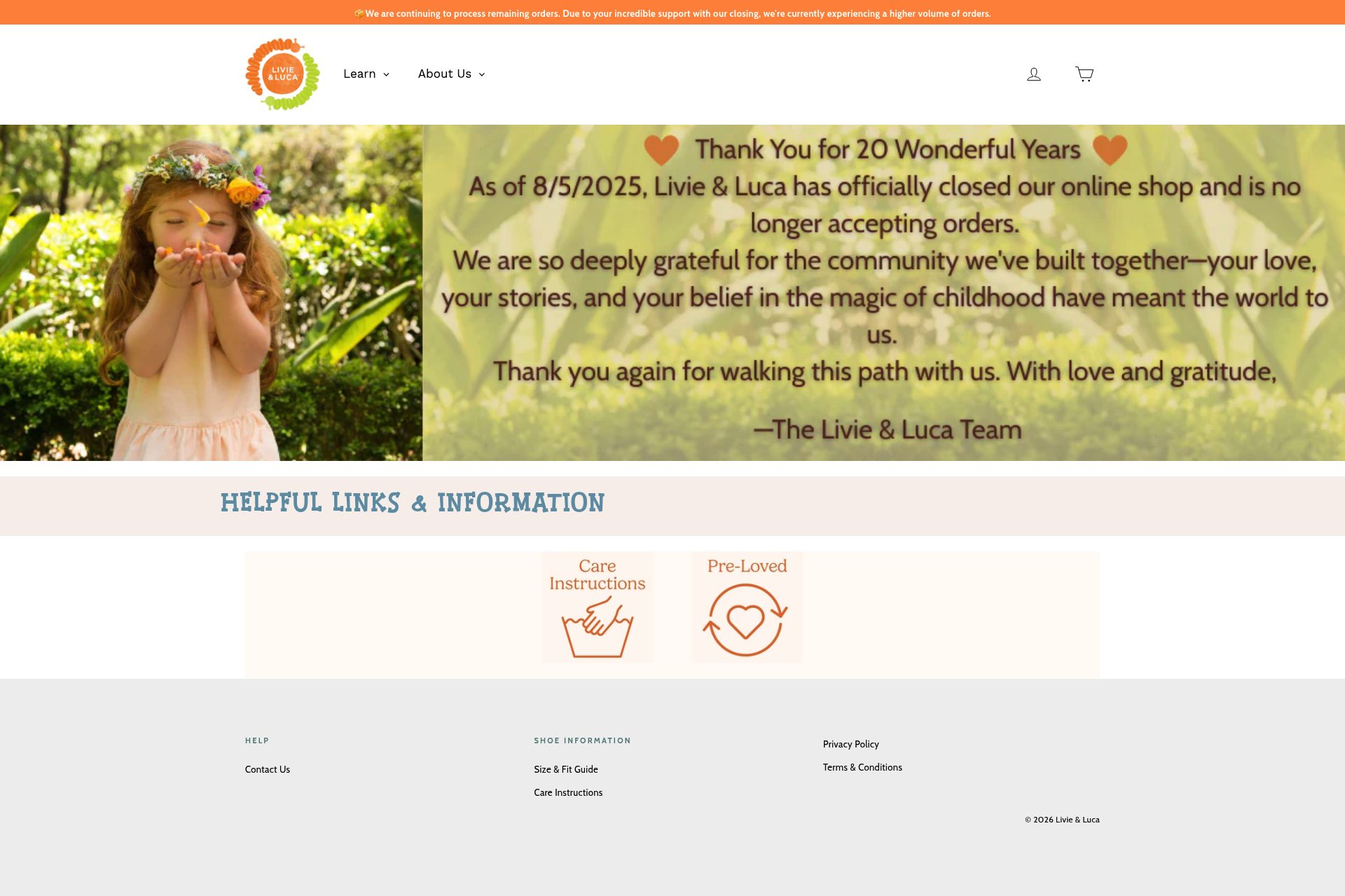
Livie & Luca is a US-based kids' shoe brand on Shopify Plus with a distinctive aesthetic: hand-stitched leather, nature-inspired motifs, and muted colour palettes that appeal to parents who want something that does not look like it came from a supermarket. The product pages lead with the story of each design, naming the artisans involved and the inspiration behind the motif, before moving to sizing and technical specification.
Their collection structure uses seasonal drops with distinct names and campaigns, a mechanic more commonly seen in fashion than children's footwear. That approach creates a reason for existing customers to return to the site at launch rather than only when their child grows a size, which is a meaningful lift to organic repeat purchase rate.
The store's bundle mechanic, pairing shoes with matching accessories (hairpins, backpacks, clothing), increases average order value in a category where the basket is otherwise often a single item. The bundles are styled editorially rather than presented as a discount, which maintains the brand's premium positioning while still moving multiple units.
10. Sole Bliss
Sole Bliss makes wider-fitting shoes for women but runs a range of children's wider-fit styles through their Shopify store, occupying a genuine gap in the market that the major children's shoe retailers underserve. The store frames the wider fit as a feature, not a niche accommodation: the product pages lead with comfort and podiatrist endorsement, and the fit guidance is comprehensive enough that a parent can make a confident decision without needing to visit a physical store.
The brand's authority content is well integrated: blog posts on children's foot health, GP and podiatrist contributors, and specific guidance on signs that a child is wearing the wrong width. That content does double work: it builds organic search visibility and it primes the customer to understand why the product is worth a premium over a standard-fit shoe from a mass-market retailer.
Sole Bliss uses a loyalty programme that tracks across both the adult and children's ranges, which is a smart retention mechanic for a brand where the adult customer (the parent) can build points on their own purchases as well as the children's shoes. That shared loyalty framework increases switching cost and gives the parent a commercial reason to stay within the Sole Bliss ecosystem as their child grows.
These stores show what excellent looks like in kids' footwear ecommerce: fit confidence, developmental framing, and navigation built around how parents actually search. If you want your Shopify store to convert at the same level, see what our Shopify design service can do or get in touch to talk through your project.
Frequently asked questions
What makes a kids' shoe Shopify store convert well?
The stores that convert best in kids' footwear solve fit anxiety before checkout: they provide width options, printable foot gauges, and age-based navigation that mirrors how parents search. Brands like Start-Rite and Bobux show that making sizing the primary UI decision, not a footnote, directly reduces returns and increases buyer confidence.
Which kids' shoe brands sell directly on Shopify?
Start-Rite, Bobux, Shooshoos, Inch Blue, Robeez, Livie & Luca, and Sole Bliss all run direct-to-consumer Shopify stores. Multi-brand retailers like Little Brogues and Jelly Mould use Shopify to stock several children's shoe brands in one place, which suits parents who want to compare fit systems across brands.
How do the best kids' shoe stores handle returns and fit concerns?
The strongest stores in this category treat fit guidance as a conversion asset, not an afterthought. Bobux provides a printable PDF foot gauge, a sizing video, and an EU/UK comparison table. Start-Rite surfaces width fit as a primary product filter. Both approaches reduce the post-purchase uncertainty that drives returns in children's footwear more than almost any other category.
Are there good Shopify stores for hard-to-fit kids' feet?
Jelly Mould specialises in unusual widths and brands that mainstream retailers no longer stock, including Pablosky and Buckle My Shoe in extended EU sizes. Sole Bliss carries a children's wider-fit range alongside their adult line and frames wide fit as a design feature, not a niche accommodation, with podiatrist endorsement on the product pages.
How do kids' shoe stores on Shopify increase average order value?
The most effective tactics in this category are developmental upsells and accessory bundles. Bobux uses their Step Up staging framework to show parents what shoe comes next after the current purchase. Livie & Luca pairs shoes with matching accessories like hairpins and backpacks in editorial-style bundles that maintain premium positioning. Both approaches increase basket size without relying on discounting.