

Quick summary
Monica Vinader is the standout for high-ticket jewellery: their engraving personalisation tool and gift-optimised checkout convert customers spending several hundred pounds without a physical touchpoint. Mulberry earns its place with a product configurator for leather and hardware selection that brings made-to-order capability to a Shopify Plus store. Aesop proves that brand voice alone can carry a skincare store, with ingredient transparency and literary copy that make a cleanser feel like a considered purchase. Wolf and Badger is the most instructive for merchants building multi-brand or marketplace stores: their values-based filtering, for sustainable materials and ethical production, is the most commercially intelligent discovery tool on this list.
Luxury ecommerce has a problem with credibility. Customers spending three figures on a cashmere jumper or a piece of fine jewellery expect an online experience that matches the quality of the product. For years, that ruled Shopify out of contention. Enterprise brands went to Salesforce Commerce Cloud or built bespoke. The assumption was that Shopify was for DTC startups, not serious luxury.
That assumption is now wrong. Shopify Plus has attracted some of the most design-conscious, quality-obsessed brands in the world, and the stores they have built are setting a new standard for what premium ecommerce looks like. These ten are the ones worth studying.
1. Reiss
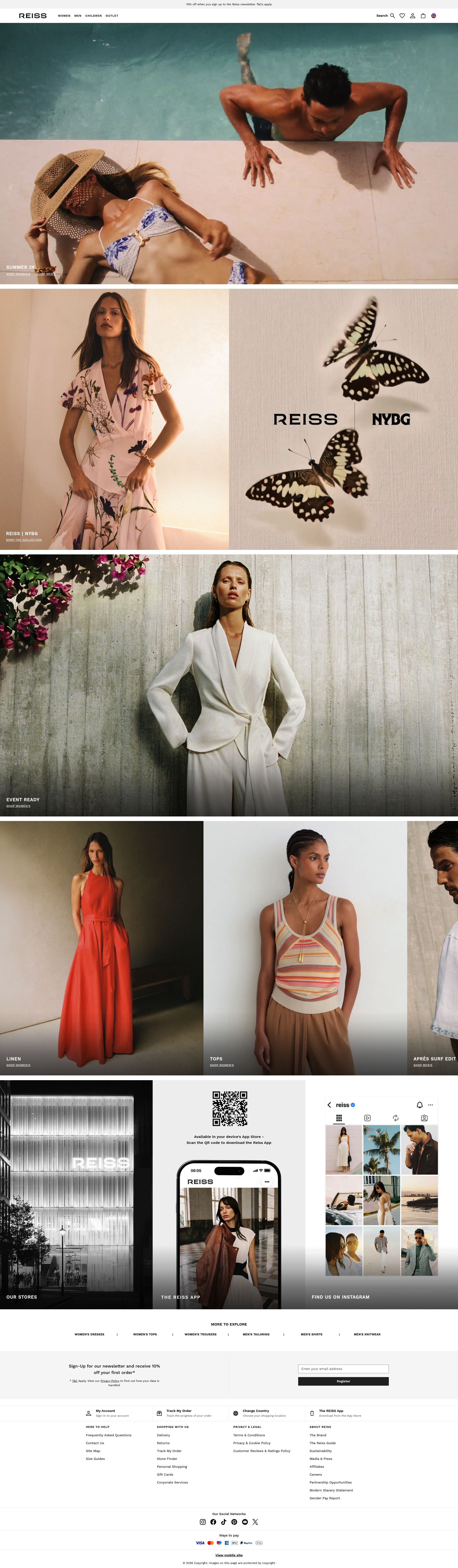
Reiss is one of the UK's strongest premium fashion brands, and their Shopify Plus store handles the breadth of their catalogue without ever feeling cluttered. The navigation is clean and category-led, with seasonal edits surfaced on the homepage to guide customers toward curated selections rather than leaving them to browse a full product grid unaided. Product pages are built around high-resolution photography from multiple angles, with a fabric and care information section that treats the buyer as someone who genuinely wants to know what they are purchasing.
Their store does something that many premium retailers get wrong: it trusts silence. The layout breathes. There is no desperate attempt to surface every promotion at once. The checkout experience is similarly clean, with minimal friction and clear returns policy messaging at the point of purchase, which matters enormously for a customer spending upwards of £200 on a single item. Click-and-collect from their UK boutiques is integrated directly into the Shopify checkout.
Reiss also invests in editorial content within the store itself, with styling guides and seasonal look books that sit alongside the product catalogue rather than in a separate blog that nobody visits. This is how premium brands should use content: not as an SEO afterthought, but as a genuine part of the shopping experience.
2. Monica Vinader
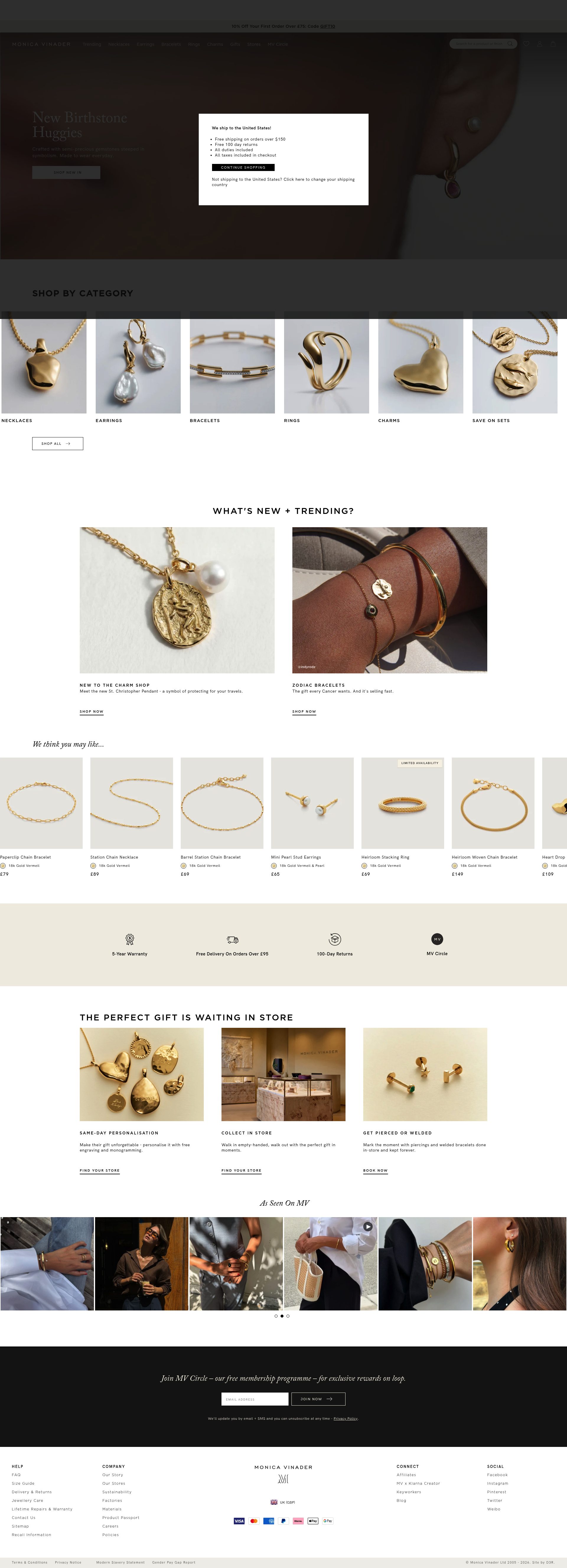
Monica Vinader is a masterclass in selling high-consideration jewellery online. Fine jewellery is one of the hardest categories in ecommerce: customers want to see scale, understand materials, and feel confident before spending several hundred pounds on something they cannot easily return. Monica Vinader's Shopify Plus store addresses every one of those concerns methodically.
Product photography is exceptional: pieces are shown on a range of skin tones, at multiple angles, and with lifestyle shots that give a sense of actual scale. The engraving personalisation tool, built directly into the product page, turns a jewellery purchase into a considered, custom experience without adding friction. Customers can preview their engraved text before adding to cart, which is exactly the kind of interaction that reduces purchase anxiety in a high-ticket category.
Their gifting flow deserves particular mention. Gift messaging, complimentary wrapping options, and delivery date selection are integrated into the checkout in a way that makes Monica Vinader one of the most gift-optimised stores on Shopify. That is not accidental. Gifting is a significant revenue driver for jewellery, and their store is engineered around it.
3. Mulberry
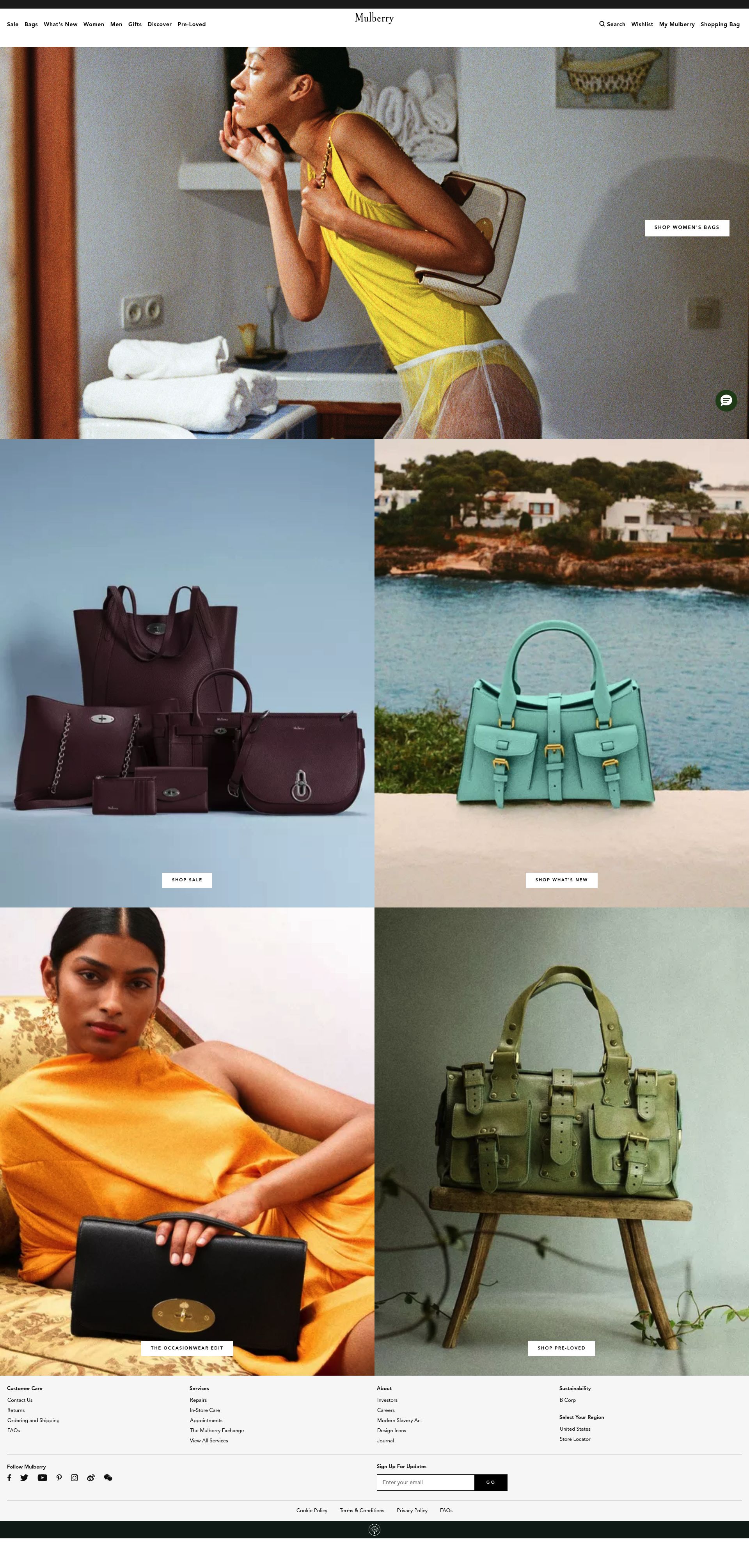
Mulberry is one of Britain's oldest luxury leather goods houses, and their Shopify Plus store carries that heritage without being weighed down by it. The homepage prioritises new season collections and collaboration pieces, keeping the store feeling current rather than museum-like. Product pages for their bags include full leather type and origin information, hardware details, and interior pocket layouts, which reflects an understanding that a customer spending £800 on a handbag wants to know exactly what they are getting.
The product configurator for select styles, which allows customers to choose leather type and hardware finish before purchase, is a strong piece of Shopify customisation that moves Mulberry from a retailer into something closer to a made-to-order service at scale. That kind of personalisation capability on Shopify Plus, without a custom platform, is genuinely impressive.
Where Mulberry's store earns the most points is in after-sale communication and the repair service integration. The ability to register a bag, access care guides, and enquire about restoration services from within the same store environment reinforces the brand's positioning around investment purchases rather than seasonal consumption. That is the right message for a luxury brand: this bag will last, and we will help you keep it that way.
4. Orlebar Brown

Orlebar Brown built their brand around a simple proposition: tailored swimwear for men. Their Shopify Plus store communicates that positioning at every touchpoint. The editorial tone in product descriptions is unhurried and specific, describing fit, occasion, and styling context rather than defaulting to generic copy about "premium quality." A description that tells you this short works equally well on the Amalfi Coast or at a country house pool is more useful than one that just says "versatile."
Their size guide is unusually thorough for a swimwear brand: it includes waist and hip measurements alongside standard sizing, which reduces the guesswork that causes returns. In a category where fit is everything and returns are expensive, that specificity has a direct impact on margin.
Orlebar Brown also uses their Shopify store to house a strong archive of editorial content and collaborations, including limited edition designer series with brands like Bulleit and Ian Fleming Estate. These are positioned as drops, with product pages that tell the story behind the collaboration rather than just listing the product. It is a smart use of Shopify's flexibility to create product moments that justify premium pricing.
5. Aesop
Aesop is one of the most visually distinctive brands in global retail, and their Shopify store translates that visual identity online with unusual fidelity. The muted palette, typographic precision, and complete absence of promotional noise create a browsing experience that feels more like a gallery than a shop, which is entirely intentional. Aesop's brand equity depends on customers feeling that they have discovered something considered, not that they are being sold to.
Product pages are text-rich by current ecommerce standards: ingredient lists are presented in full (INCI and common names), with clear guidance on skin type suitability and application method. For a skincare brand at this price point, that level of transparency is table stakes, and Aesop delivers it without making the page feel clinical or overwhelming. The writing voice is consistent, literary, and genuinely different from any other skincare brand on Shopify.
The checkout flow is smooth, with gift wrapping options presented in a way that adds occasion without adding complexity. Aesop's store does something rare: it makes a single cleanser feel like a considered purchase rather than a replenishment item, which is exactly how luxury skincare needs to be sold online.
6. Tom Dixon
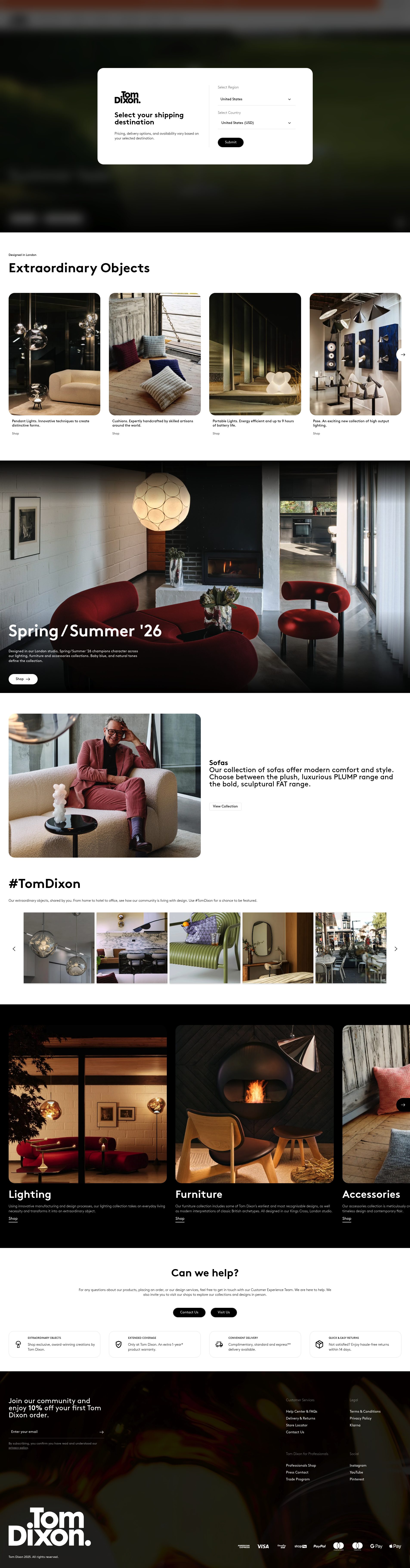
Tom Dixon occupies an interesting position in premium ecommerce: high-design home goods and lighting at prices that require genuine customer education before conversion. A pendant light at £700 is not an impulse purchase. Their Shopify Plus store handles this by investing heavily in context: every product page includes room-setting photography at scale, so the customer can see how a piece looks in an actual space rather than against a white background.
The product specifications section is unusually detailed: dimensions, materials, electrical specifications, bulb compatibility, and installation notes are all present and formatted clearly. For a brand selling statement lighting to architects, interior designers, and discerning homeowners, that level of specification is not optional. Tom Dixon's store understands their customer has done their research before arriving, and the product page does not make them search for the information they need.
Their Shopify store also handles trade customers elegantly. A dedicated trade account application is surfaced in the navigation, and trade pricing is handled within the Shopify infrastructure rather than shunted off to a separate platform. That keeps the customer experience cohesive and avoids the fractured journey that plagues many B2B-capable luxury stores.
7. Sunspel
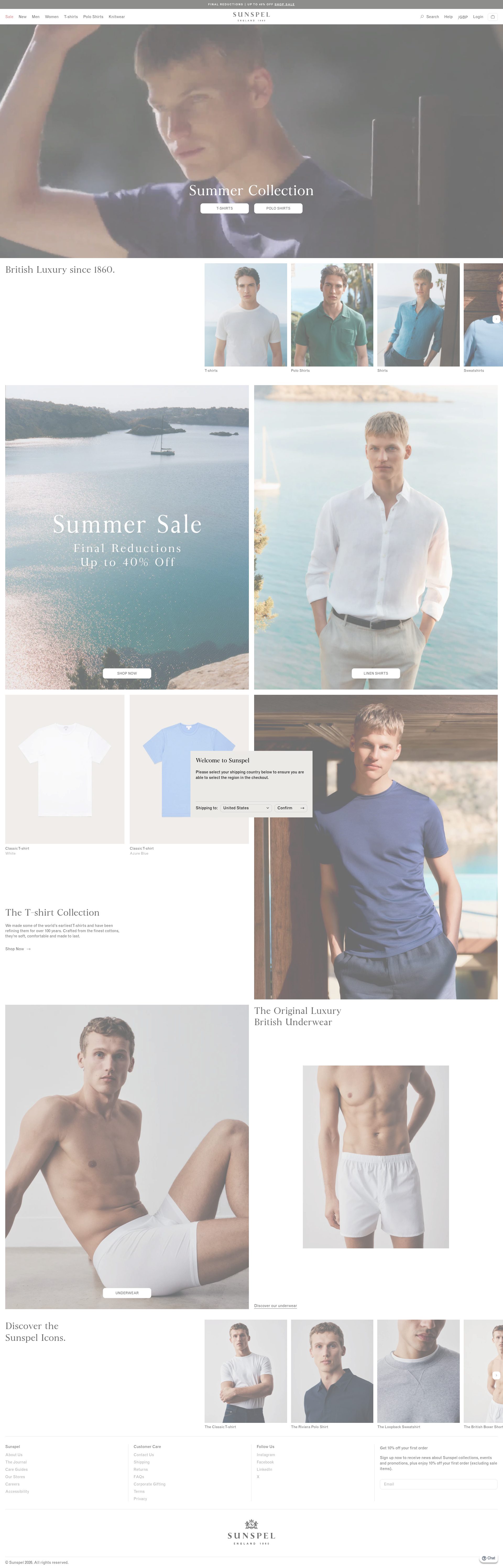
Sunspel has been making premium cotton basics in Long Eaton since 1860, and their Shopify store carries that quiet confidence without being verbose about it. The navigation is simple: the range is not enormous, and the store does not pretend otherwise. What Sunspel does exceptionally well is communicate quality through restraint: sparse copy, archive imagery, and product photography that focuses on fabric texture and construction detail rather than lifestyle aspiration.
Product descriptions include mill origin, yarn count, and garment provenance where relevant. A T-shirt described in terms of its Sea Island cotton source and jersey weight feels worth £90 in a way that a generic description never could. Sunspel uses their manufacturing heritage as a conversion tool, making it available to any customer who reads the product page rather than hiding it in an About page nobody finds.
Their Shopify store integrates a strong women's range alongside the menswear with no loss of clarity in the navigation, which is harder to execute cleanly than it sounds. The result is a store that genuinely reflects the brand: understated, considered, and built on the premise that quality needs no persuasion.
8. Skims

Skims is one of the most commercially successful DTC launches in ecommerce history, and their Shopify Plus store is a significant reason for that. The store is built for inclusivity in a way that goes beyond a size chart: product photography across the full range includes diverse skin tones and body types as a structural feature of the catalogue, not as a separate "inclusive" section. That decision, made at the product photography level, has a direct impact on customer confidence in a category where fit anxiety is the primary conversion barrier.
The navigation handles a rapidly expanding product range: underwear, loungewear, swimwear, and shapewear across an extended size range. Filtering by size, style, and fabric gives customers a path to their product without wading through irrelevant results. Skims also uses their Shopify store to execute limited drops and collaborations, including team partnerships with the NBA and WNBA, with product pages that carry the collaboration story in a way that justifies premium positioning.
Their loyalty and gifting infrastructure is strong. Gift card purchase, gift wrap, and delivery date selection are all cleanly integrated, and the post-purchase email sequences tie back into the store experience. For a brand operating at this volume on Shopify Plus, the store performance is consistently reliable across launch days, which is a technical achievement worth acknowledging.
9. Rhode
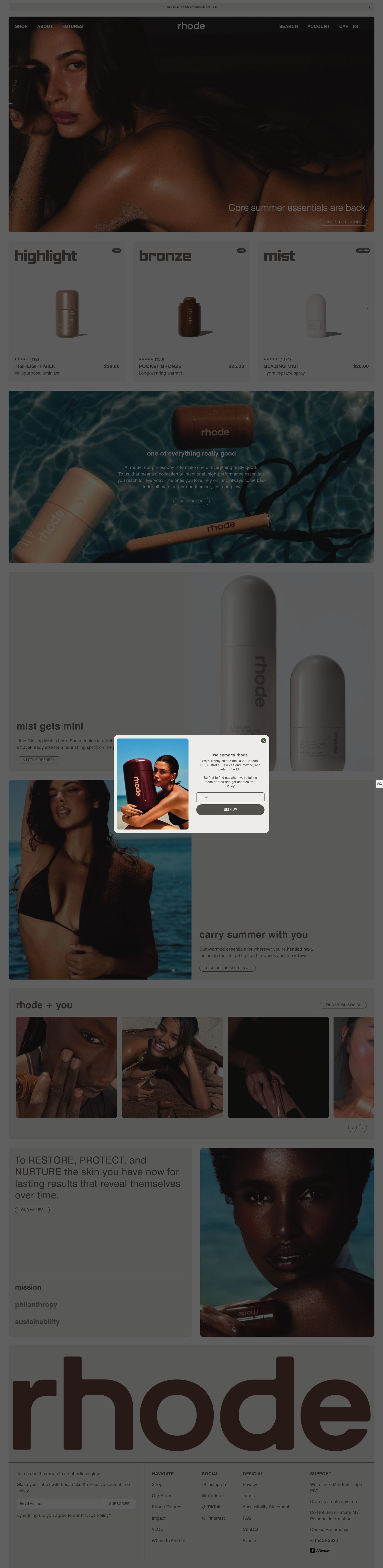
Rhode is the most interesting recent example of a Shopify launch at the premium beauty end. Hailey Bieber's brand launched with a focused edit of skincare basics, and their Shopify Plus store reflects that restraint: a small catalogue, beautifully executed. The product range discipline is itself a conversion tool. When a brand sells five things, the customer does not need to navigate. They buy.
Product pages are built around ingredient simplicity and skin benefit clarity. Rhode's positioning is that great skin does not require a twelve-step routine, and the store reinforces this at every point. Copy is short, confident, and specific. The hero product, the Peptide Glazing Fluid, has a product page that explains the mechanism of action in plain language without dumbing it down. That balance between accessibility and credibility is genuinely hard to get right.
The checkout flow has been optimised for high-demand drops. Rhode has a waiting list and restock notification infrastructure integrated into their Shopify store that handles demand spikes without degrading the experience for customers who arrive outside peak hours. For a brand at this level of cultural momentum, inventory management and drop mechanics matter as much as the product page itself.
10. Wolf and Badger
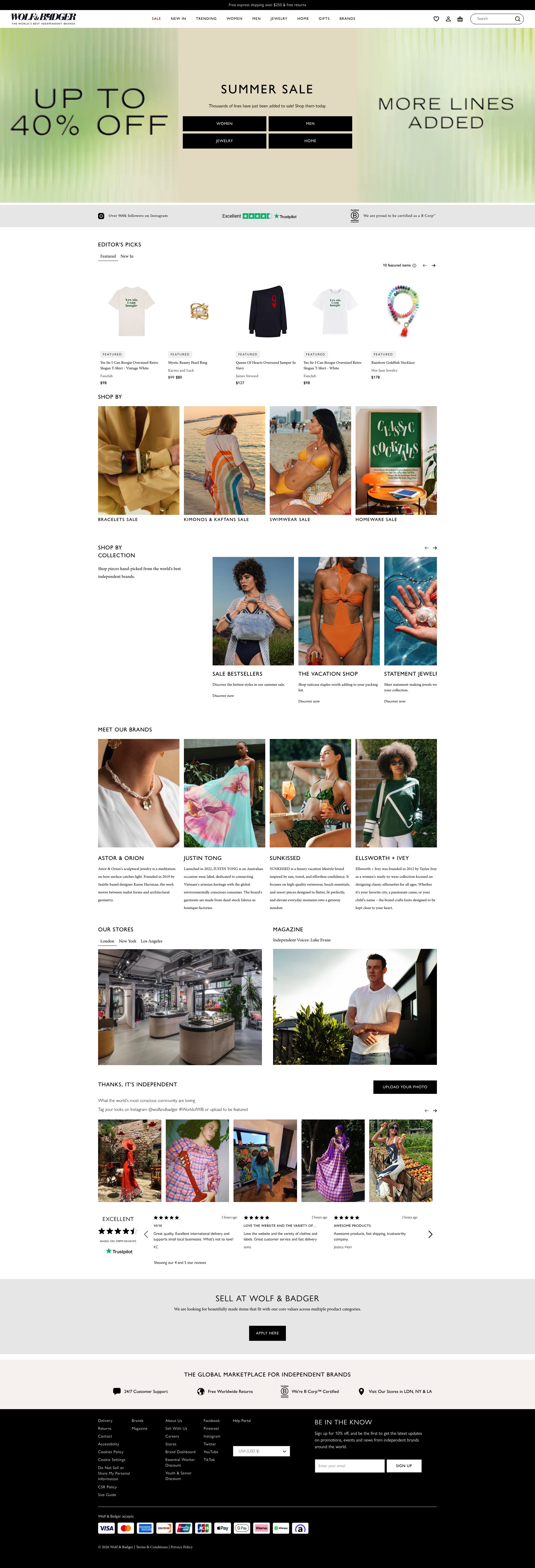
Wolf and Badger is the only marketplace entry on this list, and it earns its place because of how well they have solved a problem that kills most multi-brand stores: helping customers find something they did not know they were looking for. The platform is a curated marketplace for independent luxury and sustainable brands, and their Shopify Plus store handles hundreds of brands across fashion, jewellery, beauty, and homeware without the chaos that plagues most aggregators.
Their filtering and discovery tools are the strongest on this list. Customers can filter by brand values (sustainable materials, ethical production, female-founded), which is a purchasing signal for their audience that price and category alone cannot serve. That kind of values-based navigation requires real curation at the backend, and Wolf and Badger has invested in it.
For independent luxury brands, getting listed on Wolf and Badger is itself a credibility signal. Their editorial team produces lookbooks and trend reports that surface the best of the catalogue in a curated format, which is content that drives discovery at a rate that individual product pages cannot. As a study in how to run premium multi-brand ecommerce on Shopify, it is the benchmark.
How these stores compare
| Brand | Niche Focus | Price Point | Shopify Standout |
|---|---|---|---|
| Reiss | Premium fashion | Mid-to-high | Editorial integration, clean navigation |
| Monica Vinader | Fine jewellery | High | Personalisation tool, gifting flow |
| Mulberry | Luxury leather goods | Very high | Product configurator, repair service |
| Orlebar Brown | Premium swimwear | High | Editorial product copy, collaboration drops |
| Aesop | Premium skincare | High | Brand voice, ingredient transparency |
| Tom Dixon | Design and lighting | High | Room-setting photography, trade accounts |
| Sunspel | Premium essentials | Mid-to-high | Heritage copy, fabric provenance |
| Skims | Premium shapewear | Mid | Inclusive photography, drop mechanics |
| Rhode | Luxury beauty | Mid-to-high | Catalogue restraint, waitlist infrastructure |
| Wolf and Badger | Independent luxury marketplace | Varies | Values-based filtering, editorial discovery |
What these stores get right
- They reduce purchase anxiety without discounting. Every brand on this list earns trust through information: fabric specs, ingredient lists, size guides that actually help, and photography that shows the product as it really is. None of them compete on price. They compete on confidence.
- They treat content as part of the store, not a separate channel. Editorial look books, collaboration stories, care guides, and heritage copy live inside the product experience. The customer never leaves the store to get informed.
- Their checkout is invisible. A premium store checkout should feel effortless. Friction at the point of purchase in a high-ticket category costs real money. All ten brands have minimised the number of steps, the number of distractions, and the number of reasons to abandon.
- They handle demand spikes without degrading the experience. Shopify Plus gives these brands the infrastructure to run drops, launches, and collaborations at volume. The stores that use this well build customer expectation around scarcity without making it feel artificial.
- They make personalisation part of the product. Engraving, monogramming, fabric selection, hardware choices. Premium customers expect to be recognised as individuals. The stores that build personalisation directly into the product page, rather than bolting it on as an option, convert at a higher rate.
Frequently asked questions
Can Shopify Plus handle luxury brand standards?
Yes. Shopify Plus supports bespoke theme development, headless front-ends, custom checkout scripting, and integrations for personalisation, trade accounts, and drop mechanics. Brands like Mulberry, Aesop, and Monica Vinader have built store experiences on Shopify Plus that match or exceed what legacy enterprise platforms offer, with lower total cost of ownership and faster deployment.
What makes a luxury Shopify store different from a standard ecommerce store?
The core difference is how information is used to build confidence rather than urgency. Luxury stores replace promotional pressure with specificity: fabric mill origin, INCI ingredient lists, room-setting photography at scale, and size guides that genuinely reduce guesswork. The checkout is invisible, with minimal friction and clear returns policy messaging at the point of commitment. Nothing on the page pushes. Everything on the page informs.
How do luxury brands handle product personalisation on Shopify?
The strongest examples build personalisation directly into the product page rather than treating it as an add-on. Monica Vinader lets customers preview engraved text before adding to cart. Mulberry offers leather type and hardware finish selection on select styles via a built-in configurator. Orlebar Brown surfaces limited collaboration drops with product pages that carry the full collaboration story. All of this is achievable within Shopify Plus without a custom platform.
How do luxury Shopify stores manage high-demand product drops?
Rhode and Skims are the clearest examples here. Rhode integrates waitlist and restock notification infrastructure directly into their Shopify store, so demand spikes do not degrade the experience for customers outside the launch window. Skims uses Shopify Plus to run collaboration drops at high volume, including team partnerships, with consistent store performance on launch days. Shopify Plus's infrastructure handles the traffic; the store design handles the customer expectation.
Is Wolf and Badger a Shopify store?
Yes. Wolf and Badger operates their multi-brand luxury and sustainable marketplace on Shopify Plus. Their store manages hundreds of independent brands across fashion, jewellery, beauty, and homeware with values-based filtering that lets customers narrow by sustainable materials, ethical production, and female-founded brands. It is the most instructive Shopify store on this list for merchants building curated multi-brand or marketplace experiences.
Related reading
- Best jewellery Shopify stores
- Best fashion Shopify stores
- Best skincare Shopify stores
- Best homeware Shopify stores
- Shopify Plus: is it worth the upgrade?
If your store is not presenting your products with the confidence these brands achieve, the gap is usually design and UX. See our Shopify design service or get in touch to talk through what is possible.