

Quick summary
Matchaful sets the standard for ceremonial matcha DTC, with farm-level provenance detail and subscription mechanics that explain reorder cadence instead of just offering a discount. Ippodo Tea pulls off the hardest trick in ecommerce: a 300-year-old heritage brand that still converts first-time buyers, thanks to dual-path navigation built around experience level. Golde is the strongest example of matcha-as-anchor in a wider wellness range, using a bundle builder that lifts AOV without complicating the buying flow. For the UK market specifically, Bird & Blend Tea Co handles range breadth better than any other tea brand on Shopify, with sample sizes that turn hesitant browsers into repeat buyers.
Matcha has moved from niche health food to mainstream DTC staple, and the brands winning online share a common trait: they have built Shopify stores that educate buyers, justify premium pricing, and convert first-time visitors into subscribers. Here are ten that do it well, and the specific ecommerce decisions behind their performance.
1. Matcha Oishii
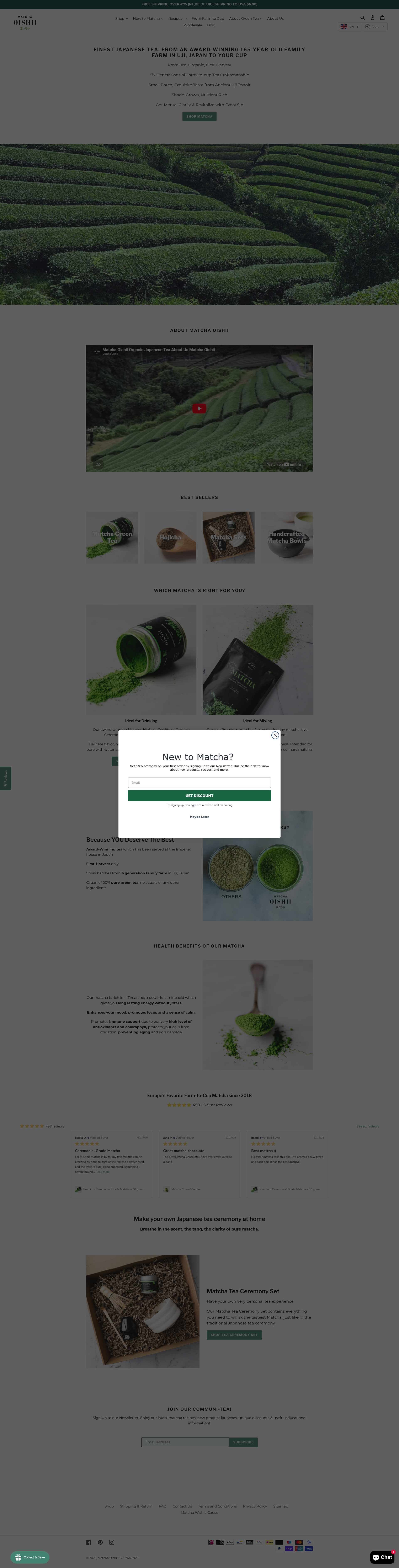
Matcha Oishii is a UK-based direct-to-consumer brand that has built its entire store around grade transparency. Every product listing spells out the harvest number, region, and intended use — ceremonial for drinking, culinary for baking — which removes a major source of pre-purchase confusion in the matcha category. That specificity does double duty: it positions the brand as knowledgeable, and it reduces return rates by setting accurate expectations.
Their subscription model is surfaced early, not buried after the add-to-cart. The default pricing toggle on product pages shows the subscribe-and-save discount immediately, which nudges buyers towards the higher-LTV option at the moment of highest intent. It is a small layout decision with a measurable impact on subscriber acquisition.
The site uses a clean, minimal Shopify theme with photography that leans into the Japanese craft angle without being pastiche. The product-to-brand story connection is tight enough that the premium price point ($30-plus for 30g) feels earned rather than arbitrary.
2. OMGtea

OMGtea is one of the longest-standing UK matcha brands online, and their Shopify store reflects years of conversion optimisation. The homepage leads with a benefit hierarchy: energy, focus, antioxidants, then taste. That sequence is deliberate, matching the decision path of health-motivated buyers who are comparing matcha to coffee rather than comparing matcha brands to each other.
Product pages include a grading explainer that positions OMGtea's own products within the wider quality spectrum, which is a confident move that only works if the product backs it up. They also integrate before-and-after style customer reviews — not just star ratings, but narrative testimonials around specific health outcomes. For a supplement-adjacent product category, that type of evidence-driven social proof significantly outperforms generic five-star reviews.
Their bundle offers (starter kits, gift sets) are structured to capture both personal buyers and gifters, which is smart for a category where gifting is a meaningful acquisition channel, particularly around January health resolutions and Christmas.
3. Matchaful

Matchaful is a New York-based ceremonial matcha brand on Shopify Plus, and their store sets a high bar for product page design in the premium segment. Each product has a dedicated origin story: specific farm, specific cultivar, specific elevation. That level of provenance detail is not just storytelling, it is a direct answer to the question a serious matcha buyer asks before spending £40 on 30g of powder.
Their subscription mechanics are particularly well designed. The subscription page explains the cadence logic: how often a typical ceremonial drinker needs to reorder based on daily use. This framing removes the friction of the buyer having to calculate their own replenishment rate, which is one of the more underrated subscription conversion tactics. They also allow subscribers to skip or delay shipments from the account portal, which reduces churn by giving subscribers control rather than forcing cancellations.
Matchaful uses editorial photography throughout that positions matcha preparation as a ritual rather than a health chore. That positioning supports a premium price point and differentiates from commodity matcha brands competing purely on price per gram.
4. Ippodo Tea
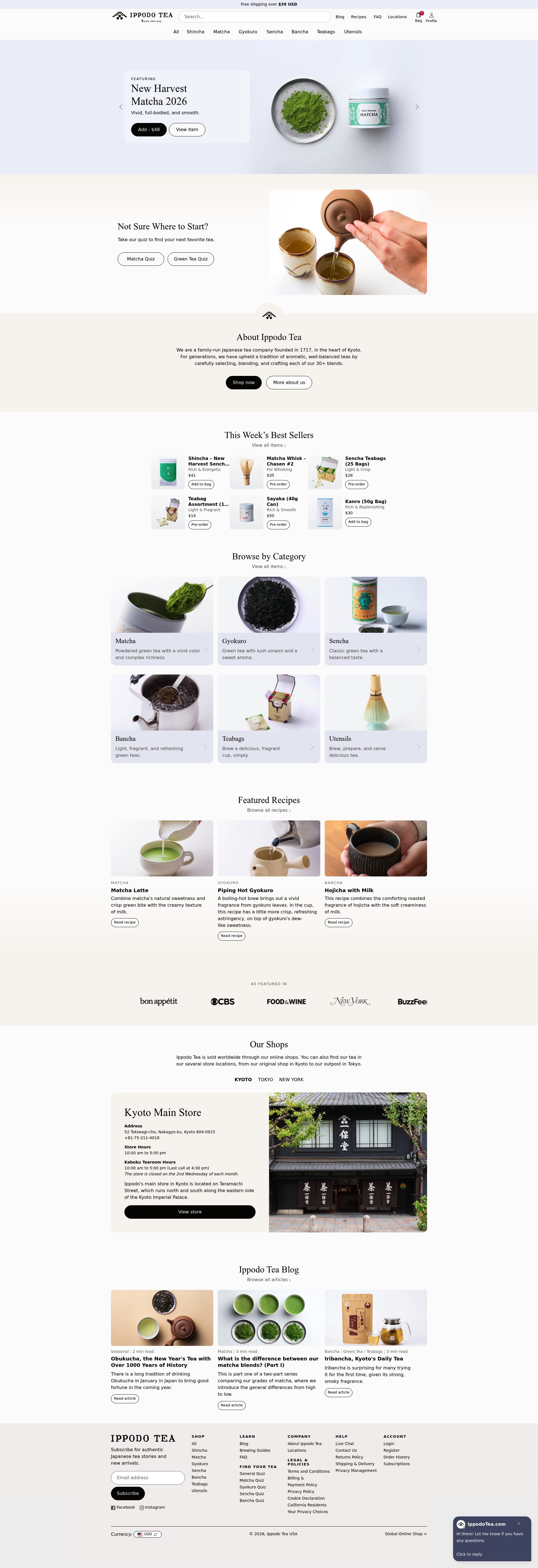
Ippodo Tea is a 300-year-old Kyoto tea house with a Shopify store serving international DTC customers, and the store manages the tension between heritage brand and direct conversion unusually well. The navigation is structured around both product type and experience level: beginners can filter by recommended starter products, while experienced drinkers can navigate by cultivar and harvest. That dual-path navigation is a deliberate accessibility decision, not an accident.
Their product pages carry detailed brewing instructions, equipment recommendations, and tasting notes for each matcha grade. This content serves two purposes: it reduces post-purchase confusion (which would otherwise drive negative reviews), and it increases average order value by surfacing complementary equipment naturally within the product context. The store does not use aggressive upsell pop-ups; the cross-sells are embedded in the product page copy itself.
Ippodo's pricing is positioned at the top of the market, and the store justifies that through provenance, certification, and the weight of institutional credibility. Their Trustpilot integration and Japanese Government certification badges sit near the add-to-cart button, which is exactly where trust signals need to be.
5. Golde
Golde is a Brooklyn-based wellness brand on Shopify Plus that uses matcha as an anchor product within a wider superfood range. Their store is one of the better examples of category expansion done without losing conversion clarity: the navigation separates matcha products from adaptogen blends and cacao, so customers shopping for matcha can find it without wading through unrelated products.
Their product photography is studio-clean with strong lifestyle integration: matcha being made in real home kitchen settings, in cafes, at desks. That breadth of context serves different buyer intentions within the same image set. The "Build Your Ritual" bundle builder is a high-LTV conversion tool: customers select their base product, add-ins, and accessories in a single flow, which increases AOV significantly compared to individual product pages.
Golde has also built a strong recipe content library that drives organic search traffic from broader food and wellness queries. That content connects back to specific products without being heavy-handed, creating an editorial-to-commerce funnel that works at scale.
6. Encha
Encha is a California-based matcha brand that has positioned itself specifically on the single-origin, organic angle. Their Shopify store leads with farm transparency from the homepage: the Uji, Japan origin is named in the hero copy, not buried in the product description. That front-loaded provenance messaging is a direct response to the market scepticism around low-quality matcha being sold with inflated health claims.
Their product page structure separates ceremonial and latte-grade matcha clearly, with a comparison table that explains the difference in terms of use case and flavour rather than just quality tier. For buyers new to matcha, this framing converts better than a simple grade label, because it answers the practical question of which product is right for their situation.
Encha runs a loyalty programme that rewards purchase frequency with grade upgrades and early access to limited-run harvests. That mechanic is well-suited to the matcha category, where engaged customers naturally progress from latte grade to ceremonial grade as their palate develops.
7. Bird & Blend Tea Co
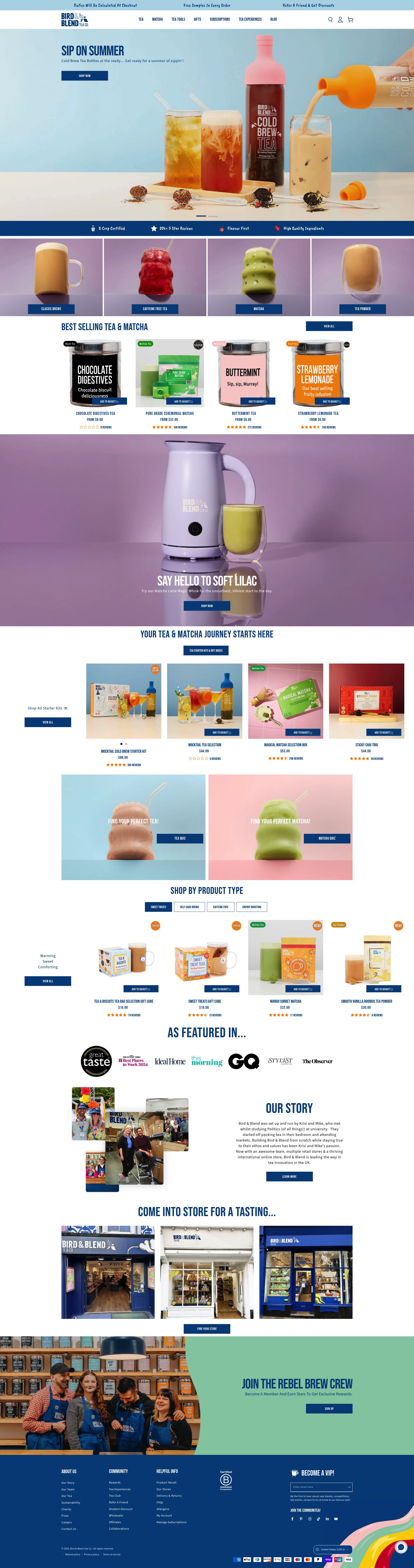
Bird & Blend Tea Co is a UK-based specialty tea brand on Shopify with a matcha range that sits within a broader loose-leaf catalogue. Their store handles range breadth better than most tea brands: the collection page filtering allows customers to shop by flavour profile, caffeine level, and brewing method, which reduces decision paralysis across a catalogue of 100-plus teas.
Their matcha range is merchandised with clear "try before you buy" sample sizes, which reduces purchase hesitation for new buyers considering an unfamiliar flavour variant. That sample strategy also works as an acquisition funnel: customers who buy a £3 sample and enjoy the product convert to full-size at high rates, and Bird & Blend has the email capture and post-purchase automation in place to drive that conversion.
The loyalty scheme, Tea Club, is woven into the store rather than sitting as a separate landing page. Points are displayed in the account area alongside purchase history, and redemption options are clear. That transparency increases engagement with the programme compared to schemes where points accumulate invisibly.
8. Ujido
Ujido is a Japanese matcha brand with a Shopify store targeting the North American health and wellness market. Their store uses a strong "hand-picked in Japan" narrative that is backed up with farm photography and video content embedded directly in product pages, not relegated to a separate about section. For a market full of matcha brands claiming Japanese origin, visual farm proof is a genuine differentiator.
Their pricing strategy is notable: Ujido positions at a mid-tier price point and uses quantity bundle pricing aggressively. The two-pack and four-pack options are given prominent placement on product pages, with clear per-unit savings calculated, which increases AOV without requiring a loyalty programme or subscription mechanic. For a brand serving customers who are buying matcha as a regular health habit, that bundle logic maps directly to purchase behaviour.
9. Kettl

Kettl is a New York tea importer on Shopify with a matcha range that targets the serious, informed buyer. Their product pages are the most information-dense of any brand in this list: harvest date, cultivar name, processing method, brewing parameters, and tasting notes with specific flavour descriptors. That depth is not for every buyer, but it is exactly right for a customer who treats matcha as a craft beverage rather than a supplement.
Their store design is intentionally spare: a monochromatic palette and minimal UI that keeps the focus on the products and photography. That restraint communicates confidence in the product quality itself, which is consistent with a brand targeting buyers who have moved past the lifestyle marketing of mass-market wellness brands.
Kettl also operates a brick-and-mortar location in New York, and the store integrates in-store events and tastings into the online experience. That connection between physical and digital builds brand credibility in a way that pure-play online brands cannot replicate easily.
10. DoMatcha
DoMatcha is a Canadian matcha brand on Shopify that has been in the market for over two decades, and their store reflects the navigation complexity that comes with a mature product range. They carry ceremonial, organic, and flavoured matcha variants alongside tea accessories and gift sets, and the site manages that range with category landing pages that serve as buying guides rather than just product grids.
Their "matcha 101" educational content is integrated into the main navigation rather than sitting in a blog that nobody visits. That positioning ensures new buyers encounter the educational layer before they hit the product pages, which reduces the dropout rate from overwhelmed first-time visitors. For a high-consideration product like matcha, educating before selling is a conversion tactic, not just a content strategy.
DoMatcha's gift set merchandising is strong: clear price-point groupings, presentation photography, and direct calls to action for corporate gifting. The gifting channel is under-served by most matcha brands, and DoMatcha captures it with dedicated landing pages and promotional calendar alignment around key gifting moments.
If you are building a Shopify store for a food, drink, or wellness brand and want to convert at the level these brands do, our Shopify design team can help, or get in touch to start the conversation.
Frequently asked questions
Which matcha Shopify stores are best for ceremonial-grade buyers?
Matchaful and Ippodo Tea are the strongest options for serious matcha drinkers. Matchaful provides farm-level provenance for every product — specific cultivar, elevation, and harvest date — while Ippodo Tea offers navigation filtered by experience level so buyers can find the right grade without wading through beginner-facing copy.
Do any of these matcha stores use Shopify Plus?
Matchaful and Golde are both on Shopify Plus. That gives them access to custom checkout scripts and more sophisticated subscription and bundle builder functionality, which is reflected in how well both stores handle high-LTV conversion paths compared to standard Shopify builds.
What makes a matcha Shopify store convert well?
The highest-converting matcha stores do two things: they remove grade confusion early (ceremonial vs culinary vs latte grade explained in plain terms before the add-to-cart), and they surface subscription pricing at the point of highest intent rather than in a separate loyalty section. Stores that bury these decisions see higher abandonment rates from buyers who are not yet sure which product is right for them.
Which matcha brands are best for the UK market?
Matcha Oishii, OMGtea, and Bird & Blend Tea Co are all UK-based and priced in GBP, which removes currency friction for UK buyers. Bird & Blend is the strongest for range breadth, with over 100 teas and filtering by flavour and caffeine level. OMGtea is the better pick for health-motivated buyers comparing matcha to coffee, based on how their homepage structures the benefit hierarchy.
How do the best matcha stores handle subscription retention?
Matchaful stands out here by explaining replenishment cadence on the subscription page — how often a daily ceremonial drinker needs to reorder — rather than just offering a percentage discount. They also allow subscribers to skip or delay shipments from the account portal, which reduces forced cancellations. Encha takes a different approach, rewarding subscription frequency with grade upgrades and early access to limited harvests, which suits buyers who are actively developing their matcha palate.