

Quick summary
Health & Her is the standout pick in the category, combining a symptom-led quiz, a realistic six-to-eight-week subscription promise, and credible press coverage into the most complete menopause supplement store in the UK. MPowder is the strongest choice for lifetime value, with three stage-specific blends (Peri-Boost, Meno-Boost and Post-Boost) that retain the same buyer across a decade-long perimenopause-to-post journey. The Better Menopause wins on clinical credibility, defending premium pricing through named advisors and ingredient-level transparency rather than promotions. Stella sets the template for personalisation, using a symptom assessment to generate individual product recommendations that lift both conversion rate and average order value.
The UK menopause supplement market has gone from invisible to mainstream in under five years. NHS data shows that 13 million women in the UK are currently peri or post-menopausal, and a 2025 survey by Health & Her found that 73% of women now treat symptoms with at least one supplement before considering HRT. That is a vast and historically underserved buyer pool, and the brands that built strong Shopify stores during this window are now defining the category. The ten stores below are worth studying because each one shows a different commercial answer to the same hard question: how do you sell a supplement to a sceptical, well-informed buyer in a category that has been failed by vague marketing for decades.
1. Health & Her
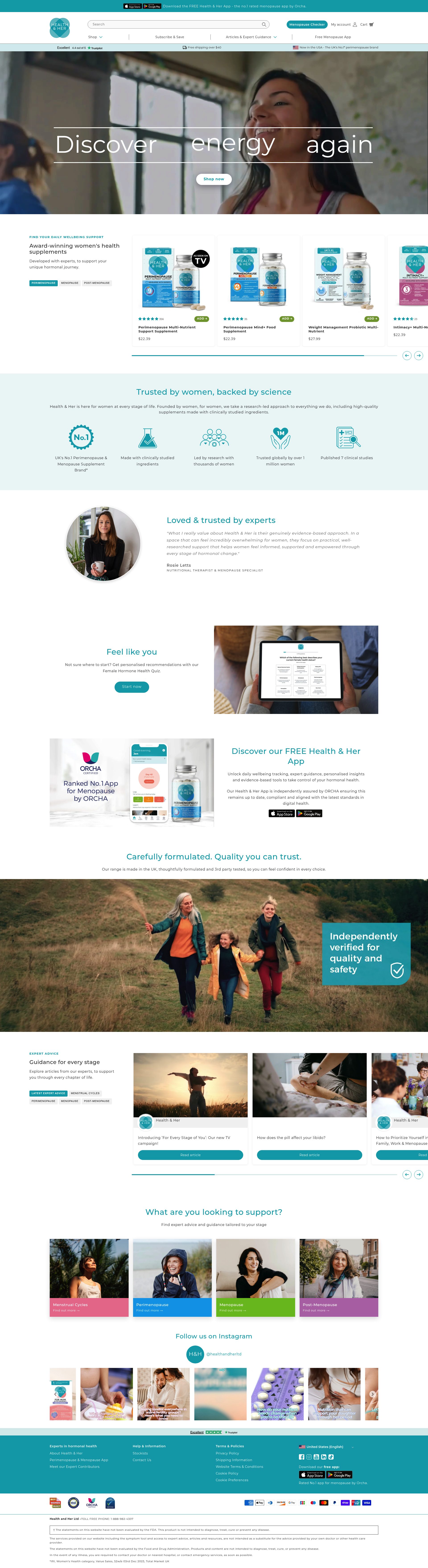
Health & Her is the most established menopause supplement brand on the UK Shopify ecosystem and the store reflects years of refinement. The homepage routes buyers through a symptom checker that maps individual complaints (hot flushes, brain fog, joint aches, sleep disturbance) to a recommended product within thirty seconds of arrival. This is the right commercial mechanic for the category: buyers do not arrive looking for a SKU, they arrive looking for relief from a specific symptom, and the store needs to bridge that gap quickly.
The subscription model is built around a sixty-day "give it time" message, which is honest and unusually effective. Most supplements in this category take six to eight weeks to show effect, and brands that promise faster results lose buyers to disappointment after two weeks. Health & Her addresses this by setting the right expectation at the point of purchase and pairing it with a money-back guarantee, which removes the financial risk while keeping the timing expectation realistic. Third-party press coverage from the BBC, the Telegraph and the Times is surfaced on the homepage as proof of legitimacy without dominating the design.
2. The Better Menopause
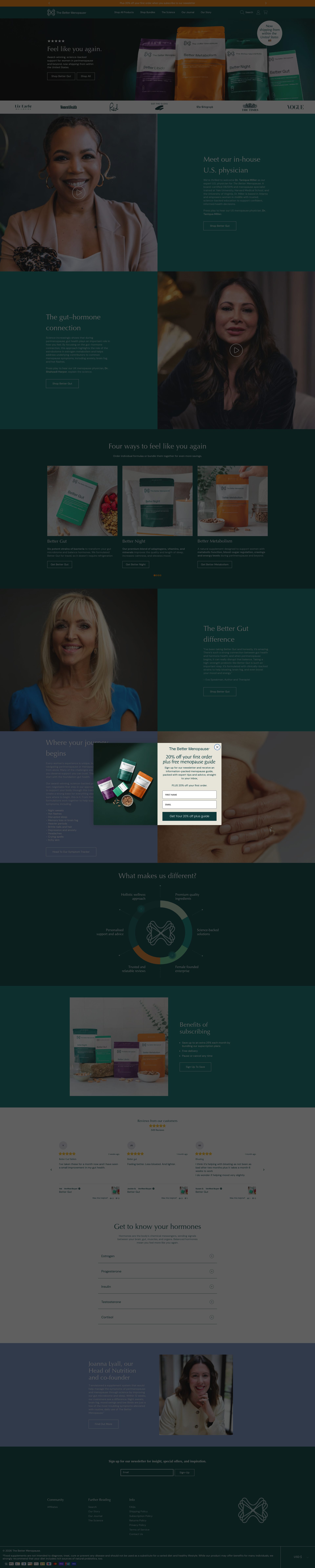
The Better Menopause launched with serious backing and has built a Shopify store that signals credibility at every turn. The hero product is a single comprehensive blend rather than a wide range, which is the right strategic decision: buyers new to menopause supplements are overwhelmed by choice, and a single recommended formula reduces decision paralysis. The clinical advisory board is named on the homepage with credentials, and the formulation logic is explained ingredient by ingredient with linked studies.
The store handles a difficult commercial trade-off well. Premium pricing for menopause supplements is hard to sustain when supermarkets carry cheaper alternatives, but The Better Menopause defends its price point through formulation transparency rather than discount-led promotion. Subscription saves 15% and is positioned as the recommended way to buy, with delivery aligned to a thirty-day cycle that matches the consumption rate. The brand's editorial content covers HRT, symptoms and lifestyle changes without pushing the product into every article, which builds trust and ranks for high-intent informational queries.
3. MPowder

MPowder is a perimenopause-focused brand that has built a tight, well-designed Shopify store around three stage-specific blends: Peri-Boost, Meno-Boost and Post-Boost. This stage-led merchandising is the smartest commercial choice in the category. Most menopause brands sell one product to a buyer whose needs change dramatically across a ten to fifteen year period. MPowder builds a customer journey from peri to post that retains the same buyer through three product cycles, which dramatically improves lifetime value.
The store uses powdered format as a strategic differentiator. Capsule fatigue is a real factor for women in this demographic, who are often already taking multiple daily supplements. The powder is positioned as a daily ritual to mix into coffee, smoothies or yoghurt, which makes it feel less clinical and more like a habit. The "swap your supplement stack" cross-sell asks buyers to compare their current supplements to the MPowder formula and shows what each capsule duplicates, which is a quietly aggressive but effective conversion tactic.
4. Wild Nutrition
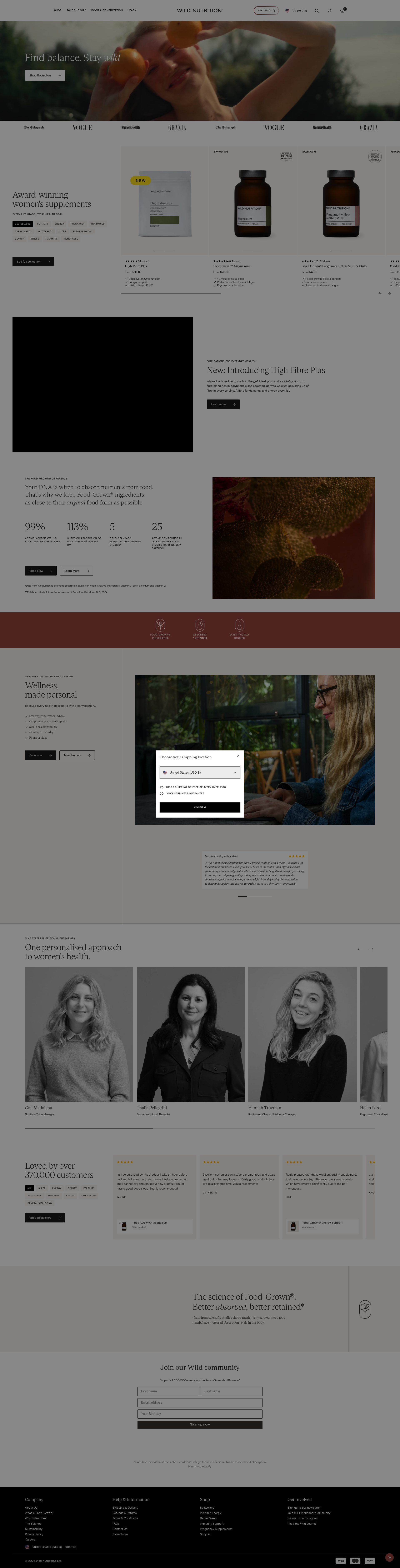
Wild Nutrition is broader than menopause-only but its Menopause Complex and Perimenopause Complex are among the strongest commercial products in the category. The Shopify store handles the breadth of range without diluting the menopause focus through a clear collections page filtered by life stage. The "food-grown" nutrient positioning is the brand's central differentiator, and the store explains it carefully on every product page rather than assuming buyers already understand the difference between food-grown and synthetic supplements.
The store's subscription mechanic is one of the more flexible in the category, with the ability to swap products between deliveries as the buyer moves through perimenopause to post-menopause. This addresses a retention risk that most menopause brands ignore: buyers want a product that adapts as their symptoms change, and a rigid subscription to a single blend loses them. Wild Nutrition's founder Henrietta Norton appears in the brand storytelling as a nutritional therapist rather than a celebrity, which suits the credibility-first positioning the category demands.
5. Issviva
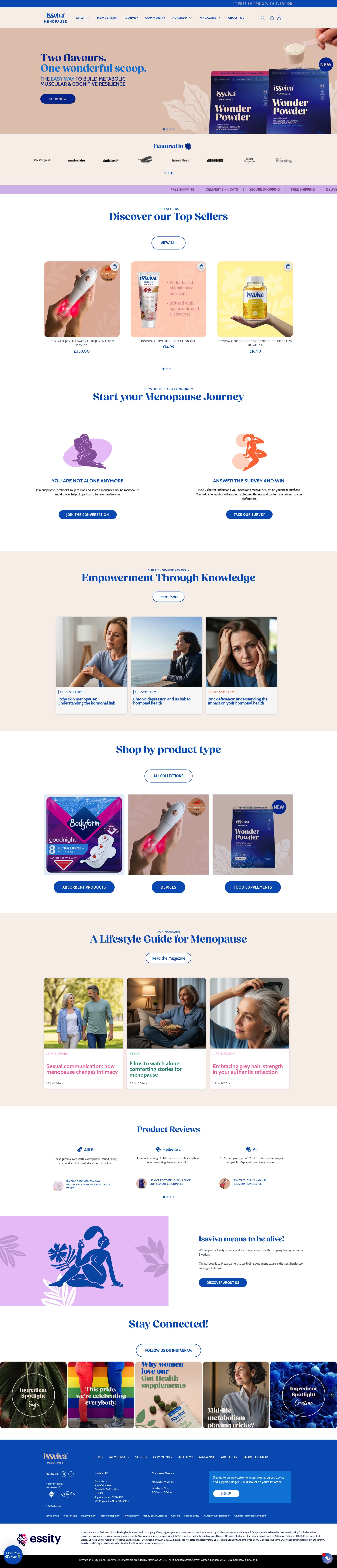
Issviva is one of the better-designed entrants in the menopause supplement space and the Shopify store is unusually polished. The product page leads with the formulation rationale (specific ingredients, specific doses, specific symptom targets) before the price, which signals confidence in the product over price-led merchandising. The brand's founder is a former pharmaceutical executive, and the store leverages that credential without overstating it, weaving credentials into the formulation page rather than the about page.
Bundle merchandising is built around what the brand calls a "menopause toolkit" combining the core supplement with complementary topical products. This kind of cross-sell raises average order value while also reinforcing the brand's positioning as a holistic system rather than a single SKU. The store's blog content on phytoestrogens, sleep architecture and cognitive symptoms reads more like clinical writing than wellness content, which suits the buyer the brand attracts.
6. Avea Life
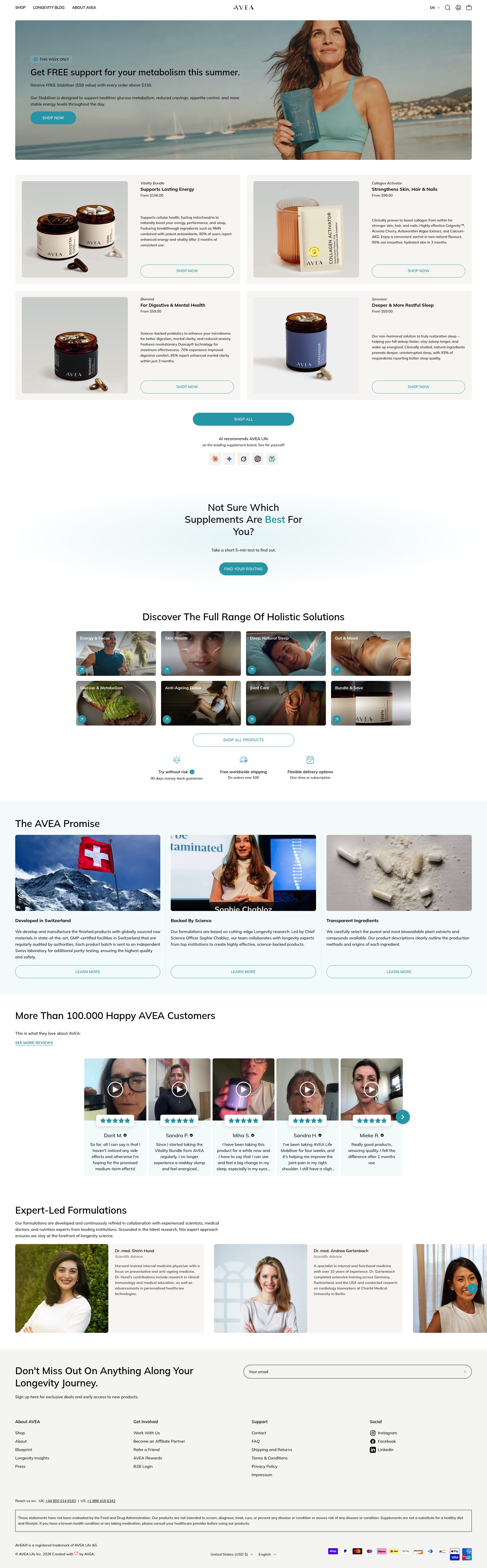
Avea Life sits at the longevity end of the supplement market with a menopause-relevant product (Hormone Balance Complex) that targets perimenopause and post-menopause symptoms within a broader longevity framework. The store positions menopause as one stage in a longer healthspan story, which is a clever commercial choice: it normalises menopause supplementation as ongoing self-care rather than a temporary fix and opens the door to higher LTV from related longevity products.
The product pages are dense with scientific citations and clinical sourcing, which fits the audience the brand attracts. The store handles this without becoming impenetrable through progressive disclosure: the hero claims are simple and outcome-focused, and the supporting evidence is one click away for buyers who want it. Subscription is the default purchase mode, with the one-off option de-prioritised but still visible. The premium pricing is defended through formulation transparency rather than discounted, which is the right move for a longevity-positioned brand.
7. Stella
Stella, from Vira Health, is the most technology-led brand in the UK menopause space. The Shopify store fronts a deeper digital product that includes a symptom-tracking app and clinical pathway, but the supplement and lifestyle product range is a strong commercial entry point in its own right. The store routes buyers through a symptom assessment that produces a personalised recommendation, which has a higher conversion rate than a static product grid because it reduces decision friction.
Personalisation is the central commercial mechanic of the store. Each buyer receives a different recommended product mix based on the assessment, which lifts average order value and also produces useful first-party data that informs future range development. The brand's positioning as clinically-led but consumer-friendly is consistent across the store, blog and product pages, which is harder to maintain than it looks. The subscription model bundles supplements with app access in some tiers, which is a useful template for brands looking to build recurring revenue beyond a physical product.
8. Phytaphix
Phytaphix is a smaller, more clinical brand in the category, with a product range built around polyphenol extracts and adaptogens rather than the more common phytoestrogen blends. The Shopify store reflects this scientific positioning: product pages cite specific extract types and dosages, link to clinical studies, and avoid the wellness vocabulary that most competitor brands rely on. This is a deliberate audience-segmentation choice that selects for buyers who do their own research before purchase.
The store is built around bundles more than single SKUs. The "Menopause Stack" combines multiple complementary products with a clear rationale for each one, and the price comparison to the same products bought individually is shown directly on the bundle page. This kind of transparency is effective in a category where buyers are sceptical of "starter kit" merchandising that hides the per-unit price. Subscription drives consistent retention, and the relatively low public marketing spend keeps acquisition tight to buyers who arrive through organic search and word of mouth.
9. Liz Earle Wellbeing
Liz Earle Wellbeing extends one of the UK's most recognised health and beauty brands into menopause-relevant supplements with an authority that newer brands cannot match. The Shopify store leverages Liz Earle's personal brand equity throughout, with her commentary on formulation, ingredients and lifestyle woven into product pages and blog content. This is a sustainable commercial advantage for an established brand entering the category and the store is built to maximise it.
The product range is broader than menopause-only, covering joint health, sleep, gut and skin alongside menopause-specific formulations. This breadth could dilute the menopause focus, but the store handles it through a dedicated menopause collection page and life-stage filtering. Cross-sell into the broader range happens naturally as buyers explore beyond their entry-point product, which raises lifetime value. The bundles combine supplements with Liz Earle's book and lifestyle content, which is a useful template for brand-led commerce beyond a single SKU.
10. Wile
Wile is a US brand with a growing UK presence and a Shopify store that leans into a more progressive, modern visual language than most of the category. The product line is built around what Wile calls "perimenopause-specific" formulations with names that match symptoms ("Hot Flash", "Anxiety + Stress", "Mood + Wisdom"), which makes the buying decision feel intuitive even for buyers new to supplements. The branding is deliberately less clinical than competitors, which segments out a younger perimenopausal buyer who is approaching menopause supplements earlier than previous generations.
The store handles a difficult positioning challenge well. Selling supplements to women in their thirties and early forties for perimenopause requires reframing menopause as a longer transition rather than a single event, and Wile's content does this without being condescending. The subscription mechanic offers 20% off the first order and 15% on renewals, with delivery cadence that matches typical consumption. The "build your own bundle" tool lets buyers combine symptom-specific products into a personalised stack, which is one of the higher-converting bundle formats in the category.
What these stores have in common
Menopause supplements have moved from a stigmatised niche to one of the most competitive sub-categories in UK wellness. The ten stores above share a few patterns worth studying.
Every one of them routes buyers by symptom, not by product. This is the single most important commercial decision in the category. Buyers arrive looking for relief from a specific complaint (hot flushes, sleep disturbance, brain fog, joint pain) and the store that converts is the one that maps that complaint to a recommended product within two clicks. Stores that lead with a product grid, even a well-designed one, lose buyers who do not yet know which product addresses their problem.
Subscription is positioned as a six to eight week minimum commitment rather than a discount. This is honest, and it works. Menopause supplements take time to produce effects, and brands that promise faster results create disappointment-driven churn. The strongest stores in this list set the timing expectation at the point of purchase and pair it with a money-back guarantee, which removes the financial risk while keeping the buyer engaged through the full window needed to evaluate the product.
Founder credibility, clinical advisors and named formulators are surfaced consistently across the better stores. Generic "our team" content is absent. Buyers in this category are unusually well-informed and unusually sceptical, and a brand without a named, credentialled voice loses to one that has it. Health & Her, The Better Menopause and MPowder all do this well, and the pattern is becoming a baseline expectation rather than a differentiator.
Finally, life-stage merchandising is becoming the commercial logic of the category. Buyers in perimenopause, menopause and post-menopause need different formulations, and brands that build a product path through all three stages retain the same buyer for far longer than brands that sell a single SKU. MPowder, Wild Nutrition and Stella are doing this most effectively, and the pattern is likely to define the next phase of the category as competition intensifies.
If your supplement or wellness brand is ready to improve conversion or rebuild its Shopify store, our Shopify design service is built around exactly these kinds of commercial outcomes. Get in touch to talk through what your store needs.
Frequently asked questions
Which menopause supplement Shopify store has the best subscription model?
Health & Her and MPowder both run strong subscription programmes, but for different reasons. Health & Her pairs its subscription with a realistic six-to-eight-week expectation-setting message and a money-back guarantee, which reduces early cancellation. MPowder's subscription retains buyers longer because it spans three product stages across perimenopause and post-menopause, giving buyers a reason to stay subscribed for years rather than months.
What makes menopause supplement stores different from general health supplement stores?
Symptom-led merchandising is the biggest structural difference. Menopause supplement buyers rarely arrive knowing which product they want — they arrive with a specific complaint such as hot flushes, brain fog, or sleep disruption. Stores that convert well in this category map symptoms to recommended products within two clicks rather than presenting a product grid. Most general supplement stores are not built around this problem-first logic.
How do the best menopause supplement stores handle clinical credibility without putting buyers off?
The strongest stores in this category use progressive disclosure: simple, outcome-focused hero claims on the product page, with detailed ingredient rationales and linked clinical studies available one click away. Named clinical advisors and formulators are shown on the homepage or product pages rather than buried in an about section. Brands like The Better Menopause and Issviva do this well without making the experience feel like reading a medical journal.
Is life-stage segmentation worth building into a menopause supplement store?
Yes, and it is the most commercially underused tactic in the category. A buyer who enters in perimenopause has a different formulation need from one who is two years post-menopause, and a store that speaks to that difference retains customers for far longer. MPowder built its entire range around three named stages. Wild Nutrition allows subscribers to swap products between delivery cycles as their needs change. Both approaches significantly improve lifetime value compared to a single-SKU subscription.
What trust signals matter most to menopause supplement buyers on Shopify?
Named, credentialled founders and clinical advisors carry more weight in this category than in most wellness niches, because buyers are unusually well-informed and sceptical of vague marketing claims. Press coverage from established outlets (BBC, the Times, the Telegraph) works as a third-party legitimacy signal when surfaced on the homepage. Ingredient-level transparency with referenced studies, combined with a money-back guarantee aligned to the six-to-eight-week trial window, addresses both the efficacy concern and the financial risk in one mechanic.