
Quick summary
WUKA leads the category with a quiz-driven buying flow and wardrobe-framing subscription model that genuinely reduces churn. DAME has the most commercially clever structure in the list: a one-time reusable applicator purchase that locks buyers into an organic tampon refill subscription. Daye stands out for turning CBD-infused tampons into a credible wellness product without straying into medical claims, built on an aggressive cycle-matched subscription. Hey Girls is the strongest dual-channel operator, running B2C and institutional B2B sales through a single Shopify store better than anyone else in the niche.
The UK period care market has been one of the most quietly transformative categories of the last decade. Reusable period pants, organic tampons, menstrual cups and subscription delivery have all moved from niche concerns to mainstream choices, and Mintel data shows roughly 26% of UK menstruating consumers now use at least one reusable period product. The brands that built strong Shopify stores during this shift are now defining the next phase: subscription mechanics that retain, sustainability claims that hold up to scrutiny, and product education that closes the trust gap with first-time buyers. The ten stores below are the ones worth learning from.
1. WUKA
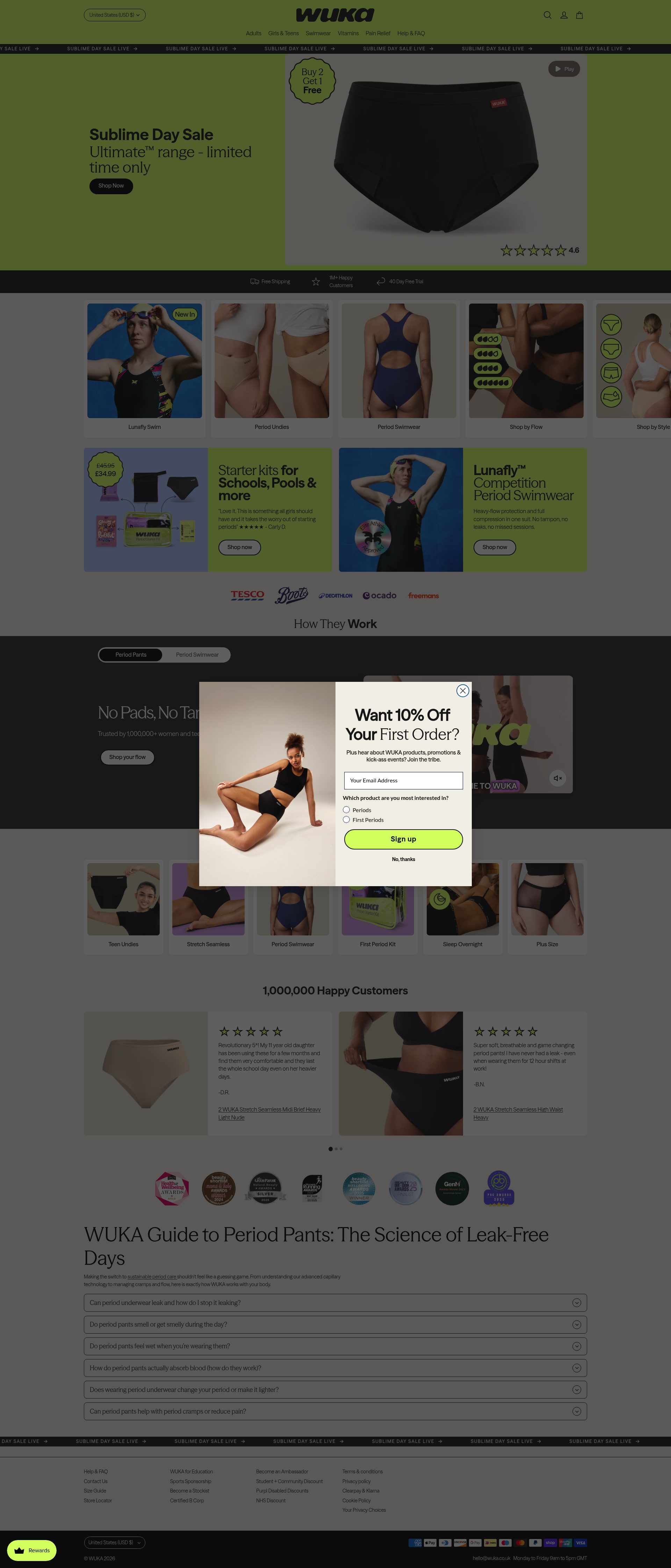
WUKA is the dominant UK period pants brand and the Shopify store has been carefully built around solving the biggest objection in the category: buyers do not know which absorbency or style they need without trying first. The homepage routes new buyers through a quiz that asks about flow, sleep patterns and preferred style, then surfaces a recommended product within seconds. This kind of guided buying is more important for period pants than almost any other category because the wrong choice means a refund, a return, or worse, a customer lost to a competitor.
The store handles size and absorbency anxiety with a free returns policy that is surfaced near the add-to-cart button, not buried in the footer. Subscription is positioned as a smart way to build a "period drawer" over time, with the first delivery being a starter pack and subsequent deliveries adding to the wardrobe rather than replacing it. This re-frames subscription from "stockpile" to "wardrobe building" and dramatically improves the long-term retention rate. WUKA's certifications (Oeko-Tex, vegan-friendly, B Corp pending status) are surfaced at product level rather than hidden on a sustainability page.
2. Modibodi
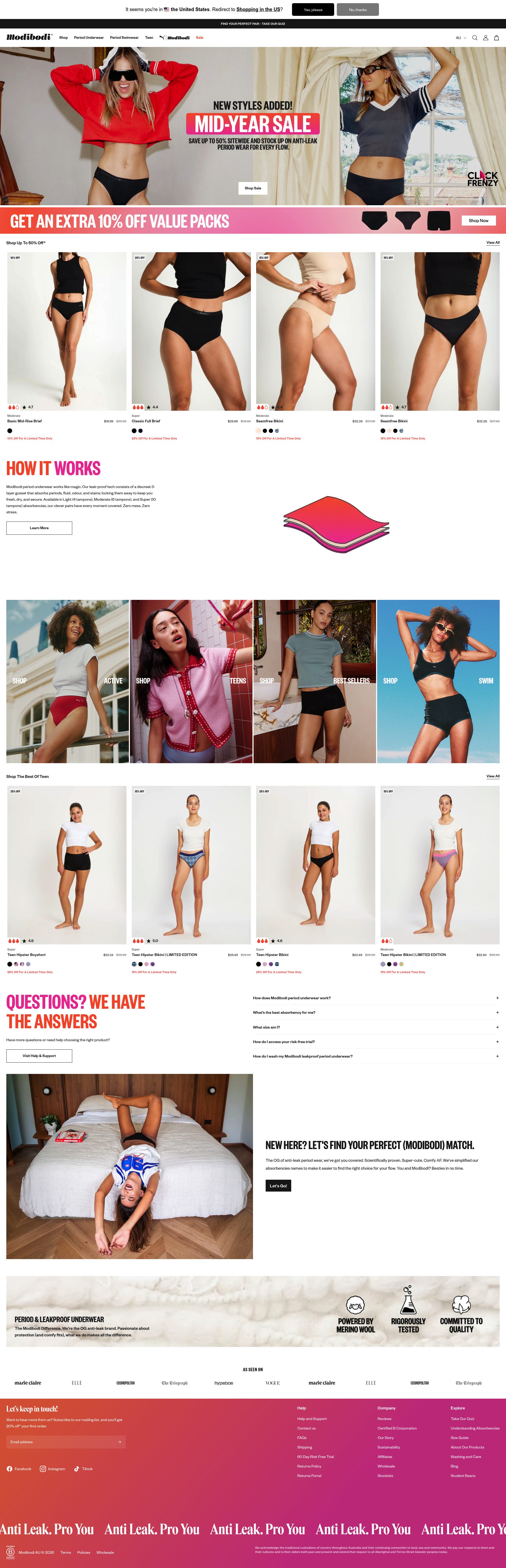
Modibodi pioneered period pants globally and operates one of the more polished Shopify stores in the UK market. The product range covers period pants, swimwear, sleepwear and incontinence products, and the store handles this breadth through a collection page that filters by use case rather than product type. The "find your fit" recommendation tool covers fit, flow level and lifestyle, then maps to a recommended product set rather than a single SKU, which raises average order value while reducing decision friction.
The store's commercial mechanics are unusually mature. Customer reviews are filtered by body type, age and use case, so prospective buyers can read reviews from women in similar circumstances. This is a significant lift for a category where individual experience varies. Subscription is offered at a 10% saving, which is a deliberately modest discount: Modibodi's products are durable and bought infrequently, so heavy subscription incentivisation would damage the product economics rather than help retention. The store understands its own product lifecycle and prices subscription accordingly.
3. Flux Undies
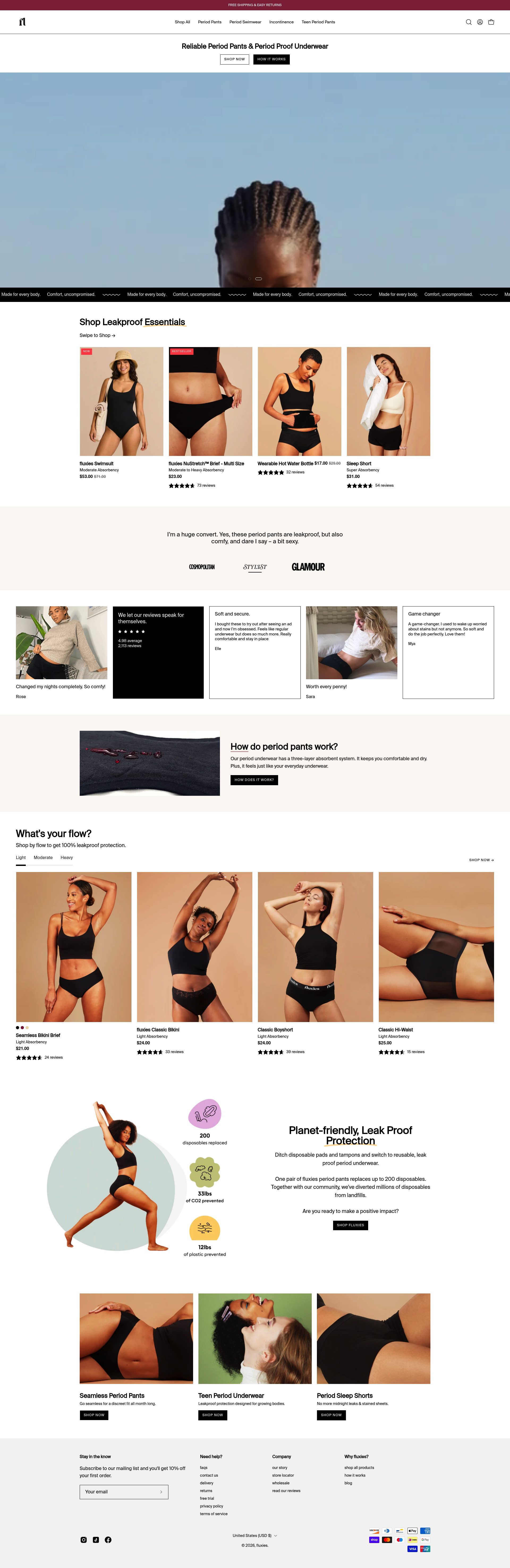
Flux Undies is a UK period pants brand with one of the most distinctive visual identities in the category. The Shopify store leans into playful, body-positive design without losing the practical information buyers need to convert. Product pages use clear absorbency comparisons (equivalent to two tampons, four tampons, six tampons), which translates an unfamiliar metric into something buyers already understand. This kind of cross-format absorbency translation is one of the highest-leverage product page improvements a period pants brand can make.
The store handles a difficult positioning problem well. Sustainable, reusable period products are sometimes perceived as "less convenient" than disposables, and the store directly addresses that with a calculator that compares total annual cost and waste reduction between Flux and traditional products. The numbers do the persuasion work, and the buyer arrives at the conclusion themselves. Subscription is offered for the disposable products in the range, with the period pants positioned as a one-time investment. This split logic is the right commercial choice and matches buyer mental models.
4. DAME

DAME built a Shopify store around a clear product innovation: the world's first reusable tampon applicator. The store is unusually focused on category education because the product is unfamiliar to most buyers. The homepage explains the product in a short video, addresses the hygiene objection directly (medical-grade self-sanitising materials), and shows the applicator next to a stack of disposable applicators to make the waste case visually obvious. This is good ecommerce thinking: the strongest argument for the product is shown, not described.
The store's subscription model is built around organic tampon refills with the applicator as the entry-point purchase. This is a smart commercial structure: one-time hardware buy creates ongoing consumable revenue, which is the same model that printer manufacturers use but applied to a wellness product. Bundle merchandising combines the applicator with starter tampon packs, which raises first-order value without feeling like an upsell. The B Corp status and ethical credentials are integrated into product copy rather than relegated to a corporate page.
5. Daye
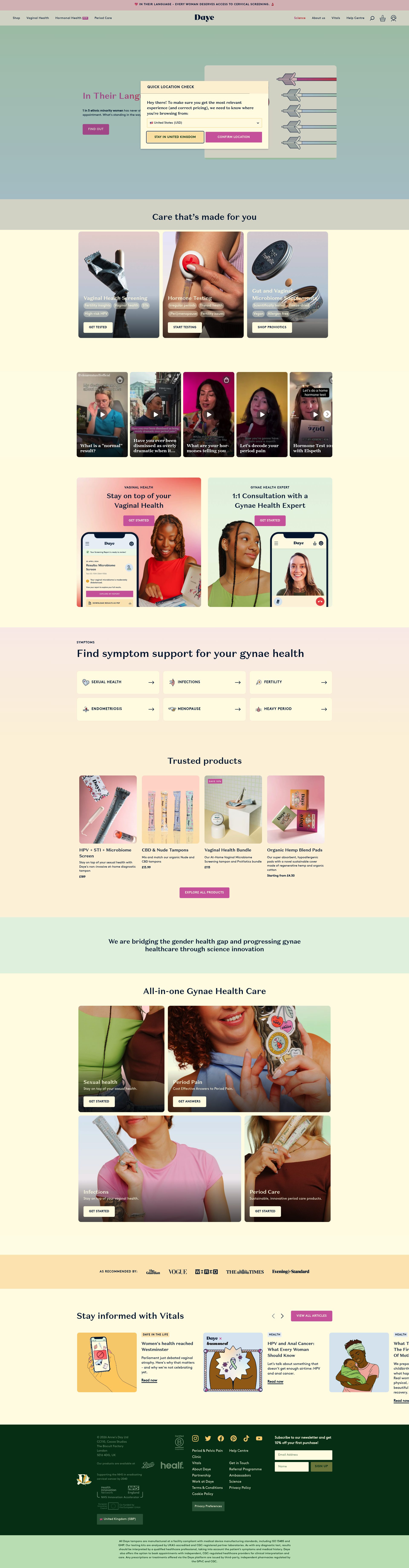
Daye sells CBD-infused tampons and has built a Shopify store around what is genuinely a category-redefining product. The store handles a difficult commercial challenge: explaining why a tampon might contain CBD without making medical claims that fall foul of UK regulation. Product pages name the active ingredient and its claimed mechanism (cramping relief), then surround the claim with customer testimonials, third-party press coverage and clinical sourcing detail. The store skirts the medical-claim line cleanly while still communicating the differentiator.
Subscription is the default purchase mode, and Daye prices it aggressively (15% off the first order plus free shipping on all subsequent deliveries). The store also handles a category-specific retention risk well: tampons are often bought reactively rather than proactively, and a subscription that delivers the wrong amount produces stockpile or run-out problems. Daye's quiz routes new buyers to a tailored delivery quantity based on flow length and cycle, which reduces the rate of subscription cancellation driven by inventory mismatch.
6. Ohne
Ohne is one of the original UK organic tampon subscription brands and the Shopify store reflects years of category leadership. The product range covers organic tampons, pads and CBD oil for period pain, with the subscription positioned as the obvious entry point. The store handles a quietly important commercial choice well: pricing the subscription at a similar level to supermarket-branded tampons rather than premium, which neutralises the price objection that limits adoption of organic period products.
The brand's editorial content is one of its strongest commercial assets. Articles on cycle awareness, period symptoms and reproductive health rank for high-intent informational queries and funnel readers into product pages without being obviously promotional. The store also handles the "period delivery" use case well, with delivery scheduling that aligns to the buyer's cycle rather than a fixed monthly cadence. This kind of cycle-aligned subscription is rare in the category and produces meaningfully better retention than calendar-based delivery.
7. &SISTERS
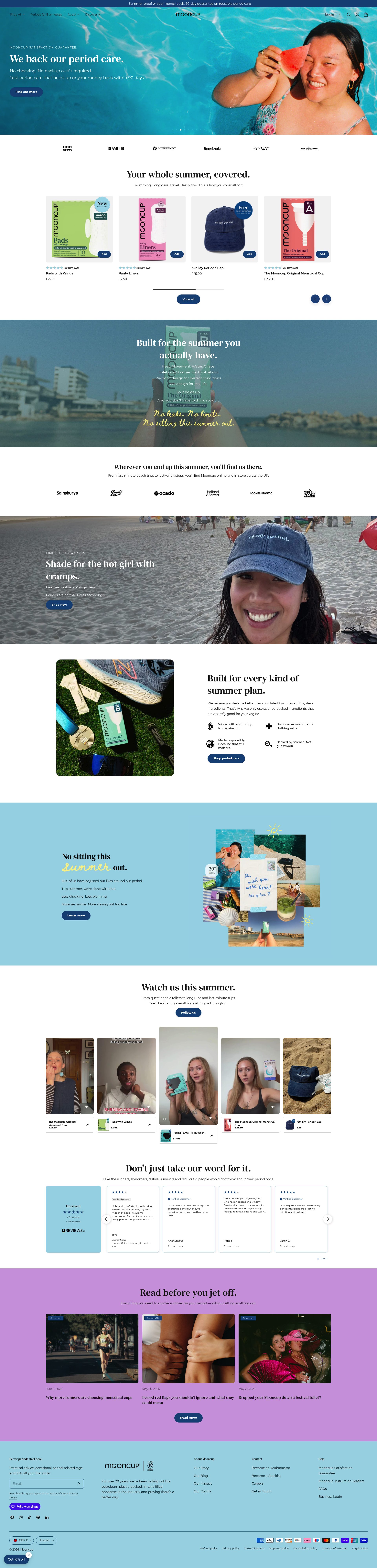
&SISTERS sells organic period products with a clear social mission woven into the commercial model. Every purchase contributes to period poverty initiatives, and the store handles this messaging carefully: the impact is communicated but never used to sell the product. This is the right choice because buyers respond better to a product that happens to do good than a product that asks them to do good. The product itself is the lead message, the impact is the supporting frame.
The store offers an unusually wide range of formats (tampons with and without applicator, pads, liners, menstrual cups, organic period pants) under one brand, which serves the cross-product buyer well. Bundle merchandising combines categories rather than just absorbencies, with mixed-format bundles that match real-world usage patterns (different products for different days of the cycle). The subscription model is flexible enough to handle these mixed-format orders, which is harder to build than single-product subscriptions but produces a much stickier customer.
8. TOTM
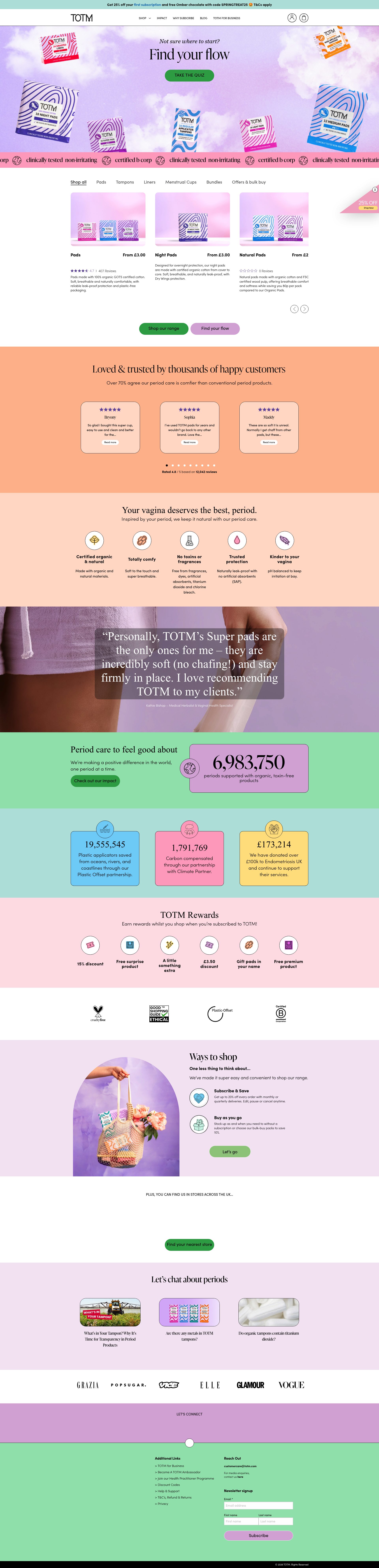
TOTM is a UK organic period products brand with a Shopify store that is unusually disciplined about ingredient transparency. The store leads with what is not in the products (chlorine, synthetic materials, fragrances) and only secondarily with what is. This negative-first messaging is the right choice for the category: buyers who are switching to organic products are often doing so because of concerns about the conventional alternatives, and the store needs to validate that concern before introducing its solution.
The bundle merchandising is built around "subscription kits" that combine tampons, pads and liners in proportions that match typical usage. This is more useful to the buyer than a single-format subscription and produces a higher basket value, which improves the unit economics of the subscription channel. The store also runs an active community programme that surfaces customer Q&A on product pages, which doubles as a category education layer and a soft trust signal for first-time buyers.
9. Hey Girls
Hey Girls is the UK's leading period poverty social enterprise and its Shopify store is built around a one-for-one model: every product purchased funds a donation of period products to someone who cannot afford them. The store handles the dual mission well by structuring the product copy to lead with quality and certifications, then close with impact. This sequencing is critical: social enterprise brands that lead with impact and treat product as secondary tend to lose buyers who are not specifically shopping for impact, while brands that get the product story right first capture both audiences.
The B2B side of the store is unusually well-built. Hey Girls supplies period products to schools, councils, NHS trusts and businesses under government period equality schemes, and the Shopify store routes B2B buyers through a separate flow with bulk pricing, tax invoicing and account-level repeat ordering. This dual B2C and B2B structure on a single Shopify store is hard to design well, and Hey Girls executes it cleanly. Few period care brands have built a comparable institutional sales channel.
10. Riley
Riley sells organic period products and pelvic floor support with a Shopify store that positions itself for the conscious consumer who buys across multiple wellness categories. The product range is intentionally tight: a small number of well-merchandised SKUs that cover the core need without overwhelming the first-time buyer. This kind of range discipline is uncommon in DTC and pays off in conversion: fewer choices reduce decision fatigue and increase the probability of purchase.
The store handles the gift and corporate market well, with workplace welfare kits that are explicitly positioned for HR teams setting up period equality programmes. This kind of B2B-adjacent positioning is a quiet revenue lever in the period care category and Riley has built it into the store more deliberately than most competitors. The subscription mechanic is straightforward and competitive, and the brand's editorial content covers pelvic floor health and post-natal recovery in a way that broadens the addressable market beyond the core period care buyer.
What these stores have in common
Period care is a category where commercial best practice has evolved fast. The ten stores above share a few patterns worth studying.
Every store handles category education seriously. Reusable period pants, organic tampons, menstrual cups and CBD-infused products all require explanation before a buyer will trust them with an intimate purchase. The strongest stores in this list (WUKA, DAME, Daye) front-load this education on the homepage and product page rather than relegating it to a separate FAQ. This costs design real estate but pays back in conversion rate from first-time buyers who would otherwise leave to research the product on a competitor's site.
Subscription mechanics are split by product type, which matches buyer mental models. Reusable products are sold as one-time investments with optional add-ons, while disposables and consumables are sold as cycle-aligned subscriptions. Brands that try to subscribe a period pants buyer to a monthly delivery of more period pants get cancelled. Brands that get this distinction right (Flux, WUKA, Daye) retain customers across multiple product lifecycles rather than churning them at the first delivery they did not need.
Cost and waste comparisons are now standard. Every store in this list includes some form of "see what you would save compared to disposables" calculator or claim. This is the right commercial framing because it gives the buyer a number to anchor to rather than asking them to evaluate sustainability as an abstract good. Numbers persuade more reliably than values in a category where the buyer is already weighing convenience against impact.
Finally, body-positive design language is now the baseline. The clinical, plastic-aesthetic period care merchandising of the supermarket aisle is being actively rejected by the DTC category, and the better Shopify stores in this list use design language that treats menstruation as a normal bodily function rather than something to be hidden or apologised for. This is not just a brand choice. It is a commercial choice, and the buyer responds to it with higher conversion rates and more repeat purchases.
If your period care or wellness brand is ready to improve conversion or rebuild its Shopify store, our Shopify design service is built around exactly these kinds of commercial outcomes. Get in touch to talk through what your store needs.
Frequently asked questions
Which UK period care Shopify stores are worth learning from for DTC brands?
WUKA, DAME and Daye are the three most commercially instructive stores in the category. WUKA nails guided buying and subscription framing, DAME uses a hardware-plus-consumable model to lock in recurring revenue, and Daye handles a genuinely complex product claim with clinical sourcing and testimonials rather than vague wellness language.
How do the best period care stores handle subscription mechanics?
The strongest stores split subscription logic by product type. Reusable period pants (WUKA, Flux) are positioned as one-time investments with optional add-ons rather than monthly deliveries. Disposables and consumables (Daye, Ohne, TOTM) are sold as cycle-aligned subscriptions timed to the buyer's period rather than a fixed calendar cadence, which meaningfully reduces cancellations from stockpile or run-out problems.
What conversion techniques do period care Shopify stores use to overcome buyer hesitation?
The common techniques are absorbency translation (showing equivalent tampon counts rather than millilitres), cost-and-waste calculators that put a number on the saving versus disposables, free returns surfaced near the add-to-cart button, and video demonstrations that address hygiene objections directly. DAME and WUKA do this best; both front-load the educational work on the homepage rather than hiding it in a FAQ page.
Do period care Shopify stores sell to businesses as well as consumers?
Hey Girls is the most developed B2B operator in the category, supplying schools, councils, NHS trusts and workplaces under period equality schemes through a dedicated B2B flow with bulk pricing and tax invoicing built into a single Shopify store. Riley also targets the corporate market with workplace welfare kits explicitly positioned for HR teams. Both stores show that institutional sales can be layered onto a DTC Shopify setup without a separate platform.
How do organic period care brands justify the price premium on their Shopify stores?
The three most effective approaches in this list are: leading with what is not in the product (chlorine, synthetics, fragrances) before introducing the organic alternative (TOTM), showing cost-per-cycle comparisons that neutralise the price premium by spreading it over a year of use (Flux, Ohne), and pricing the subscription at parity with premium supermarket alternatives so the organic switch feels financially neutral (Ohne). Brands that simply state organic credentials without anchoring to a price or cost comparison tend to lose buyers at the checkout.