

Quick summary
Fourth Trimester is the standout pick in this niche, with a lifecycle-led store built entirely around postnatal recovery and a subscription pack size matched to the fourth trimester window. Legendairy Milk is the strongest choice for breastfeeding-specific supplement buyers, using diagnostic merchandising to match the right product to each supply challenge. Milk Dust handles the sensitive postpartum weight management angle better than any competitor, leading with breastfeeding safety rather than diet messaging. Mama Natural earns its position through a decade of content-commerce integration that drives organic acquisition no paid-only brand can replicate.
Postpartum is one of the most commercially underserved windows in the female health supplement market. Buyers are motivated, purchase frequency is high, and the products genuinely matter for recovery, breastfeeding support and maternal mental health. The stores that perform best in this niche understand that a new mother has almost no time, high trust requirements and very low tolerance for vague marketing claims. Here are ten Shopify stores that have built their commercial model around those constraints.
1. Fourth Trimester
Fourth Trimester has built a Shopify store entirely around the postnatal recovery window and the commercial logic is tight. The brand name itself does the positioning work before the buyer reaches the homepage, and the store reinforces it through lifecycle-led navigation: Recovery, Breastfeeding, Sleep, and Mood are the primary collection entry points rather than product types. This symptom-and-stage architecture means a buyer who arrives searching for breastfeeding support lands on a curated collection within one click, rather than having to parse a product grid.
The product pages are built around a clear sequencing of information: what the supplement does, what is in it, and why those ingredients were chosen, in that order. The brand does not lead with ingredient lists, which is the right call for a buyer who is sleep-deprived and researching quickly. Each product page includes a "what to expect in the first 12 weeks" timeline, which sets realistic expectations and reduces early cancellations in the subscription programme.
Subscription mechanics are strong. A forty-day introductory supply is the default purchase size, matching the traditional postpartum recovery period and reinforcing the "fourth trimester" framing. This is an unusually smart commercial decision: the pack size matches the cultural moment the brand is built around, which makes the purchase feel purposeful rather than arbitrary.
2. Mama Natural

Mama Natural is one of the most established brands in the postpartum supplement space and the Shopify store reflects the depth of a brand that has been refining its customer journey for over a decade. The store is anchored by a content library that rivals dedicated parenting media sites: a full week-by-week pregnancy guide, postpartum recovery articles and breastfeeding support content sit alongside the supplement range in the main navigation. This content-commerce integration is one of the highest-performing structures in the supplement category for organic acquisition.
Product pages handle a wide SKU range without creating confusion. The postnatal multivitamin pages include a clear rationale for each formulation decision, naming which nutrients are depleted through pregnancy and birth and why the dose in the formula addresses that depletion. This clinical clarity is unusually specific for a direct-to-consumer supplement brand and it carries real conversion weight with buyers who are already informed about postpartum nutrition.
The subscription model is positioned as a "postpartum protocol" rather than a simple recurring order, giving the subscription a clinical framing that justifies ongoing commitment. Loyalty rewards accumulate across subscription purchases and are redeemable on a growing range of non-supplement products, which helps the brand retain buyers as they move out of the postpartum window.
3. Majka
Majka has built a Shopify store around one of the strongest product propositions in the postpartum supplement market: a lactation protein powder that addresses the caloric demand of breastfeeding while simultaneously supporting milk supply. The dual-function framing, both nutrition and lactation support in one product, reduces the number of supplements a new mother needs to buy and makes the value case compelling against buying two separate products.
The product pages are visually clean and information-dense without being overwhelming. Key claims, "increases milk supply", "provides 20g protein per serving", "no artificial ingredients", are surfaced as scannable headline statements before any supporting detail, which is the right approach for a buyer checking a product page in between feeds. The flavour range is presented with lifestyle photography of women drinking the shake, not clinical images, which humanises the product and makes the use case immediately legible.
Bundle merchandising is handled well. A "new mum starter kit" bundles the protein powder with a postnatal multi and a hydration supplement, and the pricing comparison to buying each separately is shown clearly. The bundle page does not rely on a discount to convert: it leads with "everything you need, all in one order", which is the right pitch for a time-poor buyer.
4. Milk Dust
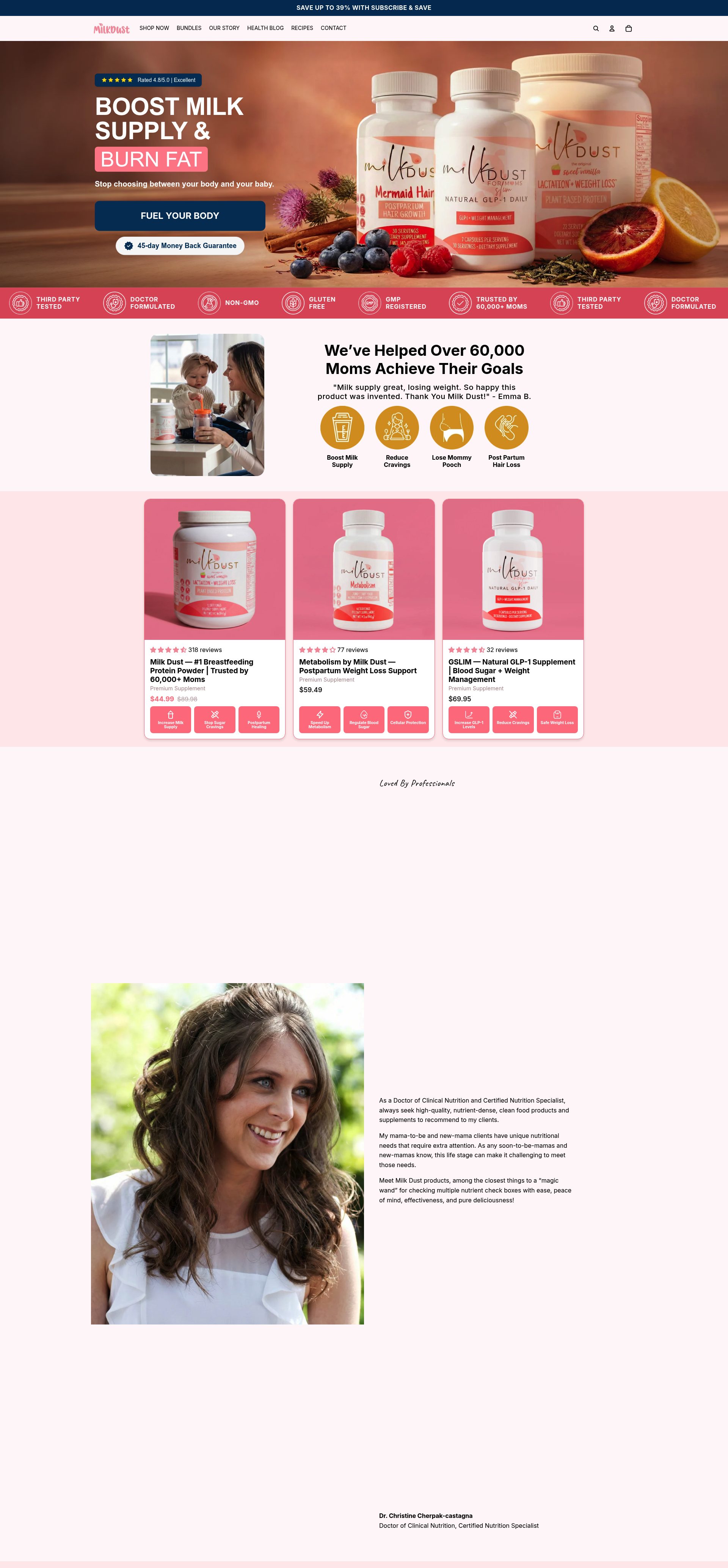
Milk Dust occupies the postpartum weight loss and breastfeeding support intersection, and the Shopify store is built to address the tension that comes with that positioning directly. The brand leads with "designed for breastfeeding mums" rather than weight loss language, which is the correct choice for a category where weight loss messaging can deter buyers who are focused on supply and recovery. The weight management angle is surfaced through ingredient education, specifically the blood sugar balancing and craving reduction properties of the formula, rather than as a headline claim.
The store does something few supplement brands do well: it handles buyer anxiety about ingredients and breastfeeding safety explicitly. A dedicated "safe for breastfeeding" content block appears on every product page, naming the research behind each ingredient and distinguishing between evidence-backed inclusions and commonly avoided compounds. This kind of safety-first transparency reduces one of the highest purchase barriers in the postpartum supplement category.
Review integration is strong. The product pages surface reviews specifically mentioning milk supply changes, energy levels and postpartum weight, filtered so the most relevant social proof is visible without requiring buyers to scroll through hundreds of unfiltered entries. This review curation approach consistently outperforms unfiltered star ratings in trust-sensitive health categories.
5. Legendairy Milk
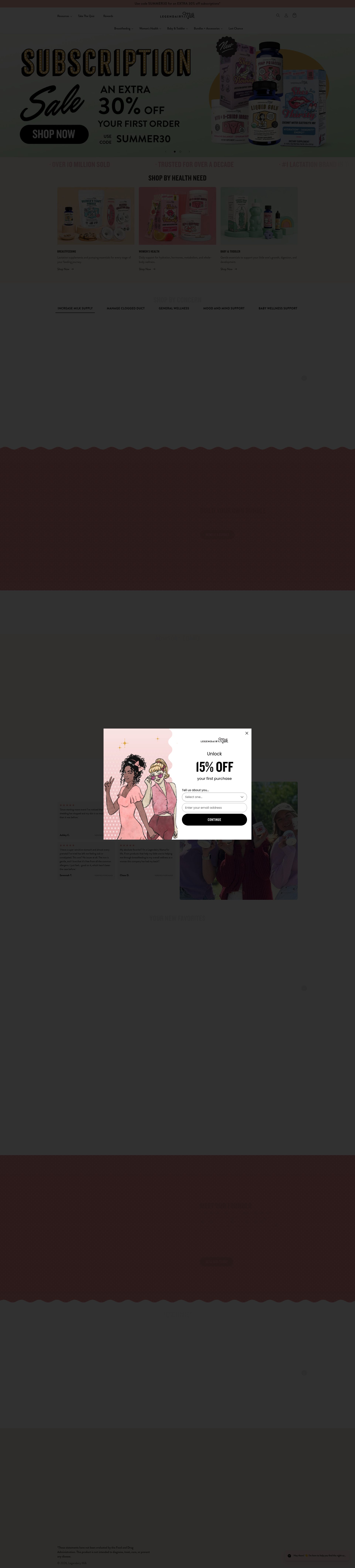
Legendairy Milk is one of the most focused stores in this list, built around a single core claim: evidence-based supplements to support and increase breast milk supply. This tight positioning is a commercial strength. The store does not try to cover the full postpartum window and is better for it, attracting buyers with a specific and high-urgency need who are willing to pay a premium for a solution they trust.
The product architecture is the store's most distinctive commercial feature. Rather than selling a single lactation supplement, Legendairy Milk offers a range of products with different active herb combinations: Imalac, Cash Cow, Pump Princess, Milkapalooza. Each one targets a slightly different milk supply challenge, and the product selection tool on the homepage asks buyers about their specific situation (low supply from the start, supply drop, returning to work) and recommends the matching product. This diagnostic merchandising approach is as close to a clinical consultation as a DTC supplement store can get without hiring practitioners.
Subscription drives a large share of revenue, and the store supports it with a "milk supply diary" email sequence that prompts buyers to log supply changes and adjust their dosage. This post-purchase engagement mechanic reduces cancellations in the first four weeks, the window where most supplement subscriptions fail, by giving buyers a structured way to evaluate the product.
6. New Chapter
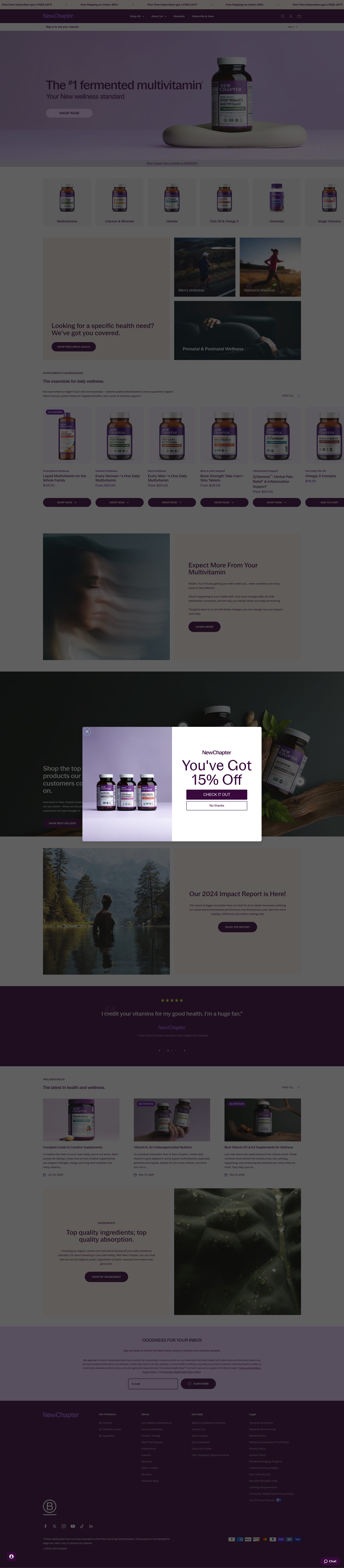
New Chapter is one of the most established supplement brands in the US market and their Shopify store handles the challenge of presenting a wide product range without diluting the postpartum category. A dedicated postnatal landing page groups their Perfect Postnatal multivitamin alongside omega-3 and probiotic SKUs with a recommended daily protocol, which reduces the cognitive load of building a supplement stack from scratch.
The Perfect Postnatal product page is one of the most information-rich in this category. Fermented nutrient sourcing, the rationale for whole-food ingredients versus synthetic, third-party certifications (Non-GMO Project, NSF Certified for Sport, USDA Organic), and clinical advisory credentials are all presented within a single product page without creating visual clutter. The information hierarchy is carefully managed: each layer of detail is progressively revealed rather than stacked.
Subscription is handled with unusual transparency. The "why subscribe" section on product pages explains that the fifteen percent discount reflects the cost saving from reduced customer acquisition spend, which is an honest and differentiated approach to subscription framing. This transparency resonates with the well-informed, values-led buyer that New Chapter's organic and fermented positioning attracts.
7. Pink Stork

Pink Stork covers the full maternal health journey from fertility through postpartum and their Shopify store has matured into a well-structured lifecycle commerce platform. The postnatal range is accessed through a dedicated "postpartum" collection page that groups supplements by recovery goal: energy, mood, milk support, sleep. This goal-led structure is more commercially effective than grouping by product type because it matches the mental model of a buyer who arrives thinking about a problem, not a product category.
The store does a strong job of cross-selling across life stages. A buyer on the postpartum collection page is shown a "what's next" block that introduces the Mama Multivitamin for ongoing nutrition beyond the fourth trimester, which extends the customer relationship past the immediate postpartum window. This lifecycle cross-sell is one of the strongest retention tools in the maternal health supplement category and most brands leave it unimplemented.
Pink Stork's subscription model includes a loyalty tier that unlocks benefits at three, six and twelve months of continuous subscription, with the twelve-month tier offering free product additions to each order. This cumulative loyalty structure is more effective at reducing long-term churn than percentage discounts because the benefit grows with commitment rather than being front-loaded on the first order.
8. Ora Organic
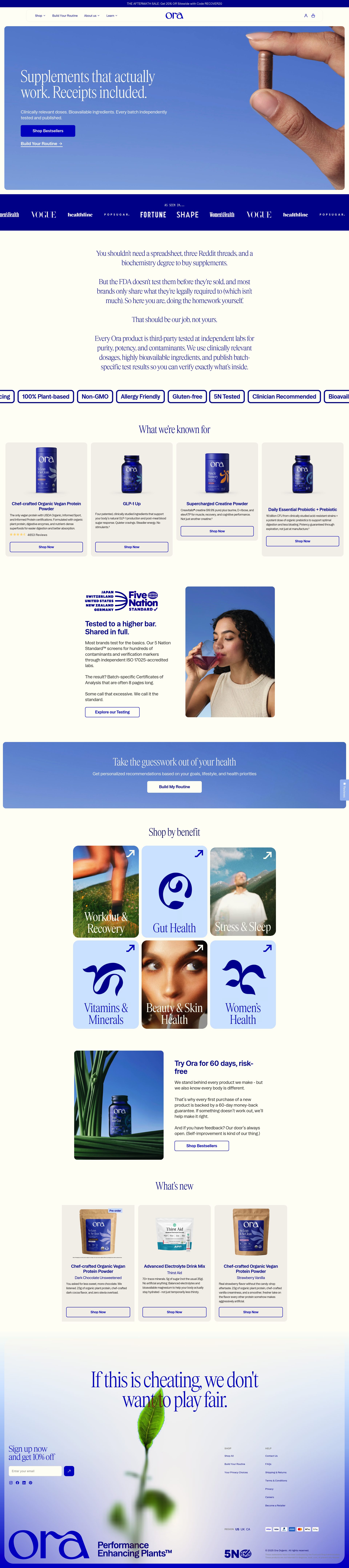
Ora Organic sits at the premium plant-based end of the postpartum supplement market, and their Shopify store is built to justify that positioning at every touchpoint. The store's design is clean, editorial and confident, with a visual language that places Ora alongside premium food brands rather than pharmaceutical supplement lines. This positioning is deliberate: it attracts buyers who are already committed to plant-based eating and treat supplement quality with the same rigour they apply to food sourcing.
The postnatal product pages lead with ingredient origins and third-party certifications rather than benefit claims, which is the right sequencing for a credibility-first buyer. The "third-party tested" badge on every product links to a verification page with actual certificate downloads, not just a claim. This level of verification transparency is rare in the supplement category and operates as a strong conversion signal for buyers who have been misled by vague "tested" claims from other brands.
Subscription is positioned around a "build your stack" flow that lets buyers combine a postnatal multi with additional single-ingredient SKUs into a monthly bundle at a fixed discount. The visual stack builder on the product page is one of the more engaging subscription acquisition mechanics in the category: it gives buyers agency over their protocol and raises average order value without requiring a manual upsell.
9. Actif Organic
Actif Organic is a smaller, more clinical brand in the postpartum supplement category, and the Shopify store is built for the informed buyer who is comparing formulations rather than responding to lifestyle imagery. Every product page leads with a full supplement facts panel, ingredient origins and the clinical rationale for each inclusion. This front-loaded transparency is a deliberate strategy to attract buyers who are already reading labels before they arrive on the site.
The postnatal multivitamin range is segmented by format: capsule, softgel and powder, each with a clear explanation of which format is best suited to different postpartum situations, including for buyers with swallowing difficulties or significant nausea. This accessibility-led format navigation is a subtle but effective conversion tool for a buyer who has found a strong formula but is uncertain about the physical product.
The store's pricing is positioned at accessible mid-market, and the value case is made through quality per serving rather than discount-led promotions. The product pages show a cost per day calculation alongside the unit price, which reframes the value assessment in terms of the daily health commitment rather than the upfront spend. Subscription drops this further and is positioned as the default with one-off purchase available for first-time buyers who want to trial.
10. Donat Mg
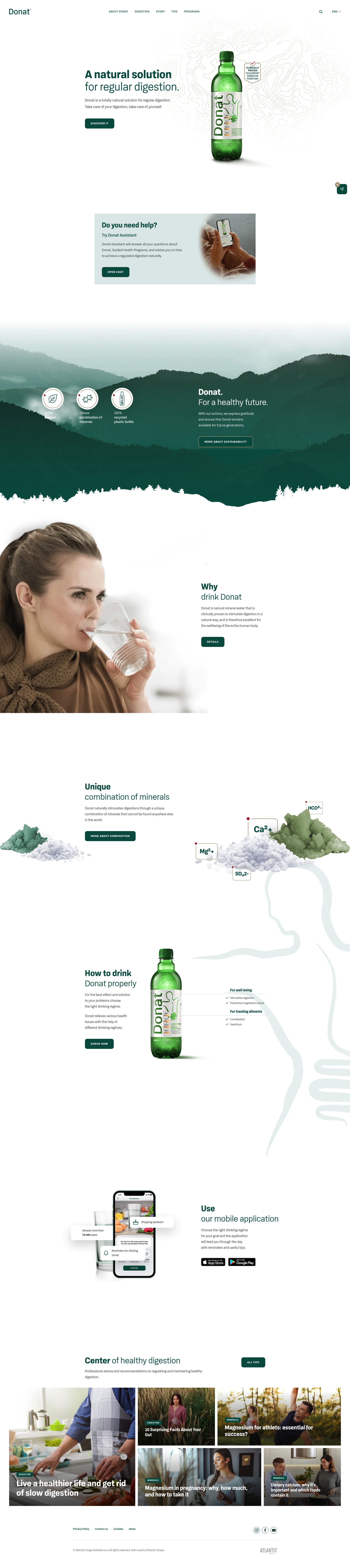
Donat Mg is a Slovenian brand with a growing UK DTC presence built around naturally occurring magnesium-rich mineral water, and their Shopify store applies this unusual format to the postpartum market in a way that stands apart from every other brand in this list. Magnesium depletion is one of the most clinically documented postpartum deficiencies, and the store leads with this evidence to position the product as a natural, format-differentiated solution compared to capsule-based magnesium supplements.
The product pages make the format advantage central to the conversion case. Clinical absorption comparisons between mineral water magnesium and magnesium oxide or citrate capsules are presented alongside sourcing details from the Rogaska mineral spring, with certifications and over 150 years of documented use as a credibility anchor. This combination of heritage provenance and clinical evidence is rare in the supplement category and gives the brand a defensible positioning that smaller competitors cannot easily replicate.
The store handles a high-consideration purchase well through a "how to take" education section that maps dosage to specific postpartum symptoms, including constipation, muscle cramps, sleep disturbance and anxiety. This symptom-to-dosage guide is the kind of practical clinical detail that converts a sceptical buyer into a subscriber, and the store uses it effectively as a final pre-purchase reassurance block before the add-to-cart.
If you are building or scaling a postpartum supplement Shopify store, our Shopify design service can help you turn clinical credibility into a store that converts. Get in touch to discuss your project.
Frequently asked questions
Which postpartum supplement Shopify store has the best subscription model?
Legendairy Milk and Fourth Trimester are the strongest. Legendairy Milk uses a post-purchase milk supply diary email sequence to reduce early cancellations, while Fourth Trimester's default forty-day pack size is designed to match the recovery window and keep buyers committed through the full protocol.
What makes a postpartum supplement store convert better than a general supplement store?
Symptom-and-stage navigation, breastfeeding safety transparency, and clinical ingredient rationale outperform generic benefit-led copy in this category. Buyers in the postpartum window are time-poor and risk-averse, so stores that answer safety questions before they are asked, such as Milk Dust's dedicated "safe for breastfeeding" content block, consistently convert better than stores that lead with lifestyle imagery.
Are these postpartum supplement stores built on Shopify?
Most stores in this category run on Shopify or Shopify Plus. The subscription mechanics, bundle builders, and loyalty programmes featured in stores like Pink Stork, Ora Organic, and New Chapter are all deliverable through Shopify's native subscription apps and third-party integrations without custom development.
What is the best postpartum supplement store for breastfeeding support specifically?
Legendairy Milk is the most focused option, with a product range built entirely around milk supply and a diagnostic quiz that matches buyers to the correct herb combination for their specific supply challenge. Majka and Milk Dust are strong alternatives if the buyer also needs a protein or nutrition product alongside lactation support.
How do top postpartum supplement Shopify stores handle trust and safety concerns?
The highest-performing stores in this niche handle trust through third-party certifications with downloadable certificates (Ora Organic), named clinical advisory credentials (New Chapter), ingredient-level breastfeeding safety explanations (Milk Dust), and heritage provenance with over 150 years of documented use (Donat Mg). Vague "tested" badges or unsubstantiated claims are the fastest way to lose a postpartum buyer.