

Quick summary
Sage Appliances leads the category with a guided machine selector that walks buyers through the barista journey before they ever see a price, making a complex premium range feel navigable. Vitamix wins on lifetime value positioning, using a ten-year warranty and a certified reconditioned category to convert hesitant buyers without discounting. KitchenAid turns its stand mixer into a platform by mapping attachments on every PDP, lifting average order value and locking in long-term brand loyalty. Nespresso solves the hardest problem in the category by architecturally linking hardware and consumable subscriptions so a machine purchase immediately anchors a recurring pod revenue stream.
Small kitchen and home appliances are one of the most commercially demanding categories in ecommerce. Purchase decisions are high-consideration: buyers compare specs across multiple tabs, weigh up warranty terms, read reviews, and often return to the site two or three times before committing. The stores that convert in this niche are the ones that treat their product pages as buying guides, not catalogue entries, and build content architecture that earns trust before the buyer has even seen a price. These ten Shopify stores do that better than most.
1. Sage Appliances
Sage Appliances (sold as Breville outside the UK) runs one of the most technically sophisticated Shopify Plus stores in the appliance category. Their espresso machine range spans entry-level to barista-grade, and the store's navigation handles that complexity with a "find your machine" guided selector that filters by grinder preference, milk texturing style, and budget in three steps. That tool removes the biggest friction in a category where feature lists alone are impenetrable to most buyers.
Product pages are built around the concept of the barista journey rather than the appliance as an object. Sage shows the espresso extraction process, the grind size impact on flavour, and the milk steaming technique as part of the PDP, tying the educational content directly to the machine being sold. Their trade-in programme, surfaced prominently on product pages, gives buyers a financial incentive to upgrade rather than a reason to go back to Amazon. The store also carries an outstanding accessories and cleaning range that is cross-sold contextually on every coffee machine PDP, with genuine upsell logic: the right tamper for the right machine, not a generic accessories grid.
2. Shark
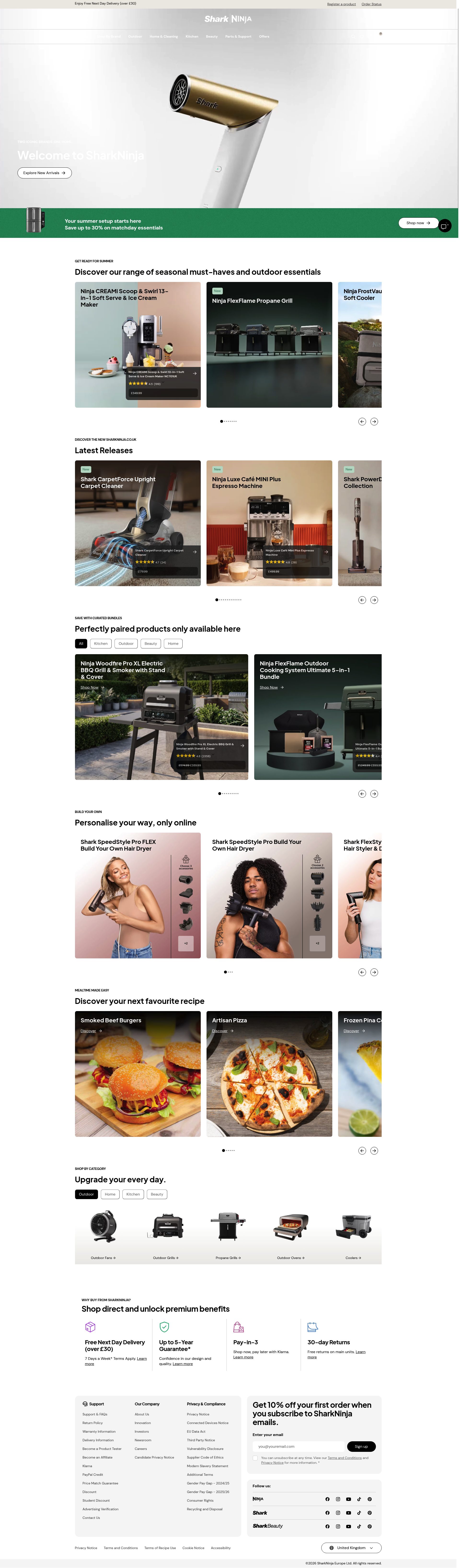
Shark is primarily known as a vacuum brand, but their Shopify store covers hair care and home appliances with the same commercial discipline that made their vacuum range dominant. The site's collection architecture is built around problem, not product: a buyer looking for a floor cleaning solution lands in a guided experience that asks about floor type, pet ownership, and household size before surfacing a shortlist. That approach reduces decision paralysis in a category where the product range is wide and the differences between models are not obvious.
On small appliances specifically, Shark's product page structure is worth studying. Key specs are presented in a visual hierarchy that puts the things buyers actually care about, suction power, battery life, and weight, at the top, with granular technical detail available further down the page for those who want it. Their customer review integration pulls ratings into the collection view rather than requiring a click-through, so buyers can see aggregate scores at the browsing stage rather than only after landing on a PDP. Financing options via Klarna are surfaced directly below the price, which matters in a category where units regularly exceed £300.
3. Vitamix

Vitamix has built one of the most defensible premium appliance brands in DTC ecommerce. Their Shopify Plus store handles the challenge of selling blenders at £400-plus by making a sustained case for lifetime value rather than competing on features. The ten-year full warranty is the lead argument on every product page: it is positioned above the fold, ahead of specs, and treated as the primary reason to buy rather than a policy disclosure at the bottom of the page.
The certified reconditioned range is a genuine commercial lever that most premium appliance brands underuse. Vitamix presents refurbished units as a curated category with dedicated photography, the same full warranty as new product, and a clear price advantage that gives hesitant buyers a credible entry point. Their content investment in recipes, techniques, and nutrition guides drives meaningful organic traffic from informational queries, and the links back to specific models from content pages create a conversion loop that compounds over time. The trade and commercial section is cleanly separated from the consumer experience, which keeps restaurant buyers and domestic buyers in distinct, relevant journeys.
4. Smeg UK

Smeg UK operates in the premium design-led appliance segment where aesthetic compatibility with a kitchen is as important as specification. Their Shopify store reflects this: colour filtering is a primary navigation option across every small appliance category, allowing buyers to match a kettle, toaster, and coffee machine to the same finish in three clicks. That sounds simple, but most appliance stores do not build this properly, and the friction of cross-referencing colour availability manually is a real barrier to purchase in this segment.
Product photography on Smeg's PDPs emphasises the appliance in styled kitchen environments rather than isolated on white, which reinforces the lifestyle positioning and helps buyers visualise the product in their own home. The store handles the question of compatibility and design coherence well: collection pages surface the full "50s Retro Style" kitchen range as a set, encouraging basket building across kettle, toaster, and blender rather than single-unit transactions. Their gift wrapping option and personalisation service, surfaced prominently around gifting occasions, reflect an understanding that a significant share of premium small appliance revenue comes from considered gift purchases.
5. Nespresso
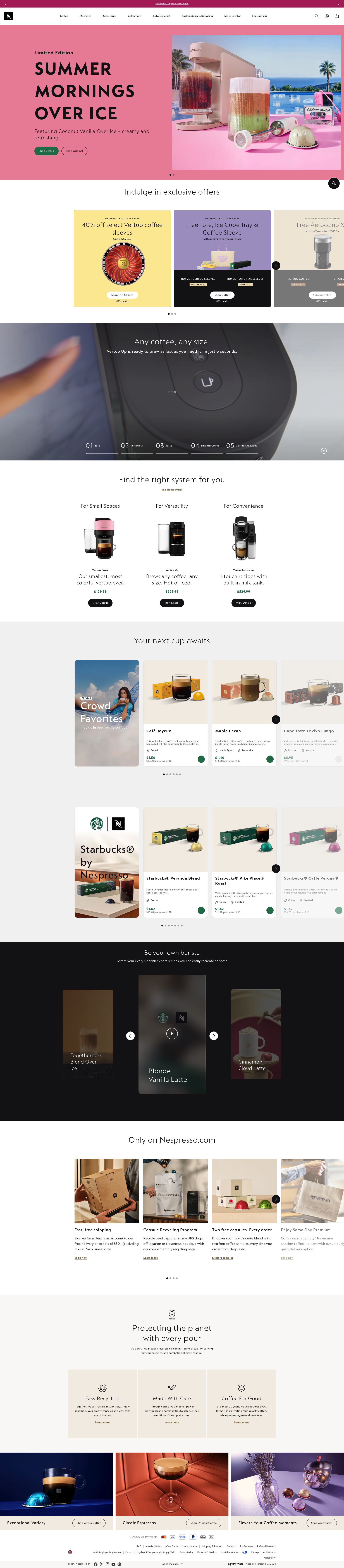
Nespresso runs a Shopify Plus store that has solved one of the most complex problems in the appliance category: selling both the hardware (machines) and the recurring consumable (pods) in a coherent DTC experience. The machine and pod ranges are architecturally linked on the site rather than treated as separate catalogues, which means a buyer purchasing a machine is immediately oriented toward the pod subscription that generates ongoing revenue.
Their machine selector is well-executed: it asks the right questions, cup size preference, milk use, and counter space, in a guided flow that leads to a specific model recommendation rather than a generic collection page. Pod subscriptions are offered at a discount to one-off purchases with a clear before/after price rather than a percentage saving, which anchors the value more effectively. The recycling programme is integrated into the checkout and post-purchase flows in a way that feels like a genuine brand commitment rather than a compliance exercise, which matters in a category where the environmental footprint of single-use capsules is a genuine purchase objection for a growing segment of buyers.
6. Nutribullet
Nutribullet defined the personal blender category and their Shopify store maintains the clarity of that positioning across a range that has grown considerably since the original bullet blender. The collection architecture is straightforward: personal blenders, full-size blenders, and juicers are cleanly separated, and the merchandising within each category leads with the most popular models rather than the full product matrix. That editorial discipline makes the store easier to navigate than competitors who surface every SKU at the same prominence.
Product pages use social proof aggressively, and it earns its place here: in a category where buyers primarily want to know whether a blender handles ice and frozen fruit cleanly, customer photos and video reviews showing actual blend results are more persuasive than any copy. Nutribullet's recipe content is volume-heavy and well-indexed, driving consistent organic traffic from health and nutrition queries. The accessories range, cup sizes, blade assemblies, and lids, is cross-sold clearly on every machine PDP with a compatibility callout that removes the uncertainty about whether an accessory will fit a specific model. Their bundle mechanic, combining a machine with a recipe book or accessory set at a modest saving, lifts average order value without requiring a promotional discount on the hero product.
7. KitchenAid
KitchenAid is one of the most recognisable appliance brands in the world, and their Shopify store reflects the design confidence of a brand that does not need to compete on price. The stand mixer range is the commercial core of the site, and the PDP structure around it is excellent: attachment compatibility is clearly mapped, with a dedicated attachments section that positions the mixer as a platform rather than a single-function appliance. That positioning lifts average order value and retention, because a buyer who owns three attachments is far less likely to switch brands than one who only owns the base machine.
The colour range on KitchenAid mixers is extensive, and the store handles colour selection well: a large swatch grid with descriptive colour names, not just hex references, and a colour visualiser that lets buyers see the mixer in different kitchen colour schemes before committing. The gifting journey is well-developed, with a "build your gift" bundle mechanic that pairs a stand mixer with a chosen attachment and recipe book at a curated price. Their trade and professional section is separated from the consumer experience and targets baking schools, food stylists, and professional kitchens with relevant positioning and pricing.
8. De'Longhi
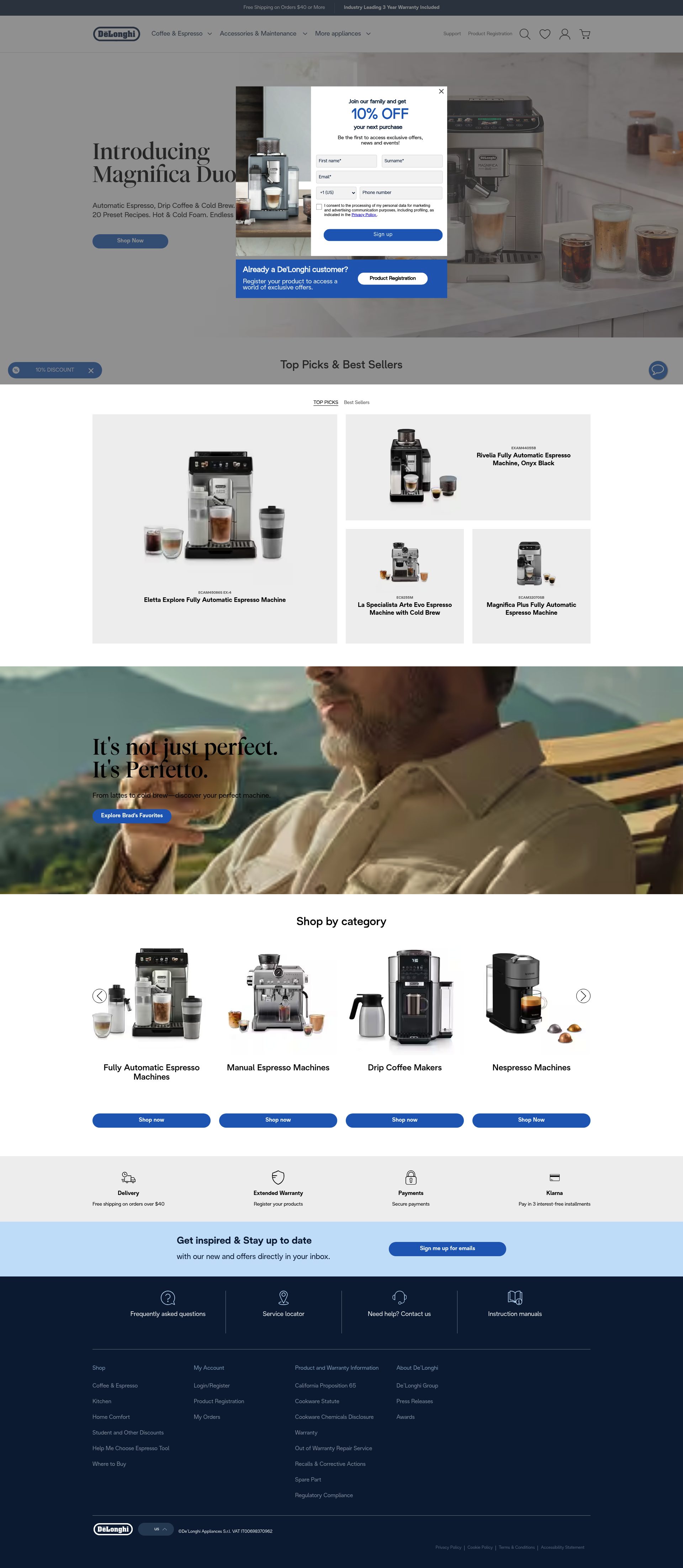
De'Longhi runs a Shopify Plus store across its coffee machine, kitchen appliance, and home comfort ranges, and the challenge of managing that catalogue breadth is handled better here than at most multi-range appliance brands. The primary navigation separates coffee from kitchen from home comfort clearly, and within each category the collection pages are structured around price bands and use cases rather than model codes. That architecture serves buyers who are category-new, which is a significant portion of any appliance audience.
Their coffee machine range is where the Shopify execution is strongest. A guided machine selector walks buyers through bean-to-cup, capsule, and manual espresso options with plain-language explanations of the differences, which is the right editorial investment for a category where the terminology alone loses half the potential audience. De'Longhi surfaces extended warranty options and care plan upsells at the cart stage rather than on the PDP, which keeps the product page focused on the purchase decision and captures the upsell at the moment of highest commitment. Their collaboration with Kenwood under the same group umbrella is reflected in cross-brand recommendations that surface Kenwood food processors to a De'Longhi kitchen buyer, which is a smart catalogue play that most multi-brand groups fail to execute on Shopify.
9. Aeropress
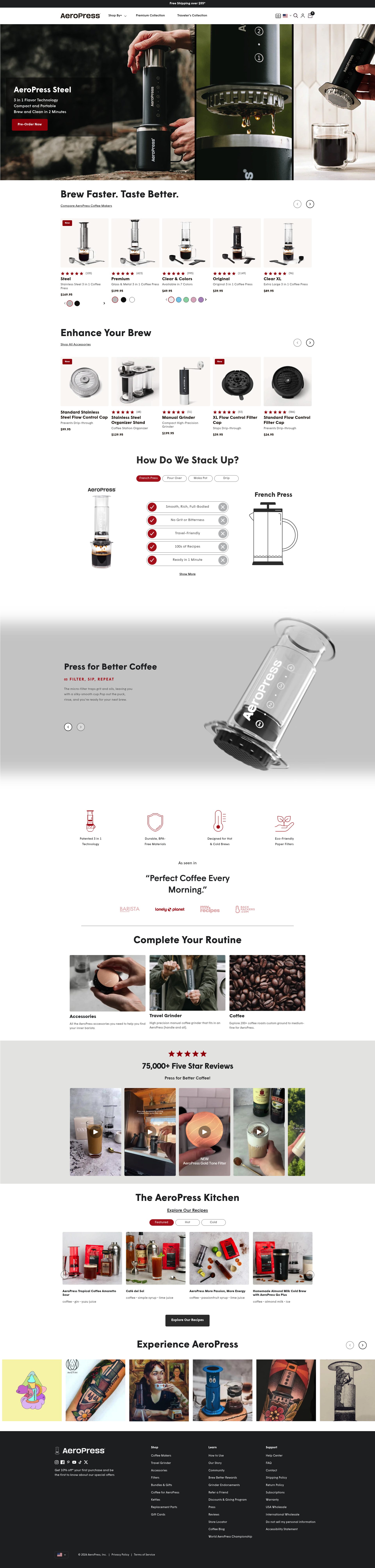
Aeropress sells a narrow range of manual coffee brewers, and their Shopify store is a case study in how to build a high-converting DTC operation around a product with genuine cult status. The site does not try to do too much: the catalogue is small, the navigation is clean, and every page is oriented around the brewing experience rather than the appliance itself. That focus keeps the store purposeful in a way that multi-range appliance stores rarely achieve.
Product pages lean heavily into the Aeropress community: world championship recipes, brewing guides from recognised baristas, and the customisation options available through the accessory range all reinforce that buying an Aeropress is buying into a craft, not just a piece of kit. The AeroPress Go (the travel version) is cross-sold contextually to buyers browsing the original, with a clear use-case distinction rather than a generic "you might also like" prompt. Their international reach is handled cleanly within Shopify's market framework, with currency and region detection that feels seamless rather than clunky. For a brand selling a £30-40 product, the content investment on this store punches well above what you would expect.
10. Zwilling
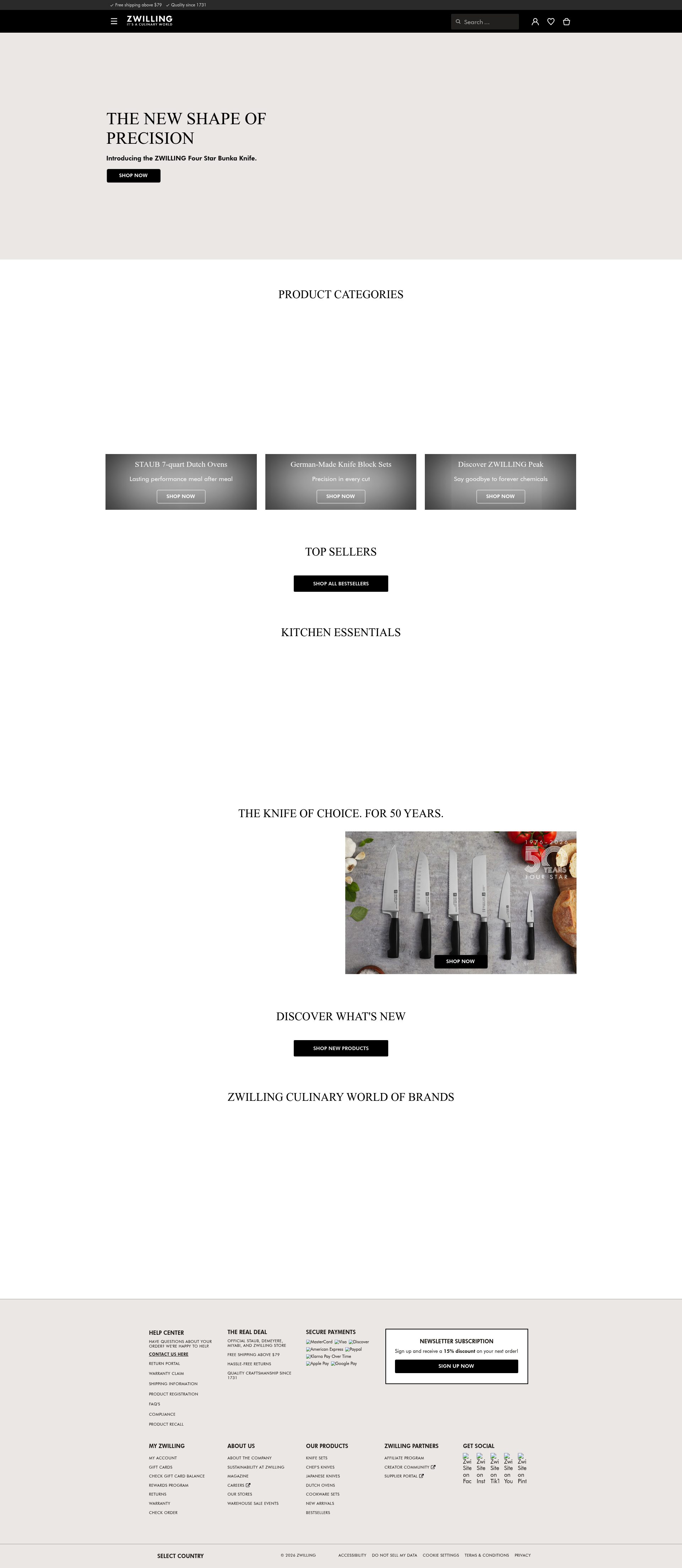
Zwilling is a heritage German brand whose Shopify Plus store covers knives, cookware, and small appliances including its ENFINIGY range of blenders, kettles, and toasters. The cross-category store architecture works because Zwilling has invested in making each category feel fully developed rather than bolting appliances onto a knife-focused navigation. The ENFINIGY appliance range has its own landing page that establishes the design language and specification credentials before leading buyers into individual product pages.
Product page photography on the appliance range follows the same editorial standard as the knife range: clean, precise, and detail-focused in a way that reflects the brand's engineering positioning. Zwilling's loyalty programme, TWIN Membership, is surfaced consistently across the store with a clear value proposition, and the points-per-pound earning rate is shown on PDPs next to the price to make the programme visible at the point of decision rather than only in account settings. Bundle mechanics in the small appliance range pair the ENFINIGY kettle and toaster as a set at a saving, which is a natural bundle for buyers fitting out a kitchen and reflects genuine purchasing behaviour in this segment.
| Brand | Niche Focus | Price Point | Shopify Standout |
|---|---|---|---|
| Sage Appliances | Espresso machines | Premium | Guided machine selector tied to the barista journey |
| Shark | Vacuums, hair, home appliances | Mid-range | Problem-first navigation with model shortlisting |
| Vitamix | Premium blenders | Premium | Certified reconditioned category and warranty-led positioning |
| Smeg UK | Design-led small appliances | Premium | Colour-first filtering and lifestyle PDP photography |
| Nespresso | Coffee machines and pods | Mid to premium | Integrated machine-and-pod architecture with subscription upsell |
| Nutribullet | Personal and full-size blenders | Mid-range | High-volume recipe content and compatibility-first accessories |
| KitchenAid | Stand mixers and attachments | Premium | Attachment platform model and colour visualiser |
| De'Longhi | Coffee machines, kitchen, home | Mid to premium | Category-new guided selectors and cross-brand recommendations |
| Aeropress | Manual coffee brewers | Entry to mid | Community-led content and tight, purposeful catalogue |
| Zwilling | Knives, cookware, appliances | Premium | Heritage positioning and loyalty programme integrated at PDP level |
What These Stores Get Right
- Education earns the sale. In small appliances, the buyer who feels confident about their decision is the buyer who converts. Every store on this list invests in guided selectors, comparison tables, or structured content that removes uncertainty before the buyer reaches the add-to-cart button.
- Bundle mechanics follow purchase logic. The best bundles here are not random product pairings: they reflect how buyers actually shop, matching a machine with the accessory that makes it more useful, or pairing two products a buyer is likely to want for the same occasion.
- Content and commerce are connected, not siloed. Recipe pages, brewing guides, and care instructions that link directly back to specific products compound organic traffic into conversion, and reduce post-purchase friction at the same time.
- Trust signals appear at the point of decision. Warranty terms, return policies, and financing options are surfaced on the PDP, not buried in the footer. The stores that convert at premium price points treat these as commercial arguments, not legal disclosures.
- The product page structure matches the category's consideration level. These brands understand that a buyer spending £300 on a coffee machine needs more from a product page than a buyer spending £30 on a travel mug. Depth, sequence, and clarity are calibrated to the purchase decision, not templated across the catalogue.
If your small appliance store is leaving conversion on the table, the gap is usually in product page depth, guided navigation, or the absence of content that bridges the research stage and the checkout. See our Shopify design service or get in touch to talk through what is possible for your store.
Frequently asked questions
Which small appliance brands use Shopify Plus?
Sage Appliances, Vitamix, Nespresso, De'Longhi, and Zwilling all run on Shopify Plus. These brands typically need Shopify Plus for its guided selector customisation, multi-region market management, and the ability to handle high-traffic product launches without performance degradation.
How do premium small appliance stores justify high price points on Shopify?
The best stores lead with trust signals rather than specs. Vitamix puts its ten-year warranty above the fold before any feature list. Sage structures PDPs around the brewing journey, not the machine. KitchenAid shows the mixer as a platform with decades of attachment compatibility. The common thread is earning confidence before asking for a large sum.
What is the best Shopify strategy for selling a wide appliance range with many similar models?
Guided selectors that filter by use case, not product code, are the highest-impact solution. Shark asks about floor type and pet ownership before surfacing vacuum models. De'Longhi separates bean-to-cup, capsule, and manual espresso with plain-language explanations. The goal is reducing the decision to three or four relevant options, not presenting the full catalogue.
How do small appliance stores increase average order value on Shopify?
The most effective mechanic is compatibility-led cross-selling rather than generic recommendations. KitchenAid maps attachments on every stand mixer PDP. Nutribullet shows which cup sizes and blade assemblies fit each specific machine. Zwilling bundles the ENFINIGY kettle and toaster as a natural kitchen set. Bundles work when they reflect how buyers actually purchase, not just what is in stock.
How important is recipe and lifestyle content for small appliance ecommerce?
Extremely important for blender and coffee brands specifically. Vitamix drives significant organic traffic through recipe and nutrition guides that link back to specific models, creating a compounding loop from informational search to product page. Nutribullet's recipe content is high-volume and well-indexed. For espresso brands, brewing technique content serves the same function. The key is linking content pages directly to the relevant PDP rather than to a generic category page.