

Quick summary
Huel sets the benchmark for subscription-first nutrition DTC, with a product architecture that filters by need-state and integrates subscribe-and-save at the point of product selection rather than as a checkout afterthought. Daily Harvest builds one of the most retention-focused smoothie models online, forcing subscription sign-up and offsetting that commitment gate with a flexible build-your-box mechanic. Nuzest earns trust through clinical-depth PDPs with study references and third-party certifications, which is the right approach for a premium protein buyer who has already been burned by over-claiming brands. BlendJet is the standout hardware-plus-consumable play, using colour and accessory bundles to lift AOV on a low-margin blender and creating a subscription layer on top via ingredient refills.
Smoothies sit at a productive crossroads for ecommerce: high repeat purchase frequency, strong subscription logic, and a health-positioning that supports premium pricing. The brands that do well online have figured out how to handle the subscription model properly, communicate nutritional credentials without turning product pages into a wall of text, and use bundle mechanics to lift average order value past the point where the unit economics work. Here are ten stores worth studying.
1. Pip & Nut

Pip & Nut's Shopify store leads with clarity: each nut butter and smoothie-adjacent product has a single dominant benefit claim at the top of the PDP, followed by a concise ingredients panel and a macro breakdown. That sequence matches how a health-conscious buyer actually reads a product page, and it reduces the time between landing and add-to-cart. The navigation is flat and category-led, with "Smooth" and "Crunchy" used as primary filters rather than a generic product grid, which is a small but correct decision for a brand whose repeat customers have strong format preferences.
Their bundle builder is structured around occasion and use case rather than just discount: "post-workout", "kids' snacks", "office stash" — each with a curated product set. That framing does two things. It increases basket size by anchoring the buyer to a context rather than a single product, and it opens a second conversion route for corporate and gifting buyers without a separate page structure.
2. MOMA Foods
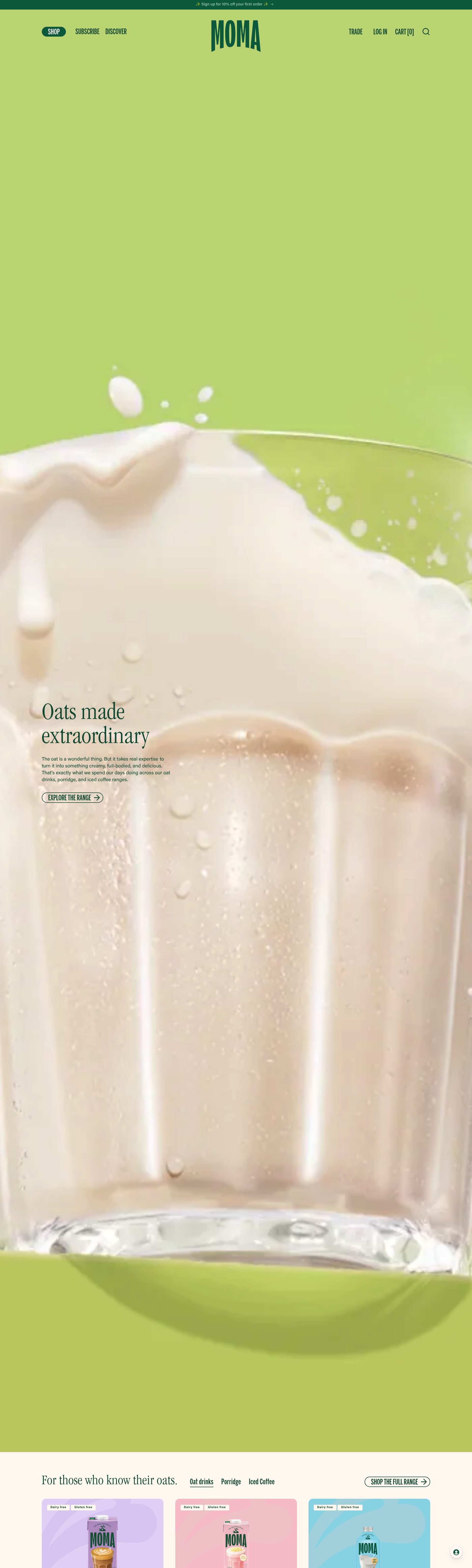
MOMA Foods trades on convenience and routine, and their Shopify store reflects that positioning throughout. The subscription mechanic is front-loaded: the homepage hero pushes a subscribe-and-save offer before any one-off product is surfaced. That is the right conversion priority for a brand whose customer lifetime value depends on regularity rather than single-occasion purchases.
Their product pages use a tabbed layout that separates "What's in it" from "Why it works" from "How to use it", which keeps the page short on first load while preserving depth for buyers who want the full nutritional argument. The brand also uses a quiz-style recommendation flow for new visitors, asking about dietary preferences and goals before presenting a curated product selection. That reduces choice paralysis for buyers unfamiliar with the range, and increases the likelihood that a first order matches the customer's actual routine.
3. Innocent Drinks
Innocent runs a DTC arm through Shopify alongside their retail presence, and the store is a useful case study in how a major FMCG brand handles direct sales without cannibalising the supermarket channel. Their online offer is deliberately different from what you find on a shelf: multipack formats, limited-edition bundles, and seasonal collections that are not available in retail. That product differentiation gives the DTC channel a genuine reason to exist rather than simply competing on convenience.
The product pages lean hard into the brand voice: short, playful copy with specific ingredient callouts rather than generic health claims. The smoothie range PDPs surface origin information for each fruit, which is a credibility signal that a retailer's shelf space does not permit. Their gifting and corporate pathway is handled cleanly with a separate landing page rather than a category filter, which means paid traffic for "corporate drinks gifts" lands in the right context.
4. Nuzest
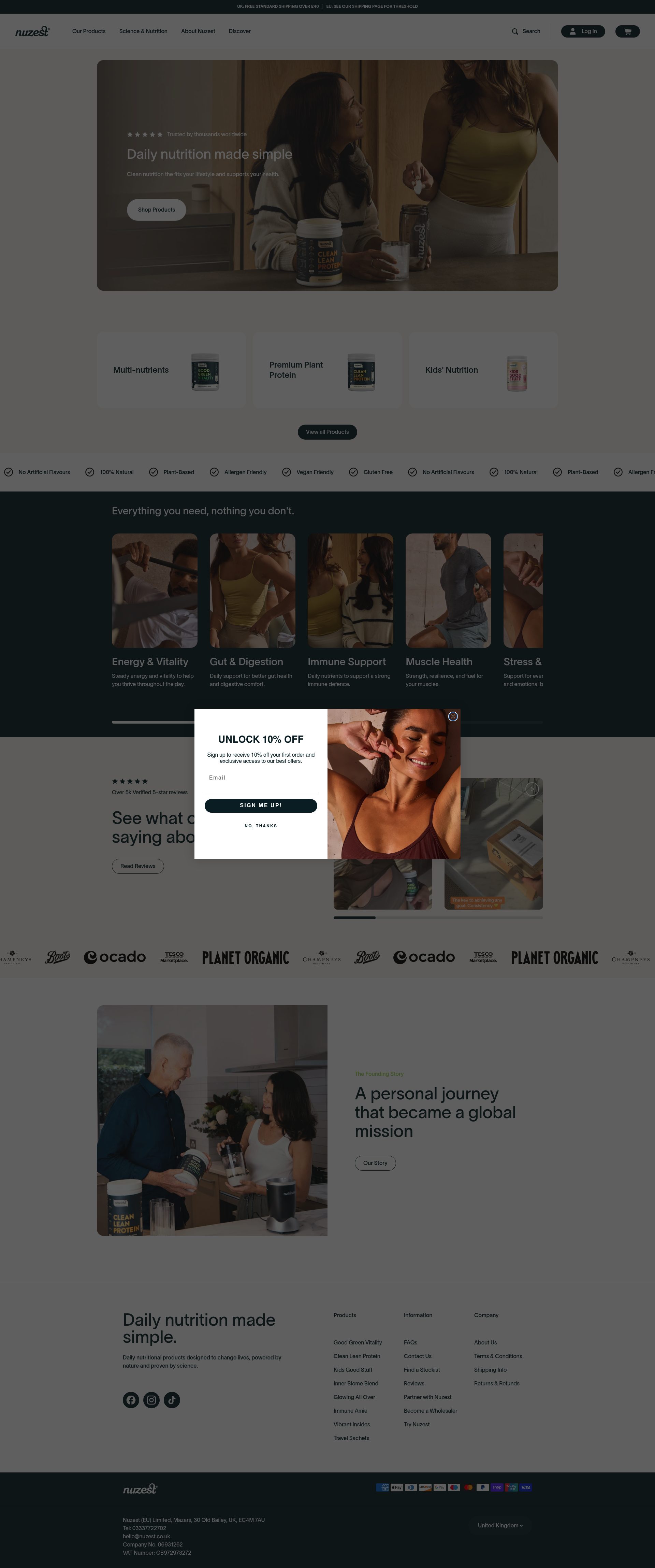
Nuzest's Shopify Plus store is built around the subscription-first model at every level of the architecture. The pricing display defaults to subscription pricing rather than one-off cost, which anchors the perceived value of the product at the lower recurring price. That is a deliberate conversion decision: customers who see the subscribe price first convert to subscription at a higher rate than those shown the one-off price with subscription as an upsell.
Their product pages are long-form and evidence-led, with clinical study references, ingredient sourcing information, and third-party certifications surfaced in a structured layout rather than a footnote. For a premium protein and nutrition brand, that depth is correct: the buyer in this category is sceptical, has usually tried multiple products, and needs a specific reason to switch. Nuzest's store provides that reason at the product page level rather than expecting the brand's social proof to do the work.
5. Huel
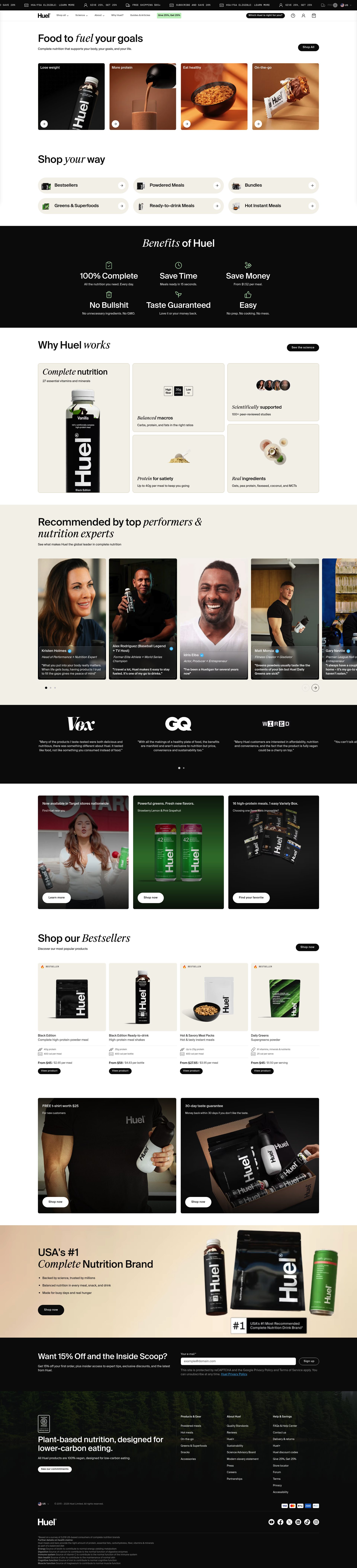
Huel's Shopify store handles the challenge of a complex product range, where products serve different use cases across meal replacement, post-workout nutrition, and convenience, without overwhelming the first-time buyer. Their navigation uses need-state as the primary filter: "Ready to drink", "Powder", "Bars", "Hot & Savoury" — each representing a distinct consumption occasion. That structure means a buyer who wants a ready-made smoothie alternative and a buyer looking for a training supplement arrive at different starting points and face a range curated to their intent.
The subscribe-and-save logic is integrated directly into the product selector rather than surfaced as a post-cart upsell. A customer choosing quantity and flavour sees the subscription price alongside the one-off price at the same decision point, which increases subscription attachment rate at the moment of highest intent. Their starter bundle pages are worth noting specifically: they are structured as a risk-reduction tool, acknowledging that a new customer does not know which flavour they will prefer and pricing the bundle accordingly.
6. Graze
Graze's move to Shopify for their DTC smoothie and snack subscription operation is a good example of a subscription-first business using the platform's native mechanics as a foundation and layering brand experience on top. Their store is structured entirely around the subscription model: there is no meaningful one-off purchase option, which eliminates conversion confusion and means every visitor is being evaluated against a single conversion goal.
The onboarding flow for new subscribers uses a preference quiz that takes under two minutes to complete and results in a personalised box recommendation. That investment in the pre-purchase experience reduces first-box disappointment, which is the primary driver of early subscription churn in the snack and smoothie category. Their product photography uses lifestyle context consistently, showing products in a home kitchen environment rather than a studio white background, which supports the "healthy everyday routine" positioning the brand is built around.
7. Radnor Hills
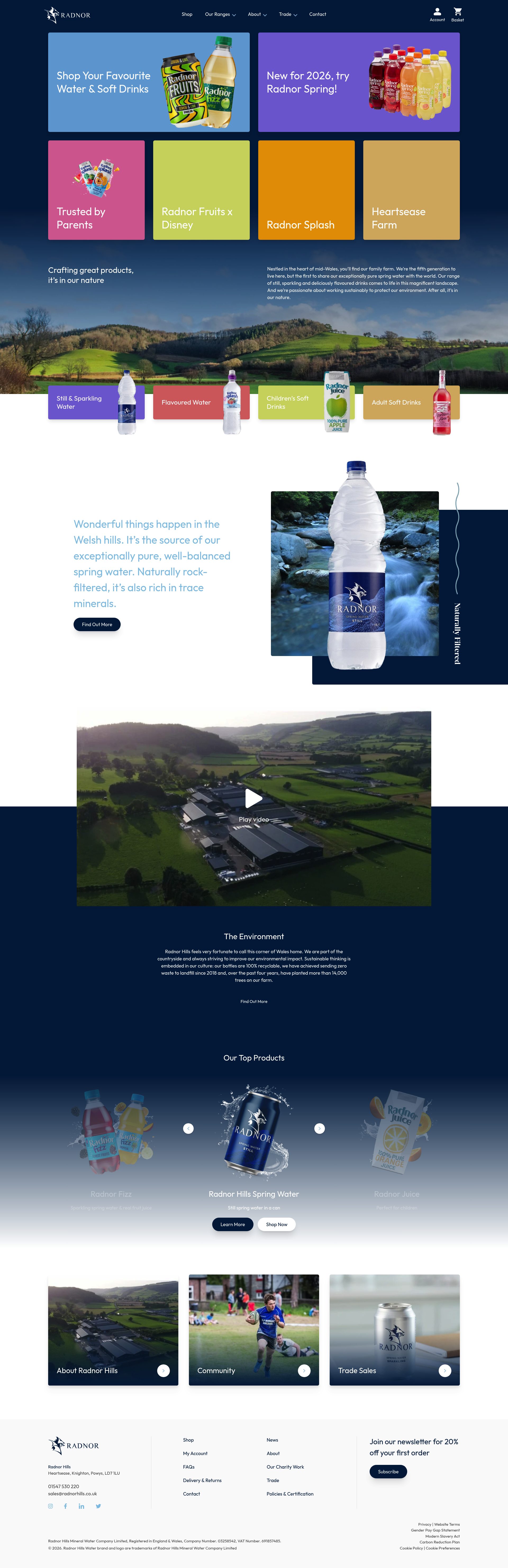
Radnor Hills is a Welsh drinks brand whose Shopify store is one of the cleaner examples of a predominantly B2B supplier building a credible DTC operation. Their smoothie and juices range is presented alongside their wider portfolio, and the store makes a clear structural decision: case-format buying at transparent per-unit pricing rather than trying to compete on single-serve convenience. That pricing architecture means the store attracts buyers who already know the brand from hospitality or retail and want to buy direct, rather than competing for the impulsive single-bottle shopper.
The product pages are efficient: origin information for the Welsh spring water base, ingredient sourcing, and nutritional data are all accessible without dominating the page. The store's corporate and wholesale enquiry pathway is given prominent placement in the navigation, which reflects the reality that their highest-value conversions are volume orders rather than household subscriptions. That is a correct prioritisation that many DTC-first brands would reverse incorrectly.
8. The Smoothie Bombs
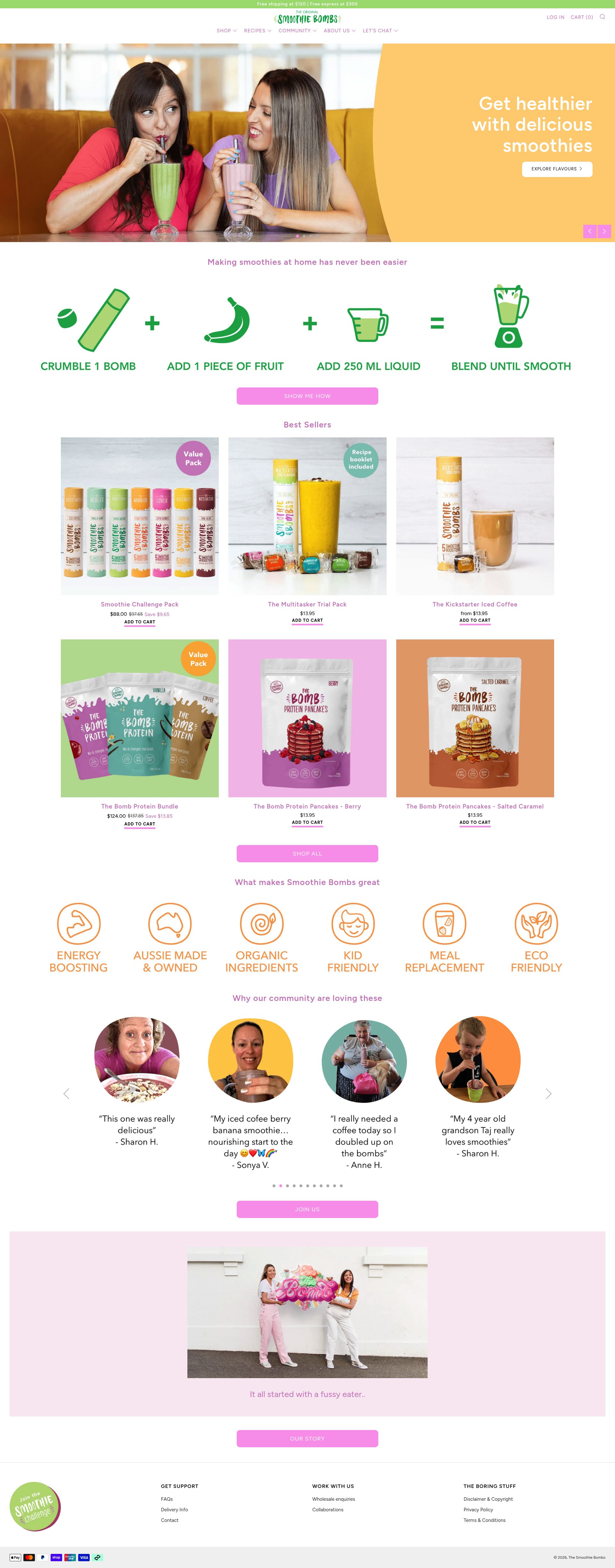
The Smoothie Bombs is an Australian brand selling concentrated smoothie add-ins through a Shopify store that handles international shipping and subscription mechanics well. Their product format — a pre-portioned frozen ball of whole fruits and superfoods — is unusual enough that the PDPs invest heavily in education before the conversion ask. The first scroll on each product page answers "what is this" and "how does it work" before any pricing or cart interaction is surfaced. That is the correct sequence for a product category that has no established mental model in most buyers' minds.
Their bundle structure is designed around a trial logic: the entry-level pack is sized to establish a routine (30 servings) rather than a one-off test (five servings), which changes the customer's framing of the purchase from an experiment to the start of a habit. The subscription option on the bundle page quantifies the daily cost at a sub-threshold price point, which removes the perceived financial commitment of signing up for a regular delivery.
9. Daily Harvest
Daily Harvest's Shopify Plus store is one of the more analytically interesting smoothie DTC operations globally. Their store is structured entirely around the subscription model: you cannot buy individual items without a subscription, which is a high-commitment conversion gate that works because their acquisition strategy pre-qualifies buyers through social proof and influencer channels before they reach the store.
The product catalogue page uses a filtering system that allows buyers to filter by dietary preference, preparation method, and product type simultaneously. For a range of over 100 SKUs, that filtering is a conversion necessity rather than a nice-to-have: without it, the catalogue becomes unnavigable and buyers default to the first product they recognise rather than the product that best fits their routine. Their "Build Your Box" mechanic, where subscribers select their own product mix per delivery, increases subscription retention by giving customers ongoing agency over their order rather than locking them into a fixed product set.
10. BlendJet
BlendJet sells a portable blender that has built a significant smoothie-adjacent community, and their Shopify store is one of the stronger examples of a hardware-plus-consumable business model executed through a single storefront. The core product page for the blender is structured around the use case rather than the spec: "make smoothies anywhere" rather than a technical breakdown of motor wattage. That framing is correct for a product whose primary conversion driver is the lifestyle aspiration rather than the technical comparison.
Their colour and bundle selector is a well-executed upsell tool: customers choosing a blender colour are shown compatible accessory bundles and ingredient starter packs at the same decision point. That cross-sell logic lifts average order value on a relatively low-margin hardware item by attaching higher-margin consumables to the initial purchase. Their subscription offering for replacement parts and ingredient packs creates a recurring revenue layer on top of a hardware sale, which is a commercially sensible extension of the product model.
If you run a smoothie, nutrition, or health drink brand and want to build a Shopify store that handles subscriptions, bundle mechanics, and high-repeat-purchase categories properly, SuttonCommerce can help: see our Shopify design service or get in touch.
Frequently asked questions
Which smoothie Shopify stores use a subscription-first model?
Huel, Daily Harvest, Graze, and Nuzest all lead with subscription pricing rather than one-off purchase. Daily Harvest takes it furthest — you cannot buy individual items without a subscription, which is a high-commitment gate that works because their influencer-led acquisition pre-qualifies buyers before they arrive at the store.
How do the best smoothie brands handle large product ranges without overwhelming buyers?
Huel filters by consumption occasion rather than product type, so buyers land on a curated view rather than a full catalogue. Daily Harvest uses simultaneous filtering by dietary preference, preparation method, and product type across 100+ SKUs. Both approaches reduce decision fatigue and push buyers toward the product that actually fits their routine.
What bundle strategies do top smoothie Shopify stores use to increase AOV?
Pip & Nut frames bundles around occasion and use case — post-workout, kids' snacks, office stash — rather than leading with a percentage discount. The Smoothie Bombs sizes their entry bundle at 30 servings specifically to anchor the buyer toward habit rather than a one-off trial. BlendJet cross-sells accessory and ingredient bundles at the colour selection step of the blender product page.
How do smoothie brands build trust on their product pages?
Nuzest surfaces clinical study references, ingredient sourcing details, and third-party certifications in a structured layout rather than as footnotes. Innocent Drinks leads with fruit origin information that supermarket shelf space does not permit. Radnor Hills includes Welsh spring water sourcing and nutritional data without letting it dominate the page. The common pattern is specific, verifiable claims rather than generic health positioning.
Can you sell smoothies and health drinks successfully on Shopify without Shopify Plus?
Yes, though the subscription and bundle mechanics that drive LTV in this category are easier to build on Shopify Plus. Brands like Radnor Hills and Pip & Nut run credible DTC operations on standard Shopify using third-party subscription apps. The platform decision matters less than getting the product page sequence — benefit claim, ingredients, macros, conversion — in the right order.