

Quick summary
Palace Skateboards sets the benchmark for drop model discipline: a deliberately sparse store that creates demand before anything goes on sale. Corteiz takes it further with a password-gated, sometimes invisible storefront that makes access itself feel like a product. Represent is the strongest pick for PDPs that actually convert, with fabric weights, garment measurements, and model fit notes written by the brand. END Clothing handles a luxury multi-brand catalogue at scale without losing editorial quality, with per-brand landing pages and sneaker release countdowns that manage drop-day demand cleanly.
Streetwear ecommerce operates by different rules to most fashion categories. Scarcity is the product. Community is the distribution channel. And the store's job is often to handle enormous demand spikes without breaking, while making the brand world feel real to a customer who chose it over dozens of alternatives. Here are ten stores that understand that brief.
1. Palace Skateboards
Palace's drop model is one of the most studied in streetwear retail. Their store is deliberately sparse between drops, which creates anticipation and trains customers to return on drop day. The drop pages themselves are clean and fast: no editorial fluff, just product, price, and add to cart. That restraint is a conversion decision as much as a brand one. Their collaboration pages (Gucci, Ralph Lauren, Evian) are handled with the same stripped-back confidence.
2. Represent
Represent's PDPs are built around the things that matter to their customer: fabric weight, wash treatment, and garment measurements. Each piece is photographed on the garment flat as well as on a model, with specific fit notes written by the brand rather than generated from a template. Their Owners Club loyalty programme is integrated throughout the store, with visible tier benefits that give customers a clear reason to register and return.
3. Corteiz (CRTZ)
Corteiz has built one of the most unconventional Shopify stores in UK fashion: password-gated drops, no persistent shop, and a homepage that often shows nothing except the brand logo until a drop goes live. That friction is entirely intentional. It filters the audience, builds demand, and makes getting access feel like an achievement. The UX would fail for almost any other brand, but for Corteiz it is the product itself.
4. Maharishi
Maharishi's store reflects the brand's distinct cultural position: military-inspired silhouettes, Japanese textile references, and a design language that sits apart from mainstream streetwear. Their product descriptions are detailed and educational, explaining the cultural and historical references behind prints and fabrics. That depth rewards an engaged customer and supports the premium price point for outerwear and cargo trousers that can run to several hundred pounds.
5. Aries Arise
Aries Arise leans into its art-world credentials throughout the store: campaign photography shot on film, oblique product descriptions that match the brand's outsider aesthetic, and a navigation structure that treats collections as exhibitions rather than product categories. The editorial-first approach could frustrate conversion if the product pages were not so clear, but Aries balances both sides well, keeping the brand world intact without sacrificing product legibility.
6. END Clothing
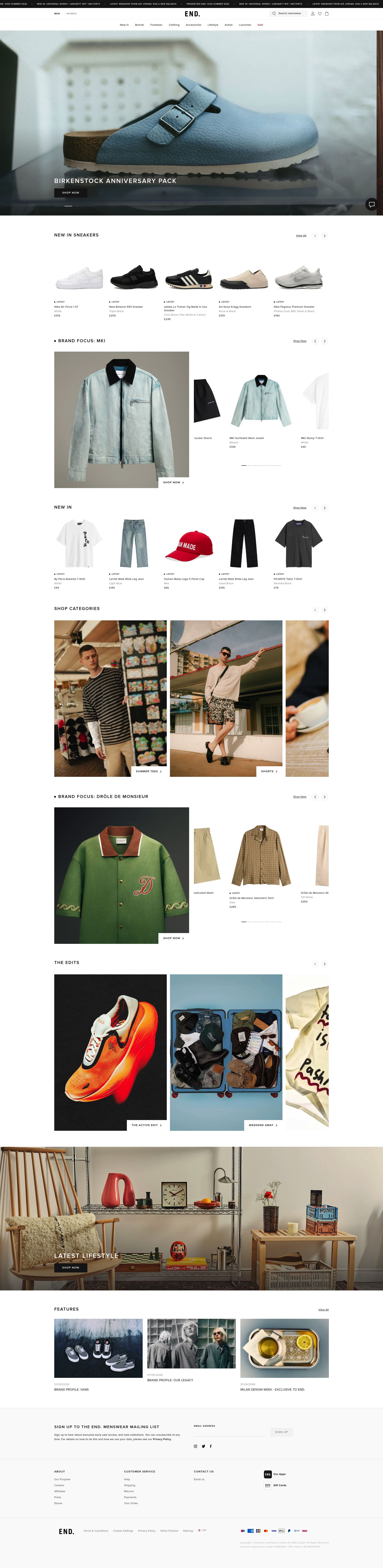
END handles a luxury streetwear multi-brand catalogue at scale and their store architecture reflects that complexity well. Strong brand landing pages give each partner (Stone Island, Moncler, Carhartt WIP) their own editorial space rather than dumping products into a shared grid. Their sneaker release pages include a heat indicator and launch countdown, which manages customer expectations clearly and reduces support queries on drop day. Filtering by brand, price, and category works reliably across a deep product set.
7. Lazy Oaf
Lazy Oaf's store is one of the most visually distinctive in UK fashion retail: bold colours, irreverent copy, and photography that puts the personality of the brand ahead of conventional product presentation. Their collection pages use a non-standard grid layout with mixed image sizes, which makes browsing feel more like scrolling a zine than shopping a catalogue. That experience matches exactly what their cult customer is looking for.
8. Hanon
Hanon is an Aberdeen-based premium streetwear and sneaker shop with a reputation that extends well beyond Scotland. The DTC store handles exclusive and limited releases with a clean, editorial approach: each drop gets a dedicated page with context on the collaboration, colourway story, and release format. The content surrounding each release elevates the product from a listing to an event, which is exactly what a customer investing £200 in a sneaker wants to see before they enter the queue.
9. Percival
Percival sits comfortably at the menswear-streetwear crossover and their store navigates that dual positioning well. Graphic tees and washed essentials are merchandised alongside tailored shirts within the same collection structure, with clear styling content showing how pieces work together. Their "Makers" series, featuring the craftspeople behind the product, adds provenance credibility to pieces that could otherwise be dismissed as premium basics.
10. Trapstar London
Trapstar's store carries the weight of the brand's deep roots in UK music and grime culture. Their homepage uses full-screen video and campaign imagery that communicates that cultural position immediately. Drop announcements are treated as events, with dedicated landing pages that build context around each release. The connection between the brand and artists like Rihanna and Jay-Z is referenced through press imagery in brand content pages, which adds aspiration without feeling like celebrity endorsement gone wrong.
Frequently asked questions
Which Shopify stores dominate UK streetwear in 2026?
Palace Skateboards, Corteiz, and Represent are the three most-studied UK streetwear stores right now. Palace perfected the drop model, Corteiz made access itself the product with password-gated drops, and Represent leads on product page quality with brand-written fit notes and fabric data that actually help customers decide.
How do streetwear brands handle high-demand drops on Shopify?
The best stores separate drop pages from the main catalogue and build anticipation before anything goes live. Palace runs a sparse storefront between drops so customers are trained to return on specific days. END Clothing uses a heat indicator and countdown timer on sneaker releases to set expectations and reduce support load on drop day.
Do streetwear brands use Shopify Plus?
Most of the larger names on this list run Shopify Plus for the higher API rate limits, checkout extensibility, and dedicated infrastructure during traffic spikes. Corteiz is the outlier: their unconventional, often deliberately restricted storefront works precisely because they control access at the application level, not through platform defaults.
What makes streetwear product pages different from standard fashion PDPs?
The best streetwear PDPs build cultural context alongside product information. Hanon writes a colourway story and collaboration background for every limited release. Maharishi explains the military or Japanese textile reference behind each print. That editorial depth justifies premium price points and reduces the need for discounting because the customer understands what they are paying for.
How important is brand world to streetwear conversion rates?
In streetwear, brand world is often more important than price or even product quality. Lazy Oaf and Aries Arise both use photography, copy tone, and navigation structure that communicates identity before a customer reads a single product description. Customers self-select into these brands because they feel like insiders, which drives higher AOV and lower return rates than brands competing on features alone.
Related reading
- Best menswear Shopify stores
- Best luxury fashion Shopify stores
- Best vintage clothing Shopify stores
- Shopify for fashion brands: full guide
If your store is not converting at the level these brands achieve, the gap is usually design and UX. See our Shopify design service or get in touch to talk through what is possible.