
Quick summary
Press London is the strongest all-round juice Shopify store, with cleanse programme pages built for both SEO and conversion and a subscription UX that openly handles the cancel objection. Coldpress stands out for evidence-led positioning built around HPP technology and goal-mapped weekly boxes. Pressed Juicery shows how to run DTC alongside a retail network without cannibalising either, using dedicated programme landing pages that dominate intent-specific search queries. Hana Beverages is the best example in the category for integrating educational content directly into the product page scroll, reducing the research-to-purchase journey to a single session.
Juice is a deceptively competitive Shopify niche. The product is perishable or shelf-stable depending on the format, the health-positioning varies enormously across brands, and customers buying cold-pressed or functional juice need a strong reason to pay a significant premium over supermarket alternatives. The stores that perform in this category have built clear product architecture around health benefits rather than flavour alone, mastered subscription mechanics for recurring revenue, and used photography and copy to make abstract wellness claims feel concrete. Here are ten that do it well.
1. Pip & Nut

Pip & Nut's Shopify store is a strong example of a nut butter brand that has successfully extended its DTC proposition into the adjacent juice and smoothie space. The product range is presented through a benefit-led navigation structure: energy, recovery, everyday, which means customers arriving with a specific goal can self-select rather than browse a generic product grid. That structure also reduces decision fatigue on a category where too many flavour options typically suppress conversion.
The bundle builder on their Shopify store is worth noting. Customers can create mixed cases, which increases average order value and gives the brand a useful signal about which flavour combinations have the strongest demand. The subscription option is presented as a default rather than an upsell, with the saving quantified at the product level rather than only at checkout, which is the correct placement for recurring purchase conversion.
Their loyalty mechanics are woven into the product page rather than relegated to a dedicated programme page, meaning first-time buyers see the long-term value proposition before they decide whether to buy at all. The brand's Instagram-native visual identity translates well to the Shopify storefront, maintaining consistency across acquisition channels.
2. Press London
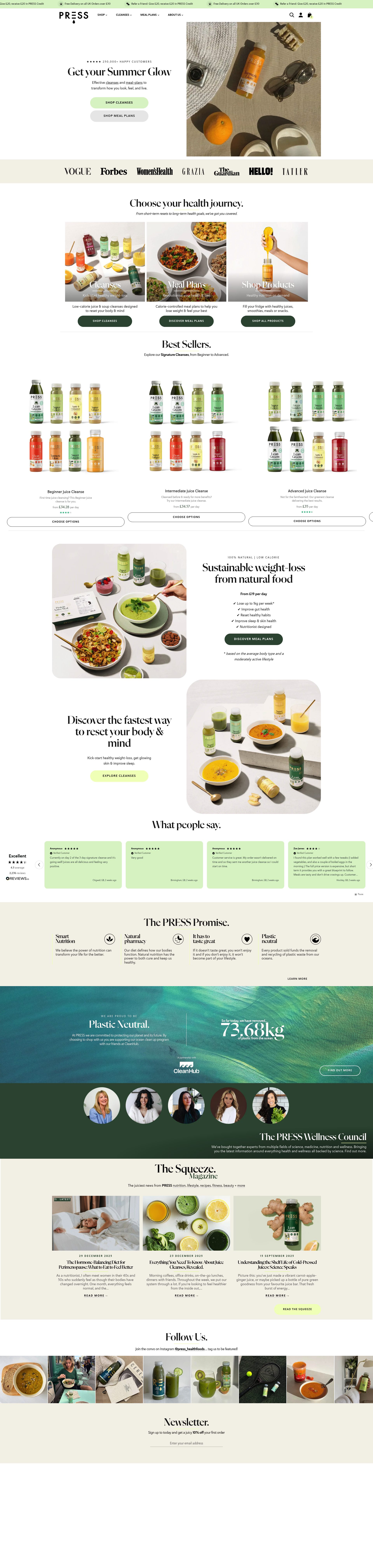
Press London's store is built around a clear ecommerce thesis: cold-pressed juice is a considered purchase, and the store should do the justification work so the checkout decision is easy. Every product page opens with the benefit stack before the ingredient list, a deliberate inversion of the typical food product page structure. Their "plans" section, which packages juices into day-by-day cleanse programmes, is the most commercially astute part of the store: it anchors the price across multiple units, increases perceived value, and creates a natural urgency mechanic around start dates.
The photography is consistently high quality and uses natural props alongside the bottles to communicate the premium positioning. Press London also handles subscription upsells well: the recurring delivery option appears with a specific saving percentage and a plain-language explanation of how to manage or cancel, addressing the two objections that kill subscription sign-ups in the food and beverage category.
Their corporate gifting pathway is a secondary revenue stream that is developed properly rather than treated as an afterthought. The B2B enquiry form captures company size and budget alongside contact details, which improves lead qualification and reduces back-and-forth before a quote is issued.
3. Coldpress
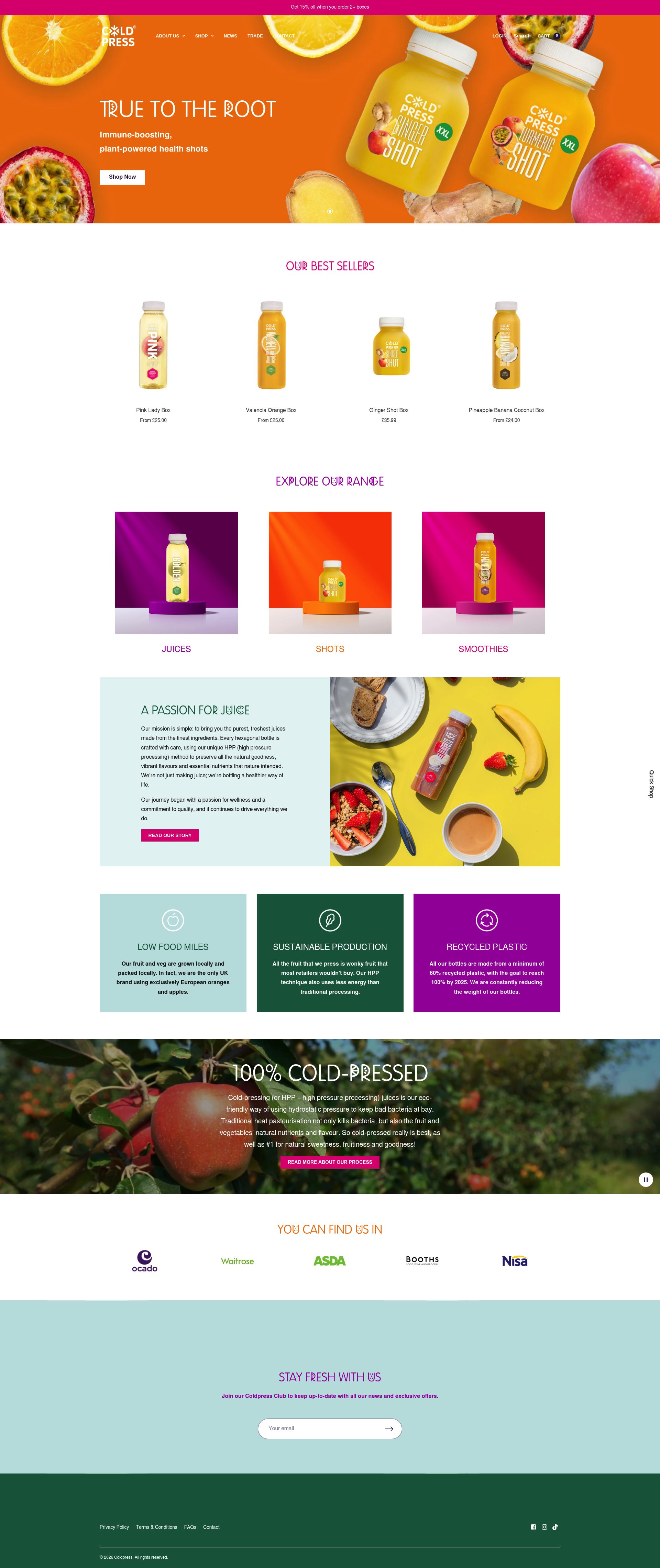
Coldpress is a UK brand whose Shopify store takes a deliberately functional approach to product presentation. Where many juice brands lead with lifestyle imagery, Coldpress leads with certifications and process detail: HPP (High Pressure Processing) technology, cold chain logistics, and nutritional data. That positioning appeals to a more sceptical, health-literate buyer who wants evidence rather than aspiration.
The subscription architecture is well-structured with four distinct weekly boxes, each mapped to a different health goal. This is a smart way to reduce the cognitive load of customisation while still allowing meaningful personalisation. The box contents are displayed as a visual grid rather than a text list, which makes the perceived value of each subscription tier immediately legible.
Coldpress also handles their retail stockist network with a store locator that is integrated into the Shopify store rather than hosted on a separate page. That integration keeps retail traffic within the DTC conversion funnel rather than letting it exit to a third-party listing.
4. Juice Warrior
Juice Warrior operates at the premium end of the cold-pressed market, and their Shopify store prices and presents accordingly. The average order value mechanics are built around bundles and multipacks displayed prominently on the homepage, which surfaces the best-value purchase format before a customer can default to a single-bottle selection. For a product where the unit economics only work at volume, this is the correct merchandising decision.
Their product descriptions are unusually detailed, naming the nutritional content per serving alongside flavour notes and sourcing information. That level of detail serves two purposes: it addresses the sceptical buyer who needs evidence for the price point, and it improves organic search visibility for ingredient and benefit-specific queries that convert well in the health food category.
The store's upsell mechanics at cart are worth studying. A free shipping threshold is displayed dynamically in the cart drawer, with suggested products shown beneath it that are specifically priced to clear the threshold. This is a standard mechanic but Juice Warrior executes it without the product suggestions feeling random or out of context.
5. Mango Bay Organics
Mango Bay Organics built their Shopify store around certification and provenance, which is the right anchor for an organic juice brand competing on integrity rather than price. Every product page links to the relevant certifications, the Fairtrade mark is visible without being the only thing on the page, and the supplier relationships are described with enough specificity to function as genuine proof rather than vague "ethically sourced" copy.
The store's subscription model is priced to reflect the certification premium clearly: subscribers are shown the comparison between their price and the equivalent one-off purchase across a quarterly window, making the saving feel substantial even at a higher base price than conventional juice. Their repeat purchase rate, referenced in their brand copy, is used as a social proof signal in a way that feels credible rather than promotional.
The gift-buying flow is handled separately from the main subscription journey, with its own landing page and a different visual treatment that communicates occasion context. A customer buying a juice subscription as a birthday present has a different set of questions from a customer buying for themselves, and the store architecture reflects that.
6. Raw Pressery
Raw Pressery is an Indian DTC brand on Shopify Plus whose store is worth studying for its category and regional expansion strategy. Their product architecture separates functional juice (immunity, energy, detox) from everyday drinking juice, which allows the store to serve both health-motivated buyers and general beverage buyers without diluting either positioning.
The store handles the D2C-to-retail channel conflict better than most: their Shopify store consistently promotes bundles and subscription formats that are not available in retail, which gives direct buyers a concrete reason to purchase online rather than picking up a bottle at a supermarket. That differentiation is the core strategic challenge for any beverage brand selling DTC, and Raw Pressery addresses it at the product level rather than just the marketing level.
Their mobile experience is optimised for a customer base that primarily shops on phone, with large tap targets, a sticky add-to-cart bar, and a checkout that completes in two steps. For a brand that acquires heavily through Instagram and WhatsApp, that mobile-first store design is a direct conversion decision.
7. Pressed Juicery
Pressed Juicery is a US Shopify Plus brand with a physical retail network that uses its Shopify store to capture the DTC segment without cannibalising in-store traffic. The store's cleanse programme pages are among the most developed in the category: each programme has a dedicated landing page with a day-by-day schedule, customer testimonials specific to that programme duration, and a comparison table showing which programme suits which health goal.
That level of page development serves a SEO function as well as a conversion function. Queries like "3-day juice cleanse" or "5-day detox programme" map directly onto specific landing pages rather than landing on a generic product grid, which means paid and organic traffic arrives with a higher purchase intent match.
The Pressed Juicery store also handles subscription pausing and management better than most food brands. Rather than a buried account settings page, the subscription management interface is surfaced in the main navigation for logged-in users, with pause and skip options visible without scrolling. That UX decision reduces the churn that comes from subscribers who cannot find the right button quickly.
8. Hana Beverages
Hana Beverages positions their adaptogen-infused juice drinks at the intersection of functional beverage and everyday refreshment, and their Shopify store reflects that dual positioning deliberately. The product pages lead with the adaptogens and their specific functions, using ingredient callouts that are named precisely (ashwagandha for stress, lion's mane for focus) rather than grouped into vague "wellness blend" language. That specificity supports conversion for a buyer who already understands adaptogens, and introduces the concepts clearly to a buyer who does not.
The store's educational content is integrated directly into the product flow rather than separated into a blog. Ingredient explainer cards appear within the product page scroll, which means customers encounter the educational material at the moment of purchase consideration rather than in a separate research journey. This reduces the number of sessions a customer needs before converting.
The bundle configuration tool allows customers to mix single cans across flavour variants within a fixed price tier, which addresses the commitment anxiety that prevents first-time buyers from selecting a single flavour in quantity.
9. Roots Pressed
Roots Pressed is a smaller independent brand whose Shopify store demonstrates the right approach for a local cold-press operation building a national DTC presence. The store leads with delivery area transparency: a postcode checker appears on the homepage, which immediately resolves the question that prevents a significant percentage of cold-pressed juice visitors from converting (whether the product can actually reach them in good condition).
Their product photography is consistent and warm without being over-produced, which suits a brand positioning around authenticity and craft rather than clinical wellness. The batch numbers and pressed dates visible on product pages are a trust signal that is specific to the cold-pressed category and works harder than generic quality copy.
The store also handles the repeat purchase cycle well for a smaller operation. Their "build a box" feature allows customers to create a custom weekly delivery without committing to a subscription at the first visit. That lower-commitment entry point converts better than a mandatory subscription, and the data from box configurations informs their production planning directly.
10. Evolution Fresh
Evolution Fresh is the Starbucks-backed cold-pressed juice brand whose Shopify store manages the tension between a mass-market parent company and a premium DTC positioning. The store's product architecture is clean and focused, presenting the range through benefit-led collections rather than a full catalogue view, which keeps the premium framing intact despite a broader product range than most independent juice brands.
Their Shopify store uses dynamic pricing to surface the subscription saving as a persistent element throughout the purchase journey, not just at the product level. The cart, the checkout header, and the post-purchase email sequence all reference the subscription value, which is a deliberate retention architecture rather than a single conversion point.
The store's nutritional transparency is executed at a level that supports the premium price point specifically: every product page includes a full nutritional breakdown, a press archive verifying third-party validation, and a cold-chain explainer that describes how the product arrives in optimal condition. For a brand competing against cheaper alternatives in a sceptical market, that information density is a commercial decision, not just compliance.
If you run a juice or beverage brand and want a Shopify store that converts browsers into subscribers, SuttonCommerce builds stores designed around your retention economics: see our Shopify design service or get in touch.
Frequently asked questions
Can you sell cold-pressed juice on Shopify?
Yes. Cold-pressed juice brands use Shopify for DTC sales alongside subscription apps like Recharge or Smartrr to manage recurring deliveries. The key technical consideration is handling perishable fulfilment logistics at checkout, including delivery date selection and cold-chain communication, which third-party apps handle via Shopify's native checkout extensibility.
What subscription apps do juice brands use on Shopify?
The most common choices are Recharge, Smartrr, and Skio. Recharge dominates at scale and integrates well with Shopify Plus, while Skio is increasingly favoured for its subscriber management UX, which makes pausing and skipping easy without requiring a cancellation. Reducing cancellation friction is one of the highest-impact decisions in a juice subscription business.
How do juice Shopify stores handle the premium price justification?
The best stores justify price through information density rather than lifestyle imagery alone. That means nutritional breakdowns at the product level, named certifications (Fairtrade, organic, HPP process detail), sourcing specifics, and third-party press validation. Coldpress and Mango Bay Organics are the clearest examples of this approach in the UK market.
How do juice brands differentiate their Shopify DTC store from retail?
The most effective approach is to offer bundle formats, subscription tiers, and cleanse programmes that are not available in supermarkets or retail stockists. This gives DTC buyers a concrete reason to purchase online rather than picking up a bottle in-store. Raw Pressery and Pressed Juicery both use this strategy explicitly, reserving their highest-value formats for direct channels only.
What makes a juice store convert better on mobile?
Large tap targets, a sticky add-to-cart bar, and a checkout that completes in two steps are the core requirements. Beyond that, the most conversion-impactful element specific to juice is a delivery area or postcode checker surfaced early, before a customer invests time in the product. Roots Pressed puts this on the homepage, which eliminates the primary abandonment reason for cold-pressed buyers outside a brand's delivery zone.