

Quick summary
Red Paddle Co is the standout pick for inflatable SUPs: their guided board finder and RSS technology storytelling justify premium pricing better than any competitor. Bluefin SUP wins on buyer confidence mechanics, with a 30-day free trial, specific delivery dates, and a trade-in programme that most paddleboard brands do not attempt. BOTE has the strongest lifestyle-led experience, surfacing gear bundles and loyalty perks before individual products to lift average order value from the first page. Tower Paddle Boards makes the clearest commercial argument for buying direct, with transparent margin savings and unusually strong social proof for a DTC brand of its size.
Stand-up paddleboarding is one of the fastest-growing watersports categories in the UK and globally, and the best stores selling into it are doing something worth studying: they are converting high-consideration buyers with multiple product variants, technical specifications, and price points from £300 to £1,500+, entirely online. Here are 10 Shopify stores in the paddleboard market that get the ecommerce fundamentals right.
1. Red Paddle Co

Red Paddle Co is the world's leading inflatable SUP brand, founded in 2008 in Devon, and their Shopify store reflects the maturity of a brand that has spent over a decade selling direct to consumers online. The product range spans touring, all-round, and wave boards, each presented with a filterable finder tool that helps buyers narrow down by body type, skill level, and intended use. That guided selling approach matters in a category where first-time buyers are likely to feel overwhelmed by a wide catalogue. The product pages carry detailed specs, weight limits, and inflation pressures alongside paddle sizing charts, all of which reduce post-purchase returns by helping customers buy the right board the first time.
Red Paddle Co also uses the store to reinforce its premium positioning throughout. The brand leans into its UK heritage, its RSS (Rocker Stiffening System) technology story, and the longevity of its boards relative to cheaper alternatives. That storytelling is not decoration: it is a direct commercial argument for a board that costs two to three times more than entry-level alternatives. The accessory cross-selling is tight, with paddle, pump, and carry bag bundles surfaced on every board page, which lifts average order values without cluttering the product experience.
2. Fanatic
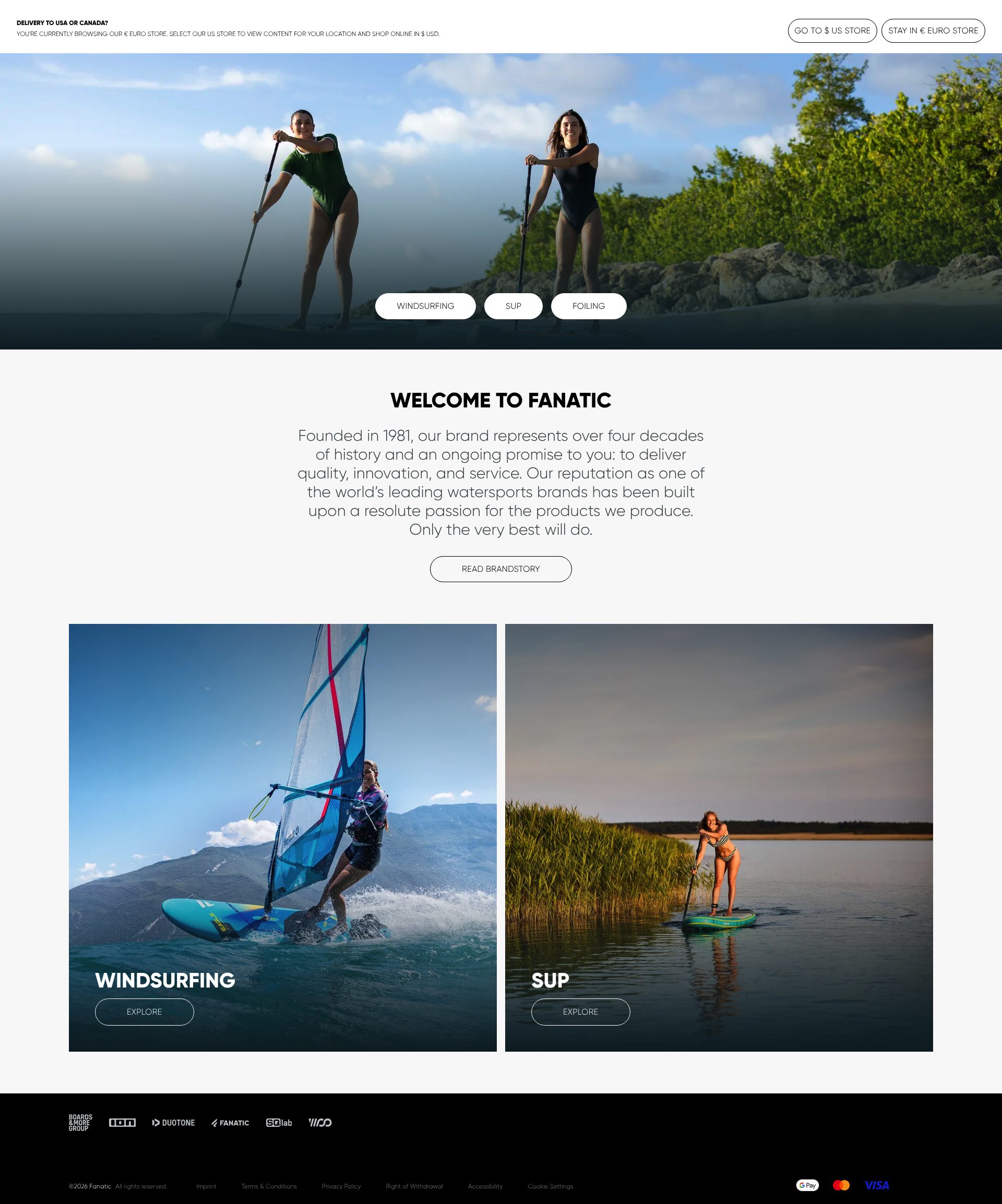
Fanatic is an Austrian watersports brand that has sold SUP boards and wing foiling equipment globally for decades, and their Shopify store handles the complexity of a large technical product catalogue with notable discipline. The navigation separates boards by discipline: flat water, surf, touring, race, and foil, with each subcategory carrying its own buying guide linked directly from the category page. For a brand selling to everyone from weekend paddlers to competitive racers, that segmentation prevents the catalogue from feeling chaotic.
Fanatic's product pages lead with clean studio photography and then expand into detailed spec tables covering board dimensions, volume, fin setup, and what they call their "ROI": the riding occasion index, a proprietary framework that tells buyers at a glance how suited a board is to surf, flatwater, and touring conditions. That kind of bespoke specification language builds brand authority and creates a vocabulary that competitors cannot easily copy. Pricing is transparent across all variants, with the tech bag and paddle bundle options presented inline rather than as afterthoughts.
3. Starboard SUP

Starboard is one of the best-known names in competitive SUP racing and has built a Shopify store that balances elite athlete credibility with accessibility for recreational buyers. The homepage surfaces its environmental credentials prominently: Starboard was one of the first SUP brands to produce boards using flax fibre and recycled materials, and the "Be the Change" sustainability programme is woven through product pages rather than confined to a single about page. For buyers who care about the provenance of what they purchase, this is a meaningful differentiator.
The product range covers everything from entry-level inflatables to carbon race boards at premium price points, and the store handles this spread through clear range naming and a category structure that steers casual buyers away from elite-spec boards that would frustrate them. The accessories store, covering paddles, bags, fins, and apparel, is tightly integrated and cross-linked from every board page, which makes Starboard easier to use as a one-stop shop than competitors who treat accessories as a separate category.
4. JP Australia
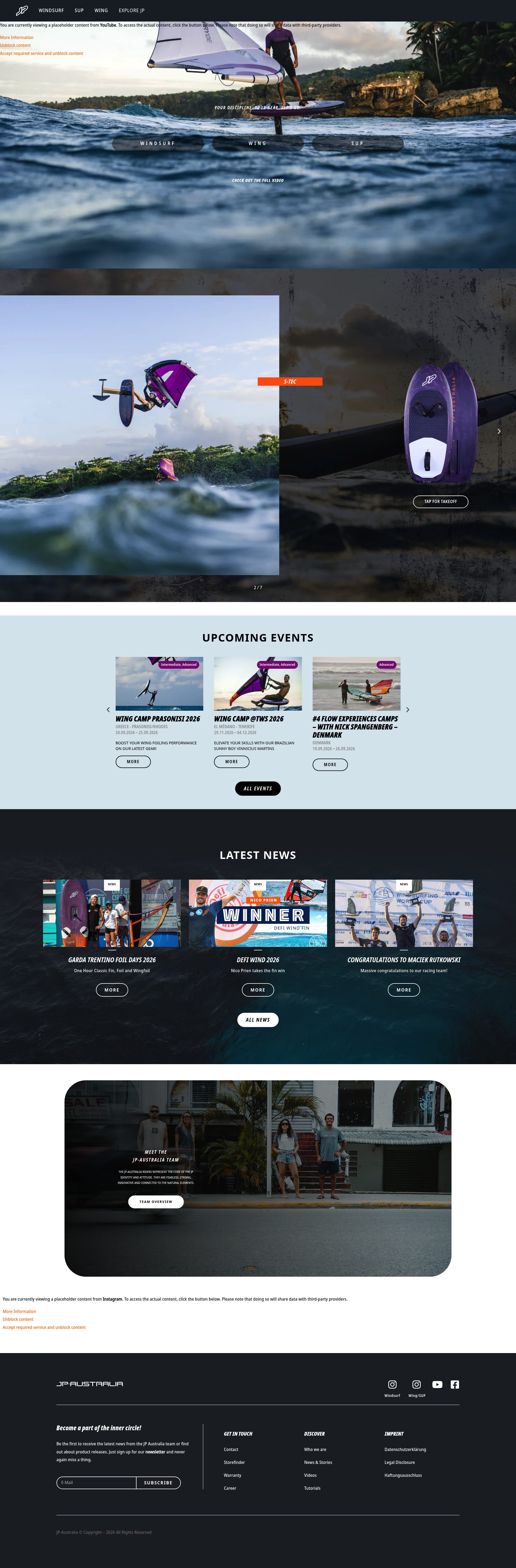
JP Australia is a leading SUP and windsurf brand with a global distribution network, running a clean Shopify store that prioritises technical buyers comfortable with in-depth specification. The product pages display detailed construction breakdowns, with inline diagrams showing carbon layup schedules, rail profiles, and rocker lines. For the core JP customer, an experienced paddler evaluating whether to upgrade their board, this level of detail is not intimidating. It is exactly the information they need to make a decision.
The store does less to accommodate first-time buyers, which is a deliberate commercial choice: JP focuses on intermediate to advanced paddlers who already know what they want, rather than trying to be a beginner-friendly retailer. That specialisation keeps the product copy sharp and avoids the generic "great for all levels" language that undermines credibility with experienced customers. The board selector tool asks riders to specify their weight, experience level, and use case before surfacing recommendations, which is a sensible way to handle range complexity without building a custom filtration system.
5. Jobe Sports
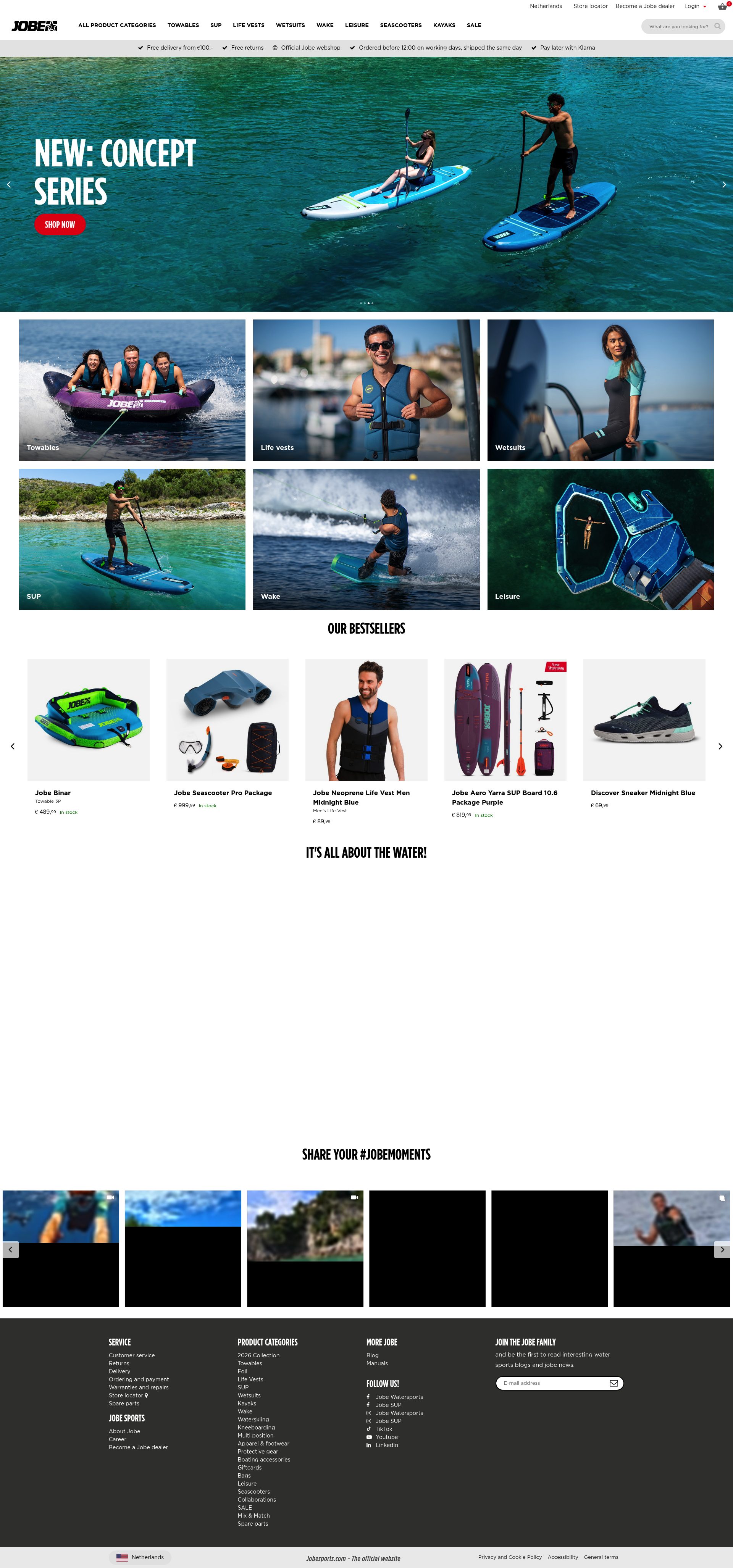
Jobe Sports is a Dutch watersports brand that covers SUP, wakeboarding, waterskiing, and kneeboarding across a wide price range, and their Shopify store does a particularly good job of handling the multi-sport catalogue without losing category clarity. The SUP section is isolated clearly in the navigation, with inflatable and hard boards separated at the first click. Jobe sells across multiple channels, including Amazon and independent retailers, and the DTC store competes on value-add: product bundles, loyalty programme integration, and content that third-party retailers cannot replicate.
The pricing strategy is notable: Jobe positions itself as accessible rather than premium, with entry-level inflatable sets (board, paddle, pump, and leash) from around £300. The bundle presentation on product pages is strong, with clear before/after savings displayed on set pricing versus individual components. That transparency around bundle value is a straightforward conversion lever that many competitors fail to implement cleanly.
6. Tower Paddle Boards
Tower Paddle Boards is a US-based direct-to-consumer brand that appeared on Shark Tank in 2012 and has been building its Shopify presence around that origin story ever since. The DTC model runs deep: the store routes around traditional retail margins by selling direct and communicating that value explicitly to customers. Product pages cite the margin savings in plain language, framing the choice between Tower and a retail-stocked competitor as a direct financial benefit to the buyer.
The store's social proof infrastructure is unusually strong for a DTC brand of its size. Video testimonials, user-generated content from paddle events, and a visible review count on every product page create a weight of social evidence that moves fence-sitters. The product range is deliberately narrow: Tower does not try to compete with mass-market brands on catalogue breadth, focusing instead on a small number of well-built boards at each price point.
7. iROCKER
iROCKER is a US inflatable SUP brand that has built its Shopify store around accessible adventure and family paddleboarding, and the commercial execution is particularly clean. The homepage runs a persistent announcement bar with current promotions and free shipping thresholds, which is a basic but effective tactic for reducing abandoned sessions. The brand also runs an active rental and try-before-you-buy programme in key US markets, and the store integrates booking for these experiences directly alongside board purchases. Giving buyers a low-commitment way to experience the product before buying at full price is a smart conversion strategy for a product category where physical confidence matters.
The board range is organised by activity, covering all-round, touring, cruiser, and kids boards, with a clear comparison table available at category level. That table covers length, width, weight capacity, and thickness for every model, and it is positioned before the individual product grid rather than after it. Surfacing comparison data before individual product pages reduces the back-and-forth navigation that loses buyers on complex catalogues.
8. Bluefin SUP
Bluefin SUP is a UK-founded inflatable paddleboard brand that has grown quickly by targeting the accessible end of the market with boards priced from £299 to £799. The Shopify store is built around removing buyer uncertainty at every touchpoint: a 30-day free trial is prominently messaged on the homepage and repeated on every product page, the warranty is clearly stated as two years (compared to the typical one-year offering from most competitors), and the delivery promise is specific, with estimated dates displayed in the checkout flow rather than vague "3-5 working days" language.
Bluefin also uses a trade-in programme to drive upgrades from within its existing customer base, which is a retention mechanic that most paddleboard brands do not attempt. Offering credit against a previous Bluefin board for an upgrade purchase reduces churn to competitors and increases lifetime customer value. The programme is surfaced in the navigation and on relevant product pages, meaning existing customers encounter it during a natural product browsing session rather than only in email.
9. NRS
NRS is a US outdoor and paddlesports retailer covering kayaking, rafting, stand-up paddleboarding, and rescue equipment, and their Shopify store is one of the most technically complete in the water sports space. The navigation is structured around activity and discipline rather than product type, which reflects how buyers actually approach the store: a customer looking for SUP gear searches by what they want to do, not by what type of product they want. That customer-first taxonomy is an ecommerce fundamentals point that many larger retailers still get wrong.
The product pages carry multi-angle photography, video demonstrations, detailed spec tables, and fit guides for anything with a size element. NRS also integrates WhiteWater video content from their sponsored athletes directly into product pages, turning what is normally brand content into a conversion asset that demonstrates the product in real conditions. The reviews system is thorough, with verified purchase tags and sorting by activity type, which helps buyers find reviews from people in their specific use case.
10. BOTE
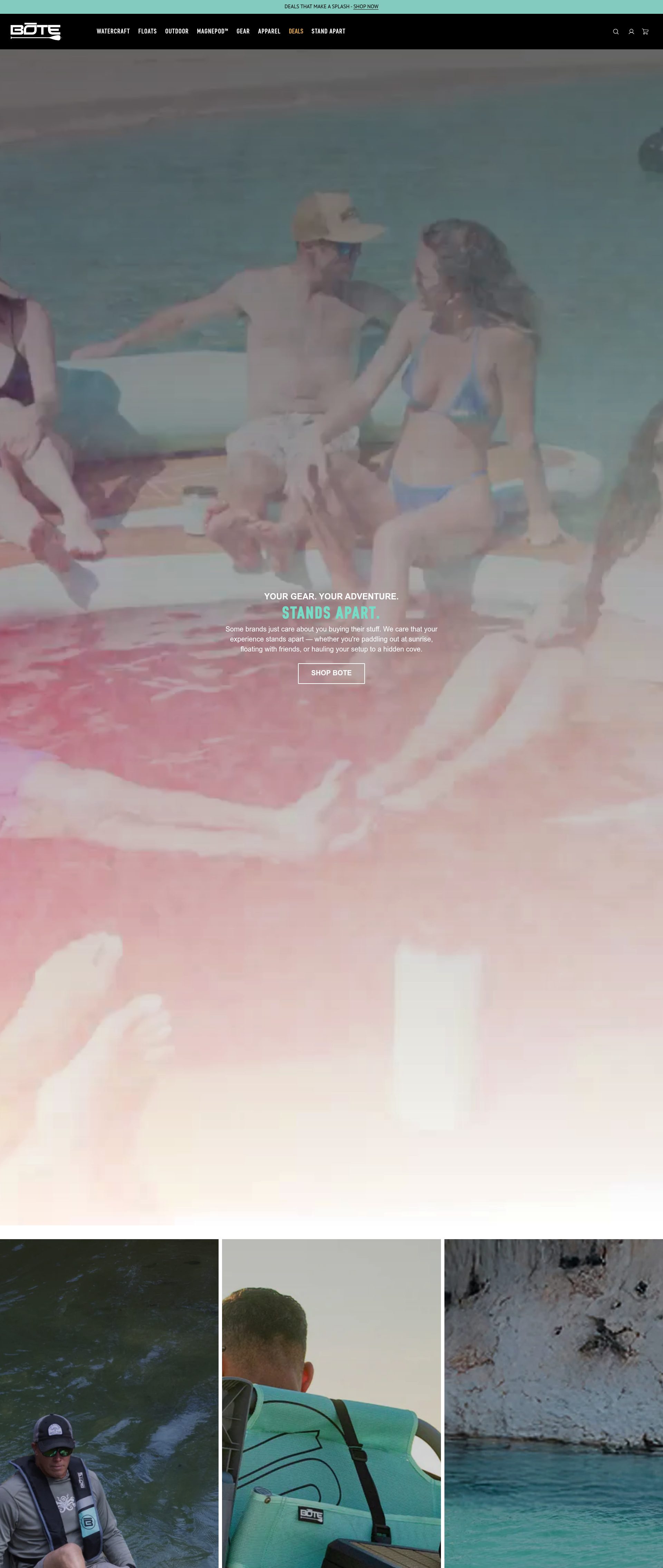
BOTE is a Florida-based paddleboard brand with a notably strong lifestyle-led Shopify store. The brand covers SUP boards, kayaks, and dock accessories, and the store does something commercially interesting: it sells the lifestyle as aggressively as it sells the product. Every category page opens with aspirational photography that puts buyers in the scene before they see a product. That approach works because BOTE's customer is not primarily a performance paddler: they are buying into a way of spending time on the water, and the store experience reflects that.
The BOTE rewards programme, called the Tribe, is integrated directly into the store rather than sitting as a separate loyalty platform, and membership benefits are communicated on product pages at the point where a buyer is weighing whether to complete a purchase. Surfacing loyalty value at that moment rather than as a post-purchase reveal is a smarter retention architecture. The brand also runs gear bundles aggressively, with board and accessories sets presented before individual boards in category navigation, which lifts average order value from the first page a customer lands on.
If you run a paddleboard, watersports, or outdoor brand and want a Shopify store built to convert buyers at every price point, our Shopify design service is built around exactly these commercial outcomes. Get in touch to talk through what the right setup looks like for your store.
Frequently asked questions
Which paddleboard brands sell direct on Shopify?
Red Paddle Co, Bluefin SUP, Tower Paddle Boards, iROCKER, BOTE, and Jobe Sports all run Shopify DTC stores as their primary sales channel. Fanatic, Starboard SUP, JP Australia, and NRS also use Shopify but sell alongside a network of independent dealers and distributors.
What makes a good paddleboard Shopify store?
The best SUP stores handle three things well: guided selling tools that help first-time buyers choose the right board without calling customer support, detailed spec tables that give experienced paddlers everything they need on one page, and bundle presentation that lifts average order value without cluttering the product experience. Stores that do all three convert significantly better than those relying on photography alone.
How do paddleboard brands sell high-ticket items online without physical demos?
The most effective tactics are free trials (Bluefin SUP's 30-day trial is the strongest in the category), try-before-you-buy rental programmes (iROCKER integrates booking directly in the store), and video demonstrations embedded on product pages. Strong review systems sorted by activity type, as NRS uses, also help buyers find validation from people in their specific use case.
Are inflatable or hard paddleboards easier to sell online?
Inflatable SUPs dominate DTC Shopify sales because they ship in a bag and avoid the logistics cost of shipping a rigid board. Red Paddle Co, Bluefin SUP, iROCKER, and Tower Paddle Boards are all primarily inflatable brands. Hard board specialists like JP Australia and Fanatic tend to sell more through dealers who can manage local fulfilment and demo stock.
What Shopify features do the best paddleboard stores use?
The standout features across the top stores are board finder and filter tools (Red Paddle Co, JP Australia), comparison tables surfaced at category level before individual products (iROCKER), loyalty programmes integrated directly into product pages rather than hidden post-purchase (BOTE), and bundle pricing with transparent before/after savings (Jobe Sports, Red Paddle Co). Most top stores also use persistent announcement bars for shipping thresholds, which iROCKER executes particularly cleanly.