
Quick summary
Legion Athletics sets the benchmark for transparency in this category: every product page lists exact ingredient dosages with linked clinical studies, and the quiz funnel converts new buyers who do not yet know which products to stack. Gainful takes personalisation further than anyone else, building a named custom protein formulation around a quiz result and pairing it with a dietitian consultation that dramatically reduces first-cycle subscription churn. Applied Nutrition is the strongest UK pick, combining Informed Sport certification front and centre with goal-led navigation that moves a goal-aware customer to the right product in two clicks. Bare Performance Nutrition rounds out the top tier with a community subscription model that gives subscribers non-price reasons to stay, a model that holds up even when cheaper alternatives are a Google search away.
Protein powder is one of the most crowded product categories on Shopify. Price comparison is easy, ingredient claims are frequently exaggerated, and customers arrive sceptical. The brands that convert well in this space are not necessarily selling the best product: they are selling it better. That means tighter product page architecture, smarter subscription flows, ingredient transparency that goes beyond a generic nutrition label, and trust signals placed at the moment they matter rather than buried in the footer.
This list focuses specifically on the overlap between protein powder and wider performance supplementation: pre-workout, creatine, amino acids, and recovery blends. Brands that play across that full range face a harder ecommerce challenge than single-product specialists, and the ones that solve it well are worth looking at closely.
Applied Nutrition
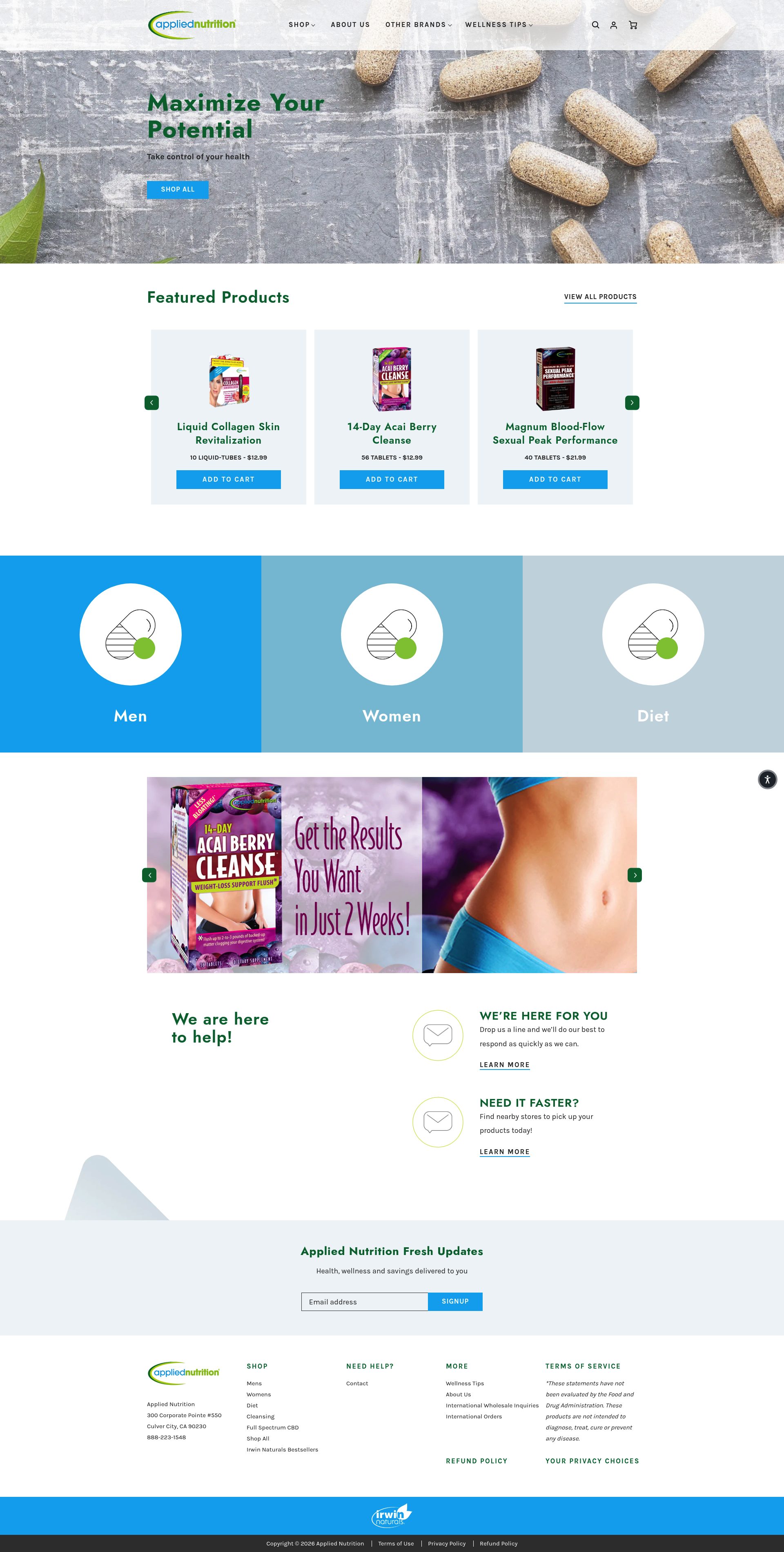
Applied Nutrition is one of the UK's fastest-growing supplement brands, and their Shopify store handles scale without sacrificing the product page clarity that drives conversion. The brand covers protein powders, pre-workouts, amino acids, and weight management, but the store does not let that catalogue breadth create confusion. Collection pages are structured by training goal rather than by product type, so a customer arriving with a specific outcome in mind, muscle gain, fat loss, endurance, navigates to a relevant product in two or three clicks rather than scrolling through an undifferentiated grid.
Product pages carry Informed Sport certification front and centre, which is the right call for a brand targeting serious athletes where third-party testing is a genuine purchase criterion. The flavour selector loads variant-specific product images rather than just toggling a text label, reducing the uncertainty that causes hesitation before add-to-cart. Their wholesale and ambassador programme is surfaced through the store navigation rather than siloed on a separate domain, which expands the revenue model without fragmenting the brand experience.
Applied Nutrition's subscription mechanic is straightforward and well-positioned: the save percentage is shown inline on the product detail page, not introduced at checkout as an afterthought. The store also runs regular bundle promotions that group protein with a complementary pre-workout or amino acid product, which is an effective average order value lever in a category where stacking multiple products is the norm for the core customer.
Grenade
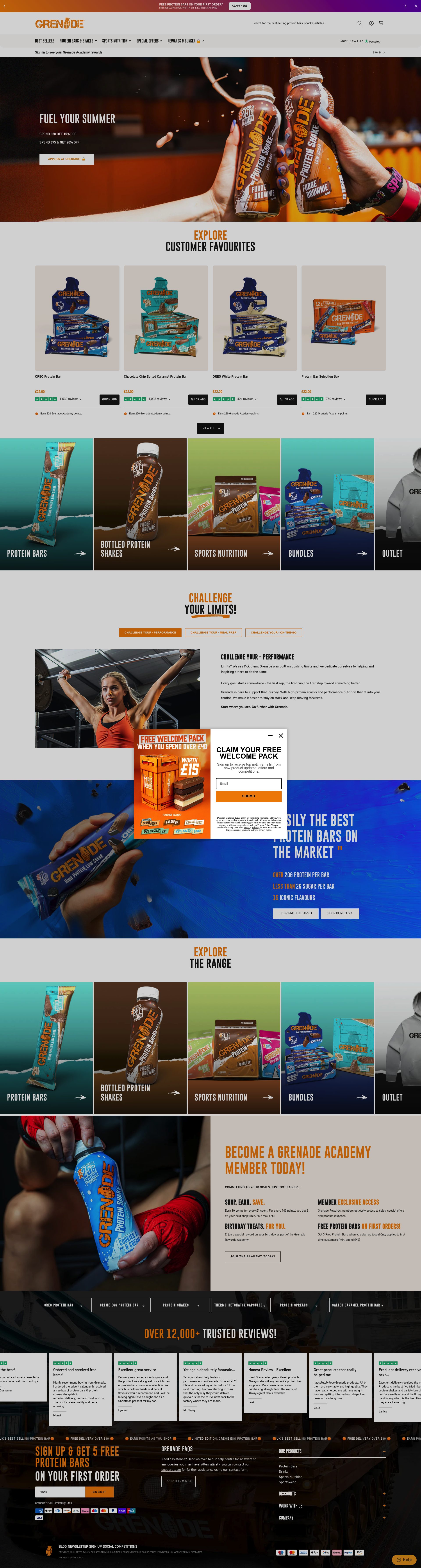
Grenade built its brand on protein bars, specifically the Carb Killa range, and their Shopify store has done the difficult work of extending that original product success into a broader performance supplement range without losing the brand identity that made them recognisable. The store leads with the bar range and uses it as a gateway to introduce customers to the protein powder, pre-workout, and hydration products that sit alongside it. That sequencing is commercially smart: a customer who trusts the bar product is a warmer lead for the powder than a cold visitor landing on a protein PDP directly.
The Grenade store handles variety pack mechanics well. Protein bars are available in mixed-flavour variety packs built directly into the product page, which reduces the trial friction that stops first-time buyers committing to a single flavour box. The bundle builder extends this logic to cross-category combinations, pairing bars with shaker bottles and protein powders in configurations that reflect how the products are actually used together. That kind of goal-oriented bundling is one of the highest-impact AOV levers available to a multi-category supplement brand on Shopify.
Their promotional cadence is well-managed: timed discount banners are used selectively rather than permanently, which preserves the perception of premium positioning that a brand at Grenade's price point needs to maintain. Post-purchase retention is handled through a loyalty points scheme that assigns points on every order, including subscriptions, and surfaces the balance clearly in the customer account area.
Reflex Nutrition
Reflex Nutrition is a UK brand with over 25 years in the supplement industry, and their Shopify store reflects a business that has survived long enough to understand what actually drives repeat purchase in this category. The site architecture prioritises the customer who already knows what they want: filter options on collection pages are granular enough to narrow by protein source, dietary preference, and certification type without requiring the customer to read every product description to find a match.
Product pages for Reflex's core protein powders carry detailed nutritional information in a format that goes beyond the minimum statutory panel: amino acid profiles, digestive enzyme content, and sourcing information are all present, which speaks to the segment of buyers who compare these metrics before making a decision. The Informed Sport certification displayed on relevant products is not just a trust badge but a genuine commercial differentiator for Reflex's target customer in the athlete market.
Subscription is handled via a straightforward subscribe-and-save model with delivery frequency options rather than a fixed monthly cadence. That flexibility matters in a category where consumption rate varies: a customer who uses protein more slowly does not want a fixed four-week delivery forcing them to stack tubs they are not ready for. Reflex also maintains an active nutrition education blog that sits within the Shopify domain and captures informational search traffic on protein and recovery topics, feeding intent-rich visitors directly into the product catalogue.
USN
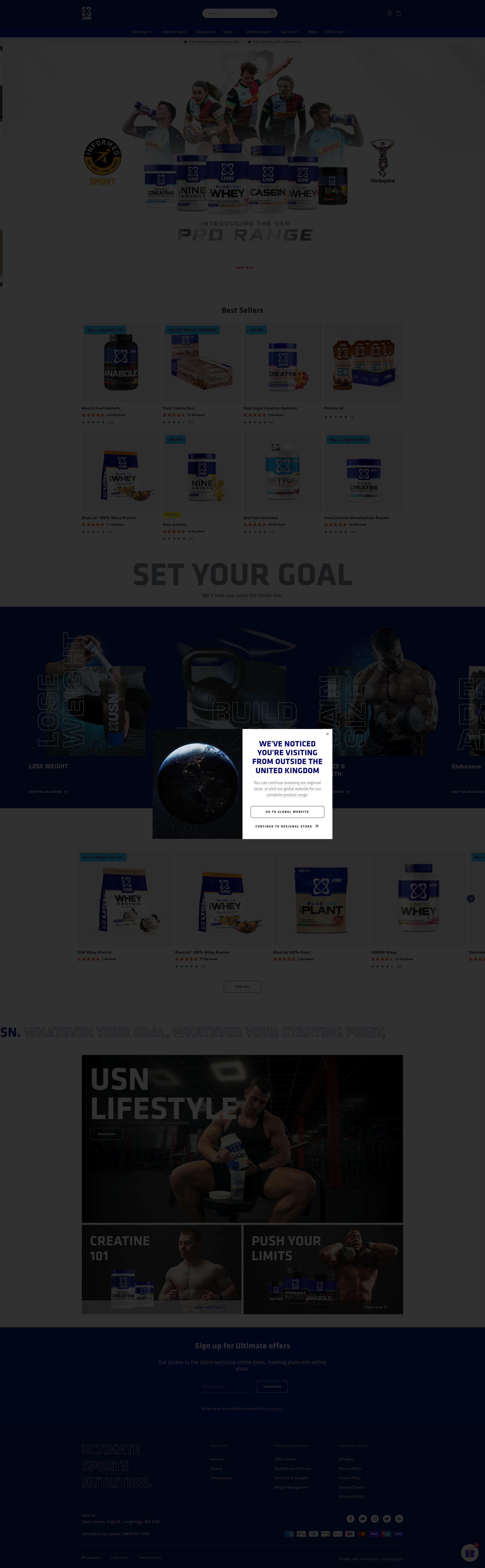
USN (Ultimate Sports Nutrition) is a South Africa-founded brand that has built a significant presence in the UK market, and their Shopify store handles both the breadth of their product range and the diversity of their customer base better than most brands at this catalogue size. The mega-menu is structured by goal and by product type simultaneously, which serves two different customer mindsets: the newcomer who searches by outcome and the experienced buyer who already knows they want casein protein or pre-workout. Offering both navigation routes without creating a bloated menu is harder than it looks, and USN's implementation is one of the cleaner examples in this category.
Their Blue Lab Whey and Diet Whey Isolean products are the anchor SKUs, and the product pages for those items are detailed without being overwhelming: macros are prominent, flavour images load on selection, and the certified product claim, Informed Sport for relevant SKUs, is visible above the fold. USN also runs a protein snack range that sits alongside the powder products, and the store integrates that range into cross-sell units on powder PDPs, lifting AOV by presenting the snack as a complement rather than a separate purchase.
The USN loyalty programme is one of the more comprehensive implementations in the UK supplement category: points accrue across all orders, are redeemable against future purchases without a minimum order threshold, and the balance is displayed in the cart, which creates a visible incentive to return that functions independently of any promotional discount.
Legion Athletics
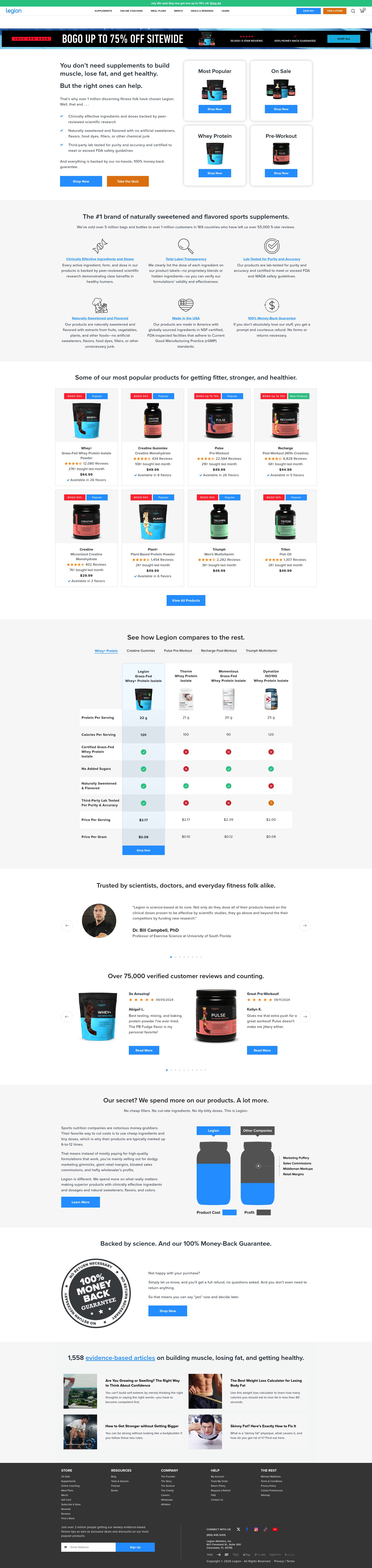
Legion Athletics is a US Shopify brand that has made radical transparency its entire commercial argument, and it works. Every product page lists every ingredient at its exact dosage, links directly to the clinical studies supporting each inclusion, and publishes a Certificate of Analysis for every batch. That level of disclosure is unusual in the supplement industry, and for the customer who has been burned by proprietary blends and underdosed formulas, it is enough to shift a purchase decision without any additional persuasion. Legion's Whey+ and Pulse pre-workout are the headline products, and both pages are structured to walk a sceptical customer from "why does this cost more than the cheaper alternative" to "I understand exactly what I am paying for" in a single scroll.
The subscription mechanic is clean and prominent: subscribe-and-save pricing is the default state on product pages, with one-time purchase available but clearly secondary. This default choice architecture, borrowed from what Huel pioneered in the UK meal replacement market, has a measurable impact on subscriber acquisition rates without being manipulative because the savings are genuine and the cancel-anytime policy is surfaced rather than buried.
Legion also uses a detailed quiz funnel for product discovery: it segments by training goal, experience level, and dietary requirements, producing a personalised stack recommendation rather than a single product suggestion. That approach converts better than category browse for customers who are new to serious supplementation and do not yet know which products belong together.
Kaged

Kaged (formerly Kaged Muscle) is a US supplement brand built around what they call "clean" performance nutrition: no proprietary blends, fermented amino acids, and patented trademarked ingredient forms across their range. Their Shopify store communicates that positioning through product page structure rather than just a homepage banner: every PDP includes a detailed ingredient breakdown with a short explanation of why each ingredient was chosen in its specific form, which is a format that works particularly well for a customer who does their own research before buying.
The Kaged Elite and Kaged Sport tier distinction is well-implemented in the store's collection architecture. Rather than presenting all products in a single grid, the store separates the professional performance range from the entry-level products, which helps experienced athletes find the premium tier without making the overall catalogue feel inaccessible to a newer buyer. That dual-track architecture is a smart way to serve two customer segments without diluting the premium positioning that justifies Kaged's price point.
Their third-party testing credentials, Informed Sport and NSF Certified for Sport on selected products, are displayed on product cards in the collection view rather than only on the PDP, which means the certification is visible before a customer clicks through. That placement reduces the friction of having to investigate trust credentials on a brand that a customer has not encountered before.
Gainful
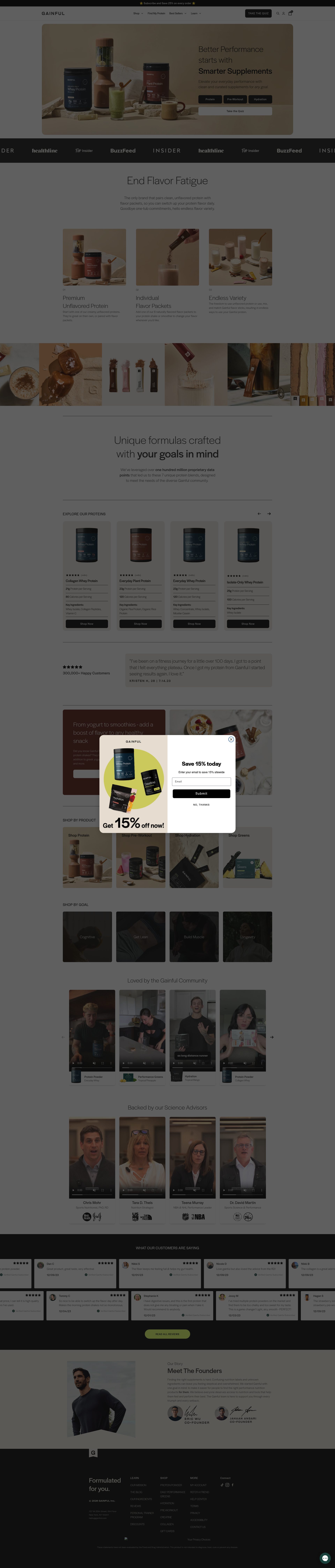
Gainful is a US Shopify brand that has taken product personalisation further than any other store in the protein powder category. Their entire customer journey is built around a quiz that produces a custom protein powder formulation based on body weight, activity level, dietary preference, and fitness goal. The output is a product labelled with the customer's name and formulated specifically for their profile. That level of personalisation is a significant operational undertaking, but the commercial payoff is a subscription retention rate that sits well above the category average because the product is not interchangeable with anything available on a generic retailer shelf.
The Shopify store is structured around the quiz as the primary entry point, with traditional product page browse available as a secondary route for customers who have already been through the personalisation flow. That architecture is unusual, but it makes sense for a brand whose entire value proposition depends on the customer completing the quiz: sending a visitor straight to a product page without the context of their personal profile undercuts the core argument.
Gainful also handles flavour sampling well: first-time subscribers can add single-serve flavour samples to their initial order at minimal cost, which reduces the commitment anxiety that is one of the main barriers to starting a supplement subscription. The post-purchase onboarding includes a registered dietitian consultation, which is positioned as a free benefit of subscribing rather than an upsell, and which functionally prevents a large proportion of first-cycle cancellations.
Bare Performance Nutrition
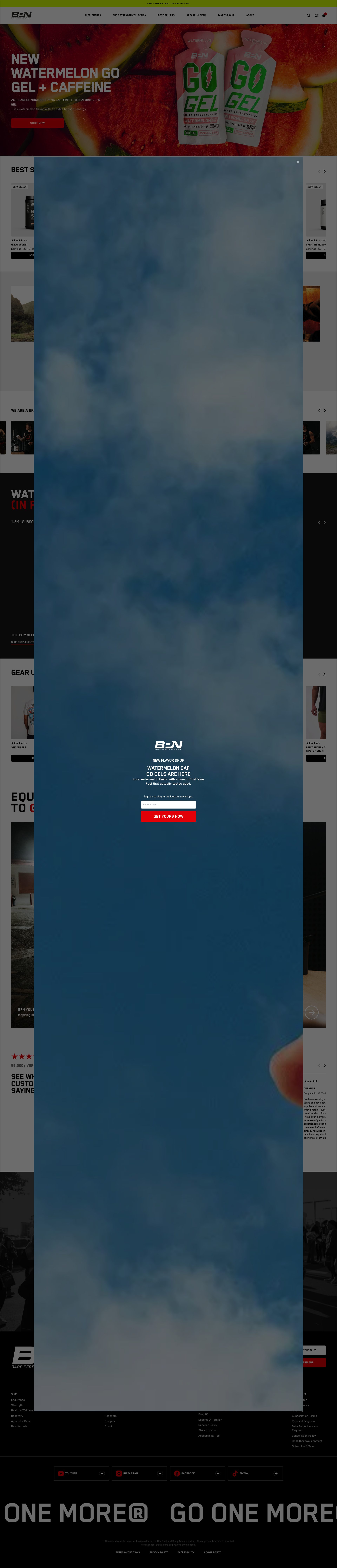
Bare Performance Nutrition, known as BPN, is a US Shopify brand founded by competitive athlete Nick Bare, and the founder-led positioning is woven into the store architecture rather than being a surface-level branding decision. The homepage features real training content from the founder alongside product launches, and the brand's "Go One More" ethos is present in product naming, copy, and the athlete content that runs through the site. For a customer who trains seriously and wants to buy from a brand that reflects their values, that coherence is a conversion argument in its own right.
The store's product pages carry a level of ingredient specificity that matches what Transparent Labs and Kaged do: exact dosages, no proprietary blends, and Informed Sport certification on core products. The BPN Whey Protein Isolate page is one of the better implementations of this format: macros and flavour selector are above the fold, the detailed ingredient breakdown is one scroll below, and customer reviews are segmented by training goal, which makes the social proof more useful than an undifferentiated star average.
BPN's subscription model uses a "Sidekick" programme that bundles subscription savings with exclusive content access and early product release. That community element distinguishes the subscription from a straightforward auto-ship and gives customers a non-price reason to stay subscribed even when a cheaper alternative is available. The referral programme is integrated into the account area and surfaced in post-purchase email flows, using BPN's community positioning to drive word-of-mouth acquisition.
Foodspring
Foodspring is a German-founded brand that has built one of the more sophisticated pan-European supplement ecommerce operations on Shopify, with localised storefronts covering the UK, Germany, France, Italy, Spain, and the Netherlands. The UK store is a clean example of how to position a premium product range in a price-sensitive category without competing on headline price. The brand leads with the clean-label and sports performance quality angle, and every product page reflects that: ingredient sourcing information, manufacturing quality standards, and flavour photography that sits closer to premium food brand standards than typical supplement industry visuals.
The Foodspring product range spans protein powders, bars, snacks, and performance supplements, and the store manages that breadth through an outcome-led navigation structure: build, perform, and recover are the primary entry points, with product type filtering available as a secondary layer. That structure serves a customer who is planning a complete nutritional programme rather than buying a single product, which aligns with Foodspring's positioning as a complete sports nutrition brand rather than a single-product specialist.
Their subscription implementation mirrors the approach that high-retention brands use: clear save percentage, delivery frequency selector, and an explicit cancel-anytime guarantee displayed at the point of subscribing rather than in a terms-and-conditions footnote. Foodspring also runs a MyWay subscription bundle builder that allows customers to mix and match protein and snack products into a personalised monthly box, which is a more engaging framing than a standard auto-ship.
Warrior Supplements
Warrior is a UK supplement brand that has built a loyal following around protein bars and snacks before expanding into powders and performance products, and their Shopify store reflects that sequence in how it handles product cross-sell. The bar and snack range drives significant traffic, and the store uses that inbound intent to introduce visitors to the powder and performance range through targeted cross-sell units on the bar PDPs. A customer arriving for a Warrior Crunch bar is three clicks from a protein powder subscription if the store surface the right recommendation at the right moment, and Warrior's implementation does this better than most single-product brands that expand their range.
The store's pricing is competitive for the UK market, and the value positioning is communicated clearly: multi-buy deals and bundle savings are shown in the product cards on collection pages rather than only revealed at checkout. That transparency at the browse stage reduces the mental arithmetic that slows purchase decisions. The review volume on Warrior's core products is substantial, and the review display integrates photo reviews from customers alongside written feedback, which provides a more persuasive social proof format than text alone for a category where visual evidence of use matters.
Warrior's promotional cadence is frequent but controlled: time-limited deals drive urgency without the permanent "sale" banner that degrades brand perception over time. The brand's ambassador and athlete network, while smaller than US competitors like BPN or Legion, is used effectively for organic content distribution rather than just as a sponsored product placement strategy.
Comparison table
| Brand | Niche Focus | Price Point | Shopify Standout |
|---|---|---|---|
| Applied Nutrition | Full performance range, Informed Sport | Mid-range | Goal-led navigation, inline subscription pricing |
| Grenade | Bars, protein, hydration | Mid-premium | Variety pack mechanics, cross-category bundling |
| Reflex Nutrition | Premium UK protein, 25+ years | Mid-premium | Deep ingredient detail, flexible subscription frequency |
| USN | Mass market to performance | Mid-range | Dual navigation, strong loyalty programme |
| Legion Athletics | Clean-label, clinically dosed | Premium | Transparent formulas, citation-backed PDPs |
| Kaged | Fermented aminos, patented ingredients | Premium | Dual-tier catalogue, collection-level trust badges |
| Gainful | Personalised protein subscription | Premium | Quiz-first funnel, named custom formulation |
| Bare Performance Nutrition | Founder-led, Informed Sport | Premium | Community subscription, segmented review display |
| Foodspring | European premium, clean-label | Premium | Localised multi-market, MyWay bundle subscription |
| Warrior Supplements | UK value, bars to powders | Budget-mid | Cross-sell from bars, photo review integration |
What these stores get right
- Ingredient transparency at the product page level, not the brand level. Brands like Legion, Kaged, and BPN put exact dosages and certifications on the PDP where they influence the purchase decision. Hiding this in an FAQ or a separate quality page loses the conversion moment.
- Subscription defaults and frequency flexibility. The stores with the highest subscription adoption set subscribe as the default state and offer delivery frequency control before the customer commits. Fixed monthly cadences drive churn. Adjustable cadences reduce it.
- Navigation by outcome, not by product type. Customers who are not expert supplement buyers do not browse by "whey concentrate" or "casein." They browse by what they want to achieve. Stores that map their collection architecture to outcomes convert new buyers faster.
- Bundle mechanics tied to how products are actually used. Protein and pre-workout are stacked products. Stores that surface relevant cross-category bundles at the PDP level lift AOV without forcing the customer to construct the bundle themselves.
- Trust signals placed before the add-to-cart button. Third-party certifications, Certificate of Analysis links, and verified review counts belong above the fold on mobile, not in the footer or in a separate tab. Placement determines whether they influence the decision.
If your supplement or protein brand is not converting at the rate these stores achieve, the gap is usually one of three things: PDP structure, subscription mechanics, or how you are handling trust signals on mobile. Talk to our Shopify team about what is holding your store back, or explore our Shopify design and development services.
Frequently asked questions
Which protein supplement Shopify stores are best for ingredient transparency?
Legion Athletics and Kaged are the two strongest examples. Legion lists every ingredient at its exact dosage and links directly to the clinical studies supporting each inclusion, with a Certificate of Analysis for every batch. Kaged follows the same no-proprietary-blend approach and surfaces third-party certification logos on product collection cards, not just on the individual product page.
How do the top supplement Shopify stores handle subscription retention?
The stores with the lowest churn use three mechanisms together: frequency flexibility rather than a fixed monthly cadence, a visible cancel-anytime guarantee at the point of subscribing rather than buried in the terms, and a non-price reason to stay subscribed. Bare Performance Nutrition's Sidekick programme is the clearest example of the last point, bundling early product access and exclusive content into the subscription rather than relying entirely on a discount.
What is the best Shopify supplement store for personalised protein powder?
Gainful is the clear leader. The entire store is built around a quiz that produces a custom protein formulation labelled with the customer's name, and first-time subscribers can add single-serve flavour samples to their initial order to reduce commitment anxiety. The post-quiz onboarding includes a registered dietitian consultation positioned as a free benefit, which prevents a significant proportion of first-cycle cancellations.
How do successful supplement stores structure their Shopify navigation?
The strongest performers organise navigation by training goal rather than by product type. Applied Nutrition and USN both separate customers by outcome first, muscle gain, fat loss, or endurance, and then let product type filtering operate as a secondary layer. That approach converts new buyers faster because a customer who knows what they want to achieve but does not yet know which product category to look in can reach a relevant PDP in two or three clicks.
Do supplement Shopify stores need Informed Sport certification to convert UK buyers?
For stores targeting competitive athletes and sports clubs, Informed Sport certification is a genuine purchase criterion rather than a nice-to-have. Applied Nutrition, Reflex Nutrition, USN, and Bare Performance Nutrition all display their certification above the fold on relevant product pages rather than in a separate quality or FAQ section. Placement matters: certification shown below the add-to-cart button or in the footer does not influence the purchase decision at the moment it is made.